Common Gearbox Specification Mistakes Engineers Make
Gearbox specification mistakes are one of the most common reasons industrial gearboxes overheat, fail prematurely, or require repeated repairs. In many cases, the gearbox itself is not defective—the problem lies in how it was specified, selected, or applied.
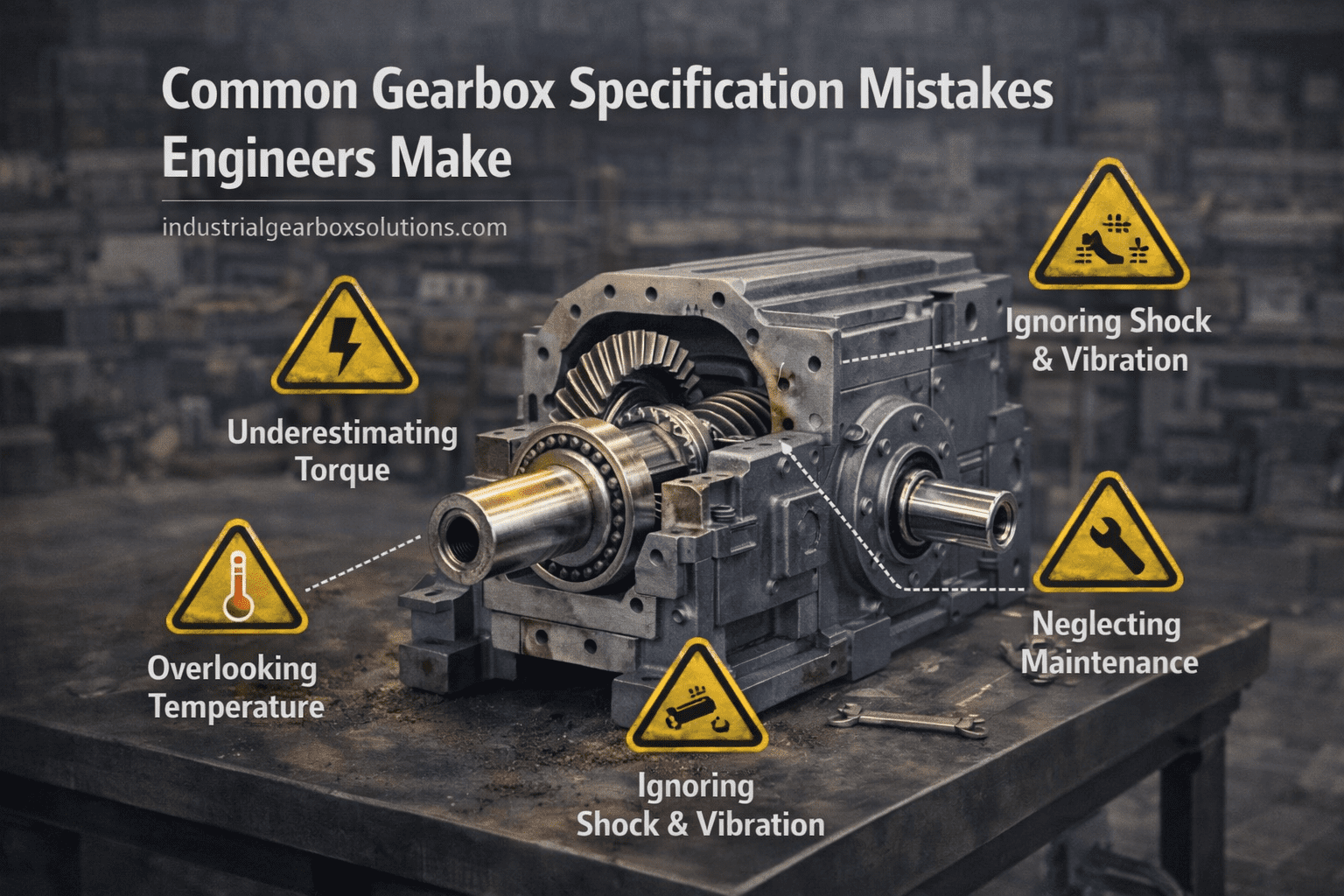
This article outlines the most frequent gearbox specification mistakes engineers make, why they happen, and how to avoid them when selecting gearboxes for real-world industrial applications.
Mistake #1: Selecting a Gearbox Based Only on Horsepower
One of the most widespread specification errors is selecting a gearbox based primarily on motor horsepower.
Horsepower alone does not describe how torque is applied at the gearbox output. Two applications with the same motor horsepower can impose very different torque loads depending on speed, inertia, and operating conditions.
This mistake often results in gearboxes that appear adequate on paper but experience excessive stress during startup or under load.
Mistake #2: Ignoring Actual Load Torque
Many gearbox specifications rely on theoretical or nominal loads instead of actual operating loads.
Actual load torque is affected by:
- Startup conditions
- Acceleration and deceleration
- Shock loading
- Process variability
Failing to account for real operating torque often leads to undersized gearboxes that run hot, wear rapidly, or fail unexpectedly.
Many specification errors stem from misunderstanding real operating loads, which is explained in Gearbox Torque Rating vs Actual Load.
Mistake #3: Underestimating Duty Cycle Severity
Duty cycle is frequently oversimplified during gearbox specification.
Common errors include:
- Assuming intermittent operation when the gearbox runs continuously
- Ignoring starts per hour
- Overlooking reversing loads
- Treating average load as worst-case load
Duty cycle directly affects thermal performance and fatigue life. Gearboxes specified without accurate duty cycle analysis often fail thermally before reaching mechanical limits.
Duty severity is often underestimated, as discussed in Gearbox Duty Cycles Explained.
Mistake #4: Misapplying Service Factor
Service factor is intended to account for shock, load variation, and duty severity. However, it is often misunderstood or misused.
Common service factor mistakes include:
- Applying a generic service factor without understanding the application
- Assuming service factor compensates for poor alignment or lubrication
- Ignoring thermal limitations while increasing mechanical service factor
Service factor is not a substitute for proper application analysis.
Mistake #5: Overlooking Heat Generation and Thermal Limits
Many gearbox specifications focus on torque capacity but ignore thermal performance.
Gearboxes generate heat during normal operation, and problems arise when heat cannot be dissipated effectively.
Thermal specification mistakes include:
- Ignoring continuous-duty heat buildup
- Assuming ambient temperature has no effect
- Overlooking enclosure ventilation
- Treating overheating as a lubrication problem only
Limits must be evaluated alongside mechanical ratings.
Thermal limits are frequently overlooked during specification, leading to issues covered in Gearbox Heat Generation: Causes and Solutions.
Mistake #6: Assuming Lubrication Is Automatic
Lubrication is often treated as a secondary consideration during gearbox specification.
Errors include:
- Selecting the wrong oil viscosity
- Ignoring additive requirements
- Assuming factory-fill lubricant suits all conditions
- Overlooking contamination risks
Improper lubrication selection accelerates wear, increases heat generation, and shortens gearbox life.
Mistake #7: Neglecting Alignment and Installation Requirements
Even a properly sized gearbox can fail if installation requirements are not considered.
Specification-stage alignment mistakes include:
- Ignoring base flatness requirements
- Failing to account for thermal growth
- Relying on flexible couplings to compensate for misalignment
- Overlooking shaft and coupling loads
Installation quality directly affects bearing life and overall reliability.
Mistake #8: Failing to Consider Efficiency Losses
Efficiency losses are often underestimated during specification.
Lower efficiency results in:
- Increased heat generation
- Higher energy consumption
- Reduced system performance
This is especially critical when comparing gearbox types such as worm, helical, and planetary designs.
Manufacturers such as Cone Drive emphasize correct load analysis, service factor selection, and thermal evaluation during gearbox specification.
We also highly recommend you use our Gearbox Efficiency Calculator and Motor Efficiency Calculator to help you extend the life of both your industrial gearbox and electric motor.
Mistake #9: Treating Repairability as an Afterthought
Many gearboxes are specified without considering future maintenance and repair.
This can lead to:
- Long repair lead times
- Obsolete components
- Limited service options
- Higher lifecycle costs
Specification should include consideration of serviceability, availability, and long-term support.
When to Involve a Gearbox Specialist
Many gearbox specification mistakes occur because selection is done in isolation.
A gearbox specialist can help evaluate:
- Actual load conditions
- Duty cycle severity
- Thermal limits
- Gearbox type suitability
- Installation constraints
Early involvement often prevents costly redesigns and failures later.
How to Avoid Gearbox Specification Mistakes
Avoiding specification errors requires a systematic approach:
- Start with actual load and torque data
- Define duty cycle accurately
- Evaluate both mechanical and thermal limits
- Select appropriate service factors
- Address lubrication and alignment early
- Consider lifecycle costs, not just purchase price
This approach leads to gearboxes that run cooler, last longer, and perform reliably.
Final Thoughts on Gearbox Specification Mistakes
Common gearbox specification mistakes are rarely caused by lack of knowledge—they result from oversimplification, assumptions, and time pressure. By understanding where these mistakes occur and addressing them during the specification process, engineers can dramatically reduce failures, downtime, and total cost of ownership.
Correct gearbox specification is not about selecting the biggest or strongest unit—it is about selecting the right gearbox for how the application truly operates.