Continuous vs Intermittent Gearbox Operation: What Engineers Must Know
Continuous vs intermittent gearbox operation is a critical distinction that directly affects gearbox sizing, thermal performance, reliability, and service life. Many gearboxes fail prematurely not because torque ratings were incorrect, but because the gearbox was never matched to how the equipment actually operates over time.
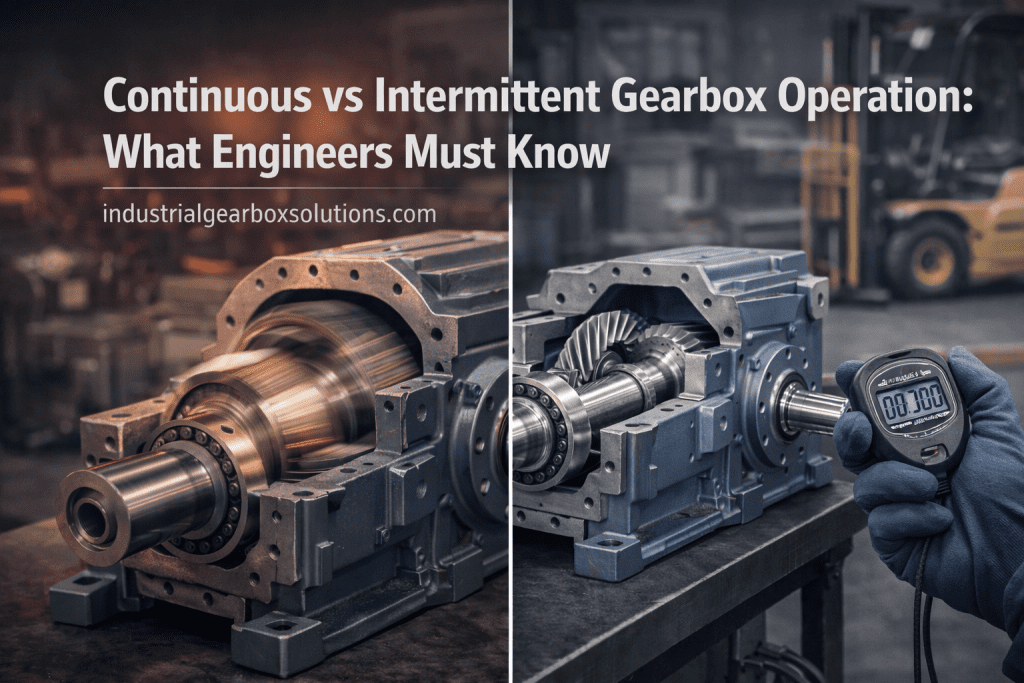
This article explains the difference between continuous and intermittent gearbox operation, how each operating mode stresses gearbox components differently, and how engineers should account for these patterns during selection.
For a complete framework on gearbox selection, see How to Select the Right Industrial Gearbox for Any Application.
What Is Continuous Gearbox Operation?
Continuous gearbox operation refers to applications where the gearbox runs for extended periods without stopping, often at steady or near-steady load.
Typical characteristics of continuous operation include:
- Long run times
- Minimal rest periods
- Relatively stable speed
- Predictable load conditions
Common continuous operation applications include conveyors, fans, pumps, process lines, and material handling systems.
In continuous operation, thermal limits are often more critical than peak torque.
What Is Intermittent Gearbox Operation?
Intermittent gearbox operation involves cycles of operation followed by rest periods. The gearbox may run at high load for short durations, then stop or idle before the next cycle.
Typical characteristics of intermittent operation include:
- Frequent starts and stops
- Short run times
- Variable speed
- Rest periods that allow cooling
Examples include indexing tables, batch mixers, hoists, packaging equipment, and positioning systems.
In intermittent operation, mechanical stress and startup torque often dominate gearbox life considerations.
Continuous vs Intermittent Gearbox Operation: Key Differences
The primary difference between continuous vs intermittent gearbox operation lies in how stress accumulates over time.
Continuous operation exposes the gearbox to sustained thermal loading. Even moderate torque levels can cause overheating if heat is not dissipated effectively.
Intermittent operation exposes the gearbox to repeated mechanical shock from starts, stops, and acceleration. While rest periods reduce thermal stress, repeated torque spikes increase fatigue damage.
Understanding which stress mechanism dominates is essential for proper gearbox selection.
Thermal Stress in Continuous Operation
In continuous gearbox operation, heat generation is constant.
As run time increases:
- Oil temperature rises
- Lubrication film strength decreases
- Bearing life shortens
- Seal materials degrade faster
A gearbox operating continuously near its rated torque may fail thermally even if it never exceeds its mechanical torque rating.
This is why continuous operation applications often require derating or enhanced cooling.
Mechanical Stress in Intermittent Operation
Intermittent gearbox operation places greater emphasis on mechanical durability.
Each start introduces:
- Elevated startup torque
- Acceleration forces
- Potential shock loads
Frequent starts per hour significantly increase fatigue damage to gears, bearings, and shafts, even if average torque appears low.
Gearboxes selected without accounting for start frequency often experience premature wear or failure.
Starts, Stops, and Reversing Loads
Reversing duty cycles are especially demanding.
When torque direction reverses:
- Gear tooth contact shifts
- Shaft stresses alternate
- Fatigue damage accelerates
Applications such as indexing systems, positioning drives, and reversing conveyors require special consideration when evaluating continuous vs intermittent gearbox operation.
Duty Cycle and Service Factor Interaction
Continuous vs intermittent gearbox operation directly influences the required service factor.
- Continuous operation may require higher service factor due to thermal stress
- Intermittent operation may require higher service factor due to shock and fatigue
Applying service factor without understanding the operating pattern often leads to undersized gearboxes.
Continuous and intermittent gearbox operation classifications and duty ratings are guided by standards published by the American Gear Manufacturers Association (AGMA).
How Continuous and Intermittent Operation Affect Gearbox Selection
Gearbox selection must reflect how the equipment actually runs.
Key questions include:
- How many hours per day does the gearbox operate?
- How many starts per hour occur?
- Are there rest periods for cooling?
- Does load vary during operation?
- Is reversing motion involved?
Two applications with identical torque ratings may require very different gearbox designs based solely on continuous vs intermittent gearbox operation.
Common Selection Mistakes
Several common mistakes appear repeatedly in gearbox failures:
- Assuming continuous duty when operation is intermittent
- Ignoring start frequency
- Using average load instead of peak load
- Overlooking thermal limits
- Treating duty cycle and service factor independently
Avoiding these errors requires evaluating operating patterns, not just nameplate values.
Standards and Operating Classifications
Continuous and intermittent gearbox operation classifications, duty ratings, and service factors are guided by standards published by the American Gear Manufacturers Association (AGMA). These standards help engineers align gearbox ratings with real operating conditions rather than simplified assumptions.
Understanding these classifications improves reliability and consistency across gearbox selections.
Practical Guidelines for Engineers
When evaluating continuous vs intermittent gearbox operation:
- Treat continuous operation as a thermal challenge
- Treat intermittent operation as a mechanical fatigue challenge
- Count starts, stops, and reversals
- Verify both mechanical and thermal ratings
- Apply service factor based on duty severity
This approach results in gearboxes that run cooler, last longer, and perform predictably.
Final Thoughts on Continuous vs Intermittent Gearbox Operation
Continuous vs intermittent gearbox operation is not a minor detail—it is a foundational design consideration. Gearboxes selected without understanding operating patterns are far more likely to overheat, wear prematurely, or fail unexpectedly.
By correctly identifying operating mode and accounting for its effects, engineers can significantly improve gearbox reliability, reduce downtime, and extend service life across industrial applications.