When to Use a Worm Gearbox vs Helical Gearbox
Choosing between a worm gearbox vs helical gearbox is a common decision in industrial power transmission. While both reduce speed and increase torque, they behave very differently in terms of efficiency, heat generation, load handling, and long-term reliability.
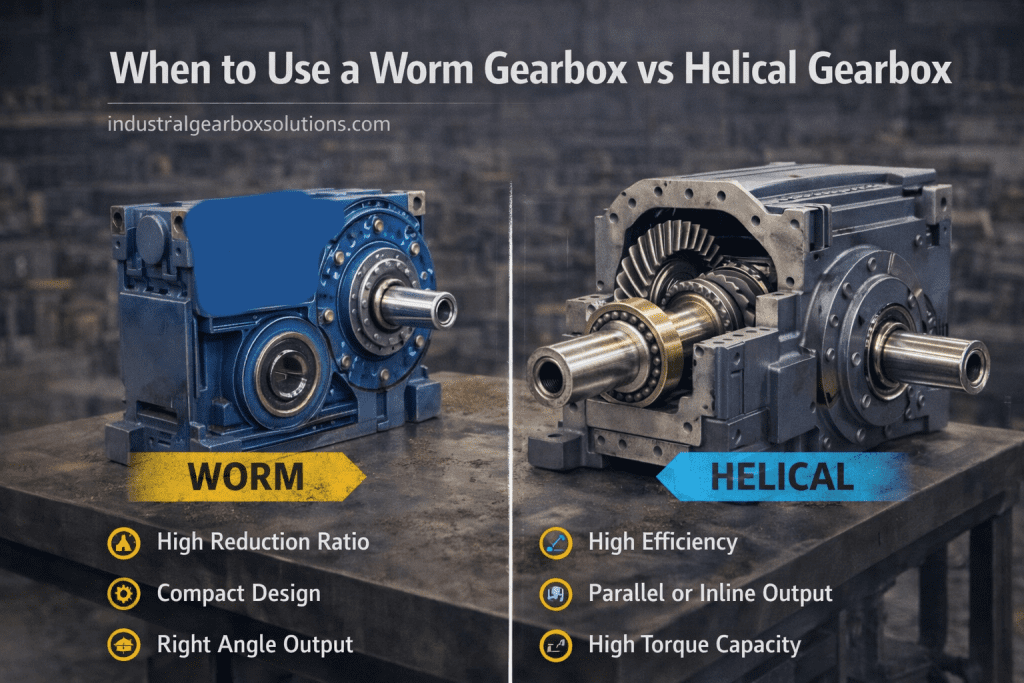
This article explains how worm and helical gearboxes work, where each design excels, and how to determine which one is the right choice for your application.
Recommended: How to Select the Right Industrial Gearbox for Any Application.
How Worm Gearboxes Work
A worm gearbox uses a screw-like worm that meshes with a worm wheel. As the worm rotates, it drives the wheel at a reduced speed.
Key characteristics of worm gearboxes include:
- High reduction ratios in a compact package
- Sliding contact between gear teeth
- Inherent speed reduction in a single stage
- Often self-locking at certain ratios
Because power is transmitted primarily through sliding friction, worm gearboxes behave very differently from rolling-contact gear designs.
How Helical Gearboxes Work
Helical gearboxes use angled (helical) teeth that engage gradually as they rotate. This design spreads load across multiple teeth at once, resulting in smoother operation.
Key characteristics of helical gearboxes include:
- High efficiency due to rolling contact
- Lower vibration and noise
- Higher torque capacity for a given size
- Better suitability for continuous-duty operation
Helical gearboxes are widely used in conveyors, mixers, pumps, and other continuously running systems.
Efficiency Differences: Worm vs Helical Gearboxes
Efficiency is one of the most important differences when comparing a worm gearbox vs helical gearbox.
Worm gearboxes typically operate at lower efficiencies due to sliding friction between the worm and wheel. Depending on ratio and lubrication, efficiency may range from moderate to low.
Helical gearboxes, by contrast, use rolling contact and typically achieve high efficiencies. This results in:
- Less heat generation
- Lower energy consumption
- Reduced lubricant stress
In applications where energy efficiency and temperature control matter, helical gearboxes usually outperform worm gearboxes.
Efficiency differences are explained in more detail in Worm Gearbox Efficiency Explained (With Real Numbers).
You can also use our free motor efficiency calculator and gearbox efficiency calculator.
Torque Capacity and Load Handling
Helical gearboxes generally handle higher continuous torque loads more effectively than worm gearboxes of similar size.
Because load is distributed across multiple teeth, helical designs experience:
- Lower tooth stress
- Better shock load resistance
- Longer service life under steady load
Worm gearboxes can handle high torque at low speeds, but they are more sensitive to shock loading and duty severity.
Load handling differences are tied closely to principles outlined in Gearbox Torque Rating vs Actual Load.
Heat Generation and Thermal Limits
Heat generation is a critical factor when comparing worm and helical gearboxes.
Worm gearboxes generate more heat due to sliding friction. This can limit:
- Continuous operating time
- Allowable torque
- Maximum ambient temperature
Helical gearboxes generate less heat and dissipate it more efficiently, making them better suited for long run times and higher duty cycles.
Heat buildup is a critical factor discussed in Gearbox Heat Generation: Causes and Solutions.
Duty Cycle Considerations
Duty cycle often determines whether a worm or helical gearbox is appropriate.
Worm gearboxes are commonly used in:
- Intermittent operation
- Low-speed positioning systems
- Applications with limited run time
- Situations where self-locking is beneficial
Helical gearboxes are preferred for:
- Continuous-duty applications
- High starts-per-hour
- Reversing or variable-speed operation
- Systems requiring long service life
Ignoring duty cycle is one of the most common selection mistakes when choosing between these gearbox types.
Self-Locking and Backdriving
One unique advantage of worm gearboxes is their potential self-locking behavior.
At certain ratios, a worm gearbox may resist backdriving, which can:
- Hold loads in position
- Reduce the need for external brakes
- Improve safety in lifting or positioning applications
Helical gearboxes are not self-locking and will backdrive unless external braking is used.
Size, Cost, and Mounting Considerations
Worm gearboxes often offer:
- Compact right-angle layouts
- Lower initial cost for simple applications
- Easy mounting in tight spaces
Helical gearboxes may require:
- More space for multi-stage reduction
- Higher upfront cost
- More precise alignment
However, helical gearboxes typically offer lower total cost of ownership due to higher efficiency and longer life.
When a Worm Gearbox Is the Better Choice
A worm gearbox is often the better option when:
- Space is limited
- High reduction is needed in a single stage
- Operation is intermittent
- Self-locking is desirable
- Initial cost must be minimized
When a Helical Gearbox Is the Better Choice
A helical gearbox is typically the better choice when:
- Continuous operation is required
- High efficiency matters
- Heat must be minimized
- Shock loads are present
- Long service life is expected
Common Selection Mistakes to Avoid
Common errors when choosing between worm and helical gearboxes include:
- Selecting a worm gearbox for continuous-duty operation
- Ignoring efficiency losses and heat buildup
- Assuming self-locking applies in all worm gearboxes
- Oversizing to compensate for poor application analysis
Understanding real operating conditions is critical.
Final Selection Guidance
The decision between a worm gearbox vs helical gearbox should be based on how the system actually operates—not just on size, ratio, or price.
By evaluating duty cycle, efficiency requirements, heat generation, load characteristics, and lifecycle costs, engineers can select the gearbox type that delivers reliable performance and long-term value.