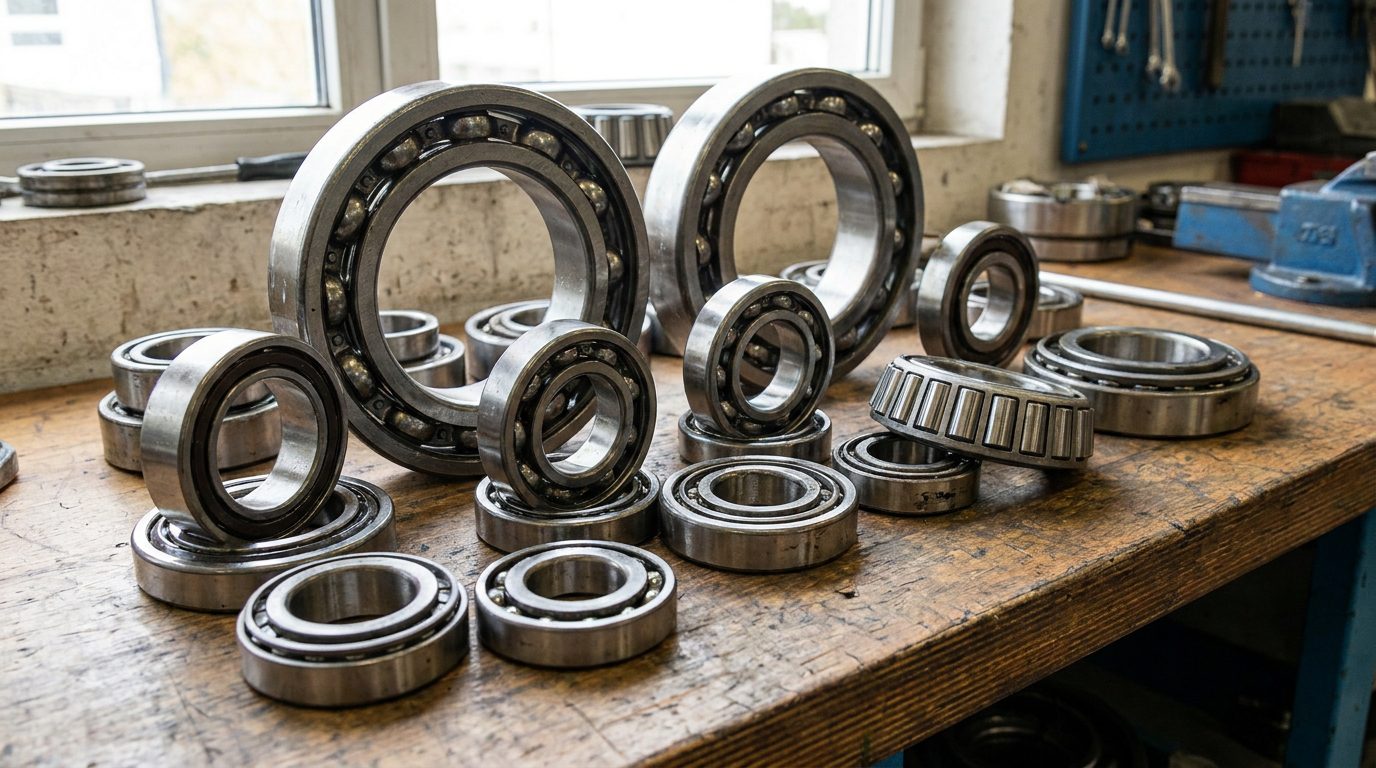
Choosing the Right Bearings for Industrial Gearboxes starts with understanding the loads, speeds, operating environment, lubrication system, and failure history of the gearbox. For maintenance managers, plant engineers, reliability engineers, mechanics, and purchasing teams, bearing selection is not just a parts decision—it directly affects uptime, vibration levels, thermal stability, gearbox life, and total cost of ownership. Ball bearings and roller bearings both have important roles in industrial gearboxes, but they are not interchangeable in demanding applications. The right choice depends on radial load, axial thrust, shaft speed, misalignment, shock loading, mounting arrangement, and whether the gearbox is being repaired, rebuilt, upgraded, or replaced.
Ball bearings are typically best for higher-speed, lighter-to-moderate-load gearbox applications where low friction, compact design, and efficient rotation are priorities. Roller bearings are usually better for heavy-duty industrial gearboxes because they carry higher radial loads, tolerate shock loads better, and offer longer service life in harsh operating conditions. In many gearboxes, the correct solution is a combination: cylindrical or tapered roller bearings on heavily loaded shafts, spherical roller bearings where misalignment is present, and ball bearings in lower-load, high-speed positions.
When considering the differences between ball bearings and roller bearings in industrial gearboxes, it’s essential to understand their respective advantages and applications. For a deeper insight into the maintenance and repair of industrial gearboxes, which can significantly impact bearing performance, you can refer to this related article on industrial gearbox repair in West Virginia. For more information, visit Industrial Gearbox Repair in West Virginia.
Ball Bearings vs. Roller Bearings in Industrial Gearboxes
Industrial gearboxes rely on bearings to support rotating shafts, maintain gear mesh alignment, control axial and radial movement, and reduce friction. When bearings are undersized, misapplied, poorly lubricated, or installed incorrectly, the gearbox may develop overheating, vibration, noise, gear wear, seal failure, and ultimately catastrophic failure.
What Ball Bearings Do Best
Ball bearings use spherical rolling elements that contact the raceways at small points. This design produces relatively low friction and allows smooth operation at higher speeds.
Common ball bearing types used in gearbox applications include:
- Deep groove ball bearings
- Angular contact ball bearings
- Four-point contact ball bearings
- Self-aligning ball bearings, less common in heavy gearbox service
Ball bearings are often selected when:
- Shaft speeds are relatively high
- Loads are moderate
- Space is limited
- Low friction is important
- Axial loads are light to moderate
- Precision and smooth operation are required
However, because ball bearings have point contact between the balls and raceways, they generally cannot handle the same heavy radial loads as roller bearings of similar size.
What Roller Bearings Do Best
Roller bearings use cylindrical, tapered, spherical, or needle-shaped rolling elements. Because rollers have line contact with the raceway, they distribute loads over a larger surface area than ball bearings.
Common roller bearing types used in industrial gearboxes include:
- Cylindrical roller bearings
- Tapered roller bearings
- Spherical roller bearings
- Needle roller bearings
- Full-complement roller bearings
Roller bearings are typically used when:
- Radial loads are high
- Shock loading is present
- Gear forces are severe
- Shaft deflection or misalignment must be managed
- Longer bearing life is required under heavy-duty conditions
- The gearbox operates in mining, steel, paper, cement, aggregate, chemical, power generation, or material handling environments
For many heavy industrial gearboxes, roller bearings are the preferred choice for output shafts and heavily loaded intermediate shafts.
Key Differences Between Ball Bearings and Roller Bearings
Choosing between ball bearings and roller bearings requires more than comparing catalog dimensions. Engineers and reliability teams must evaluate how each bearing handles load, speed, friction, heat, axial thrust, and alignment.
| Selection Factor | Ball Bearings | Roller Bearings |
||||
| Load capacity | Lower to moderate | Moderate to very high |
| Speed capability | Generally higher | Often lower than ball bearings, depending on type |
| Friction | Lower | Higher than ball bearings in many cases |
| Radial load handling | Moderate | Excellent |
| Axial load handling | Depends on type; angular contact handles thrust well | Tapered and spherical roller bearings handle thrust well |
| Shock load resistance | Limited | Stronger, especially spherical and tapered roller bearings |
| Misalignment tolerance | Limited, except self-aligning ball bearings | Spherical roller bearings handle misalignment well |
| Heat generation | Usually lower | Can be higher if overloaded, misadjusted, or poorly lubricated |
| Common gearbox use | High-speed/light-load shafts | Heavy-duty, high-load shafts |
| Cost | Often lower | Often higher, but may reduce lifecycle cost |
Radial Loads
Radial loads act perpendicular to the shaft. Gear mesh forces, pulley loads, coupling misalignment, and process loads all contribute to radial loading.
Roller bearings generally outperform ball bearings in high-radial-load gearbox applications. Cylindrical roller bearings are especially effective when the load is primarily radial and shaft speed is moderate to high.
Axial Loads
Axial loads, also called thrust loads, act parallel to the shaft. Helical gears, bevel gears, worm gears, and thrust from connected equipment can create significant axial forces.
Angular contact ball bearings can handle axial loads in one direction and are often paired for bidirectional thrust. Tapered roller bearings are commonly selected for combined radial and axial loads, making them a strong choice for helical gearboxes and bevel gear reducers.
Speed and Friction
Ball bearings typically operate with lower friction and can handle higher speeds than roller bearings of similar size. This makes them useful in high-speed gear stages, auxiliary drives, and lighter-duty gearbox positions.
Roller bearings may generate more heat if they are over-preloaded, misaligned, contaminated, or improperly lubricated. However, when correctly selected and installed, they deliver excellent service life in heavy-duty applications.
Industrial gearbox bearing failure can lead to costly downtime and production losses, so it’s important to address the issue promptly. Industrial gearbox bearing failure
Common Bearing Types Used in Industrial Gearboxes
Different bearing designs solve different gearbox problems. A gearbox may use several bearing types depending on shaft position, gear geometry, and load direction.
Deep Groove Ball Bearings
Deep groove ball bearings are simple, efficient, and widely available. They support radial loads and limited axial loads in both directions.
Best suited for:
- High-speed applications
- Light-to-moderate radial loads
- Lower-thrust gearbox positions
- Compact gearbox designs
Limitations:
- Not ideal for heavy shock loads
- Limited axial load capacity compared with angular contact or tapered roller bearings
- Sensitive to misalignment
Angular Contact Ball Bearings
Angular contact ball bearings are designed to carry combined radial and axial loads. They are often installed in pairs to handle thrust in both directions.
Best suited for:
- High-speed shafts with axial load
- Precision gearbox arrangements
- Applications requiring controlled shaft location
- Moderate thrust conditions
Limitations:
- Must be installed in the correct orientation
- Preload and clearance are critical
- Not the best option for severe shock loading
Cylindrical Roller Bearings
Cylindrical roller bearings have high radial load capacity and are common in industrial gearboxes. Some designs allow axial displacement, which helps manage thermal expansion of shafts.
Best suited for:
- High radial loads
- Intermediate shafts
- Output shafts
- Gearboxes requiring axial float on one end
Limitations:
- Limited thrust capacity unless specifically designed for axial load
- Sensitive to misalignment
- Requires proper lubrication film
Tapered Roller Bearings
Tapered roller bearings carry both radial and axial loads. They are frequently used in helical, bevel, and heavy-duty gearbox applications.
Best suited for:
- Combined radial and thrust loads
- Output shafts
- Heavy industrial gearboxes
- Applications requiring shaft positioning and stiffness
Limitations:
- Require accurate preload or endplay adjustment
- Incorrect setting can cause overheating or premature failure
- Installation precision is critical
Spherical Roller Bearings
Spherical roller bearings are rugged and self-aligning. They can handle heavy radial loads, moderate-to-high axial loads, and shaft misalignment.
Best suited for:
- Heavy shock loads
- Mining, aggregate, steel, cement, and paper mill gearboxes
- Misalignment-prone applications
- Large industrial reducers
Limitations:
- Higher friction than ball bearings
- May run hotter if overgreased or improperly lubricated
- Usually larger and more expensive
When considering the best options for enhancing efficiency in industrial gearboxes, it’s important to understand the differences between ball bearings and roller bearings. Each type offers unique advantages that can significantly impact performance and longevity. For a deeper insight into how these components interact within gear systems, you may find this article on helical gears particularly informative, as it explores the synergy between gear design and bearing selection.
Causes of Bearing Failure in Industrial Gearboxes
| Category | Ball Bearings | Roller Bearings |
|---|---|---|
| Load Capacity | Lower | Higher |
| Friction | Lower | Higher |
| Speed | Higher | Lower |
| Alignment | Less tolerant | More tolerant |
| Application | Lighter loads, high speeds | Heavier loads, lower speeds |
Bearing failures are rarely random. Most failures are caused by incorrect selection, lubrication problems, contamination, mounting errors, overload, or operating conditions outside the original design envelope.
Common Failure Causes
| Cause | How It Damages Bearings | Typical Result |
||||
| Overload | Exceeds bearing load rating | Spalling, cracking, overheating |
| Poor lubrication | Inadequate oil film or wrong viscosity | Scoring, wear, heat, seizure |
| Contamination | Dirt, water, metal particles enter bearing | Abrasive wear, corrosion, pitting |
| Misalignment | Uneven load distribution | Edge loading, raceway damage |
| Incorrect installation | Brinelling, preload errors, damaged fits | Early failure after startup |
| Improper bearing selection | Bearing type does not match load/speed | Chronic vibration and short life |
| Electrical current passage | Arcing through rolling elements | Fluting and washboard raceways |
| Excessive temperature | Reduces lubricant life and clearance control | Oxidation, cage damage, seizure |
| Shock loading | Impact forces exceed fatigue limits | Cracks, spalling, fractured components |
For deeper failure analysis, maintenance teams can review resources from SKF at https://www.skf.com, Timken at https://www.timken.com, and lubrication guidance from Noria at https://www.noria.com.
Lubrication-Related Failures
Lubrication is one of the most important factors in bearing life. Even the correct bearing will fail prematurely if the lubricant is wrong, contaminated, overheated, or not delivered properly.
Common lubrication problems include:
- Wrong oil viscosity
- Insufficient oil level
- Excessive oil level causing churning and heat
- Incompatible grease or oil
- Plugged lubrication lines
- Water contamination
- Oxidized or varnished oil
- Infrequent oil sampling
- Incorrect additives for gearbox service
Noria provides excellent lubrication education and oil analysis resources at https://www.noria.com, especially for teams building condition-based maintenance programs.
Installation and Fit Problems
Even premium bearings can fail quickly when installed incorrectly. Hammering bearings onto shafts, heating bearings unevenly, using improper tools, or setting tapered roller bearings with too much preload can cause severe early-life failures.
Important installation considerations include:
- Shaft and housing fit tolerances
- Bearing seating against shoulders
- Correct heating temperature
- Proper preload or endplay
- Clean assembly environment
- Correct orientation of angular contact and tapered bearings
- Verification of shaft runout and housing bore condition
If your facility is repeatedly replacing the same gearbox bearings, consider a professional gearbox failure analysis to identify the root cause rather than only replacing parts.
When considering the best options for industrial gearboxes, understanding the differences between ball bearings and roller bearings is crucial for optimal performance. A related article that delves deeper into the specifics of gearbox maintenance and replacement can be found at Dodge Gearbox Replacement, which provides valuable insights into ensuring the longevity and efficiency of your machinery. By exploring these resources, you can make informed decisions that enhance the reliability of your industrial applications.
Symptoms of Incorrect Bearing Selection or Bearing Failure
Bearing issues often appear before total gearbox failure. Early detection allows maintenance teams to schedule repairs instead of reacting to unplanned downtime.
Common Warning Signs
- Rising gearbox temperature
- Abnormal vibration
- Rumbling, growling, clicking, or whining noise
- Metallic particles in oil
- Oil discoloration or burnt odor
- Leaking seals caused by shaft movement
- Gear tooth wear patterns changing
- Increased motor amperage
- Excessive backlash
- Shaft endplay outside tolerance
- Repeated coupling failures
- Premature lubricant breakdown
Ball Bearing Failure Symptoms
Ball bearing issues often present as:
- High-frequency vibration peaks
- Clicking or ticking sounds
- Cage noise at higher speeds
- Overheating from excessive thrust or misalignment
- Smooth raceway fatigue progressing to spalling
Because ball bearings have point contact, overload damage can develop quickly if the application was better suited for a roller bearing.
Roller Bearing Failure Symptoms
Roller bearing problems often appear as:
- Low-frequency rumbling
- Elevated vibration at bearing defect frequencies
- Uneven raceway wear
- Edge loading marks
- Heat caused by improper preload
- Roller skewing or cage damage
- Spalling in heavily loaded zones
Tapered roller bearings are especially sensitive to incorrect preload or endplay. Too much preload can generate heat; too much endplay can allow poor gear mesh and impact loading.
Troubleshooting Bearing Problems in Gearboxes
A structured troubleshooting process helps determine whether the problem is bearing selection, lubrication, installation, gear loading, alignment, or contamination.
Step-by-Step Troubleshooting Checklist
| Step | What to Check | Why It Matters |
||||
| 1 | Operating temperature | Heat often indicates overload, lubrication failure, or preload problems |
| 2 | Vibration data | Identifies bearing defect frequencies and imbalance/misalignment |
| 3 | Oil sample results | Reveals wear metals, contamination, oxidation, and viscosity change |
| 4 | Gear mesh pattern | Poor gear contact can overload bearings |
| 5 | Shaft endplay | Incorrect endplay affects tapered roller bearings and gear alignment |
| 6 | Coupling alignment | Misalignment transfers external loads into bearings |
| 7 | Lubricant type and level | Wrong viscosity or oil level causes heat and wear |
| 8 | Load history | Process changes may exceed original gearbox design |
| 9 | Bearing fit condition | Loose fits can cause creep, fretting, and heat |
| 10 | Previous repair records | Repeated failures indicate unresolved root cause |
Questions to Ask During Troubleshooting
- Did the failure occur shortly after installation?
- Has production load increased?
- Was the gearbox recently rebuilt?
- Was lubricant changed to a different brand, viscosity, or additive package?
- Are oil breathers and seals controlling contamination?
- Is the gearbox exposed to washdown, dust, heat, or chemicals?
- Are bearings failing on the same shaft every time?
- Is there evidence of electrical fluting?
- Was the bearing set according to OEM endplay or preload specifications?
- Has shaft or housing wear changed bearing fits?
If the gearbox is critical to production, schedule a gearbox inspection service before secondary damage affects gears, shafts, housings, and seals.
Inspection Methods for Gearbox Bearings
Inspection should combine visual, dimensional, lubrication, and condition monitoring methods. The best reliability programs do not wait until a bearing is noisy before investigating.
Visual Inspection
During teardown, inspect bearings for:
- Spalling
- Pitting
- Flaking
- Discoloration
- Scoring
- Corrosion
- Cage cracking
- Roller skew marks
- False brinelling
- Fretting on shaft or housing fits
- Uneven raceway loading
- Heat tinting
Timken’s bearing damage analysis resources at https://www.timken.com are useful for identifying damage patterns and linking them to root causes.
Vibration Analysis
Vibration analysis can identify bearing defects before severe damage occurs. Reliability teams typically monitor:
- Inner race defect frequencies
- Outer race defect frequencies
- Ball or roller spin frequencies
- Cage frequencies
- Gear mesh frequencies
- Sidebands around gear mesh
- Overall velocity and acceleration trends
A rise in high-frequency vibration may indicate early bearing fatigue, inadequate lubrication, or contamination.
Oil Analysis
Oil analysis is critical for gearbox bearing reliability. Recommended tests include:
- Particle count
- Ferrous density
- Karl Fischer water test
- Viscosity at 40°C and 100°C
- Acid number
- Oxidation and nitration
- Spectrometric wear metals
- Analytical ferrography for severe or recurring failures
Oil analysis helps distinguish bearing wear from gear wear and can identify contamination before failure accelerates.
Dimensional Inspection
During repair or rebuild, measure:
- Shaft journals
- Housing bores
- Bearing seats
- Shoulder squareness
- Shaft runout
- Bore roundness
- Endplay
- Gear backlash
- Contact pattern
- Bearing internal clearance
A new bearing installed on a worn shaft or damaged housing bore may fail quickly, even if the bearing type is correct.
How to Choose the Right Bearing for an Industrial Gearbox
Selecting the right bearing requires a balance of engineering calculation, practical field experience, OEM requirements, and operating conditions.
Load Type and Direction
Start by identifying the dominant loads:
- Radial load from gear forces
- Axial thrust from helical, bevel, or worm gearing
- Combined loading
- Shock or impact loading
- External loads from belts, chains, or couplings
General guidance:
| Application Condition | Likely Bearing Choice |
|||
| High speed, moderate load | Deep groove or angular contact ball bearing |
| Heavy radial load | Cylindrical roller bearing |
| Combined radial and axial load | Tapered roller bearing |
| Heavy load with misalignment | Spherical roller bearing |
| Compact space with moderate radial load | Needle roller bearing |
| High thrust and precision location | Angular contact ball bearing pair or tapered roller bearing set |
Speed Requirements
Bearing speed capability depends on design, lubrication, cage type, heat dissipation, and load. Ball bearings usually perform better at higher speeds, while roller bearings carry heavier loads but may have lower speed limits.
When evaluating speed:
- Compare operating speed to bearing limiting speed
- Consider oil bath, splash, circulating oil, or grease lubrication
- Account for heat generation
- Verify cage material suitability
- Review lubrication viscosity at operating temperature
SKF provides bearing selection guidance and speed rating information at https://www.skf.com.
Gearbox Environment
Harsh environments can shift the decision toward more robust bearing types and upgraded sealing or lubrication systems.
Consider:
- Dust and abrasive contamination
- Water washdown
- High ambient temperature
- Low-temperature startup
- Chemical exposure
- Shock loading
- Variable speed drives
- Reversing loads
- Frequent starts and stops
- Outdoor operation
In contaminated or wet environments, bearing selection should be paired with improved seals, breathers, filtration, and oil analysis.
Bearing Life and Reliability Targets
Bearing life calculations help determine whether a bearing is adequate for the application. However, calculated life assumes proper lubrication, alignment, cleanliness, mounting, and operating conditions.
Useful standards and references include:
- AGMA gearbox standards and technical publications: https://www.agma.org
- SKF bearing rating life resources: https://www.skf.com
- Timken engineering guidance: https://www.timken.com
In real plants, actual life is often limited by contamination, installation practices, lubrication errors, and operating overloads—not catalog capacity alone.
Prevention: How to Extend Gearbox Bearing Life
Bearing reliability improves when maintenance teams control contamination, lubrication, alignment, load, temperature, and installation quality.
Preventive Maintenance Best Practices
- Use the correct lubricant viscosity and specification
- Maintain proper oil level
- Install desiccant breathers in humid or dusty environments
- Filter new oil before adding it to the gearbox
- Use dedicated transfer containers
- Perform routine oil sampling
- Monitor vibration trends
- Check operating temperature regularly
- Inspect seals and vents
- Maintain coupling alignment
- Avoid overloading the gearbox
- Verify bearing endplay during rebuilds
- Store spare bearings properly
- Use induction heaters instead of open flames
- Keep assembly areas clean
For additional support, see our industrial gearbox maintenance resources.
Lubrication Best Practices
| Practice | Benefit |
|||
| Select correct viscosity | Maintains oil film between rolling elements and raceways |
| Control contamination | Reduces abrasive wear and corrosion |
| Monitor water content | Prevents rust, hydrogen embrittlement, and additive depletion |
| Use filtration | Removes wear particles before they damage bearings |
| Avoid overfilling | Reduces churning, foaming, and heat |
| Sample consistently | Builds trend data for predictive maintenance |
Installation Best Practices
- Confirm part number and bearing type before installation
- Check shaft and housing dimensions
- Use clean gloves and tools
- Heat bearings uniformly with an induction heater
- Never apply force through rolling elements
- Set tapered roller bearing preload/endplay correctly
- Verify bearing seating
- Rotate shafts by hand after assembly
- Check backlash and contact pattern
- Document all measurements
Repair vs. Replacement: What Makes Sense?
When a gearbox bearing fails, the decision is not simply whether to replace the bearing. Maintenance and purchasing teams must decide whether the gearbox should be repaired, rebuilt, upgraded, or replaced.
When Bearing Replacement May Be Enough
Replacing bearings may be appropriate when:
- Damage is limited to bearings
- Gears and shafts are within tolerance
- Housing bores are not worn
- Lubrication system is clean and functional
- No recurring failure pattern exists
- Root cause is understood
- Replacement bearings match the application
When a Gearbox Rebuild Is Better
A full industrial gearbox rebuild is often better when:
- Gear teeth show pitting, scoring, or abnormal wear
- Shafts are worn or bent
- Housing bores are out of round
- Bearing fits are loose
- Seals have repeatedly failed
- Oil analysis shows significant metal contamination
- The gearbox has high operating hours
- The failure caused secondary damage
When Replacement May Be the Best Option
Replacing the gearbox may make sense when:
- The unit is obsolete
- Parts availability is poor
- Repair cost approaches replacement cost
- The gearbox is undersized for current production
- The application has changed significantly
- Lead time for rebuild is unacceptable
- A newer design offers better efficiency or reliability
If downtime is urgent, consider emergency gearbox repair to reduce production losses while a long-term reliability plan is developed.
Purchasing Considerations for Gearbox Bearings
Purchasing professionals play an important role in reliability. The lowest-cost bearing is not always the lowest-cost solution.
What to Specify When Buying Bearings
Include the following information when requesting a quote:
- Bearing manufacturer and part number
- Internal clearance class
- Cage type and material
- Precision class
- Lubrication requirements
- Seals or shields, if applicable
- Heat stabilization requirements
- Matched set requirements
- Preload or endplay requirements
- Application details
- OEM gearbox model and serial number
Avoid These Purchasing Mistakes
- Substituting bearing types without engineering review
- Buying unknown-brand bearings for critical gearboxes
- Ignoring clearance class
- Reusing old bearing part numbers after the application has changed
- Ordering single bearings when matched sets are required
- Focusing only on unit price instead of downtime cost
- Failing to verify authenticity and traceability
For critical gearboxes, involve engineering, maintenance, reliability, and purchasing before approving substitutions.
Ball Bearings vs. Roller Bearings: Application Examples
Conveyor Gearboxes
Conveyor drives often experience shock loads, contamination, and heavy radial loads. Roller bearings, especially tapered or spherical roller bearings, are frequently better for output shafts. Ball bearings may be used in lighter-duty or higher-speed positions.
Mixer and Agitator Gearboxes
Mixers can impose severe radial and axial loads, especially if the process material creates fluctuating resistance. Tapered or spherical roller bearings are often preferred, depending on shaft orientation and misalignment.
Cooling Tower Gearboxes
Cooling tower gearboxes may face moisture, corrosion, and difficult access. Bearing selection must be paired with strong lubrication and sealing practices. Roller bearings are commonly used where load is high, while ball bearings may appear in lighter, high-speed sections.
Steel Mill and Mining Gearboxes
These applications usually demand roller bearings due to shock loading, contamination risk, and heavy torque. Spherical roller bearings are common where misalignment and impact loads are present.
High-Speed Gearboxes
High-speed gearboxes may require angular contact ball bearings or specialized cylindrical roller bearings depending on load and thermal requirements. Lubrication method and heat control are critical.
FAQs About Choosing Bearings for Industrial Gearboxes
Are roller bearings always better than ball bearings for gearboxes?
No. Roller bearings are better for heavy loads and shock loading, but ball bearings can be better for high-speed, lower-load applications where low friction and compact design are important.
Can I replace a ball bearing with a roller bearing?
Not without engineering review. Roller bearings may have different dimensions, load paths, clearance requirements, speed limits, lubrication needs, and mounting arrangements. An incorrect substitution can damage gears, shafts, and housings.
Why do tapered roller bearings overheat after installation?
Common causes include excessive preload, insufficient lubrication, wrong lubricant viscosity, misalignment, incorrect bearing seating, or overfilled oil level. Endplay and preload should be measured and documented during assembly.
What bearing type is best for heavy radial loads?
Cylindrical roller bearings and spherical roller bearings are commonly used for heavy radial loads. The best choice depends on speed, axial load, alignment, shock loading, and gearbox design.
What bearing type is best for combined radial and axial loads?
Tapered roller bearings are often ideal for combined radial and axial loads. Angular contact ball bearings may also be used in higher-speed, moderate-load applications.
How often should gearbox bearings be inspected?
Critical gearboxes should be monitored continuously or routinely through vibration analysis, oil analysis, and temperature checks. Internal bearing inspection usually occurs during planned outages, rebuilds, or when condition monitoring indicates a problem.
What is the most common cause of gearbox bearing failure?
Lubrication failure and contamination are among the most common causes. Incorrect installation, overload, misalignment, and wrong bearing selection are also frequent contributors.
Should bearings be replaced during every gearbox rebuild?
In most industrial gearbox rebuilds, bearings are replaced as standard practice, especially if the gearbox has operated for a long period, experienced contamination, or suffered a failure. Reusing bearings can risk premature failure and repeat downtime.
Key Takeaways
- Ball bearings are typically better for higher-speed, lower-to-moderate-load gearbox applications.
- Roller bearings are usually better for heavy-duty industrial gearboxes with high radial loads, shock loads, or misalignment.
- Tapered roller bearings are excellent for combined radial and axial loads.
- Spherical roller bearings are strong choices for heavy loads and misalignment.
- Cylindrical roller bearings are effective for high radial loads where axial loading is limited or managed separately.
- Bearing failure is often caused by lubrication problems, contamination, incorrect installation, overload, or poor bearing selection.
- Troubleshooting should include vibration analysis, oil analysis, temperature trending, gear contact inspection, and dimensional checks.
- Repair vs. replacement decisions should consider total gearbox condition, downtime risk, parts availability, and long-term reliability.
- Purchasing decisions should account for bearing quality, authenticity, clearance, cage type, and application requirements—not just price.
Suggested Branded Images
Image 1: Ball Bearing vs. Roller Bearing Cutaway
Alt text: Ball bearing and roller bearing comparison for industrial gearbox applications
Caption: Ball bearings and roller bearings handle loads differently, making correct selection critical for gearbox reliability.
Image 2: Technician Inspecting Gearbox Bearings
Alt text: Industrial gearbox technician inspecting roller bearings during gearbox rebuild
Caption: Bearing inspection during gearbox repair helps identify root causes such as contamination, misalignment, and overload.
Image 3: Gearbox Bearing Failure Patterns
Alt text: Common industrial gearbox bearing failure patterns including spalling and raceway wear
Caption: Raceway damage, spalling, and discoloration can reveal whether a bearing failed from overload, lubrication failure, or installation error.
Image 4: Oil Sampling on Industrial Gearbox
Alt text: Maintenance technician performing oil analysis sampling on industrial gearbox
Caption: Oil analysis is one of the most effective methods for detecting early bearing and gear wear.
Image 5: Industrial Gearbox Rebuild Workbench
Alt text: Industrial gearbox rebuild with bearings shafts and gears on inspection bench
Caption: A complete gearbox rebuild should include dimensional inspection, bearing fit checks, and proper bearing selection.
SEO Metadata
SEO Title
Choosing the Right Bearings for Industrial Gearboxes: Ball Bearings vs. Roller Bearings
Meta Description
Learn how to choose between ball bearings and roller bearings for industrial gearboxes. Compare load capacity, speed, symptoms, troubleshooting, inspection, repair, and maintenance best practices.
Primary Keyword
Choosing the Right Bearings for Industrial Gearboxes
Secondary Keywords
- ball bearings vs roller bearings
- industrial gearbox bearings
- gearbox bearing failure
- roller bearings for gearboxes
- ball bearings for gearboxes
- gearbox bearing inspection
- gearbox bearing replacement
- tapered roller bearings
- spherical roller bearings
- cylindrical roller bearings
Suggested URL Slug
choosing-bearings-industrial-gearboxes-ball-vs-roller
Search Intent
Informational and commercial investigation for maintenance, engineering, reliability, and purchasing professionals evaluating industrial gearbox bearing selection, failure prevention, repair, or replacement.
Conclusion
Choosing between ball bearings and roller bearings for industrial gearboxes requires a practical understanding of speed, load, thrust, shock, alignment, lubrication, environment, and reliability goals. Ball bearings can be the right choice for high-speed, moderate-load positions, but roller bearings are often the better solution for heavy-duty industrial gearbox service. The best bearing is the one that matches the actual operating conditions—not just the one that fits the shaft and housing.
If your gearbox is overheating, vibrating, leaking, or repeatedly failing bearings, do not rely on part replacement alone. A proper inspection can reveal whether the root cause is lubrication, contamination, misalignment, overload, incorrect bearing selection, or worn gearbox components. Industrial Gearbox Solutions can help evaluate your gearbox, recommend the right bearing arrangement, and support repair, rebuild, or replacement decisions that reduce downtime and improve reliability.
FAQs
1. What are ball bearings and roller bearings?
Ball bearings and roller bearings are types of bearings used in industrial gearboxes to reduce friction and support rotating or moving parts. Ball bearings use balls to separate the bearing races, while roller bearings use cylindrical rollers.
2. What are the differences between ball bearings and roller bearings?
Ball bearings have lower load capacity and are better suited for high-speed applications, while roller bearings have higher load capacity and are better for heavy-duty applications. Roller bearings also have higher friction and are more durable than ball bearings.
3. What are the advantages of using ball bearings in industrial gearboxes?
Ball bearings are known for their high-speed capabilities, low friction, and smooth operation. They are also more cost-effective and require less maintenance compared to roller bearings.
4. What are the advantages of using roller bearings in industrial gearboxes?
Roller bearings are preferred for heavy-duty applications due to their higher load capacity and durability. They also provide better shock absorption and are more suitable for applications with high radial loads.
5. How do I choose between ball bearings and roller bearings for my industrial gearbox?
The choice between ball bearings and roller bearings depends on the specific requirements of the industrial gearbox, including load capacity, speed, and operating conditions. It is important to consult with a bearing specialist to determine the most suitable type of bearing for the application.