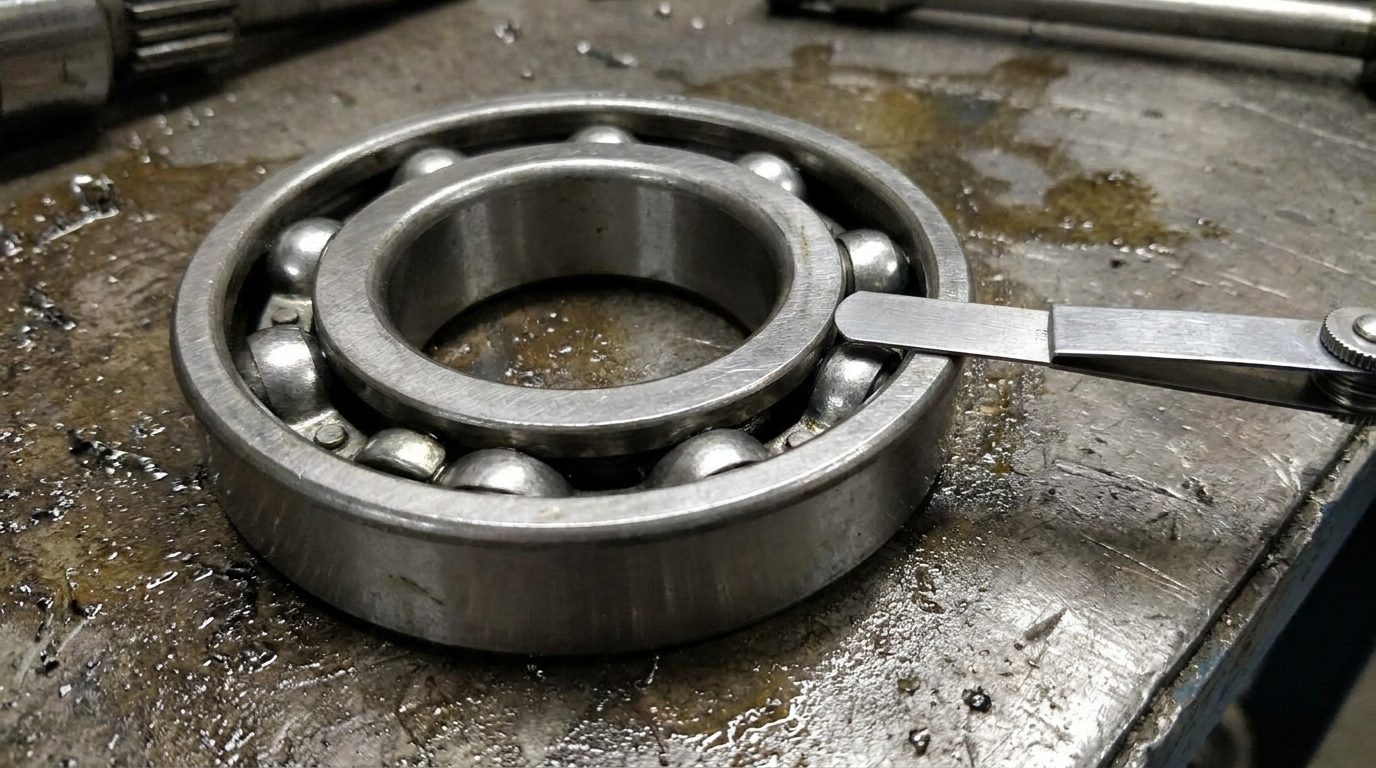
Bearing clearance is one of the most important but often misunderstood factors in industrial gearbox reliability. In gear drives, bearings must support radial and axial loads, maintain shaft alignment, control gear mesh, and survive heat, contamination, lubrication challenges, and shock loading. Too little clearance can cause heat, smearing, preload-related failures, and seizure. Too much clearance can cause vibration, gear misalignment, cage damage, spalling, and reduced service life. For maintenance managers, plant engineers, reliability engineers, mechanics, and purchasing teams, understanding bearing clearance helps prevent repeat failures, reduce downtime, and make better repair-versus-replacement decisions.
Bearing clearance is the internal space between rolling elements and bearing raceways before, during, or after installation. In industrial gearboxes, the correct clearance depends on bearing type, shaft and housing fits, operating temperature, load, speed, lubrication, and gear arrangement. A bearing that is too tight can overheat and fail from inadequate oil film or excessive preload. A bearing that is too loose can allow shaft movement, vibration, gear mesh errors, and fatigue damage. The best practice is to verify the manufacturer’s bearing clearance class, measure shaft and housing fits, account for thermal growth, inspect operating symptoms, and document clearance during gearbox repair or rebuild.
Understanding bearing clearance is crucial for the optimal performance of machinery, and for those interested in further exploring this topic, a related article on industrial gearbox repair can provide valuable insights. You can read more about the importance of maintaining gearboxes and the role of proper bearing clearance in enhancing their longevity by visiting this link: Industrial Gearbox Repair in Collinsville, Illinois.
What Is Bearing Clearance?
Bearing clearance refers to the amount of internal movement available between a bearing’s rolling elements and raceways. It is not simply “looseness.” It is an engineered condition that allows the bearing to operate properly after installation, under load, and at temperature.
In industrial gearboxes, clearance affects:
- Gear tooth contact pattern
- Shaft deflection and alignment
- Bearing operating temperature
- Lubricant film formation
- Vibration signature
- Noise levels
- Seal performance
- Bearing fatigue life
- Gearbox efficiency
A bearing may have measurable clearance before mounting, but that clearance changes once the bearing is pressed onto a shaft, installed in a housing, exposed to temperature differences, and loaded during operation.
For gearbox inspection and rebuild support, see Industrial Gearbox Solutions’ resources on industrial gearbox repair and gearbox inspection services.
Radial Internal Clearance
Radial internal clearance is the total possible movement of one bearing ring relative to the other in the radial direction, perpendicular to the shaft centerline.
This is especially important for:
- Deep groove ball bearings
- Spherical roller bearings
- Cylindrical roller bearings
- Tapered roller bearing arrangements
- Gearbox shaft support bearings
Radial clearance is commonly specified by bearing clearance classes such as C2, CN, C3, C4, and C5. These classes indicate whether the bearing has less than normal, normal, or greater than normal clearance.
Axial Clearance and Endplay
Axial clearance, often called endplay, is movement along the shaft axis. In gearboxes, axial clearance is critical because many gear arrangements generate thrust loads.
Axial clearance is especially important in:
- Helical gearboxes
- Bevel gearboxes
- Worm gear reducers
- Tapered roller bearing arrangements
- Angular contact ball bearing arrangements
Too much endplay can allow gears to shift out of proper mesh. Too little endplay can create excessive preload, heat, and rapid bearing damage.
Mounted Clearance
Mounted clearance is the clearance after the bearing is installed on the shaft and inside the housing. This is not the same as catalog clearance.
Clearance is typically reduced when:
- The bearing inner ring is press-fit onto the shaft
- The outer ring is interference-fit into the housing
- The shaft is larger than nominal size
- The housing bore is smaller than nominal size
This is why measuring shaft and housing fits is essential during gearbox rebuilds. Reusing a worn housing or shaft without dimensional verification can cause the same bearing failure to return.
Operating Clearance
Operating clearance is the bearing clearance during actual operation at load and temperature. It is the clearance that matters most for reliability.
Operating clearance is affected by:
- Shaft temperature
- Housing temperature
- Lubricant temperature
- Bearing load
- Gear load direction
- Shaft material and housing material
- Bearing type and size
- Speed and duty cycle
For example, if the shaft runs hotter than the housing, the inner ring may expand more than the outer ring, reducing internal clearance. In high-temperature gearboxes, a bearing with normal clearance may become too tight during operation.
Bearing Clearance Classes Explained
Bearing manufacturers use standardized clearance classes to define internal clearance ranges. These classes help engineers choose bearings suited for mounting fits and operating conditions.
Common radial internal clearance classes include:
| Clearance Class | General Meaning | Typical Use Case |
||||
| C2 | Less than normal clearance | Light fits, low temperature differential, special precision applications |
| CN or Normal | Standard internal clearance | General applications with moderate fits and normal temperatures |
| C3 | Greater than normal clearance | Common in electric motors, pumps, and gearboxes with press fits or thermal growth |
| C4 | More clearance than C3 | High-temperature or heavy interference-fit applications |
| C5 | More clearance than C4 | Special applications with extreme thermal expansion or tight fits |
According to bearing manufacturers such as SKF and Timken, clearance selection should account for fits, temperature gradients, load, speed, and operating conditions rather than relying on a generic rule.
What Does C3 Bearing Clearance Mean?
C3 clearance means the bearing has greater internal clearance than normal before mounting. This does not mean the bearing will run loose in service. In many gearbox applications, a C3 bearing may be selected because the mounting fit and thermal expansion reduce the clearance to an appropriate operating range.
C3 bearings are commonly used when:
- The inner ring is interference-fit to the shaft
- Operating temperatures are elevated
- The shaft runs hotter than the housing
- Loads are moderate to heavy
- The gearbox has continuous-duty operation
However, C3 is not always correct. Installing a C3 bearing where a CN bearing is required can create excessive operating clearance, vibration, and gear mesh instability.
What Does C2 Bearing Clearance Mean?
C2 clearance is less than normal. It may be used in applications where a tight operating clearance is needed and installation fits do not significantly reduce internal clearance.
C2 bearings can be risky in industrial gearboxes if used incorrectly because small amounts of shaft growth, interference fit, or heat can eliminate clearance and create preload.
Normal Clearance Is Not Always “Standard” for Gearboxes
A common purchasing mistake is assuming that “normal clearance” is always correct because it sounds standard. In reality, the correct clearance must match the application.
Purchasing professionals should confirm:
- Full bearing part number
- Clearance suffix
- Cage type
- Lubrication groove or holes
- Precision class
- Sealing or shielding configuration
- Brand equivalency
- Heat treatment or stabilization
- Application-specific requirements
A missing suffix on a purchase order can result in receiving the wrong clearance class, even if the bearing bore, outside diameter, and width are correct.
Industrial gearbox bearing failure can lead to costly downtime and production losses, so it’s important to address the issue promptly. Industrial gearbox bearing failure
Why Bearing Clearance Matters in Industrial Gearboxes
Industrial gearboxes are sensitive to shaft position. Bearings do more than carry load; they control where gears run.
When bearing clearance changes, the entire gearbox geometry can change.
Gear Mesh Alignment
Gears are designed to carry load across a specific tooth contact pattern. Excessive bearing clearance can allow shaft movement, causing:
- Edge loading
- Uneven tooth contact
- High gear tooth stress
- Micropitting
- Scuffing
- Abnormal noise
- Accelerated gear wear
During a gearbox rebuild, a contact pattern check can reveal whether bearing clearance, shaft deflection, or housing wear is affecting gear alignment.
For related support, visit Industrial Gearbox Rebuilding.
Bearing Fatigue Life
Bearing life calculations assume correct internal clearance, lubrication, load distribution, and alignment. Incorrect clearance changes load distribution across rolling elements.
Too little clearance can concentrate load and create heat. Too much clearance can reduce the number of rolling elements carrying load, increasing stress on the loaded zone.
The American Gear Manufacturers Association, available at AGMA, provides standards and technical guidance related to gearing, gearbox performance, and power transmission reliability.
Lubricant Film Thickness
Bearings require adequate lubricant film between rolling elements and raceways. Incorrect clearance can disrupt that film.
Too little clearance may squeeze out the lubricant film or generate excessive heat that reduces oil viscosity. Too much clearance may increase skidding, vibration, and impact loading.
Noria’s lubrication education resources at Noria are useful for understanding how viscosity, contamination, and lubrication intervals affect gearbox and bearing life.
Understanding bearing clearance is crucial for the optimal performance of machinery, and for those looking to delve deeper into related topics, an insightful article on gearbox manufacturers can provide valuable context. You can explore the intricacies of gearbox design and its impact on performance in this informative piece about ABM Drives. This resource complements the discussion on bearing clearance by highlighting how precision in manufacturing affects overall machinery efficiency.
Causes of Incorrect Bearing Clearance
| Bearing Type | Clearance | Application |
|---|---|---|
| Ball Bearings | Radial and axial clearance | Automotive, industrial machinery |
| Roller Bearings | Radial clearance | Heavy machinery, conveyor systems |
| Thrust Bearings | Axial clearance | Aircraft, automotive transmissions |
Incorrect bearing clearance can result from design errors, installation problems, operating changes, or maintenance practices.
Wrong Bearing Specification
A gearbox may fail repeatedly if the wrong bearing clearance class is installed. This can happen when:
- The original bearing suffix is omitted
- A substitute bearing is selected by dimensions only
- A purchasing cross-reference is incomplete
- The gearbox has been modified from original design
- A previous repair used an incorrect bearing
- The OEM documentation is unavailable or outdated
When sourcing replacement bearings, always verify the complete bearing designation, not just the size.
Improper Shaft or Housing Fits
Bearing clearance changes after installation. If the shaft or housing fit is incorrect, the final clearance may be too tight or too loose.
Common fit-related issues include:
- Oversized shaft journal
- Undersized housing bore
- Worn housing fit
- Fretting damage
- Out-of-round bores
- Tapered shaft seats
- Bell-mouthed housings
- Improper sleeve installation
Dimensional inspection is essential before installing new bearings.
Thermal Growth
Temperature differences between the shaft, bearing, and housing can significantly alter operating clearance.
Common thermal causes include:
- Insufficient lubrication
- Oil viscosity too high or too low
- Restricted oil flow
- High ambient temperature
- Overloaded gearbox
- Misalignment
- Excessive seal friction
- Cooling system failure
- Incorrect bearing preload
A bearing that feels acceptable during assembly may become too tight after several hours of operation.
Incorrect Assembly Practices
Poor assembly can damage bearings or change clearance.
Examples include:
- Hammering directly on bearing rings
- Applying force through rolling elements
- Heating bearings unevenly
- Overheating bearings during installation
- Incorrect locknut torque
- Improper shimming
- Reusing damaged spacers
- Mixing bearing components
- Contaminating bearings during assembly
For critical gearboxes, controlled assembly procedures and documented measurements should be standard practice.
Housing Wear and Shaft Damage
A new bearing installed into a worn housing may not be properly supported. The outer ring can creep, spin, or distort under load.
Signs of housing or shaft fit problems include:
- Fretting corrosion
- Polished bearing seats
- Black oxide debris
- Out-of-round wear
- Loose bearing outer ring
- Evidence of ring rotation
- Uneven contact marks
- Repeated failures in the same position
In these cases, bearing replacement alone is rarely enough.
Symptoms of Incorrect Bearing Clearance
Bearing clearance problems often show up as temperature, vibration, noise, lubrication, or gear contact issues.
Symptoms of Too Little Clearance
When clearance is too tight, the bearing may operate with excessive preload.
Common symptoms include:
- Rapid temperature rise after startup
- High bearing housing temperature
- Discolored bearing raceways
- Smearing or scoring
- Lubricant darkening or oxidation
- Seizure marks
- Abnormal high-frequency vibration
- Excessive amperage draw
- Short bearing life after rebuild
- Reduced gearbox efficiency
A bearing with insufficient operating clearance may fail quickly, sometimes within hours or days.
Symptoms of Too Much Clearance
Excessive clearance can be just as damaging.
Common symptoms include:
- Gearbox rumbling or knocking
- Increased vibration at gear mesh frequency
- Shaft movement
- Seal leakage
- Irregular gear tooth contact
- Cage wear or breakage
- False brinelling during standby
- Roller skidding
- Fatigue spalling
- Looseness detected during inspection
Excessive clearance can also cause secondary failures in gears, seals, couplings, and lubrication systems.
Symptoms That May Be Misdiagnosed
Clearance problems can look like other gearbox issues. Before replacing bearings, confirm whether symptoms are actually caused by:
- Misalignment
- Soft foot
- Coupling imbalance
- Gear tooth damage
- Lubricant contamination
- Incorrect oil viscosity
- Resonance
- Foundation looseness
- Overload
- Bent shaft
- Improper backlash
A complete root cause analysis prevents unnecessary parts replacement and repeat downtime.
Troubleshooting Bearing Clearance Problems
Troubleshooting should move from operating symptoms to inspection data, then to dimensional verification.
Step-by-Step Troubleshooting Checklist
| Step | What to Check | Why It Matters |
||||
| 1 | Review bearing part number and suffix | Confirms clearance class and configuration |
| 2 | Check operating temperature trend | Identifies preload, lubrication, or overload issues |
| 3 | Review vibration data | Detects looseness, bearing defects, and gear mesh issues |
| 4 | Inspect lubricant condition | Identifies contamination, wear debris, and overheating |
| 5 | Check shaft endplay | Confirms axial movement or preload condition |
| 6 | Measure radial movement where possible | Helps identify looseness or worn fits |
| 7 | Inspect gear contact pattern | Reveals shaft movement or misalignment |
| 8 | Measure shaft and housing fits | Confirms mounted clearance impact |
| 9 | Inspect failed bearing surfaces | Supports root cause analysis |
| 10 | Compare to OEM or engineering specs | Ensures correct repair decisions |
Vibration Analysis
Vibration analysis can help identify excessive clearance, looseness, misalignment, gear mesh issues, and bearing defects.
Potential vibration indicators include:
- Elevated 1X running speed vibration
- Harmonics of running speed
- Gear mesh frequency sidebands
- Bearing defect frequencies
- Impacting or modulation
- Increased noise floor
- Looseness signatures
However, vibration data should be interpreted alongside oil analysis, temperature trends, and mechanical inspection.
Temperature Monitoring
Temperature is one of the most practical indicators of bearing clearance problems. A bearing that runs too tight often generates heat quickly.
Useful practices include:
- Baseline temperature after installation
- Compare identical gearbox positions
- Trend temperature over time
- Use infrared thermography carefully
- Confirm readings with contact sensors where possible
- Investigate sudden temperature changes immediately
A gradual temperature increase may suggest lubrication degradation, contamination, or increasing load. A rapid increase after bearing replacement may indicate incorrect fit, clearance, or preload.
Oil Analysis
Oil analysis can reveal conditions linked to clearance-related damage.
Look for:
- Iron particles
- Bearing alloy particles
- Increased particle count
- Oxidation
- Viscosity change
- Water contamination
- Additive depletion
- Darkened oil
- Abnormal wear debris morphology
Noria recommends using oil analysis as part of a proactive reliability program, especially for critical gearboxes.
Bearing Clearance Inspection Methods
Inspection methods vary depending on whether the gearbox is operating, shut down, partially disassembled, or fully rebuilt.
In-Service Inspection
While the gearbox is operating, maintenance teams can assess bearing clearance indirectly through:
- Vibration analysis
- Ultrasound
- Temperature monitoring
- Oil analysis
- Visual leak inspection
- Sound changes
- Load trend review
- Motor current monitoring
These methods do not directly measure internal bearing clearance, but they can identify symptoms that justify a shutdown inspection.
Shutdown Inspection
During a planned outage, mechanics can check for signs of excessive movement or preload.
Inspection tasks may include:
- Checking shaft endplay with a dial indicator
- Checking lift or radial movement where accessible
- Inspecting seals for leakage or wear
- Checking coupling movement
- Inspecting gear backlash
- Reviewing gear contact pattern
- Looking for bearing seat fretting
- Checking fastener tightness
- Verifying lubrication flow
Endplay measurements are especially important in tapered roller bearing and angular contact bearing arrangements.
Disassembly Inspection
During gearbox teardown, more detailed measurements should be taken.
Key inspections include:
- Bearing visual inspection
- Shaft journal diameter measurement
- Housing bore measurement
- Roundness and taper checks
- Shoulder squareness
- Spacer and shim measurement
- Locknut and washer inspection
- Bearing seat surface condition
- Gear tooth contact pattern
- Seal journal condition
Use calibrated micrometers, bore gauges, dial indicators, and surface finish tools when required.
Bearing Failure Analysis
A failed bearing can reveal whether clearance was too tight, too loose, or affected by another root cause.
Common evidence includes:
| Failure Evidence | Possible Clearance-Related Cause |
|||
| Bluing or discoloration | Excessive heat from preload or lubrication failure |
| Smearing | Sliding due to inadequate film or preload |
| Cage damage | Excessive looseness, skewing, or poor lubrication |
| Spalling in loaded zone | Fatigue from load concentration |
| Fretting on bore or OD | Loose fit or ring creep |
| Uneven raceway marks | Misalignment or incorrect mounting |
| Roller end scoring | Excessive thrust or preload |
| Polished shaft seat | Bearing ring movement |
For emergency help, see Emergency Gearbox Repair.
Preventing Bearing Clearance Problems
Prevention starts before installation and continues through operation.
Specify Bearings Correctly
A complete bearing specification should include:
- Manufacturer
- Full bearing designation
- Clearance class
- Cage material
- Precision class
- Lubrication features
- Seals or shields
- Heat stabilization
- Matched set requirements
- Application position in gearbox
Do not purchase bearings by size alone. Two bearings with the same dimensions may have different internal clearance, cage design, load rating, or heat treatment.
Control Installation Practices
Best practices include:
- Keep bearings clean and packaged until installation
- Use induction heaters with temperature control
- Avoid open flames
- Do not overheat bearings
- Apply force only to the ring being mounted
- Use proper sleeves and press tools
- Measure components before assembly
- Follow OEM torque and shim specifications
- Document endplay or preload
- Rotate shafts during adjustment when required
SKF and Timken both provide installation guidance emphasizing cleanliness, correct mounting methods, and controlled fits.
Maintain Proper Lubrication
Lubrication directly affects bearing operating clearance and temperature.
Gearbox lubrication best practices include:
- Use OEM-recommended viscosity grade
- Verify lubricant type and additive package
- Avoid mixing incompatible oils
- Maintain correct oil level
- Use desiccant breathers where appropriate
- Filter oil during transfer
- Perform routine oil analysis
- Control water and particle contamination
- Inspect lubrication lines and spray nozzles
- Maintain cooling systems
A bearing with correct clearance can still fail prematurely if lubrication is poor.
Monitor Operating Conditions
Reliability teams should trend:
- Bearing temperatures
- Gearbox vibration
- Oil condition
- Oil level
- Load
- Speed
- Ambient temperature
- Cooling water flow
- Gearbox noise
- Seal leakage
Changes in process conditions can make a previously acceptable clearance selection unsuitable.
Repair vs. Replacement: What Should You Do?
When a gearbox shows signs of bearing clearance problems, the decision is not always as simple as replacing bearings.
When Bearing Replacement May Be Enough
Bearing replacement may be appropriate when:
- The failure is isolated
- Shaft and housing fits are within tolerance
- Gear teeth are undamaged
- Lubrication system is clean and functional
- The correct bearing specification is verified
- No evidence of housing distortion exists
- Endplay or preload can be properly restored
Even then, the root cause should be documented.
When Gearbox Repair or Rebuild Is Recommended
A full repair or rebuild may be needed when:
- Bearing failures repeat
- Gear contact patterns are poor
- Housings are worn or distorted
- Shaft journals are damaged
- Seals repeatedly leak
- Gears show pitting or scuffing
- Oil contains significant metal debris
- Bearing seats show fretting or spinning
- Endplay cannot be held
- OEM parts are obsolete or unavailable
A rebuild allows technicians to restore fits, correct shaft alignment, replace worn gears, reset backlash, and verify bearing clearance properly.
When Replacement Gearbox Evaluation Makes Sense
Replacing the gearbox may be more practical when:
- Housing damage is severe
- Lead time for repair exceeds production needs
- Gearbox design is obsolete
- Upgrade options improve reliability
- Repair cost approaches replacement cost
- The unit is undersized for current load
- Multiple internal components are damaged
- Safety or compliance concerns exist
Purchasing teams should compare total cost of ownership, not just purchase price. A cheaper replacement that repeats the same clearance or fit problem can be more expensive over time.
Maintenance Best Practices for Bearing Clearance Reliability
Clearance reliability is achieved through precision maintenance, documentation, and condition monitoring.
Recommended Maintenance Schedule
| Frequency | Maintenance Activity | Purpose |
||||
| Daily/Weekly | Check noise, leaks, temperature, and oil level | Identify early warning signs |
| Monthly | Inspect breathers, seals, and lubrication condition | Prevent contamination and lubricant failure |
| Quarterly | Review vibration and temperature trends | Detect developing looseness or preload issues |
| Semiannual | Perform oil analysis | Monitor wear particles and lubricant health |
| Annual | Inspect alignment, foundation, and fasteners | Reduce external causes of bearing movement |
| Planned outage | Measure endplay, inspect gear contact, verify fits if opened | Confirm mechanical condition |
| Rebuild | Document bearing clearance, fits, preload, backlash, and contact pattern | Establish reliable baseline |
Documentation Matters
Every gearbox repair should document:
- Bearing part numbers
- Clearance classes
- Shaft dimensions
- Housing dimensions
- Shim packs
- Endplay readings
- Preload settings
- Gear backlash
- Gear contact pattern
- Lubricant type
- Torque values
- Failure observations
- Photos of damaged parts
Good documentation makes future troubleshooting faster and more accurate.
Train Mechanics and Buyers Together
Bearing clearance problems often start with communication gaps between maintenance and purchasing.
For example, a mechanic may remove a C3 bearing, but purchasing may order the same base bearing number without the C3 suffix. The bearing fits dimensionally but fails in service.
Maintenance, engineering, and procurement should align on:
- Approved bearing brands
- Complete part numbers
- Critical suffixes
- Substitution rules
- Storage requirements
- Inspection standards
- Repair vendor requirements
Common Bearing Clearance Mistakes
Assuming More Clearance Is Safer
More clearance is not always better. Excess clearance can create vibration, poor load distribution, and gear mesh problems.
Ignoring Fits
Catalog clearance is only the starting point. Shaft and housing fits determine mounted clearance.
Reusing Damaged Spacers and Shims
Spacers, shims, and locknuts influence axial clearance and preload. Reusing damaged components can undo an otherwise good bearing installation.
Measuring Only After Failure
Clearance-related data should be captured during planned maintenance and rebuilds, not only after catastrophic failure.
Treating the Bearing as the Root Cause
The bearing is often the failed component, not the root cause. The real cause may be misalignment, contamination, overload, incorrect fit, or lubrication failure.
Branded Image Suggestions
Image 1: Bearing Clearance Diagram
Suggested file name: bearing-clearance-diagram-industrial-gearbox.jpg
Alt text: Diagram showing radial and axial bearing clearance in an industrial gearbox bearing
Caption: Radial and axial bearing clearance must be controlled to maintain shaft alignment and gear mesh.
Image 2: Technician Measuring Shaft Endplay
Suggested file name: gearbox-shaft-endplay-measurement.jpg
Alt text: Technician using a dial indicator to measure gearbox shaft endplay
Caption: Endplay measurement helps confirm whether bearing clearance or preload is within specification.
Image 3: Failed Bearing Inspection
Suggested file name: failed-gearbox-bearing-clearance-analysis.jpg
Alt text: Failed industrial gearbox bearing showing heat discoloration and raceway damage
Caption: Bearing damage patterns can reveal whether clearance, preload, lubrication, or fit issues caused failure.
Image 4: Gear Contact Pattern Check
Suggested file name: industrial-gearbox-contact-pattern-bearing-clearance.jpg
Alt text: Gear tooth contact pattern inspection during industrial gearbox rebuild
Caption: Incorrect bearing clearance can shift gear contact patterns and increase tooth stress.
Image 5: Precision Gearbox Rebuild Bench
Suggested file name: industrial-gearbox-rebuild-bearing-installation.jpg
Alt text: Industrial gearbox rebuild with bearings, shafts, and gears on a precision workbench
Caption: Precision measurement and documented assembly practices reduce repeat bearing failures.
SEO Metadata
Meta title: Demystifying Bearing Clearance: What You Need to Know
Meta description: Learn what bearing clearance means, why it matters in industrial gearboxes, symptoms of incorrect clearance, inspection methods, troubleshooting, and repair best practices.
Primary keyword: bearing clearance
Secondary keywords:
- bearing internal clearance
- radial bearing clearance
- axial bearing clearance
- gearbox bearing clearance
- C3 bearing clearance
- bearing endplay
- industrial gearbox bearing failure
- gearbox repair
- bearing preload
- bearing inspection
Suggested URL slug: demystifying-bearing-clearance
Search intent: Informational and commercial investigation for maintenance and engineering teams diagnosing gearbox bearing failures or planning repairs.
Recommended internal links:
- Industrial Gearbox Repair
- Industrial Gearbox Rebuilding
- Gearbox Inspection Services
- Emergency Gearbox Repair
Recommended external sources:
- SKF Bearing Knowledge
- Timken Engineering Resources
- AGMA Standards and Technical Resources
- Noria Lubrication Resources
FAQs
What is bearing clearance?
Bearing clearance is the internal movement between a bearing’s rolling elements and raceways. It may be measured radially or axially and changes after mounting and during operation.
What is the difference between radial clearance and axial clearance?
Radial clearance is movement perpendicular to the shaft centerline. Axial clearance, or endplay, is movement along the shaft centerline. Both are important in industrial gearboxes.
Is C3 bearing clearance better than normal clearance?
Not always. C3 clearance provides more internal clearance than normal and is useful in applications with interference fits or thermal growth. However, if the application requires normal clearance, C3 may create excessive looseness.
What happens if bearing clearance is too tight?
A bearing with too little clearance can overheat, lose lubricant film, smear, discolor, seize, or fail prematurely due to excessive preload.
What happens if bearing clearance is too loose?
Too much clearance can cause vibration, gear misalignment, cage damage, seal leakage, roller skidding, and fatigue spalling.
Can bearing clearance be measured while the gearbox is running?
Direct internal clearance measurement is usually not possible while running. However, vibration, temperature, oil analysis, and noise monitoring can identify symptoms of clearance-related issues.
Why do new bearings fail shortly after installation?
Common causes include incorrect clearance class, improper fit, contamination, poor lubrication, excessive preload, incorrect assembly, housing wear, or unresolved gear alignment problems.
Should I replace bearings during every gearbox rebuild?
In most industrial gearbox rebuilds, bearings are replaced because they are critical components and may have hidden fatigue or damage. However, the rebuild should also verify fits, preload, endplay, and lubrication conditions.
How do I know which bearing clearance class to order?
Use the OEM specification, bearing manufacturer guidance, application data, and measured shaft and housing fits. Do not order based on dimensions alone.
Can incorrect bearing clearance damage gears?
Yes. Incorrect bearing clearance can allow shaft movement or excessive preload, both of which can alter gear mesh, create edge loading, and accelerate gear tooth wear.
Key Takeaways
- Bearing clearance is engineered internal movement, not accidental looseness.
- Clearance changes after mounting and again during operation.
- Too little clearance can cause heat, smearing, preload damage, and seizure.
- Too much clearance can cause vibration, gear misalignment, cage damage, and fatigue.
- C3 clearance is common in many industrial applications, but it is not automatically correct.
- Shaft and housing fits must be measured during gearbox repair or rebuild.
- Temperature, vibration, oil analysis, and endplay checks are key troubleshooting tools.
- Bearing failures should be investigated as symptoms of a system problem, not isolated events.
- Proper lubrication, clean assembly, and documented measurements reduce repeat failures.
- Repair-versus-replacement decisions should consider housing condition, gear damage, lead time, and total cost of ownership.
Conclusion
Bearing clearance has a direct impact on industrial gearbox reliability, gear mesh quality, bearing life, operating temperature, vibration, and maintenance cost. The right clearance depends on the complete operating system: bearing type, fits, load, speed, temperature, lubrication, gear arrangement, and assembly method. When clearance is misunderstood, teams may replace bearings repeatedly without solving the underlying problem.
For maintenance managers, plant engineers, reliability professionals, mechanics, and purchasing teams, the best approach is disciplined and data-driven: verify the full bearing specification, inspect shaft and housing fits, monitor operating symptoms, document endplay and preload, and perform root cause analysis when failures occur. If your gearbox is overheating, vibrating, leaking, or experiencing repeat bearing failures, a professional inspection can help determine whether bearing clearance, lubrication, alignment, or component wear is the real cause.
FAQs
What is bearing clearance?
Bearing clearance refers to the space or gap between the inner and outer race of a bearing and the rolling elements. It is an important factor in determining the proper functioning and longevity of a bearing.
Why is bearing clearance important?
Proper bearing clearance is crucial for ensuring smooth operation, reducing friction, and preventing premature wear and failure of the bearing. It also affects the amount of lubricant that can be retained within the bearing.
How is bearing clearance measured?
Bearing clearance is typically measured using instruments such as feeler gauges, micrometers, or dial indicators. The measurement is taken between the inner and outer race of the bearing and the rolling elements.
What are the different types of bearing clearance?
There are three main types of bearing clearance: radial clearance, axial clearance, and angular clearance. Radial clearance is the most common and refers to the space between the inner and outer race in a radial direction.
How does bearing clearance affect bearing performance?
The proper amount of bearing clearance is essential for optimal performance. Too much clearance can lead to excessive vibration and noise, while too little clearance can cause overheating and premature wear. It is important to follow manufacturer specifications for bearing clearance to ensure proper functioning.