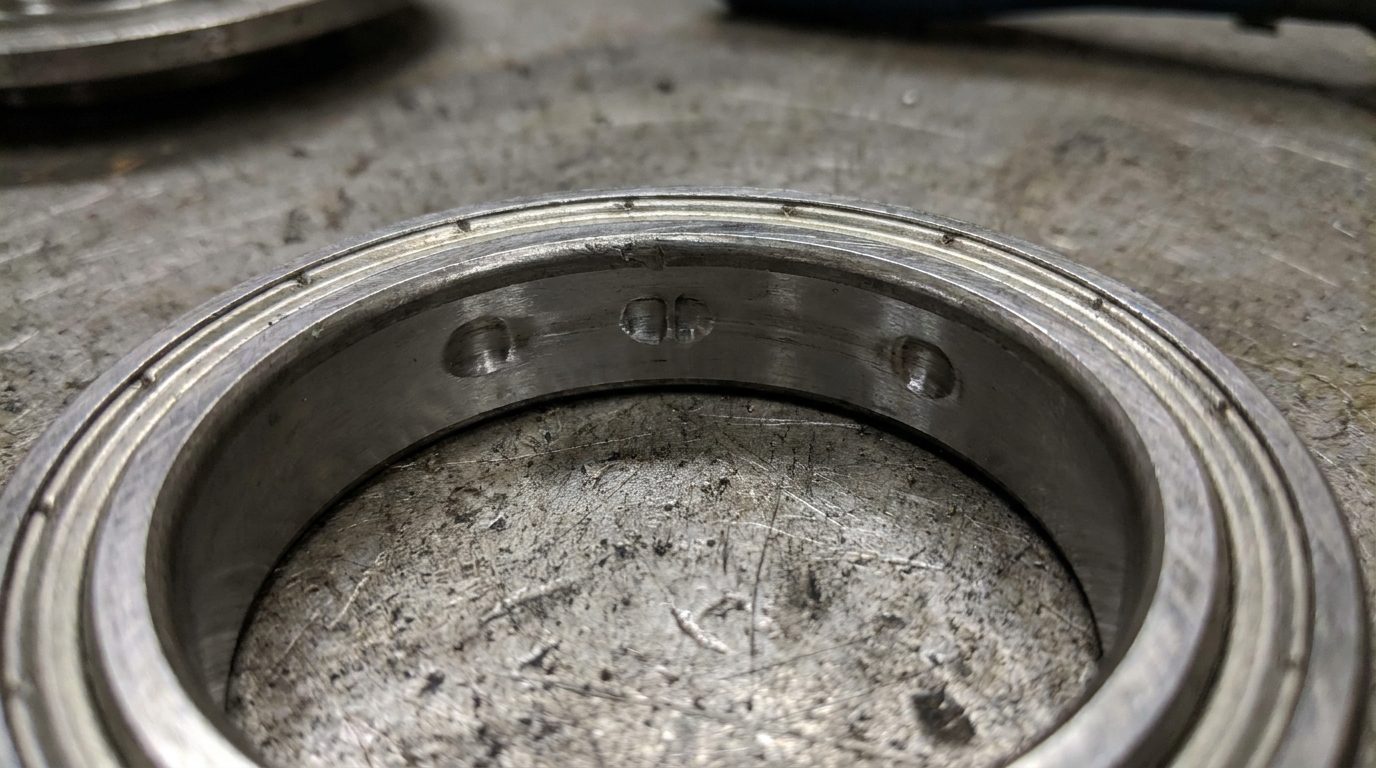
Brinelling is bearing damage caused by permanent dents in raceways or rolling elements, and understanding the difference between true brinelling and false brinelling is critical for protecting industrial gearboxes, motors, pumps, conveyors, mixers, crushers, and other rotating equipment. For maintenance managers, plant engineers, reliability teams, mechanics, and purchasing professionals, misdiagnosing brinelling can lead to repeat bearing failures, unnecessary gearbox rebuilds, extended downtime, and incorrect lubrication or storage practices. This guide explains what brinelling looks like, why it happens, how to inspect for it, and how to prevent it in industrial power transmission systems.
True brinelling is permanent indentation of a bearing raceway caused by excessive static or impact loading that exceeds the material’s elastic limit. False brinelling, also called fretting corrosion or vibration wear, is damage caused by small oscillatory motion, vibration, or inadequate lubricant film while the bearing is stationary or moving through very small angles. True brinelling usually appears as clean, regularly spaced dents matching rolling element spacing. False brinelling often appears as reddish-brown, polished, or worn depressions caused by micro-motion and oxidation. Correct diagnosis determines whether the solution is load control, handling improvement, vibration isolation, lubrication changes, shaft rotation during storage, or bearing replacement.
In the discussion of Brinelling versus False Brinelling, it is essential to understand the implications of these wear mechanisms on industrial machinery, particularly in gearboxes. For a deeper insight into the maintenance and repair of industrial gearboxes, you can refer to the article on industrial gearbox repair services in San Jose, California, which provides valuable information on how to address these issues effectively. For more details, visit Industrial Gearbox Repair in San Jose, CA.
What Is Brinelling in Bearings and Gearboxes?
Brinelling refers to localized damage on a bearing raceway or rolling element that appears as indentations, depressions, or wear marks. The term comes from the Brinell hardness test, where a hardened steel or carbide ball is pressed into a material to measure hardness. In bearings, a similar indentation pattern can occur unintentionally when loading, impact, vibration, or micro-motion damages the raceway surface.
In industrial gearbox applications, brinelling can affect:
- Input shaft bearings
- Output shaft bearings
- Intermediate shaft bearings
- Motor bearings
- Pillow block bearings
- Spherical roller bearings
- Tapered roller bearings
- Cylindrical roller bearings
- Deep groove ball bearings
- Thrust bearings
Because gearboxes are often exposed to high loads, shock loading, vibration, shipping impacts, long storage periods, and variable lubrication conditions, brinelling is a common concern in heavy industry.
Industries where brinelling is frequently found include:
- Mining and aggregate
- Cement and lime
- Steel and metals
- Pulp and paper
- Food processing
- Wastewater treatment
- Chemical processing
- Power generation
- Marine and port operations
- Conveyor and material handling systems
For related gearbox failure topics, see Industrial Gearbox Solutions resources on gearbox repair, gearbox inspection, bearing failure analysis, and industrial gearbox maintenance at IndustrialGearboxSolutions.com.
True Brinelling vs. False Brinelling: The Core Difference
The most important distinction is that true brinelling is caused by excessive load, while false brinelling is caused by micro-motion and vibration.
True Brinelling
True brinelling occurs when a load is high enough to plastically deform the raceway or rolling element surface. In other words, the metal is permanently dented. This can happen during operation, installation, handling, shipping, or maintenance.
Common causes include:
- Heavy static loads while the shaft is stationary
- Shock loads from crushers, mills, presses, or impact equipment
- Improper bearing mounting force through rolling elements
- Dropped shafts, gearboxes, or bearing assemblies
- Hammering during installation
- Pressing a bearing incorrectly onto a shaft or into a housing
- Overloading caused by misalignment or incorrect bearing selection
- Transportation shock without proper blocking or vibration control
True brinelling marks are typically spaced at intervals corresponding to the rolling element spacing. The dents are usually smooth, sharply defined, and located where the rolling elements contacted the raceway under excessive load.
False Brinelling
False brinelling looks similar to true brinelling but is caused by a different mechanism. Instead of one high-load event permanently denting the surface, false brinelling develops from small oscillations, vibration, or micro-sliding between rolling elements and raceways. This often occurs when equipment is stationary but exposed to vibration from nearby machinery.
Common causes include:
- Stored gearboxes exposed to plant vibration
- Motors or gearboxes shipped without proper protection
- Standby equipment sitting idle for long periods
- Bearings oscillating through a small angle instead of rotating fully
- Insufficient lubricant film
- Grease displacement from the contact zone
- Windmilling of fans or turbines
- Vibration from adjacent crushers, compressors, conveyors, or pumps
- Improper transport over long distances
False brinelling is frequently accompanied by fretting corrosion. The damaged areas may show reddish-brown oxide debris, polished wear marks, or shallow depressions. Unlike true brinelling, false brinelling is not primarily caused by a single overload event.
Comparison Table: True vs. False Brinelling
| Category | True Brinelling | False Brinelling |
||||
| Primary cause | Excessive static or impact load | Vibration, micro-motion, oscillation |
| Damage mechanism | Plastic deformation | Fretting wear and oxidation |
| Appearance | Smooth, permanent dents | Worn, polished, reddish-brown marks |
| Common timing | Installation, shock event, overload | Storage, standby, shipping, idle operation |
| Lubrication role | Secondary | Often significant |
| Pattern | Matches rolling element spacing | May resemble rolling element spacing but often appears worn or corroded |
| Prevention focus | Load control and proper mounting | Vibration control, lubrication, periodic rotation |
| Repairability | Usually requires bearing replacement | Usually requires bearing replacement if advanced |
Industrial gearbox bearing failure can lead to costly downtime and repairs, so it’s important to address the issue promptly. Industrial gearbox bearing failure
Causes of Brinelling in Industrial Gearboxes
Brinelling rarely occurs without an underlying mechanical, operational, or maintenance issue. Finding the root cause is essential to prevent repeat failures.
Excessive Static Loading
Bearings are designed to support specific radial and axial loads. When a machine is stationary, the rolling elements concentrate load at small contact areas. If the static load exceeds the bearing’s static load rating, true brinelling may occur.
This is especially important for:
- Heavily loaded conveyors stopped under full load
- Kiln drives held stationary under torque
- Hoists and winches with suspended loads
- Crushers or mills stopped with material packed inside
- Gearboxes locked in position during process interruptions
The bearing’s static safety factor should be reviewed during design or replacement selection. Authoritative sources such as SKF and Timken provide bearing load rating guidance and application engineering references for static load calculations.
Shock Loading and Impact
Shock loads can be far higher than normal operating loads. Even if the gearbox is correctly sized for steady operation, impact loading can dent raceways.
Typical shock sources include:
- Jammed conveyors suddenly restarting
- Crusher tramp metal events
- Mill torque spikes
- Emergency stops
- Coupling impacts
- Backstops engaging suddenly
- Gear tooth impact caused by excessive backlash
- Motor starts across the line in high-inertia systems
Shock loading can also contribute to gear tooth damage, shaft deflection, and housing distortion. For help with severe-duty gearbox evaluation, Industrial Gearbox Solutions can support industrial gearbox repair and failure analysis through IndustrialGearboxSolutions.com.
Improper Bearing Installation
Incorrect installation is one of the most preventable causes of true brinelling. Bearings should never be installed by applying force through the rolling elements.
Examples of improper installation include:
- Hammering the outer ring to install a bearing on a shaft
- Hammering the inner ring to install a bearing into a housing
- Using punches or drifts directly on bearing rings
- Pressing across the wrong ring
- Installing bearings without proper heating methods
- Contaminating bearings during installation
- Using excessive force due to burrs, incorrect fits, or damaged shafts
Correct practice is to apply mounting force only to the ring being fitted. For example, when mounting on a shaft, force should be applied to the inner ring. When installing into a housing, force should be applied to the outer ring.
Vibration During Storage or Standby
False brinelling commonly occurs while machines are not operating. A gearbox stored near active machinery may experience enough vibration to move rolling elements microscopically against raceways. Over time, lubricant is displaced from the contact area, metal-to-metal contact occurs, and fretting wear develops.
Risk factors include:
- Long-term warehouse storage
- Gearboxes stored on mezzanines or near operating equipment
- Standby pumps and gear drives near running units
- Spare motors stored close to presses or compressors
- Equipment shipped by truck, rail, or ocean freight
- Lack of shaft rotation during storage
This is why long-term storage procedures are critical for spare gearboxes, motors, and bearings.
Inadequate Lubrication Film
Lubrication is especially important in false brinelling. When a bearing moves through a very small angle, grease may not redistribute properly. The rolling elements can push lubricant away from the contact area and repeatedly rub the same location.
Lubrication-related contributors include:
- Wrong grease consistency
- Incompatible grease mixing
- Low base oil viscosity
- Oil starvation
- Excessive vibration causing grease channeling
- Incorrect lubricant for temperature or load
- Extended relubrication intervals
- Contamination by water or process fluids
Noria’s lubrication reliability resources are useful for understanding lubricant film formation, grease selection, contamination control, and condition monitoring.
In the discussion of Brinelling versus False Brinelling, it is essential to understand the implications of these wear types on machinery performance and longevity. For those looking to delve deeper into related topics, the article on gearbox repair provides valuable insights into maintenance practices that can help mitigate these issues. You can read more about it in this informative piece on gearbox repair. Understanding these concepts can significantly enhance the reliability of your equipment and reduce downtime.
Symptoms of Brinelling
“`html
| Metrics | Brinelling | False Brinelling |
|---|---|---|
| Description | Permanent indentation on the surface of a material due to heavy loads | Surface damage caused by fretting or vibration, not permanent |
| Cause | Heavy static loads | Fretting or vibration |
| Appearance | Indentation marks | Shiny or polished spots |
| Damage Type | Mechanical | Surface |
“`
Brinelling symptoms can appear during operation, inspection, vibration analysis, oil analysis, or teardown. Because some symptoms overlap with other bearing failure modes, confirmation requires careful inspection.
Operational Symptoms
Common operating symptoms include:
- Increased vibration
- Audible rumbling, clicking, growling, or knocking
- Elevated bearing temperature
- Torque fluctuations
- Increased motor current
- Gearbox noise under load
- Intermittent vibration at low speed
- Premature seal failure due to vibration
- Reduced bearing life after installation or storage
In a gearbox, brinelling can also lead to gear mesh misalignment if bearing internal clearances or raceway geometry deteriorate.
Vibration Analysis Symptoms
Brinelled bearings often produce vibration signatures related to bearing defect frequencies. However, early-stage false brinelling may appear as broadband vibration, modulation, or impacts that are difficult to distinguish from other defects.
Vibration indicators may include:
- Ball pass frequency outer race
- Ball pass frequency inner race
- Fundamental train frequency
- Harmonics of bearing defect frequencies
- Increased acceleration enveloping values
- Peaks that change with load or speed
- Impacting visible in time waveform data
A reliability engineer should compare vibration data with bearing geometry, speed, load, lubrication history, and recent maintenance events.
Visual Symptoms During Inspection
Visual inspection may reveal:
- Dents in raceways
- Regularly spaced indentations
- Brown or reddish fretting corrosion
- Polished wear pockets
- Spalled areas around dents
- Etching in the contact zone
- Smearing or micro-wear
- Discolored lubricant
- Metallic debris
True brinelling marks often look like clean depressions. False brinelling often looks like corrosion-stained or worn depressions.
Oil and Grease Analysis Symptoms
Lubricant analysis can provide supporting evidence. Possible findings include:
- Elevated iron particles
- Oxidation byproducts
- Rust particles
- Increased particle count
- Darkened grease
- Metal flakes if spalling has started
- Water contamination
- Depleted additives
Oil analysis alone may not distinguish true from false brinelling, but it helps determine whether wear is active and whether contamination or lubrication breakdown contributed.
When exploring the differences between Brinelling and False Brinelling, it’s essential to consider how these phenomena can affect the performance and longevity of machinery. A related article that delves into the intricacies of industrial gearbox repair offers valuable insights into maintaining equipment and preventing such issues. For more information on effective repair strategies, you can read the article here: industrial gearbox repair. Understanding these concepts can help in making informed decisions about maintenance and repairs.
Troubleshooting Brinelling: A Practical Field Approach
Troubleshooting should begin with the failure timeline. The key question is: did damage occur from overload, installation, storage, shipping, vibration, lubrication, or operation?
Step 1: Review the Failure History
Gather the following information:
- When was the bearing installed?
- Was the gearbox recently rebuilt?
- Was the unit transported or stored?
- How long was the equipment idle?
- Were nearby machines operating during storage?
- Was the shaft rotated periodically?
- Was the correct lubricant used?
- Were there recent shock events or jams?
- Was the bearing mounted with heat, press, or hammering?
- Did vibration begin immediately after startup?
If a bearing fails shortly after installation, consider mounting damage, contamination, incorrect fit, or transport damage. If a bearing fails after long storage or standby service, false brinelling becomes more likely.
Step 2: Inspect the Damage Pattern
Use the damage pattern to separate true from false brinelling.
| Inspection Finding | Likely Meaning |
|||
| Smooth dents matching rolling element spacing | True brinelling |
| Reddish-brown debris in depressions | False brinelling/fretting |
| Wear marks on both raceways after storage | False brinelling |
| Damage after shock event | True brinelling |
| Damage after long idle period | False brinelling |
| Spalling around indentation | Advanced brinelling damage |
| Random denting with contamination marks | Particle denting, not classic brinelling |
| Electrical fluting pattern | Electrical discharge damage, not brinelling |
Step 3: Check Mounting and Fits
Incorrect fits can cause excessive bearing stress, creep, heat, and vibration. Inspect:
- Shaft diameter
- Housing bore diameter
- Roundness
- Taper
- Surface finish
- Shoulder squareness
- Fillet radius
- Bearing seating contact
- Locknut torque
- Adapter sleeve installation
- Internal clearance after mounting
For tapered roller bearings and spherical roller bearings, incorrect setting or reduced internal clearance can create excessive loads that contribute to damage.
Step 4: Review Lubrication Practices
Confirm:
- Correct lubricant type
- Correct viscosity or grease grade
- Compatibility with existing lubricant
- Correct fill level
- Proper relubrication interval
- Contamination control
- Breather condition
- Seal condition
- Oil cleanliness target
- Operating temperature range
AGMA gearbox lubrication standards and technical guidance can help establish suitable oil viscosity, lubricant selection, and industrial gear drive maintenance practices. SKF, Timken, and Noria also provide valuable references for bearing lubrication and failure analysis.
Step 5: Evaluate Vibration Exposure
For false brinelling, investigate vibration when the machine is not running.
Check:
- Adjacent operating machines
- Structural vibration
- Foundation resonance
- Piping strain
- Conveyor impact vibration
- Shipping route and packaging
- Storage rack vibration
- Fan windmilling
- Standby unit vibration
- Shaft movement during lockout or idle periods
A stationary gearbox near a running crusher, compressor, or large motor can suffer bearing damage even without operating.
Inspection Methods for Brinelling
Inspection should combine visual, dimensional, vibration, and lubricant-based methods.
Visual Bearing Inspection
When the bearing is removed, clean it carefully and inspect under good lighting. Use magnification if needed.
Look for:
- Indentations in raceways
- Matching marks on rolling elements
- Corrosion staining
- Surface polishing
- Uneven wear
- Spalling
- Cage damage
- Heat discoloration
- Lubricant residue
- Contamination particles
Do not grind, polish, or alter the raceway before documenting the damage. Photographs are important for root cause analysis.
Borescope Inspection
If a gearbox cannot be fully disassembled, a borescope may help inspect accessible bearing surfaces, gear teeth, and lubricant condition. Borescope inspection is useful during planned outages or when deciding whether to continue operating until a scheduled shutdown.
Borescope limitations include:
- Limited access to bearing raceways
- Difficulty seeing loaded zones
- Oil film or grease obstruction
- Need for experienced interpretation
Vibration Analysis
Vibration monitoring is one of the most effective non-invasive methods for detecting bearing defects. Trending is often more valuable than one-time readings.
Recommended vibration practices include:
- Baseline readings after installation
- Routine route-based monitoring
- Online monitoring for critical assets
- Acceleration enveloping for bearing faults
- Time waveform analysis for impacts
- Comparison with bearing defect frequencies
- Load and speed correlation
For gearboxes, vibration should be evaluated along with gear mesh frequencies, shaft speeds, bearing frequencies, and structural resonance.
Lubricant Analysis
Lubricant analysis can reveal active wear and contamination. Useful tests include:
- Particle count
- Ferrous density
- Analytical ferrography
- Karl Fischer water test
- Viscosity at 40°C and 100°C
- Acid number
- Elemental spectroscopy
- Oxidation and nitration
- Membrane patch colorimetry
- Grease consistency and wear debris analysis
Oil analysis is especially valuable for large industrial gearboxes where bearing replacement requires major downtime.
Dimensional Inspection
During rebuild, inspect:
- Shaft journals
- Housing bores
- Bearing shoulders
- Endplay
- Radial internal clearance
- Gear contact pattern
- Shaft runout
- Coupling alignment
- Housing flatness
- Bearing seat condition
A brinelled bearing may be the visible failure, but the root cause may be a bent shaft, distorted housing, poor fit, or misalignment.
Prevention of True Brinelling
Preventing true brinelling requires controlling loads, shock, and installation practices.
Use Correct Bearing Selection
Bearing selection should consider:
- Static load rating
- Dynamic load rating
- Shock factors
- Duty cycle
- Speed
- Temperature
- Lubrication method
- Shaft and housing fits
- Misalignment
- Contamination
- Service factor
When replacing gearbox bearings, purchasing professionals should avoid selecting bearings based only on part number and price. Confirm bearing type, clearance, cage design, precision class, manufacturer, and application requirements.
Improve Installation Procedures
Best practices include:
- Use induction heaters for appropriate bearing mounting
- Apply force only to the ring being fitted
- Use proper sleeves, presses, and fixtures
- Avoid hammering bearings
- Keep bearings clean and wrapped until installation
- Verify shaft and housing dimensions
- Check internal clearance after mounting
- Use manufacturer-recommended mounting methods
- Train mechanics on bearing handling
- Document installation conditions
Timken and SKF both publish bearing installation and maintenance resources that are useful for training maintenance teams.
Control Shock Loads
To reduce shock loading:
- Use soft starts or variable frequency drives where appropriate
- Inspect couplings for wear or looseness
- Maintain backstops and brakes
- Prevent conveyor jams
- Use torque limiters when justified
- Improve process control
- Avoid repeated emergency stops
- Inspect gear tooth condition
- Verify alignment
- Review service factor for severe-duty applications
If shock loading is unavoidable, bearing and gearbox upgrades may be needed.
Protect Bearings During Handling and Transport
Handling precautions include:
- Do not drop bearings, shafts, or gearboxes
- Use proper lifting points
- Block and brace shafts during shipment
- Use vibration-resistant packaging
- Avoid impact tools near bearings
- Protect machined surfaces
- Store bearings in original packaging
- Keep gearboxes sealed and dry
Large gearboxes should be shipped with shafts locked or supported according to manufacturer recommendations.
Prevention of False Brinelling
False brinelling prevention focuses on limiting vibration, maintaining lubricant film, and preventing repetitive micro-motion.
Rotate Shafts During Storage
For stored gearboxes, motors, and bearing assemblies, periodically rotate shafts to redistribute lubricant and move rolling elements to a new contact position.
General practices may include:
- Rotate shafts monthly or according to OEM guidance
- Turn shafts several revolutions, not just a few degrees
- Mark shaft position after rotation
- Maintain a storage log
- Follow long-term storage procedures
- Reapply rust preventive where needed
- Keep breathers sealed or use desiccant breathers
The correct interval depends on equipment type, storage environment, lubricant, and vibration exposure.
Isolate Stored Equipment from Vibration
To reduce false brinelling risk:
- Store gearboxes away from operating machinery
- Use vibration-damping pads or pallets
- Avoid storage on vibrating mezzanines
- Do not store motors near presses or compressors
- Secure equipment during transport
- Monitor vibration in storage areas
- Use shock indicators for critical shipments
Spare gearboxes are often expensive, long-lead assets. Storage damage can turn a critical spare into an unreliable unit.
Use Proper Lubricants and Preservatives
Lubrication practices for standby and stored equipment may include:
- Fill gearbox to proper storage level
- Use rust-inhibited oil where appropriate
- Grease bearings according to OEM recommendations
- Avoid overgreasing electric motors
- Use compatible grease
- Protect against water ingress
- Use vapor phase corrosion inhibitors if recommended
- Replace storage oil before startup if required
Consult the gearbox OEM, bearing manufacturer, or lubricant supplier before changing lubricant type.
Manage Standby Equipment
Standby equipment should not be ignored. Pumps, fans, compressors, and gearboxes that sit idle near running assets are common false brinelling candidates.
Recommended practices include:
- Periodically run standby units
- Rotate shafts manually if startup is not possible
- Include standby equipment in vibration routes
- Maintain lubrication schedules
- Inspect for condensation
- Check heaters on stored motors
- Verify seals remain functional
- Keep equipment aligned and ready
Repair vs. Replacement: What Should You Do?
Once brinelling is confirmed, the bearing is usually not repairable for reliable industrial service. The larger decision is whether to replace only the bearing, rebuild the gearbox, or replace the entire gearbox.
When Bearing Replacement May Be Enough
Bearing replacement may be sufficient when:
- Damage is limited to one bearing
- Gear teeth are in good condition
- Shafts are dimensionally acceptable
- Housing bores are not worn
- Lubrication system is clean
- Root cause is identified and corrected
- No secondary spalling debris has circulated
- Vibration was detected early
Even then, flush the gearbox and inspect for metallic debris. A brinelled bearing can shed particles that damage gears and other bearings.
When Gearbox Repair Is Recommended
A gearbox repair or rebuild is recommended when:
- Multiple bearings show damage
- Gear teeth show pitting, scoring, or abnormal contact
- Shaft journals are worn or damaged
- Housing bores are loose or distorted
- Oil analysis shows severe wear debris
- Seals failed and contamination entered
- Vibration remained high after bearing replacement
- Failure history suggests misalignment or overload
- The gearbox is critical to production
Industrial Gearbox Solutions can assist with gearbox inspection, repair, rebuild, reverse engineering, bearing replacement, gear manufacturing, and emergency breakdown support. Visit IndustrialGearboxSolutions.com for service options.
When Replacement May Be Better
Full gearbox replacement may be justified when:
- Housing damage is severe
- Gear sets are obsolete and uneconomical to manufacture
- Repair cost approaches replacement cost
- Lead time is acceptable
- A redesign improves reliability
- Existing gearbox is undersized
- Repeated failures indicate application mismatch
- Efficiency or ratio changes are needed
Purchasing professionals should compare not only the purchase price, but also downtime cost, repair lead time, warranty, interchangeability, engineering support, and expected service life.
Repair vs. Replacement Table
| Situation | Recommended Action |
|||
| Single brinelled bearing, no gear damage | Replace bearing and correct root cause |
| False brinelling from storage | Replace affected bearings and improve storage procedures |
| True brinelling from installation | Replace bearing and retrain installation team |
| Shock-load damage with gear distress | Full gearbox inspection or rebuild |
| Housing bore wear | Machine, sleeve, or replace housing |
| Repeated bearing failures | Engineering review and root cause analysis |
| Obsolete gearbox with severe damage | Consider replacement or reverse-engineered rebuild |
| Critical production asset | Rebuild with upgraded reliability measures |
Maintenance Best Practices for Brinelling Control
A proactive maintenance program reduces the likelihood of both true and false brinelling.
Best Practices for Maintenance Managers
Maintenance managers should focus on systems and accountability:
- Establish bearing installation standards
- Train mechanics on correct mounting methods
- Maintain storage procedures for spares
- Require documentation for critical rebuilds
- Use precision alignment
- Trend vibration and oil analysis
- Track failure modes in CMMS
- Review recurring gearbox failures
- Maintain adequate spare parts
- Partner with qualified gearbox repair specialists
Best Practices for Plant Engineers
Plant engineers should address design and operating conditions:
- Verify bearing load calculations
- Review service factors
- Evaluate shock loading
- Improve foundations and supports
- Reduce structural vibration
- Specify proper lubrication systems
- Consider filtration and breathers
- Review standby equipment practices
- Evaluate upgrades for severe-duty applications
Best Practices for Reliability Engineers
Reliability engineers should focus on detection, trending, and root cause analysis:
- Establish baseline vibration data
- Use bearing defect frequency analysis
- Review oil analysis trends
- Correlate failures with operating events
- Inspect failed bearings systematically
- Use photographic documentation
- Implement root cause corrective actions
- Track mean time between failures
- Develop asset criticality rankings
- Apply reliability-centered maintenance principles
Best Practices for Mechanics
Mechanics play a direct role in preventing bearing damage:
- Keep bearings clean
- Use correct tools
- Never hammer through rolling elements
- Verify fit before pressing
- Heat bearings properly when required
- Avoid mixing incompatible greases
- Check seals and breathers
- Follow torque specifications
- Report unusual fit or installation issues
- Document what was found during teardown
Best Practices for Purchasing Professionals
Purchasing decisions affect reliability. Best practices include:
- Buy from authorized bearing sources
- Avoid counterfeit bearings
- Specify manufacturer and clearance class
- Confirm cage and material requirements
- Store bearings correctly after receipt
- Coordinate with maintenance on critical spares
- Consider total cost of ownership
- Use qualified gearbox repair vendors
- Require inspection reports after rebuilds
- Confirm warranty terms and technical support
Common Mistakes That Lead to Repeat Brinelling Failures
Avoid these frequent errors:
- Assuming all raceway dents are contamination damage
- Confusing false brinelling with true brinelling
- Replacing bearings without root cause analysis
- Storing gearboxes near operating equipment
- Failing to rotate shafts during storage
- Hammering bearings during installation
- Ignoring shock loads
- Using the wrong grease
- Overlooking housing bore wear
- Reusing contaminated lubricant
- Failing to flush after bearing failure
- Buying bearings based only on lowest price
- Not documenting bearing condition during teardown
A brinelled bearing is often a symptom, not the entire problem.
Authoritative References for Brinelling and Bearing Reliability
Useful technical resources include:
- SKF bearing damage and failure analysis resources: https://www.skf.com
- Timken bearing maintenance and troubleshooting guides: https://www.timken.com
- AGMA gear drive standards and technical publications: https://www.agma.org
- Noria lubrication and oil analysis resources: https://www.noria.com
These sources provide guidance on bearing selection, lubrication, gear drive maintenance, failure modes, and reliability best practices. Always combine published guidance with OEM recommendations and site-specific operating conditions.
Suggested Branded Images
Image 1: True vs. False Brinelling Comparison
Alt text: True brinelling vs false brinelling bearing raceway damage comparison in an industrial gearbox bearing
Caption: True brinelling produces permanent load dents, while false brinelling is caused by vibration, micro-motion, and fretting wear.
Image 2: Brinelled Bearing Raceway Close-Up
Alt text: Close-up of brinelling marks on bearing raceway from industrial gearbox failure analysis
Caption: Brinelling marks often align with rolling element spacing and should be documented during gearbox teardown.
Image 3: Gearbox Storage Best Practices
Alt text: Industrial gearbox stored with shaft rotation tag and vibration isolation to prevent false brinelling
Caption: Proper storage, periodic shaft rotation, and vibration isolation help prevent false brinelling in spare gearboxes.
Image 4: Bearing Installation Best Practices
Alt text: Mechanic using induction heater for proper bearing installation on industrial gearbox shaft
Caption: Correct bearing installation prevents true brinelling caused by improper mounting force.
Image 5: Gearbox Inspection and Root Cause Analysis
Alt text: Technician inspecting industrial gearbox bearings and gears during repair evaluation
Caption: A complete gearbox inspection helps determine whether bearing replacement, repair, or full rebuild is required.
SEO Metadata
SEO title: Understanding Brinelling: True vs. False Bearing Damage in Industrial Gearboxes
Meta description: Learn the difference between true brinelling and false brinelling, including causes, symptoms, inspection methods, troubleshooting, prevention, and gearbox repair guidance.
Primary keyword: brinelling
Secondary keywords:
- true brinelling
- false brinelling
- bearing brinelling
- fretting corrosion
- gearbox bearing failure
- industrial gearbox repair
- bearing failure analysis
- gearbox maintenance
- vibration wear
- bearing inspection
Suggested URL slug: understanding-brinelling-true-vs-false
Search intent: Informational and commercial investigation for industrial maintenance, reliability, engineering, and purchasing teams diagnosing bearing and gearbox failures.
Recommended internal links:
- Industrial gearbox repair services: IndustrialGearboxSolutions.com
- Gearbox inspection and failure analysis: IndustrialGearboxSolutions.com
- Emergency gearbox repair: IndustrialGearboxSolutions.com
- Gearbox rebuild and remanufacturing: IndustrialGearboxSolutions.com
- Industrial gearbox maintenance resources: IndustrialGearboxSolutions.com
FAQs About True and False Brinelling
What is the main difference between true and false brinelling?
True brinelling is permanent raceway indentation caused by excessive static or impact loading. False brinelling is wear caused by vibration, small oscillations, lubricant displacement, and fretting corrosion. They may look similar, but their causes and prevention methods are different.
Can a brinelled bearing continue operating?
A lightly damaged bearing may continue operating temporarily, but brinelling usually progresses into noise, vibration, spalling, heat, and eventual failure. Critical equipment should be evaluated quickly. In most industrial applications, a brinelled bearing should be replaced during the next appropriate maintenance window.
Is false brinelling the same as fretting corrosion?
False brinelling is closely associated with fretting corrosion. It occurs when small movements between rolling elements and raceways remove lubricant and create wear. Oxidized wear debris often appears reddish-brown, which is typical of fretting corrosion.
Can poor lubrication cause brinelling?
Poor lubrication is more strongly associated with false brinelling than true brinelling. Without adequate lubricant film, vibration or oscillation can cause metal-to-metal contact and fretting wear. However, lubrication alone cannot prevent true brinelling if the bearing is overloaded beyond its static capacity.
Can brinelling happen during shipping?
Yes. Gearboxes, motors, and bearing assemblies can develop true or false brinelling during shipping if they are exposed to shock, impact, or vibration without proper shaft blocking, packaging, or vibration isolation.
How do you prevent false brinelling in stored gearboxes?
Store gearboxes away from vibration, rotate shafts periodically, maintain proper lubricant or preservative levels, protect against moisture, use desiccant breathers when appropriate, and follow OEM long-term storage instructions.
Can brinelling be repaired by polishing the raceway?
No. Polishing does not restore the original bearing geometry, hardness, or fatigue life. A brinelled bearing should generally be replaced. If brinelling debris has circulated through a gearbox, additional inspection and cleaning are recommended.
Why does brinelling cause vibration?
Dents or worn depressions disrupt smooth rolling contact. Each time a rolling element passes over the damaged area, it creates an impact or vibration impulse. Over time, the damage can grow into spalling and more severe bearing failure.
Does brinelling only affect ball bearings?
No. Brinelling can affect ball bearings, spherical roller bearings, tapered roller bearings, cylindrical roller bearings, needle bearings, and thrust bearings. Any rolling element bearing can be damaged by excessive load, shock, vibration, or micro-motion.
Should I replace the gearbox or only the bearing?
It depends on the extent of damage. If only one bearing is affected and the gears, shafts, housing, and lubricant system are clean and within tolerance, bearing replacement may be enough. If debris, gear damage, housing wear, or repeat failures are present, a gearbox rebuild or replacement should be considered.
Key Takeaways
- True brinelling is caused by excessive static or impact load that permanently dents the bearing raceway.
- False brinelling is caused by vibration, micro-motion, lubricant displacement, and fretting corrosion.
- True brinelling often appears as smooth dents matching rolling element spacing.
- False brinelling often appears as reddish-brown, polished, or worn depressions.
- Misdiagnosing brinelling can lead to repeat bearing and gearbox failures.
- Common causes include shock loading, poor installation, storage vibration, inadequate lubrication, and improper handling.
- Inspection should include visual analysis, vibration data, lubricant analysis, dimensional checks, and failure history review.
- Prevention requires proper bearing installation, shock load control, vibration isolation, shaft rotation during storage, and correct lubrication.
- Brinelled bearings are usually replaced rather than repaired.
- Critical gearbox failures should be evaluated through root cause analysis before returning equipment to service.
Conclusion
Understanding brinelling—and correctly distinguishing true brinelling from false brinelling—helps maintenance and reliability teams prevent repeat bearing failures, reduce downtime, and make better repair or replacement decisions. True brinelling points toward overload, shock, or installation damage. False brinelling points toward vibration, standby conditions, storage practices, or lubrication film failure. In both cases, the damaged bearing is only part of the story. The real value comes from identifying why the damage occurred and correcting the condition before the next bearing or gearbox fails.
If your facility is dealing with gearbox bearing damage, abnormal vibration, repeat failures, or uncertain inspection findings, Industrial Gearbox Solutions can help evaluate the failure, recommend corrective action, and support repair, rebuild, or replacement decisions.
FAQs
What is Brinelling?
Brinelling is a type of damage that occurs on the surface of a metal bearing or other metal component due to excessive pressure or impact. It is characterized by indentations or impressions on the surface of the metal.
What causes Brinelling?
Brinelling is typically caused by heavy loads, vibration, or repetitive impact on the metal surface. This can occur in machinery and equipment where metal components are in contact with each other, such as in bearings or gears.
What is False Brinelling?
False Brinelling, also known as fretting corrosion, is a type of damage that appears similar to Brinelling but is caused by a different mechanism. It occurs due to small oscillations or movements between two surfaces in contact, leading to wear and corrosion in the contact area.
How can Brinelling be prevented?
Brinelling can be prevented by using proper lubrication, reducing excessive loads or impacts, and ensuring proper maintenance of machinery and equipment. Using materials with higher hardness and resistance to indentation can also help prevent Brinelling.
How can False Brinelling be distinguished from Brinelling?
False Brinelling can be distinguished from Brinelling by examining the pattern of damage and the underlying mechanism. False Brinelling typically shows signs of wear and corrosion in the contact area, while Brinelling is characterized by distinct indentations or impressions on the metal surface.