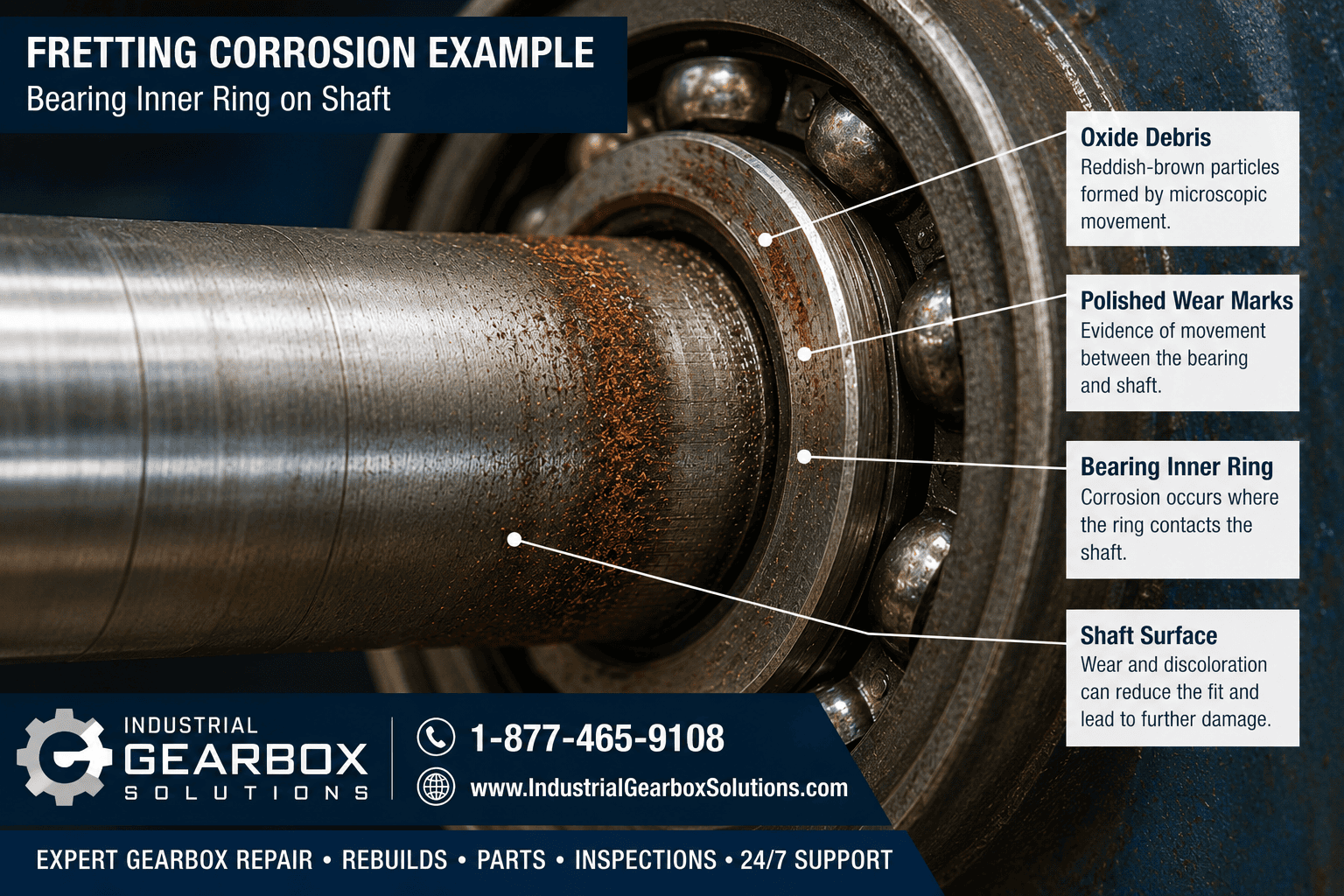
Preventing fretting corrosion on gearbox bearings begins with identifying the conditions that allow it to develop. Although the damage starts as microscopic movement between metal surfaces, it can eventually loosen bearing fits, contaminate lubricants, increase vibration, and shorten gearbox life. Fortunately, most fretting corrosion can be prevented through proper bearing fits, lubrication, alignment, and maintenance. This guide explains the causes, warning signs, inspection methods, repair options, and best practices for preventing fretting corrosion in industrial gearboxes.
Need Gearbox Repair?
Recurring bearing failures, vibration, or reddish-brown debris around bearing seats usually indicate more than a worn bearing. Fretting corrosion is often a symptom of improper fits, misalignment, lubrication problems, or excessive vibration that must be corrected before the gearbox is returned to service.
At Industrial Gearbox Solutions, we inspect failed components, determine the root cause of bearing damage, and recommend the most practical repair or replacement solution for your application.
Whether you need a complete gearbox rebuild, bearing replacement, shaft restoration, or troubleshooting assistance, our experienced team is ready to help.
What Is Fretting Corrosion?
Fretting corrosion is a form of wear that occurs when two metal surfaces experience repeated microscopic movement while pressed together under load. In industrial gearboxes, it most commonly develops where a bearing contacts the shaft or housing. As the surfaces move against one another, their protective oxide layers break down, exposing fresh metal that rapidly oxidizes into abrasive debris.
Unlike normal bearing wear, fretting corrosion develops at stationary contact points rather than rotating rolling elements. Left untreated, it can damage bearing fits, contaminate lubricants, increase vibration, and contribute to premature gearbox failure.
| Component | Common Location | Typical Signs |
|---|---|---|
| Bearing inner ring | Shaft journal | Reddish-brown oxide, polished wear |
| Bearing outer ring | Housing bore | Dark staining, movement marks |
| Rolling elements | Stationary raceways | False brinelling |
| Coupling hubs | Shaft interface | Rust-colored debris |
| Gear bores | Shaft fit | Oxide buildup and polished wear |
Where Fretting Occurs
Fretting corrosion can develop anywhere two metal components are tightly fitted but subjected to vibration or slight movement. While bearing seats are the most common location, other gearbox components are also vulnerable under the right operating conditions.
Areas that should receive careful inspection include:
- Bearing inner and outer ring fits
- Shaft journals
- Housing bores
- Coupling hubs and keyways
- Gear-to-shaft interfaces
- Locknuts and bearing shoulders
- Gearbox mounting feet
During routine maintenance or a gearbox teardown, look for reddish-brown powder, black oxide staining, polished wear marks, or evidence that a bearing ring has shifted on the shaft or inside the housing. Catching these signs early can prevent much larger repairs later.
Common Causes
Fretting corrosion rarely has a single cause. Instead, it usually develops when slight movement occurs repeatedly over thousands of operating hours. Eliminating that movement is the key to preventing future failures.
The most common causes include:
- Loose or worn bearing fits
- Continuous machine vibration
- Long idle or standby periods
- Improper lubrication
- Shaft or coupling misalignment
- Thermal expansion and contraction
- Improper bearing installation
- Water or particle contamination
Replacing the bearing without correcting these underlying conditions often leads to the same failure occurring again. During every repair, maintenance teams should identify why the bearing moved before installing replacement components.
Improper Bearing Fits
Incorrect bearing fits are one of the leading causes of fretting corrosion. If the shaft journal or housing bore allows even slight movement under load, the bearing ring can gradually creep instead of remaining securely seated. Although the movement is microscopic, repeated loading eventually wears away the contact surfaces and produces abrasive oxide debris.
Common fit-related problems include:
- Undersized shaft journals
- Oversized housing bores
- Worn bearing seats
- Out-of-round components
- Poor surface finish
- Reusing damaged shafts or housings
- Incorrect bearing tolerances
Every gearbox rebuild should include precise dimensional measurements rather than assuming existing bearing fits remain within specification.
Vibration During Idle Periods
Many gearboxes develop fretting corrosion while they are not operating. Equipment stored near vibrating machinery or installed as standby units can experience constant low-level vibration that causes rolling elements to move slightly without rotating.
This commonly affects:
- Spare gearboxes
- Emergency backup drives
- Stored equipment
- Long-distance shipments
- Idle process equipment
Because lubricant is not replenished during these small movements, metal-to-metal contact occurs, increasing the risk of fretting corrosion and false brinelling.
Lubrication Problems
Proper lubrication creates a protective film between contacting metal surfaces. When that film becomes too thin or contaminated, fretting corrosion develops much more quickly.
Lubrication issues may result from:
- Incorrect oil viscosity
- Low lubricant level
- Water contamination
- Dirty lubricant
- Oxidized oil
- Poor filtration
- Incompatible lubricants
- Extended service intervals
Routine oil analysis is one of the most effective ways to identify contamination and monitor lubricant condition before bearing damage becomes severe.
Misalignment
Misalignment places uneven loads on bearings, increasing the likelihood of microscopic movement between bearing rings and their mounting surfaces. Over time, this movement can wear bearing fits and accelerate fretting corrosion.
Common sources of misalignment include:
- Coupling misalignment
- Shaft misalignment
- Soft foot
- Distorted baseplates
- Improper shimming
- Foundation movement
- Pipe strain
- Excessive overhung loads
Precision alignment during installation and after major maintenance helps reduce unnecessary bearing stress and improves overall gearbox reliability.
Thermal Expansion
Industrial gearboxes constantly heat and cool during operation. As shafts, bearings, and housings expand and contract, bearing fits may change if thermal growth was not considered during the original design or repair.
Applications with frequent start-stop cycles or large temperature swings are especially susceptible. Proper bearing selection and fit calculations should always account for expected operating temperatures rather than relying solely on room-temperature measurements.
Poor Installation Practices
Even premium bearings can fail prematurely if they are installed incorrectly. Damage introduced during assembly often creates the conditions that allow fretting corrosion to develop months later.
Avoid these common installation mistakes:
- Hammering bearings into place
- Pressing through rolling elements
- Overheating bearings
- Using dirty tools or work surfaces
- Incorrect preload or endplay
- Failure to verify proper seating
- Reusing damaged locknuts or washers
Following manufacturer installation procedures helps protect bearing fits and ensures the gearbox begins service with the best possible reliability.
Warning Signs
Fretting corrosion often develops long before a bearing fails completely. Recognizing the early warning signs allows maintenance teams to schedule repairs before the damage spreads to shafts, housings, or gears.
Common symptoms include:
- Increased vibration
- Rising bearing temperatures
- Rumbling or growling noises
- Rust-colored debris near bearing fits
- Black oxide staining
- Oil contamination
- Recurring bearing failures
- Bearing ring movement
- Seal leakage
While these symptoms may indicate other mechanical issues, they should always prompt a detailed inspection of the bearing fits and surrounding components.
Visual Inspection
Many cases of fretting corrosion can be identified during routine maintenance or gearbox teardown. Before cleaning any components, document the condition with photographs to aid root cause analysis.
Inspect the following areas carefully:
- Bearing bores
- Shaft journals
- Housing bores
- Bearing shoulders
- Coupling hubs
- Locknuts
- Bearing spacers
- Lubricant condition
Look for reddish-brown powder, polished wear bands, dark oxide staining, or evidence that the bearing has shifted within its mounting surface.
Measure Critical Fits
A visual inspection alone cannot determine whether a bearing fit remains within specification. Even components that appear undamaged may have worn beyond acceptable tolerances.
Critical measurements include:
- Shaft diameter
- Housing bore diameter
- Roundness
- Taper
- Surface finish
- Bearing seat concentricity
- Shaft runout
Always compare measurements with the gearbox manufacturer’s specifications or the bearing manufacturer’s recommended fit tolerances before reassembly.
Vibration Analysis
Vibration monitoring is one of the most effective methods for detecting developing bearing problems. Trending vibration data over time often reveals loosening bearing fits before visible damage occurs.
Indicators that may suggest fretting corrosion include:
- Increasing overall vibration
- Broadband vibration
- Bearing fault frequencies
- Looseness harmonics
- High-frequency acceleration
- Changing vibration trends
Vibration analysis is most valuable when combined with physical inspection rather than used as a standalone diagnostic tool.
Oil Analysis
Oil analysis provides an early indication of bearing wear and lubricant contamination. Changes in oil condition often appear before maintenance personnel notice increased noise or vibration.
Testing may reveal:
- Elevated iron content
- Increased particle counts
- Water contamination
- Oxidation
- Reduced viscosity
- Ferrous wear debris
For critical industrial gearboxes, combining oil analysis with vibration monitoring creates a much more complete picture of gearbox health.
Differentiate Similar Damage
Several bearing failures resemble fretting corrosion, but each has a different root cause and requires a different corrective action.
| Damage Type | Primary Cause | Typical Appearance |
|---|---|---|
| Fretting corrosion | Microscopic movement | Oxide debris and polished wear |
| False brinelling | Vibration while stationary | Evenly spaced depressions |
| True brinelling | Impact or overload | Deep permanent indentations |
| Ring creep | Loose rotating fit | Circumferential polishing |
| Rust corrosion | Moisture exposure | General rusting and pitting |
Correctly identifying the damage pattern helps ensure the underlying problem is repaired instead of simply replacing another failed bearing.
How to Prevent Fretting
Preventing fretting corrosion requires eliminating the conditions that allow microscopic movement between bearing components. Rather than relying on a single solution, successful prevention combines proper engineering, precision installation, clean lubrication, and routine condition monitoring.
The most effective prevention measures include:
- Maintaining proper bearing fits
- Using the correct lubricant
- Controlling vibration
- Performing precision alignment
- Following proper installation procedures
- Inspecting critical components regularly
A proactive maintenance program is almost always less expensive than repairing a gearbox after fretting damage has progressed.
Use Proper Bearing Fits
Correct bearing fits are the foundation of reliable gearbox operation. If the fit between the bearing and shaft or housing is too loose, the bearing can shift under load and begin wearing the mating surfaces.
When selecting bearing fits, consider:
- Load direction
- Load magnitude
- Operating temperature
- Housing material
- Shaft rotation
- Bearing type
- Internal clearance
- Application speed
Always follow the gearbox manufacturer’s recommendations or bearing supplier’s fit specifications instead of relying on previous installations.
Maintain Clean Lubrication
Clean, properly selected lubricants help prevent metal-to-metal contact while protecting bearings against corrosion and wear. Even the correct lubricant will perform poorly if it becomes contaminated with water or abrasive particles.
Lubrication best practices include:
- Use the correct viscosity grade
- Filter new oil before filling
- Monitor oil condition regularly
- Replace degraded lubricant promptly
- Prevent water ingress
- Keep transfer containers clean
- Avoid mixing incompatible lubricants
Routine oil analysis allows maintenance teams to detect contamination long before it causes significant bearing damage.
Reduce Vibration
Continuous vibration is one of the primary contributors to fretting corrosion, especially in idle or standby equipment. Reducing unnecessary vibration helps protect bearing fits and extends gearbox life.
Consider these preventive measures:
- Correct machine imbalance
- Improve foundation stability
- Tighten mounting hardware
- Eliminate soft foot
- Reduce nearby vibration sources
- Verify coupling alignment
- Inspect flexible couplings regularly
Monitoring vibration trends also provides valuable insight into developing mechanical problems before failures occur.
Store Gearboxes Correctly
Improper storage can cause fretting corrosion before a gearbox is ever placed into service. Spare gearboxes should be protected from vibration, moisture, and contamination throughout storage.
Recommended storage practices include:
- Store away from vibrating equipment
- Rotate shafts periodically
- Keep vents and openings sealed
- Maintain proper lubricant levels
- Inspect for moisture regularly
- Follow OEM preservation procedures
Long-term storage plans should become part of every facility’s reliability program for critical spare equipment.
Follow Proper Installation Procedures
Correct installation minimizes the risk of bearing movement and helps ensure long service life. Taking shortcuts during assembly often leads to repeat failures that are far more expensive than doing the job correctly the first time.
Installation best practices include:
- Clean all mating surfaces
- Measure bearing fits before assembly
- Heat bearings properly when required
- Apply force only to the ring being installed
- Verify bearing seating
- Set preload or endplay correctly
- Confirm shaft alignment before startup
Documenting installation measurements also provides valuable information for future maintenance and failure analysis.
Repair or Replace?
When fretting corrosion is discovered, the best solution depends on the severity of the damage, the condition of the gearbox, and the cost of repair versus replacement. Minor fretting may be repaired successfully, while severe damage often requires rebuilding or replacing major components.
A thorough inspection should always determine the extent of the damage before making a repair decision.
| Condition | Recommended Action |
|---|---|
| Light wear on a bearing seat | Repair if dimensions can be restored |
| Slightly worn shaft journal | Restore or sleeve if within limits |
| Housing bore out of tolerance | Machine or line bore if practical |
| Multiple damaged bearing fits | Consider a complete rebuild |
| Cracked housing | Replace or perform major structural repair |
| Repeated fretting failures | Identify and correct the root cause before repair |
Repairing the underlying problem—not just replacing the bearing—is the key to long-term reliability.
Restore Bearing Fits
Many gearbox components can be restored instead of replaced, reducing both downtime and replacement costs. The repair method depends on the amount of wear, the gearbox design, and the operating requirements.
Common repair methods include:
- Precision machining
- Thermal metal spraying
- Shaft sleeving
- Chrome plating
- Housing bore restoration
- Line boring
- Bearing seat grinding
Any repair should restore the original dimensions, surface finish, and alignment before the gearbox is returned to service.
Replace When Necessary
Replacement becomes the better option when repairs cannot reliably restore the gearbox to its original operating condition. Continuing to repair severely worn components often leads to recurring failures and higher long-term costs.
Replacement should be considered when:
- Bearing fits cannot be restored
- Housing damage is extensive
- Shafts are deeply worn or cracked
- Multiple internal components have failed
- The gearbox has reached the end of its service life
- Repair costs approach replacement costs
Evaluating the total cost of ownership—including downtime, reliability, and future maintenance—is often more valuable than comparing repair costs alone.
Build a Monitoring Program
The most reliable gearboxes are monitored continuously rather than repaired only after failures occur. A condition monitoring program helps identify developing problems before they cause unplanned downtime.
An effective program may include:
- Vibration analysis
- Oil analysis
- Thermography
- Visual inspections
- Alignment verification
- Mounting bolt inspections
- Lubricant sampling
- Maintenance records
Tracking equipment condition over time makes it easier to identify trends and schedule repairs before minor issues become major failures.
Maintenance Best Practices
Preventing fretting corrosion should be part of every preventive maintenance program. Consistent inspection and documentation improve gearbox reliability while reducing emergency repairs.
Best practices include:
- Measure bearing fits during rebuilds
- Keep lubricants clean
- Inspect seals regularly
- Monitor vibration trends
- Correct alignment issues promptly
- Tighten mounting hardware to specification
- Rotate stored gearboxes periodically
- Document repairs and inspection results
Small improvements in maintenance practices often have a significant impact on bearing life and overall gearbox performance.
Inspection Checklist
Use this checklist whenever fretting corrosion is suspected or a gearbox is being rebuilt.
- Inspect bearing seats for oxide debris
- Check shaft journals and housing bores
- Measure all critical bearing fits
- Review vibration history
- Analyze lubricant condition
- Verify coupling alignment
- Inspect the foundation and mounting hardware
- Document all measurements and findings
- Replace damaged bearings
- Correct the root cause before returning the gearbox to service
A systematic inspection helps prevent repeat failures and ensures repairs address the underlying mechanical issue instead of only the symptoms.
Key Takeaways
Fretting corrosion is a preventable cause of gearbox bearing failure that develops when microscopic movement occurs between loaded metal surfaces. Correct bearing fits, clean lubrication, precision alignment, vibration control, and proper installation significantly reduce the risk of damage.
If your gearbox shows recurring bearing failures, excessive vibration, or worn bearing fits, identifying the root cause is essential before replacing components. A professional inspection can determine whether repair or replacement is the most cost-effective solution and help restore long-term reliability.
Frequently Asked Questions
What causes fretting corrosion on gearbox bearings?
Fretting corrosion occurs when two metal surfaces experience repeated microscopic movement while under load. Common causes include loose bearing fits, vibration, poor lubrication, misalignment, thermal expansion, and improper installation. Unless these underlying issues are corrected, replacing the bearing alone often leads to another failure.
What does fretting corrosion look like?
Fretting corrosion usually appears as reddish-brown or black oxide debris around bearing seats, shaft journals, or housing bores. Other signs include polished wear marks, bearing ring movement, increased vibration, unusual noise, and contaminated lubricant.
Can fretting corrosion be repaired?
Yes, depending on the extent of the damage. Minor wear may be corrected by restoring bearing fits through machining, sleeving, thermal spray, or line boring. Severe damage to shafts, housings, or multiple gearbox components may require a complete gearbox rebuild or replacement.
Is fretting corrosion the same as false brinelling?
No. False brinelling creates evenly spaced depressions in bearing raceways caused by vibration while the bearing is stationary. Fretting corrosion is caused by microscopic movement between contacting metal surfaces, producing oxide debris and wear. The two conditions can occur together but have different damage patterns.
How can fretting corrosion be prevented?
The best prevention combines proper bearing fits, clean lubrication, precision alignment, vibration control, correct installation, and regular inspections. Monitoring oil condition and vibration trends can also help identify problems before significant damage develops.
Should a bearing with fretting corrosion be replaced?
In most cases, yes. Even if the visible damage appears minor, fretting corrosion often indicates wear that can shorten bearing life. The bearing should typically be replaced, and the shaft or housing should be inspected to ensure the original cause has been corrected.
What industries commonly experience fretting corrosion?
Fretting corrosion is common in mining, steel production, cement plants, power generation, wastewater treatment, food processing, material handling, and other industries that rely on heavily loaded industrial gearboxes operating under vibration or intermittent service.