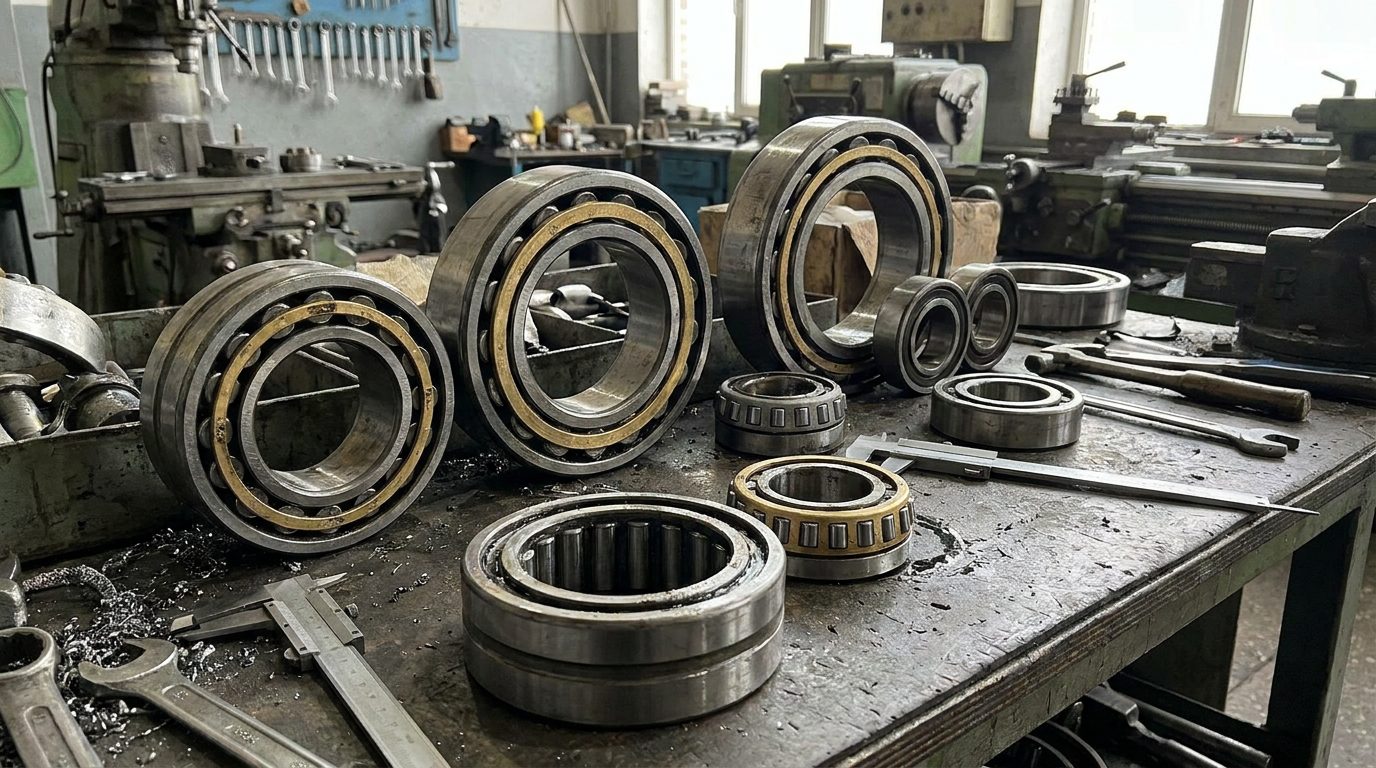
Cylindrical roller bearings are high-capacity rolling elements used in industrial gearboxes, motors, pumps, compressors, conveyors, mills, and heavy rotating equipment where radial load support, speed capability, and shaft alignment control are critical. For maintenance managers, plant engineers, reliability engineers, mechanics, and purchasing teams, understanding how these bearings work can reduce unplanned downtime, prevent secondary gearbox damage, and improve repair decisions. Unlike ball bearings, cylindrical roller bearings use line contact between rollers and raceways, allowing them to carry heavier radial loads. However, they require proper lubrication, fit, clearance, alignment, and contamination control to reach their expected service life.
Cylindrical roller bearings are rolling-element bearings designed primarily to carry heavy radial loads at moderate to high speeds. They are commonly used in industrial gearboxes because their roller design provides high load capacity, stiffness, and durability. Common failure causes include inadequate lubrication, contamination, misalignment, overload, improper installation, and electrical damage. Symptoms include abnormal vibration, heat, noise, metal particles in oil, and raceway spalling. Best practices include routine oil analysis, vibration monitoring, correct mounting fits, proper lubricant selection, contamination control, and timely inspection during gearbox rebuilds.
For a deeper understanding of the applications and maintenance of cylindrical roller bearings, you may find the article on industrial gearbox repair particularly insightful. It discusses the importance of proper bearing selection and maintenance in ensuring the longevity and efficiency of industrial gearboxes. You can read more about it here: Industrial Gearbox Repair in Lake of the Ozarks, Missouri.
What Are Cylindrical Roller Bearings?
Cylindrical roller bearings are anti-friction bearings that use cylindrical rollers positioned between an inner ring and an outer ring. Because the rollers make line contact with the raceways, they distribute load over a larger surface area than ball bearings, making them ideal for heavy radial load applications.
In industrial gearboxes, these bearings are commonly found on:
- Input shafts
- Intermediate shafts
- Output shafts
- Pinion shafts
- High-speed gear stages
- Heavy-load reducer assemblies
- Rolling mill drives
- Conveyor gear drives
- Extruder gearboxes
- Crushers and agitators
Their design allows them to support rotating shafts while minimizing friction, heat generation, and wear when properly lubricated and installed.
How Cylindrical Roller Bearings Work
A cylindrical roller bearing consists of several key components:
| Component | Function |
|||
| Inner ring | Mounts to the shaft and rotates with it |
| Outer ring | Fits into the housing or bearing bore |
| Cylindrical rollers | Carry radial loads between the rings |
| Cage or retainer | Separates rollers and controls spacing |
| Raceways | Precision-ground paths where rollers rotate |
| Flanges | Guide rollers and control axial movement depending on design |
As the shaft rotates, the rollers roll between the inner and outer raceways. The cage prevents roller-to-roller contact, reducing friction and heat. Depending on bearing configuration, flanges may guide the rollers and allow limited axial load capacity.
Why They Are Used in Industrial Gearboxes
Industrial gearboxes often experience high radial forces from gear mesh loads. Cylindrical roller bearings are well suited for these conditions because they offer:
- High radial load capacity
- High stiffness
- Good speed capability
- Compact design
- Reliable performance under heavy-duty service
- Suitability for oil bath, splash, forced-feed, or circulating lubrication systems
- Availability in many clearance, cage, and material configurations
For gearbox applications, bearing selection must account for gear forces, shaft deflection, operating speed, lubrication method, temperature, housing rigidity, and expected service life.
For related gearbox service support, see Industrial Gearbox Solutions resources on gearbox repair, gearbox rebuilds, bearing replacement, and preventive maintenance at IndustrialGearboxSolutions.com.
Common Types of Cylindrical Roller Bearings
Cylindrical roller bearings come in several configurations. The correct type depends on whether the bearing must accommodate axial displacement, carry axial load, or provide shaft location.
NU Type Cylindrical Roller Bearings
NU bearings have two integral flanges on the outer ring and no flanges on the inner ring. This design allows axial movement of the shaft relative to the housing.
Best used for:
- Floating bearing positions
- Thermal expansion compensation
- Gearbox shafts that require axial freedom
- High radial load applications
NJ Type Cylindrical Roller Bearings
NJ bearings have two flanges on the outer ring and one flange on the inner ring. They can carry radial loads and limited axial loads in one direction.
Best used for:
- Semi-locating bearing positions
- Shafts needing axial control in one direction
- Gear reducer applications with moderate thrust loads
NUP Type Cylindrical Roller Bearings
NUP bearings include two flanges on the outer ring, one fixed flange on the inner ring, and one loose flange ring. This arrangement allows axial location in both directions.
Best used for:
- Locating bearing positions
- Gear shafts requiring controlled axial positioning
- Applications with moderate axial loads in both directions
N Type Cylindrical Roller Bearings
N bearings have two flanges on the inner ring and no flanges on the outer ring. Like NU bearings, they permit axial displacement.
Best used for:
- Floating positions
- Applications requiring easy mounting
- Designs where the outer ring must move axially
Full Complement Cylindrical Roller Bearings
Full complement bearings contain the maximum number of rollers and typically do not use a cage. They offer very high radial load capacity but usually have lower speed capability than caged designs.
Best used for:
- Slow-speed, heavy-load gearboxes
- Hoists and lifting equipment
- Crushers
- Presses
- Heavy conveyors
Industrial gearbox bearing failure can lead to costly downtime and production losses, so it’s important to address the issue promptly. Industrial gearbox bearing failure
Causes of Cylindrical Roller Bearing Failure
Bearing failure rarely happens without a root cause. In gearboxes, the failed bearing is often the symptom of a deeper issue such as lubrication breakdown, contamination, shaft misalignment, or gear mesh problems.
Inadequate Lubrication
Lubrication is one of the most common causes of cylindrical roller bearing failure. Too little oil, incorrect viscosity, degraded lubricant, foaming, or blocked oil passages can lead to metal-to-metal contact.
Common lubrication-related problems include:
- Low oil level
- Incorrect oil viscosity
- Oxidized or degraded oil
- Water contamination
- Additive depletion
- Grease incompatibility
- Oil starvation at high-speed bearings
- Excessive oil churning and heat
According to lubrication reliability principles published by Noria, contamination control and correct lubricant selection are fundamental to extending bearing and gearbox life. Reference: https://www.noria.com
Contamination
Contaminants damage raceways and rollers by causing abrasive wear, dents, polishing, and early fatigue. Even small particles can create stress risers that develop into spalling.
Typical contaminants include:
- Dirt
- Metal wear debris
- Water
- Process chemicals
- Sand or dust
- Failed seal material
- Paint flakes
- Rust particles
Contamination often enters through damaged seals, breathers, poor maintenance practices, or improper oil handling.
Misalignment and Shaft Deflection
Cylindrical roller bearings tolerate some operational variation, but they are not immune to misalignment. Misalignment causes uneven roller loading, edge stress, high temperature, and premature raceway fatigue.
Common sources include:
- Soft foot
- Bent shaft
- Distorted gearbox housing
- Improper bearing fits
- Poor coupling alignment
- Excessive gear mesh forces
- Foundation movement
- Thermal growth
Overload and Shock Loading
Gearboxes in crushers, mills, conveyors, and mixers may experience shock loads beyond original design limits. Overload can cause brinelling, raceway deformation, cage damage, roller skewing, and rapid fatigue.
Examples include:
- Conveyor jams
- Crusher tramp metal events
- Sudden start-stop cycles
- Torque spikes
- Process upsets
- Incorrect motor upgrades
- Gear ratio changes without bearing review
Improper Installation
Installation damage is a frequent cause of early bearing failure. Cylindrical roller bearings require clean handling, correct heating methods, proper mounting tools, and accurate fits.
Installation mistakes include:
- Hammering directly on bearing rings
- Applying force through rollers
- Overheating during mounting
- Installing with contamination present
- Incorrect shaft or housing fit
- Wrong internal clearance
- Mixing components from different bearings
- Reusing damaged locknuts, washers, or spacers
Manufacturers such as SKF and Timken provide detailed mounting guidance for industrial bearings. References: https://www.skf.com and https://www.timken.com
Electrical Damage
Electric current passing through a bearing can create fluting, pitting, and washboard-like raceway patterns. This is common in variable frequency drive applications when shaft grounding or insulation is inadequate.
Signs include:
- Fine axial fluting marks
- Frosted raceway appearance
- High-frequency vibration
- Rapid lubricant darkening
- Repeated bearing failures in motor-driven equipment
Cylindrical roller bearings are essential components in various industrial applications, providing support and reducing friction in rotating machinery. For those interested in understanding the broader context of mechanical components, a related article on industrial gearbox repair offers valuable insights into the maintenance and functionality of these systems. You can explore this topic further by visiting industrial gearbox repair, which discusses the importance of keeping gearboxes in optimal condition to enhance performance and longevity.
Symptoms of Cylindrical Roller Bearing Problems
| Feature | Description |
|---|---|
| Design | Cylindrical rollers are used to provide a larger contact area and higher radial load capacity. |
| Applications | Commonly used in heavy-duty applications such as machine tools, rolling mills, and gearboxes. |
| Types | Single row, double row, multi-row, and full complement designs are available. |
| Advantages | High radial load capacity, high speed capability, and easy installation. |
| Disadvantages | Limited axial load capacity and potential for increased friction compared to other bearing types. |
Early detection allows maintenance teams to plan repairs instead of reacting to catastrophic gearbox failure.
Common Warning Signs
| Symptom | Possible Cause | Recommended Action |
||||
| Rising vibration | Bearing wear, misalignment, gear mesh issue | Perform vibration analysis |
| High temperature | Lubrication failure, overload, incorrect clearance | Check oil level, viscosity, load, and alignment |
| Rumbling or growling noise | Roller or raceway damage | Inspect bearing and lubricant |
| Metallic particles in oil | Spalling, cage wear, gear damage | Conduct oil analysis and magnetic plug inspection |
| Oil discoloration | Oxidation, overheating, contamination | Sample oil and check operating temperature |
| Seal leakage | Overfilled gearbox, pressure buildup, worn seals | Inspect breathers, seals, and oil level |
| Increased motor amps | Higher friction or mechanical load | Check bearing condition and gearbox load |
| Axial shaft movement | Bearing or locating component damage | Inspect bearing arrangement and retainers |
Vibration Patterns
Cylindrical roller bearing defects often appear as vibration peaks related to bearing defect frequencies. Reliability engineers commonly monitor:
- Ball pass frequency outer race, adapted for roller bearings
- Ball pass frequency inner race
- Roller spin frequency
- Fundamental train frequency
- Sidebands around gear mesh frequencies
- Broadband high-frequency energy
A single vibration reading rarely tells the full story. Trending over time is more valuable than isolated measurements.
Lubricant Clues
Oil condition often reveals bearing health. Warning signs include:
- Shiny metal flakes
- Bronze or brass particles from cages
- Darkened or burnt smell
- Milky appearance from water contamination
- Sludge or varnish
- Rapidly increasing particle counts
- Elevated iron, chromium, or copper in oil analysis
For critical gearboxes, routine oil analysis should be part of the maintenance plan.
Cylindrical roller bearings are essential components in various machinery, providing support and reducing friction. For those interested in understanding the broader context of these bearings, a related article on industrial gearbox repair offers valuable insights into how these systems function and the importance of maintaining them. You can explore this topic further by visiting industrial gearbox repair, which discusses the intricacies of gearbox maintenance and the role of bearings in ensuring optimal performance.
Troubleshooting Cylindrical Roller Bearings in Gearboxes
Troubleshooting should follow a structured process. Replacing a failed bearing without identifying the root cause often leads to repeat failure.
Step-by-Step Troubleshooting Checklist
- Confirm the operating complaint: noise, heat, vibration, leakage, or oil contamination.
- Review operating history, including load changes and recent repairs.
- Check lubricant type, oil level, viscosity, and condition.
- Inspect breathers, seals, filters, and oil sampling points.
- Perform vibration analysis at multiple bearing locations.
- Use infrared thermography to compare bearing temperatures.
- Check alignment of motor, coupling, gearbox, and driven equipment.
- Inspect foundation bolts, soft foot, and baseplate condition.
- Review gearbox drawings and bearing arrangement.
- Inspect magnetic plugs, filters, and oil debris.
- If shutdown is possible, perform borescope inspection.
- During teardown, document bearing position, orientation, damage patterns, and fits.
Troubleshooting by Symptom
| Problem | Likely Root Causes | Field Checks |
||||
| Bearing overheating | Low oil, wrong viscosity, excessive preload, overload | Oil level, oil grade, bearing clearance, load data |
| Repeated same-position failure | Misalignment, housing distortion, wrong fit | Blue checks, bore measurements, shaft runout |
| Cage damage | Lubrication starvation, roller skewing, vibration | Oil flow, bearing loading, vibration history |
| Outer race spalling | Contamination, overload, housing looseness | Particle analysis, fit inspection |
| Inner race fretting | Loose shaft fit, vibration, micro-movement | Shaft measurements, fretting marks |
| Fluting | Electrical discharge | Shaft grounding, VFD inspection |
| Edge loading | Misalignment, shaft deflection | Contact pattern, alignment survey |
Root Cause Analysis Questions
Before approving a repair or replacement, ask:
- Did the bearing fail from fatigue or abnormal operating conditions?
- Was the correct bearing installed?
- Were shaft and housing fits within tolerance?
- Was internal clearance correct for the application?
- Was lubricant viscosity suitable at operating temperature?
- Were seals and breathers protecting the gearbox?
- Did vibration data show gear mesh or alignment problems?
- Has production increased load or duty cycle?
- Was the gearbox previously modified?
Inspection Methods for Cylindrical Roller Bearings
A proper inspection combines operating data, lubricant analysis, dimensional checks, and physical examination.
Visual Inspection
During gearbox disassembly, inspect the bearing before cleaning if possible. Document condition with photos.
Look for:
- Spalling
- Pitting
- Smearing
- Scoring
- Cage cracking
- Roller end wear
- Discoloration from heat
- Corrosion
- False brinelling
- Fretting
- Fluting
- Cracked rings
- Uneven contact paths
Dimensional Inspection
Critical measurements include:
- Shaft journal diameter
- Housing bore diameter
- Roundness
- Taper
- Surface finish
- Shoulder squareness
- Bearing seat runout
- Spacer thickness
- End float
- Internal clearance
- Gear backlash and contact pattern
If fits are out of tolerance, installing a new bearing will not correct the underlying problem.
Borescope Inspection
Borescopes allow maintenance teams to inspect internal gearbox components without full teardown. They can identify:
- Raceway distress
- Gear tooth damage
- Oil sludging
- Cage wear
- Broken retainers
- Loose debris
- Lubrication path blockages
Oil Analysis
Oil analysis is one of the most effective predictive maintenance tools for gearbox bearings.
Recommended tests include:
- Viscosity at 40°C and 100°C
- Particle count
- Karl Fischer water test
- Acid number
- Elemental spectroscopy
- Ferrous density
- Analytical ferrography
- Oxidation and nitration
- Additive levels
Vibration Analysis
Vibration analysis can detect bearing defects before they become audible. For industrial gearboxes, vibration should be trended at consistent speeds, loads, and measurement points.
Useful techniques include:
- Time waveform analysis
- FFT spectrum analysis
- Envelope detection
- High-frequency acceleration
- Phase analysis
- Gear mesh frequency tracking
- Bearing defect frequency calculation
AGMA standards and technical resources provide guidance on gear drive rating, lubrication, and operational considerations. Reference: https://www.agma.org
Prevention and Maintenance Best Practices
The goal is not simply to replace bearings; it is to maximize bearing life and gearbox reliability.
Lubrication Best Practices
Follow OEM recommendations and validate lubricant selection based on real operating conditions.
Best practices include:
- Use the correct ISO viscosity grade.
- Maintain proper oil level.
- Avoid mixing incompatible lubricants.
- Filter new oil before adding it to the gearbox.
- Use dedicated, sealed oil transfer containers.
- Monitor oil temperature.
- Install desiccant breathers where appropriate.
- Use offline filtration for critical gearboxes.
- Sample oil from a live zone, not from a drain plug only.
- Keep lubrication records for each asset.
Contamination Control
Contamination control is often the difference between short bearing life and long bearing life.
Recommended actions:
- Upgrade seals if the environment is dusty or wet.
- Use high-quality breathers.
- Keep gearbox inspection covers sealed.
- Clean around fill ports before opening.
- Store lubricants indoors.
- Use quick-connect filtration carts.
- Replace damaged shaft seals immediately.
- Avoid pressure washing near seals.
- Use magnetic plugs and inspect them regularly.
Installation Best Practices
Correct installation is essential for bearing performance.
Important practices:
- Verify bearing part number and internal clearance.
- Keep bearings in original packaging until installation.
- Use induction heaters with temperature control.
- Do not overheat bearings.
- Apply mounting force only to the ring being fitted.
- Check shaft and housing dimensions before installation.
- Use clean gloves and lint-free wipes.
- Confirm axial location and end float.
- Rotate shaft by hand after assembly.
- Record installed clearances and torque values.
Alignment and Fit Control
Poor alignment and incorrect fits create abnormal stresses.
Maintenance teams should:
- Laser-align motor and gearbox couplings.
- Check soft foot before alignment.
- Inspect baseplates and foundations.
- Confirm shaft runout.
- Measure housing bores during rebuilds.
- Check for fretting or looseness.
- Review thermal growth effects.
- Verify gear contact pattern after assembly.
Operating Practices
Operational changes can overload bearings. Review bearing capacity when:
- Increasing motor horsepower
- Changing gear ratio
- Increasing conveyor load
- Running at higher speed
- Adding VFD operation
- Changing duty cycle
- Reversing direction frequently
- Operating in hotter environments
Repair vs. Replacement: What Should You Do?
In most industrial gearbox applications, a damaged cylindrical roller bearing should be replaced, not repaired. However, the larger decision is whether to replace only the bearing, rebuild the gearbox, or replace the entire gearbox.
When Bearing Replacement May Be Enough
Bearing replacement may be suitable when:
- Damage is localized and caught early.
- Gears are in good condition.
- Shaft and housing fits are within tolerance.
- Lubrication system is clean and functional.
- No major contamination event occurred.
- Root cause is clearly identified and corrected.
- Downtime window supports controlled repair.
When a Full Gearbox Rebuild Is Recommended
A rebuild is often the better option when:
- Multiple bearings show distress.
- Gears have pitting, scoring, or abnormal contact.
- Shafts are worn or fretted.
- Housing bores are oversized or distorted.
- Seals and lubrication passages are compromised.
- Oil analysis shows significant debris.
- The gearbox has high operating hours.
- Previous repairs failed prematurely.
Industrial Gearbox Solutions can support gearbox inspection, reverse engineering, rebuild planning, bearing replacement, and failure analysis. For related service pages, consider internal links such as:
- Industrial gearbox repair: /industrial-gearbox-repair/
- Gearbox rebuild services: /gearbox-rebuild-services/
- Emergency gearbox repair: /emergency-gearbox-repair/
- Gearbox inspection and failure analysis: /gearbox-failure-analysis/
- Gearbox bearing replacement: /gearbox-bearing-replacement/
- Preventive gearbox maintenance: /preventive-gearbox-maintenance/
When Replacement of the Gearbox Makes Sense
Complete gearbox replacement may be justified when:
- Housing damage is severe.
- Replacement parts are obsolete or unavailable.
- Repair cost approaches replacement cost.
- Lead time for rebuild exceeds production requirements.
- The gearbox is undersized for current duty.
- Repeated failures indicate a design mismatch.
- Efficiency upgrades offer lifecycle cost savings.
Cost Factors for Purchasing Professionals
Purchasing teams should evaluate total cost, not only bearing price.
| Cost Factor | Why It Matters |
|||
| Bearing quality | Low-cost bearings may reduce service life |
| Downtime cost | Production losses often exceed component cost |
| Labor cost | Repeat failures increase maintenance hours |
| Lubricant and filtration | Clean oil extends bearing life |
| Gearbox condition | Bearing failure may indicate broader damage |
| Lead time | Critical bearings may require stocking strategy |
| Root cause analysis | Prevents repeat purchase and downtime cycles |
Cylindrical Roller Bearings vs. Other Bearing Types
Selecting the correct bearing requires understanding alternatives.
| Bearing Type | Best For | Limitations |
||||
| Cylindrical roller bearing | High radial loads, gearbox shafts | Limited axial capacity depending on design |
| Spherical roller bearing | Misalignment and heavy radial loads | More friction and heat at higher speeds |
| Tapered roller bearing | Combined radial and axial loads | Requires preload/endplay control |
| Deep groove ball bearing | High speed, lighter loads | Lower radial capacity than roller bearings |
| Angular contact bearing | Axial load and high speed | More sensitive to mounting arrangement |
Cylindrical roller bearings are often preferred in gearboxes where radial loads dominate and shaft positioning is controlled by a separate locating bearing or bearing pair.
Bearing Selection Considerations for Gearbox Applications
Load and Speed
Engineers must calculate radial loads from gear mesh forces, torque, pitch diameter, pressure angle, and shaft arrangement. Bearings should be selected for both dynamic and static load ratings.
Internal Clearance
Internal clearance affects temperature, load distribution, and bearing life. Too little clearance may cause overheating. Too much clearance may increase vibration and roller skidding.
Common clearance classes include:
- Normal clearance
- C3
- C4
High-temperature or interference-fit applications may require greater clearance.
Cage Material
Cage selection depends on speed, lubrication, temperature, and shock loading.
Common cage materials:
- Steel
- Brass
- Polyamide
- Machined bronze
- Pin-type cages for large bearings
Brass and steel cages are common in heavy-duty industrial gearbox applications.
Lubrication Method
Cylindrical roller bearings may be lubricated by:
- Oil bath
- Splash lubrication
- Circulating oil
- Oil mist
- Grease
- Forced oil jets
High-speed gearboxes often require directed lubrication to prevent starvation.
Suggested Branded Images for IndustrialGearboxSolutions.com
Image 1: Cylindrical Roller Bearing Components
Alt text: Cylindrical roller bearing components including rollers, cage, inner ring, and outer ring for industrial gearbox repair
Caption: Cylindrical roller bearings use line-contact rollers to support heavy radial loads in industrial gearboxes.
Image 2: Gearbox Bearing Inspection During Rebuild
Alt text: Industrial Gearbox Solutions technician inspecting cylindrical roller bearing during gearbox rebuild
Caption: Bearing inspection during gearbox teardown helps identify lubrication, alignment, and contamination-related failures.
Image 3: Failed Cylindrical Roller Bearing Raceway
Alt text: Spalling damage on cylindrical roller bearing raceway from industrial gearbox failure analysis
Caption: Raceway spalling is commonly linked to fatigue, contamination, overload, or inadequate lubrication.
Image 4: Oil Analysis and Magnetic Plug Debris
Alt text: Metal debris on gearbox magnetic drain plug indicating cylindrical roller bearing wear
Caption: Oil analysis and magnetic plug inspections can detect bearing distress before catastrophic gearbox failure.
Image 5: Precision Bearing Installation
Alt text: Technician using induction heater to install cylindrical roller bearing on gearbox shaft
Caption: Controlled heating and proper fit verification help prevent installation-related bearing failures.
SEO Metadata Suggestions
Meta title: Understanding Cylindrical Roller Bearings for Industrial Gearboxes
Meta description: Learn how cylindrical roller bearings work, why they fail, how to inspect them, and when to repair or replace gearbox bearings. Expert guide for industrial maintenance teams.
Primary keyword: cylindrical roller bearings
Secondary keywords:
- industrial gearbox bearings
- cylindrical roller bearing failure
- gearbox bearing replacement
- bearing troubleshooting
- gearbox maintenance
- roller bearing inspection
- bearing lubrication best practices
- gearbox repair services
Suggested URL slug: /understanding-cylindrical-roller-bearings/
Search intent: Informational and commercial investigation
Recommended schema types:
- Article
- FAQPage
- HowTo
- Service
Key Takeaways
- Cylindrical roller bearings are designed for high radial load capacity and are widely used in industrial gearboxes.
- Common failure causes include lubrication problems, contamination, misalignment, overload, improper installation, and electrical damage.
- Early symptoms include vibration, heat, noise, metal debris, oil discoloration, and abnormal shaft movement.
- Troubleshooting should include oil analysis, vibration analysis, thermography, alignment checks, and dimensional inspection.
- Replacing a bearing without correcting the root cause often leads to repeat failure.
- Proper lubrication, contamination control, installation practices, and alignment are essential for long bearing life.
- Repair vs. replacement decisions should consider gearbox condition, downtime cost, part availability, and root cause findings.
- Authoritative resources from SKF, Timken, AGMA, and Noria can help support best practices for bearing selection, lubrication, and gearbox reliability.
Frequently Asked Questions
What is the main purpose of a cylindrical roller bearing?
The main purpose of a cylindrical roller bearing is to support heavy radial loads while allowing smooth shaft rotation. In gearboxes, these bearings help carry gear mesh forces and maintain shaft stability.
Can cylindrical roller bearings carry axial loads?
Some cylindrical roller bearing designs can carry limited axial loads depending on flange arrangement. NU and N types generally allow axial displacement, while NJ and NUP types provide more axial control.
Why do cylindrical roller bearings fail?
They commonly fail due to inadequate lubrication, contamination, overload, misalignment, improper installation, incorrect fits, excessive heat, or electrical discharge damage.
How do you know if a gearbox bearing is failing?
Warning signs include increased vibration, abnormal noise, overheating, metal particles in oil, oil discoloration, seal leakage, and rising motor current.
Should a failed cylindrical roller bearing be reused?
No. If a bearing shows spalling, pitting, scoring, cage damage, heat discoloration, or abnormal wear, it should be replaced. Reusing a damaged bearing risks catastrophic gearbox failure.
What lubricant is best for cylindrical roller bearings in gearboxes?
The best lubricant depends on speed, load, temperature, and gearbox design. Many industrial gearboxes use mineral or synthetic gear oils with appropriate viscosity and additives. Always confirm with OEM guidance and operating conditions.
How often should gearbox bearings be inspected?
Inspection frequency depends on criticality, operating environment, and duty cycle. Critical gearboxes should have routine vibration monitoring, oil analysis, and periodic visual or borescope inspection.
What is the difference between cylindrical and spherical roller bearings?
Cylindrical roller bearings have high radial load capacity and stiffness but limited misalignment tolerance. Spherical roller bearings can accommodate more misalignment but may generate more friction and heat in certain applications.
Is vibration analysis reliable for detecting cylindrical roller bearing defects?
Yes. Vibration analysis is one of the most effective predictive tools for detecting bearing defects, especially when readings are trended consistently over time.
When should I contact a gearbox repair specialist?
Contact a specialist when a gearbox shows repeated bearing failures, abnormal vibration, overheating, metal debris, oil contamination, or signs of gear damage. Early evaluation can prevent major downtime.
Conclusion
Cylindrical roller bearings play a critical role in industrial gearbox reliability. Their high radial load capacity, stiffness, and speed capability make them essential for demanding rotating equipment, but they must be selected, installed, lubricated, and maintained correctly. For maintenance and reliability teams, the key to longer bearing life is a disciplined program that includes contamination control, oil analysis, vibration monitoring, precision alignment, accurate fits, and root cause failure analysis. When symptoms appear, do not treat the bearing as an isolated component. Investigate the gearbox, lubrication system, operating conditions, and installation history.
If your plant is experiencing gearbox bearing failures, overheating, vibration, or metal contamination, Industrial Gearbox Solutions can help inspect, troubleshoot, repair, or rebuild your gearbox with reliability in mind.
FAQs
What are cylindrical roller bearings?
Cylindrical roller bearings are a type of rolling-element bearing that uses cylinders (rollers) to maintain separation between the moving parts of the bearing. They are designed to support heavy radial loads and are commonly used in applications such as machine tool spindles, rolling mills, and gearboxes.
How do cylindrical roller bearings work?
Cylindrical roller bearings work by providing a line contact between the rolling elements and the raceways. This design allows them to support heavy radial loads while also accommodating some axial loads. The cylindrical shape of the rollers distributes the load over a larger surface area, reducing stress and extending the bearing’s lifespan.
What are the advantages of using cylindrical roller bearings?
Cylindrical roller bearings offer several advantages, including high radial load capacity, high speed capability, and the ability to accommodate misalignment. They are also relatively easy to install and maintain, making them a popular choice in many industrial applications.
What are the different types of cylindrical roller bearings?
There are several different types of cylindrical roller bearings, including single row, double row, and multi-row configurations. Single row cylindrical roller bearings are the most common and are available in various designs, such as NU, NJ, NUP, and N designs. Double row and multi-row cylindrical roller bearings are used for applications that require higher load-carrying capacity.
How are cylindrical roller bearings lubricated?
Cylindrical roller bearings are typically lubricated with grease or oil to reduce friction and wear. The lubricant helps to extend the bearing’s lifespan and improve its performance. Proper lubrication is essential for ensuring smooth operation and preventing premature failure of the bearing.