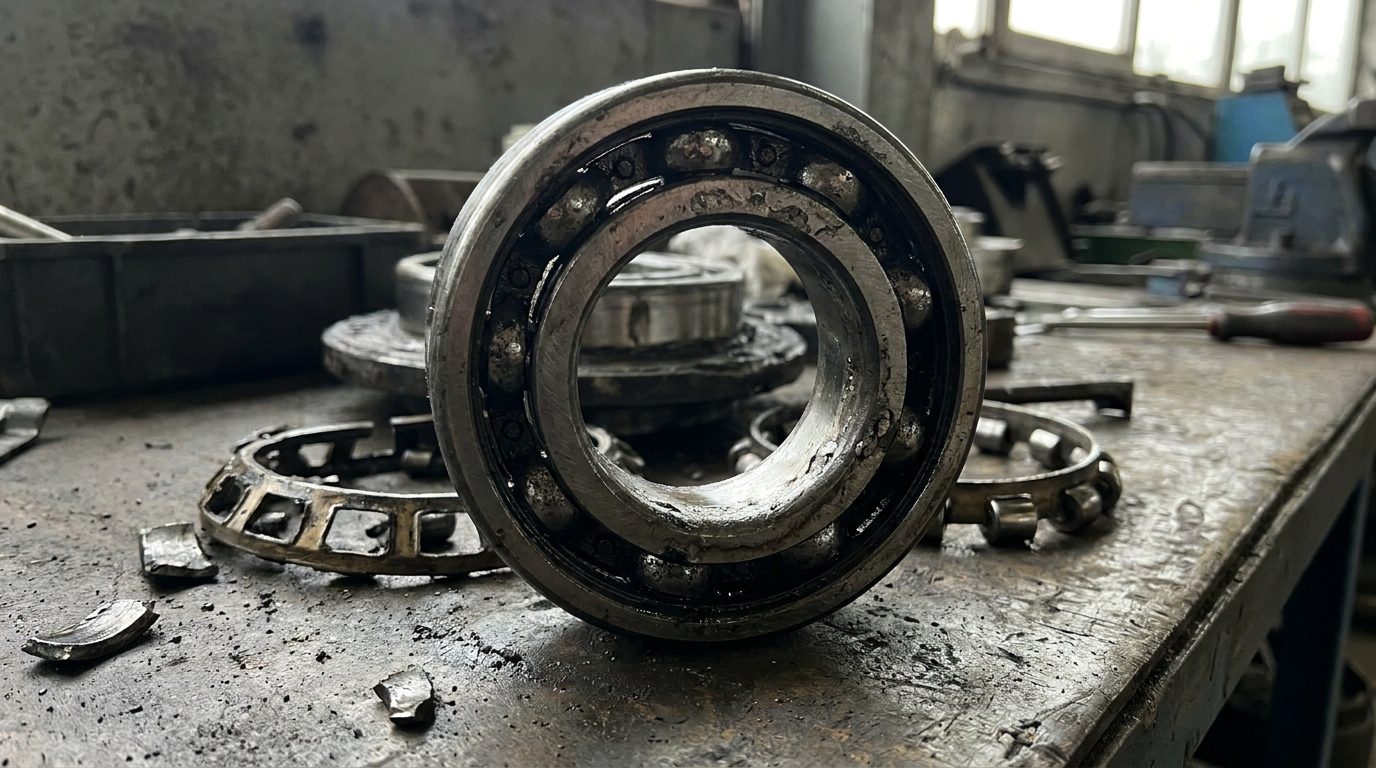
Right-angle gearbox bearing failures are among the most common reasons industrial drives develop noise, heat, vibration, shaft movement, seal leakage, and unexpected downtime. In right-angle gearboxes, bearings support shafts that turn power 90 degrees through bevel, spiral bevel, hypoid, or worm gearing, often under high radial and axial loads. When a bearing begins to fail, the gearbox rarely fails “quietly”; it usually provides warning signs through temperature changes, lubricant contamination, abnormal vibration, and changes in gear mesh behavior. Understanding why these failures happen, how to inspect them, and when to repair or replace the gearbox helps maintenance teams reduce downtime, protect connected equipment, and control lifecycle costs.
Right-angle gearbox bearing failures are usually caused by lubrication breakdown, contamination, misalignment, overload, incorrect installation, poor shaft fits, excessive heat, or fatigue from long service life. Common symptoms include rising operating temperature, growling or whining noise, increased vibration, leaking seals, metal particles in oil, shaft endplay, and gear tooth wear. The best troubleshooting approach is to combine visual inspection, oil analysis, vibration analysis, temperature trending, shaft movement checks, and bearing/gear contact pattern inspection. Early intervention can often save the gearset, shafts, and housing; delayed action may require a complete gearbox replacement.
Bearing failure in right-angle gearboxes can lead to significant operational disruptions and costly repairs. For a deeper understanding of the implications of bearing issues and the importance of timely maintenance, you may find the article on industrial gearbox repair in Tucson, Arizona, particularly insightful. It discusses common gearbox problems, including bearing failures, and offers guidance on effective repair solutions. You can read more about it here: Industrial Gearbox Repair in Tucson, Arizona.
Why Bearings Matter in Right-Angle Gearboxes
Bearings do more than simply allow shafts to rotate. In a right-angle gearbox, bearings control shaft position, maintain gear mesh alignment, carry radial and thrust loads, and help prevent destructive gear contact patterns. If a bearing loses internal clearance, develops spalling, overheats, or moves in the housing, the entire gearbox geometry can change.
Right-angle gearboxes are especially sensitive because their gearsets generate complex forces. Spiral bevel, hypoid, and worm gearboxes all create axial thrust loads that must be absorbed by properly selected and correctly installed bearings. If the bearings cannot maintain shaft position, gear teeth may run off-pattern, increasing heat, noise, wear, and risk of catastrophic failure.
For related service support, see Industrial Gearbox Solutions’ resources on industrial gearbox repair, gearbox inspection services, and right-angle gearbox repair.
Common Bearing Types Used in Right-Angle Gearboxes
Right-angle gearboxes may use several bearing types depending on the design, load, speed, and duty cycle.
| Bearing Type | Common Use in Right-Angle Gearboxes | Strengths | Common Failure Risks |
|||||
| Tapered roller bearings | Bevel, spiral bevel, and hypoid gearboxes | Handles combined radial and axial loads | Incorrect preload, contamination, overheating |
| Cylindrical roller bearings | High radial load shaft support | High radial capacity | Poor axial control if misapplied |
| Spherical roller bearings | Heavy-duty and misalignment-tolerant applications | Handles high loads and some misalignment | Lubrication sensitivity, skidding at low loads |
| Deep groove ball bearings | Lighter-duty gearboxes and auxiliary shafts | Low friction, economical | Limited thrust capacity |
| Angular contact ball bearings | Higher-speed shafts with thrust loads | Good axial load control | Sensitive to preload and alignment |
For bearing application fundamentals, SKF provides useful technical references at SKF bearing knowledge and Timken offers bearing selection and failure analysis resources at Timken engineering resources.
Common Causes of Right-Angle Gearbox Bearing Failures
Bearing failure is rarely random. Most failures can be traced to operating conditions, lubrication practices, installation errors, gearbox alignment, or design/application mismatch.
Lubrication Breakdown
Lubrication failure is one of the leading causes of right-angle gearbox bearing failures. Bearings require a lubricant film to separate rolling elements from raceways. When the film breaks down, metal-to-metal contact occurs, leading to heat, smearing, scoring, and spalling.
Common lubrication-related causes include:
- Incorrect oil viscosity
- Wrong lubricant type for worm, bevel, or hypoid gearing
- Depleted additives
- Oxidized or thermally degraded oil
- Low oil level
- Overfilling, causing churning and heat
- Grease hardening or channeling in grease-lubricated units
- Infrequent oil changes
- Mixing incompatible lubricants
Noria offers extensive lubrication guidance at Noria lubrication resources, including best practices for oil analysis, contamination control, and lubricant selection.
Contamination
Contamination accelerates bearing wear and is a major contributor to premature gearbox failure. Abrasive particles such as dirt, metal debris, casting sand, or wear particles damage bearing raceways and rolling elements. Water contamination reduces lubricant film strength, promotes corrosion, and can cause hydrogen embrittlement or etching.
Contaminants often enter through:
- Failed seals
- Damaged breathers
- Improper washdown practices
- Open inspection ports
- Dirty oil transfer containers
- Poor rebuild cleanliness
- Condensation in humid environments
A small amount of contamination can create a large amount of damage, especially in high-load right-angle gearboxes where bearing contact stresses are severe.
Misalignment and Improper Mounting
Right-angle gearboxes rely on precise shaft alignment. Misalignment between the gearbox input shaft, output shaft, motor, coupling, driven equipment, or internal gear components can overload bearings and produce uneven load zones.
Misalignment may be caused by:
- Soft foot at the motor or gearbox base
- Poor coupling alignment
- Foundation movement
- Pipe strain or conveyor frame distortion
- Improper shimming
- Worn mounting surfaces
- Housing bore damage
- Incorrect bearing seating during rebuild
When a bearing is not mounted squarely, load concentrates on a small area of the raceway. This can produce edge loading, excessive heat, and early fatigue.
Overload and Shock Loading
Many right-angle gearbox bearing failures occur because the gearbox is subjected to loads beyond its design capacity. Even a properly lubricated and aligned bearing can fail if overloads are repeated.
Typical overload sources include:
- Jammed conveyors
- Crusher or mixer shock loads
- Frequent starts and stops
- Improper service factor selection
- Excessive belt or chain tension
- Reverse loading
- Process changes that increase torque demand
- Incorrect gearbox used after an equipment modification
AGMA standards and technical publications provide guidance on gear rating, service factors, and gearbox application considerations. Visit the American Gear Manufacturers Association for authoritative gear industry resources.
Excessive Heat
Heat reduces oil viscosity, accelerates oxidation, damages seals, and shortens bearing life. In a right-angle gearbox, heat may come from overloaded gear mesh, bearing friction, lubricant churning, or inadequate cooling.
Warning signs of heat-related bearing damage include:
- Darkened oil
- Burnt oil smell
- Discolored bearing races
- Hardened or cracked seals
- Paint discoloration on the housing
- Repeated breather venting
- Rising temperature trend over time
Operating temperature should always be evaluated in context. A gearbox that has always run at 180°F may not be in distress, but a gearbox that historically ran at 145°F and now runs at 180°F needs investigation.
Incorrect Bearing Preload or Clearance
Tapered roller bearings and angular contact bearings often require controlled preload or endplay. Too much preload increases friction and heat. Too much clearance allows shaft movement, gear misalignment, and impact loading.
Incorrect preload may result from:
- Wrong shim pack
- Incorrect bearing cone/cup seating
- Reusing worn spacers
- Improper torque procedures
- Housing distortion
- Thermal expansion not considered
- Lack of OEM specifications during rebuild
This is one of the reasons precision gearbox rebuilds should include dimensional inspection, bearing setting verification, and gear contact pattern checks.
Industrial gearbox bearing failure can lead to costly downtime and production losses, so it’s important to address the issue promptly. Industrial gearbox bearing failure
Symptoms of Bearing Failure in a Right-Angle Gearbox
Early detection gives maintenance teams a chance to repair the gearbox before gear teeth, shafts, and housings are damaged. Bearing failures usually produce measurable symptoms before final breakdown.
Noise Changes
Bearing defects often produce new or worsening noise. The sound may be described as:
- Growling
- Rumbling
- Grinding
- Clicking
- Whining
- High-pitched squealing
- Intermittent knocking
A bearing noise may change with speed, load, direction, or temperature. In right-angle gearboxes, bearing noise can be confused with gear mesh noise, so further diagnostics are usually required.
Increased Vibration
Vibration analysis is one of the most effective methods for detecting bearing defects. Bearing faults may appear as harmonics, sidebands, impacts, or high-frequency energy depending on the defect location and severity.
Potential vibration indicators include:
- Increase in overall vibration velocity
- High-frequency acceleration spikes
- Bearing defect frequencies
- Gear mesh sidebands
- Axial vibration increase
- Looseness signatures
- Modulation linked to shaft speed
For critical gearboxes, establish baseline vibration readings after installation or rebuild and trend changes over time.
Rising Temperature
A bearing that is failing often generates additional friction. Temperature may rise gradually as lubrication degrades or rapidly if preload, contamination, or spalling is severe.
Useful temperature inspection methods include:
- Infrared thermometer readings
- Thermal imaging
- Permanent RTD or thermocouple sensors
- Oil sump temperature monitoring
- Bearing housing temperature comparison
Temperature should be trended under similar load, speed, and ambient conditions.
Seal Leakage
Bearing failure and seal leakage often appear together. A failing bearing can allow shaft movement, which damages seals. Conversely, a failed seal can let lubricant escape or contaminants enter, causing bearing damage.
Look for:
- Oil weeping around input or output seals
- Grease purging from seal lips
- Dust buildup stuck to leaked oil
- Oil slinger damage
- Shaft groove wear
- Pressure buildup from blocked breathers
If a seal is replaced without checking shaft movement and bearing condition, the leak may return quickly.
Metal Particles in Oil
Metal particles are a serious warning sign. Fine metallic shimmer may indicate wear, while larger flakes or chips may indicate bearing spalling or gear damage.
Recommended checks include:
- Magnetic drain plug inspection
- Oil sample laboratory analysis
- Patch test
- Ferrography
- Filter debris analysis
- Borescope inspection after oil drain
If metal is found, identify whether it is bearing material, gear tooth material, bronze worm wheel material, or housing debris.
Understanding the intricacies of bearing failure in right-angle gearboxes is crucial for maintaining optimal performance in industrial applications. For those looking to delve deeper into the topic, a related article discusses the importance of regular maintenance and timely repairs to prevent such failures. You can read more about it in this informative piece on industrial gearbox repair, which highlights best practices and solutions for ensuring the longevity of your equipment.
Troubleshooting Right-Angle Gearbox Bearing Failures
| Metrics | Value |
|---|---|
| Number of bearing failures | 25 |
| Mean time between failures (MTBF) | 500 hours |
| Cost of bearing replacement | 2000 |
| Percentage of failures due to lack of lubrication | 40% |
Troubleshooting should follow a structured process. Guessing often leads to repeated failures and unnecessary replacement costs.
Step-by-Step Diagnostic Process
| Step | Inspection Activity | What It Reveals |
||||
| 1 | Review operating history | Recent overloads, process changes, repeated failures |
| 2 | Check oil level and lubricant type | Lubrication errors, wrong viscosity, low oil |
| 3 | Measure temperature | Heat trends, overload, friction |
| 4 | Listen for abnormal noise | Bearing, gear, or coupling problems |
| 5 | Perform vibration analysis | Bearing defect frequencies, looseness, gear mesh issues |
| 6 | Inspect seals and breather | Contamination paths, pressure buildup |
| 7 | Check shaft endplay/runout | Bearing clearance, looseness, shaft damage |
| 8 | Analyze oil sample | Wear metals, water, oxidation, particle count |
| 9 | Borescope internal components | Gear wear, bearing cage damage, debris |
| 10 | Disassemble if necessary | Confirms root cause and repair scope |
Field Checks Maintenance Teams Can Perform
Before removing the gearbox, maintenance personnel can often gather valuable information.
Recommended field checks:
- Confirm gearbox model, ratio, RPM, horsepower, and service factor
- Verify lubricant matches OEM specifications
- Inspect oil level while the gearbox is stopped and settled
- Compare temperature readings to identical gearboxes
- Inspect coupling alignment and guard for rubbing
- Check mounting bolts and baseplate condition
- Look for soft foot or cracked foundations
- Inspect breathers for blockage
- Listen with an ultrasonic tool or mechanic’s stethoscope
- Pull oil sample from a live zone, not just the drain bottom
When to Stop the Gearbox Immediately
Some symptoms justify immediate shutdown to prevent a more expensive failure.
Stop and inspect the gearbox if you observe:
- Sudden severe vibration increase
- Loud grinding or banging
- Rapid temperature rise
- Smoke or burnt oil smell
- Large metal flakes in oil
- Visible shaft movement
- Loss of lubrication
- Seized input or output shaft
- Broken mounting feet or housing cracks
Continuing to operate a failing right-angle gearbox may destroy gears, shafts, bearings, seals, and connected equipment.
Inspection Methods for Bearing Failure Analysis
A good inspection does not just identify the failed component; it identifies why the component failed. This is essential for preventing repeat failures.
Visual Inspection
During disassembly, technicians should inspect:
- Bearing raceways
- Rolling elements
- Bearing cages
- Shaft journals
- Housing bores
- Gear tooth contact patterns
- Shims and spacers
- Seals and seal journals
- Lubricant condition
- Magnetic plugs and filters
Bearing damage patterns can reveal whether the failure was caused by contamination, fatigue, misalignment, electrical current, corrosion, poor fit, or lubrication breakdown.
Bearing Damage Pattern Review
| Damage Pattern | Likely Cause | Typical Appearance |
||||
| Spalling | Fatigue, overload, contamination | Flaking or pitting on raceways |
| Smearing | Lubrication failure, sliding, high speed | Torn or smeared metal surface |
| False brinelling | Vibration while stationary | Wear marks at rolling element spacing |
| True brinelling | Shock load or impact | Permanent dents in raceways |
| Corrosion | Water or chemical contamination | Rust, etching, staining |
| Cage failure | Misalignment, vibration, poor lubrication | Cracked, worn, or broken cage |
| Electrical fluting | Shaft current | Washboard-like grooves |
| Overheating | Excess preload, low oil, overload | Blue/brown discoloration |
SKF and Timken both publish bearing failure analysis guidance that can help maintenance and reliability teams interpret these patterns.
Oil Analysis
Oil analysis is one of the most valuable predictive tools for industrial gearboxes. A proper oil analysis program can detect abnormal wear before vibration or noise becomes obvious.
Useful oil analysis tests include:
- Viscosity at 40°C and 100°C
- Acid number
- Water content
- Particle count
- Ferrous density
- Elemental spectroscopy
- Oxidation and nitration
- Additive depletion
- Analytical ferrography
For right-angle gearboxes, pay close attention to iron, chromium, copper, tin, silicon, aluminum, and water. Copper or tin may indicate bronze worm gear wear, while iron and chromium may point to bearings or steel gears.
Vibration Analysis
Vibration analysis helps distinguish bearing defects from gear mesh problems, looseness, imbalance, and misalignment. For best results, collect vibration data at consistent operating conditions and sensor locations.
Common measurement points include:
- Input shaft bearing housing
- Output shaft bearing housing
- Intermediate shaft bearing locations
- Axial and radial positions
- Motor and driven equipment bearings
A qualified analyst can compare measured frequencies to bearing geometry, shaft speed, and gear mesh frequency.
Gear Contact Pattern Inspection
Bearing problems often affect gear contact. In bevel and spiral bevel gearboxes, small shaft position changes can shift the contact pattern. A poor pattern may indicate bearing looseness, incorrect shim settings, housing wear, or gear misalignment.
Technicians may use gear marking compound to verify:
- Tooth contact position
- Load distribution
- Pinion depth
- Backlash
- Shaft alignment
- Bearing support stability
If bearing replacement is performed without correcting contact pattern issues, the repaired gearbox may fail prematurely.
Prevention Strategies for Right-Angle Gearbox Bearing Failures
Prevention is more cost-effective than emergency repair. A gearbox reliability program should combine correct lubrication, contamination control, alignment, monitoring, and proper operating practices.
Improve Lubrication Practices
Best practices include:
- Use the OEM-recommended viscosity and lubricant type
- Confirm compatibility before changing oil brands
- Use synthetic oil where heat or oxidation is a concern
- Avoid overfilling and underfilling
- Label fill points clearly
- Use dedicated, sealed oil transfer containers
- Filter new oil before adding it to the gearbox
- Sample oil at consistent intervals
- Change oil based on condition and operating severity
- Maintain proper grease intervals for grease-lubricated bearings
For worm gearboxes, verify lubricant compatibility with bronze worm wheels. Some extreme-pressure additives may not be suitable for yellow metals.
Control Contamination
Contamination control is one of the fastest ways to extend bearing life.
Recommended actions:
- Install desiccant breathers where moisture is present
- Upgrade seals in washdown or dusty environments
- Keep fill ports closed
- Use quick-connect filtration ports
- Store lubricants indoors and sealed
- Avoid pressure washing directly at seals
- Inspect breathers during routine PMs
- Use filtration carts for critical gearboxes
- Clean the area before opening inspection covers
Maintain Alignment and Mounting Integrity
Alignment should be checked during installation, after major repairs, and whenever equipment is moved.
Key checks include:
- Coupling alignment
- Belt or chain tension
- Baseplate flatness
- Soft foot
- Mounting bolt torque
- Foundation cracks
- Driven equipment alignment
- Thermal growth effects
Poor alignment does not only damage bearings; it can also damage seals, couplings, shafts, and gears.
Avoid Overload Conditions
Reliability teams should compare actual operating conditions to gearbox design limits.
Review:
- Motor horsepower
- Input speed
- Output torque
- Service factor
- Duty cycle
- Shock loading
- Ambient temperature
- Starts per hour
- Reversing loads
- Process modifications
If the process has changed since the gearbox was selected, the drive may now be undersized.
Repair vs. Replacement: How to Decide
When bearing failure occurs, the key question is whether to repair the gearbox, rebuild it, or replace it. The answer depends on damage severity, gearbox criticality, parts availability, lead time, and total cost of downtime.
When Repair Is Usually Practical
Repair may be the best option when:
- Damage is limited to bearings and seals
- Gear teeth are in good condition
- Shafts are reusable or repairable
- Housing bores are within tolerance
- OEM replacement lead time is long
- Gearbox is obsolete but rebuildable
- Downtime cost favors fast repair
- The unit is large, custom, or expensive
A proper repair should include bearing replacement, seal replacement, cleaning, dimensional inspection, lubricant change, backlash/contact verification, and test run when possible.
When Replacement May Be Better
Replacement may be more practical when:
- Gear teeth are severely pitted, cracked, or broken
- Housing is cracked or distorted
- Multiple shafts are damaged
- Bearing bores are spun beyond economical repair
- The gearbox is undersized for the application
- Parts are unavailable or excessively expensive
- The design has a history of repeat failures
- A modern unit offers better efficiency or reliability
Purchasing professionals should compare not only the purchase price but also lead time, installation cost, foundation modifications, coupling changes, and expected service life.
Repair vs. Replacement Comparison
| Factor | Repair/Rebuild | Replacement |
||||
| Typical lead time | Often faster for large/obsolete units | Faster for stocked standard units |
| Cost | Lower if gears/housing are reusable | Higher initial cost |
| Reliability | High if root cause is corrected | High if properly specified |
| Risk | Depends on inspection quality | Depends on fit and application match |
| Best for | Large, custom, or long-lead gearboxes | Severely damaged or undersized units |
| Engineering required | Dimensional checks, contact pattern, preload | Application verification, mounting fit |
Industrial Gearbox Solutions can help evaluate whether a failed unit is a candidate for gearbox rebuild service or whether a replacement is the better long-term decision.
Maintenance Best Practices for Reliability Teams
The most reliable plants treat gearboxes as critical assets, not sealed boxes that are ignored until failure.
Recommended Preventive Maintenance Schedule
| Frequency | Maintenance Task |
|||
| Daily/Shift | Check for abnormal noise, leaks, vibration, and temperature changes |
| Weekly | Inspect oil level, breathers, seals, mounting bolts, and visible contamination |
| Monthly | Record temperature and vibration readings; inspect coupling and guards |
| Quarterly | Pull oil sample on critical units; inspect magnetic plugs if available |
| Semiannual | Verify alignment on critical drives; inspect baseplate and fasteners |
| Annual | Review lubricant condition, operating history, and failure trends |
| Shutdown | Borescope internal components; check backlash/endplay where accessible |
Documentation to Keep
Maintenance records help identify patterns and justify repair or replacement decisions.
Track:
- Gearbox make, model, serial number, ratio, and service factor
- Lubricant type and viscosity
- Oil change dates
- Oil analysis reports
- Vibration trends
- Temperature trends
- Seal replacements
- Bearing replacements
- Alignment readings
- Failure photos
- Rebuild reports
- Operating load changes
Spare Gearbox and Parts Strategy
Purchasing and maintenance teams should identify critical right-angle gearboxes and plan spares accordingly.
Consider stocking:
- Complete spare gearbox for critical production assets
- Bearings and seals
- Shim kits
- Breathers
- Couplings
- Lubricant
- Gaskets
- Oil sight glasses
- Magnetic drain plugs
For obsolete or long-lead gearboxes, a repairable spare can reduce emergency downtime significantly.
Application-Specific Considerations
Right-angle gearboxes are used across many industries, and failure risks vary by environment.
Conveyors
Conveyor gearboxes often experience shock loads, misalignment, and high shaft overhung loads. Excessive belt tension can overload output bearings. Inspect pulley alignment, belt tension, and mounting rigidity.
Mixers and Agitators
Mixer gearboxes may see variable loads, radial forces, and process shock. Bearings must handle thrust and bending forces. Check for process changes such as higher viscosity materials or larger batch sizes.
Cooling Towers and Outdoor Drives
Outdoor gearboxes are exposed to moisture, temperature swings, and condensation. Desiccant breathers, proper seals, and routine oil analysis are especially important.
Crushers and Heavy Material Handling
Shock loading is a major concern. Gearbox selection should include adequate service factor, and bearings should be inspected for brinelling, spalling, and cage damage after severe jams.
Food, Beverage, and Washdown Environments
Washdown can force water past seals and breathers. Use appropriate seals, washdown-rated breathers, and lubrication practices that reduce water contamination risk.
Branded Image Recommendations
Use original, branded images to improve user engagement, SEO value, and trust. Suggested images for IndustrialGearboxSolutions.com include:
| Image Concept | Suggested Alt Text | Caption |
||||
| Technician inspecting a right-angle gearbox bearing | Technician inspecting right-angle gearbox bearing failure | A detailed bearing inspection helps identify the root cause before repair. |
| Close-up of spalled bearing race | Spalled bearing race from right-angle gearbox bearing failure | Spalling often indicates fatigue, contamination, overload, or lubrication breakdown. |
| Oil sample with metallic debris | Metallic debris in gearbox oil from bearing wear | Oil analysis can detect bearing wear before catastrophic gearbox failure. |
| Thermal image of gearbox housing | Thermal inspection of overheating right-angle gearbox | Temperature trending helps maintenance teams find developing bearing problems. |
| Gear contact pattern inspection | Spiral bevel gear contact pattern inspection after bearing replacement | Proper bearing settings help maintain correct gear mesh and prevent repeat failures. |
| Rebuilt industrial right-angle gearbox | Rebuilt right-angle gearbox ready for industrial service | A precision rebuild should include bearings, seals, inspection, and test run procedures. |
Authoritative Resources for Further Reading
Maintenance and engineering teams can strengthen their reliability programs by referencing recognized industry sources:
- SKF bearing knowledge and failure analysis: https://www.skf.com/
- Timken bearing engineering resources: https://www.timken.com/
- American Gear Manufacturers Association standards and publications: https://www.agma.org/
- Noria lubrication and oil analysis resources: https://www.noria.com/
SEO Metadata Recommendations
SEO Title
Understanding Right-Angle Gearbox Bearing Failures | Causes, Symptoms, and Repair
Meta Description
Learn the causes, symptoms, troubleshooting steps, inspection methods, and repair vs. replacement options for right-angle gearbox bearing failures in industrial applications.
Primary Keyword
right-angle gearbox bearing failures
Secondary Keywords
- right-angle gearbox repair
- gearbox bearing failure symptoms
- industrial gearbox troubleshooting
- bevel gearbox bearing failure
- worm gearbox bearing failure
- gearbox vibration analysis
- gearbox oil analysis
- industrial gearbox maintenance
- gearbox bearing inspection
- gearbox repair vs replacement
Suggested URL Slug
understanding-right-angle-gearbox-bearing-failures
Search Intent
Informational and commercial investigation. The reader wants to diagnose a gearbox bearing problem, understand root causes, prevent repeat failures, and decide whether to repair, rebuild, or replace the unit.
FAQs About Right-Angle Gearbox Bearing Failures
What is the most common cause of right-angle gearbox bearing failure?
Lubrication failure is one of the most common causes. This may include low oil level, wrong viscosity, degraded lubricant, contamination, or poor lubrication practices. However, overload, misalignment, and incorrect bearing preload are also frequent root causes.
How do I know if a right-angle gearbox bearing is failing?
Common signs include increased noise, rising temperature, abnormal vibration, oil leaks, shaft movement, metal particles in oil, and changes in gear mesh sound. Vibration analysis and oil analysis can help confirm the issue.
Can a gearbox keep running with a bad bearing?
It may continue running temporarily, but operating with a failing bearing is risky. A bearing failure can quickly damage gears, shafts, seals, and the housing. If vibration, heat, or metal debris is severe, the gearbox should be shut down and inspected.
Why do new bearings fail shortly after installation?
Early bearing failure after repair is often caused by incorrect installation, improper preload or clearance, contaminated assembly conditions, misalignment, wrong lubricant, shaft or housing fit problems, or failure to correct the original root cause.
Should bearings always be replaced during a gearbox rebuild?
In most industrial gearbox rebuilds, bearings and seals should be replaced unless there is a specific reason not to. Bearings are relatively low-cost compared to the labor and downtime involved in disassembling a gearbox again.
What role does oil analysis play in detecting bearing failure?
Oil analysis can identify wear metals, water, particle contamination, oxidation, viscosity changes, and additive depletion. It is especially valuable for detecting early bearing wear before catastrophic failure occurs.
Can misalignment cause bearing failure in a right-angle gearbox?
Yes. Misalignment can increase radial and axial loads, distort gear contact patterns, and overload bearings. Coupling alignment, soft foot correction, and baseplate condition should always be reviewed during troubleshooting.
When should a right-angle gearbox be replaced instead of repaired?
Replacement may be better if the gearbox is undersized, the housing is cracked, gear teeth are severely damaged, bearing bores are destroyed, parts are unavailable, or repeat failures indicate the design is unsuitable for the application.
Key Takeaways
- Right-angle gearbox bearing failures are commonly caused by lubrication problems, contamination, overload, misalignment, heat, and incorrect bearing settings.
- Early warning signs include noise, vibration, temperature increases, seal leaks, shaft movement, and metal debris in the oil.
- Troubleshooting should combine operating history, oil analysis, vibration analysis, temperature trending, visual inspection, and dimensional checks.
- Bearing failure can shift gear contact patterns, causing secondary damage to bevel, spiral bevel, hypoid, or worm gearsets.
- Preventive maintenance should focus on lubrication quality, contamination control, alignment, operating load review, and consistent monitoring.
- Repair is often practical when damage is limited to bearings, seals, and minor shaft or housing wear.
- Replacement may be the better choice when the gearbox is severely damaged, obsolete, repeatedly failing, or undersized for the application.
- Correcting the root cause is essential; replacing bearings without solving lubrication, alignment, or overload issues usually leads to repeat failure.
Conclusion
Right-angle gearbox bearing failures can disrupt production, damage expensive gearsets, and create urgent repair decisions for maintenance and purchasing teams. The best results come from a disciplined approach: identify symptoms early, collect oil and vibration data, inspect seals and lubrication systems, verify alignment and loading, and determine the true root cause before authorizing repair or replacement. Bearings are precision components, and their condition directly affects gear mesh, shaft stability, seal life, and overall gearbox reliability.
For critical industrial drives, do not wait until a noisy or overheating gearbox fails completely. A professional inspection can often determine whether a bearing replacement, full rebuild, or replacement gearbox is the most cost-effective path forward.
FAQs
What are the common causes of bearing failure in right-angle gearboxes?
Common causes of bearing failure in right-angle gearboxes include inadequate lubrication, contamination, overloading, misalignment, and improper installation.
How can inadequate lubrication lead to bearing failure in right-angle gearboxes?
Inadequate lubrication can lead to bearing failure in right-angle gearboxes by causing increased friction, heat, and wear on the bearings, ultimately leading to premature failure.
What types of contamination can contribute to bearing failure in right-angle gearboxes?
Contamination such as dirt, dust, metal particles, and moisture can contribute to bearing failure in right-angle gearboxes by causing abrasive wear, corrosion, and reduced lubrication effectiveness.
How does overloading impact bearing failure in right-angle gearboxes?
Overloading can impact bearing failure in right-angle gearboxes by causing excessive stress and fatigue on the bearings, leading to accelerated wear and eventual failure.
What steps can be taken to prevent bearing failure in right-angle gearboxes?
To prevent bearing failure in right-angle gearboxes, it is important to ensure proper lubrication, minimize contamination, avoid overloading, maintain proper alignment, and follow correct installation procedures. Regular maintenance and monitoring of the gearboxes can also help prevent bearing failure.