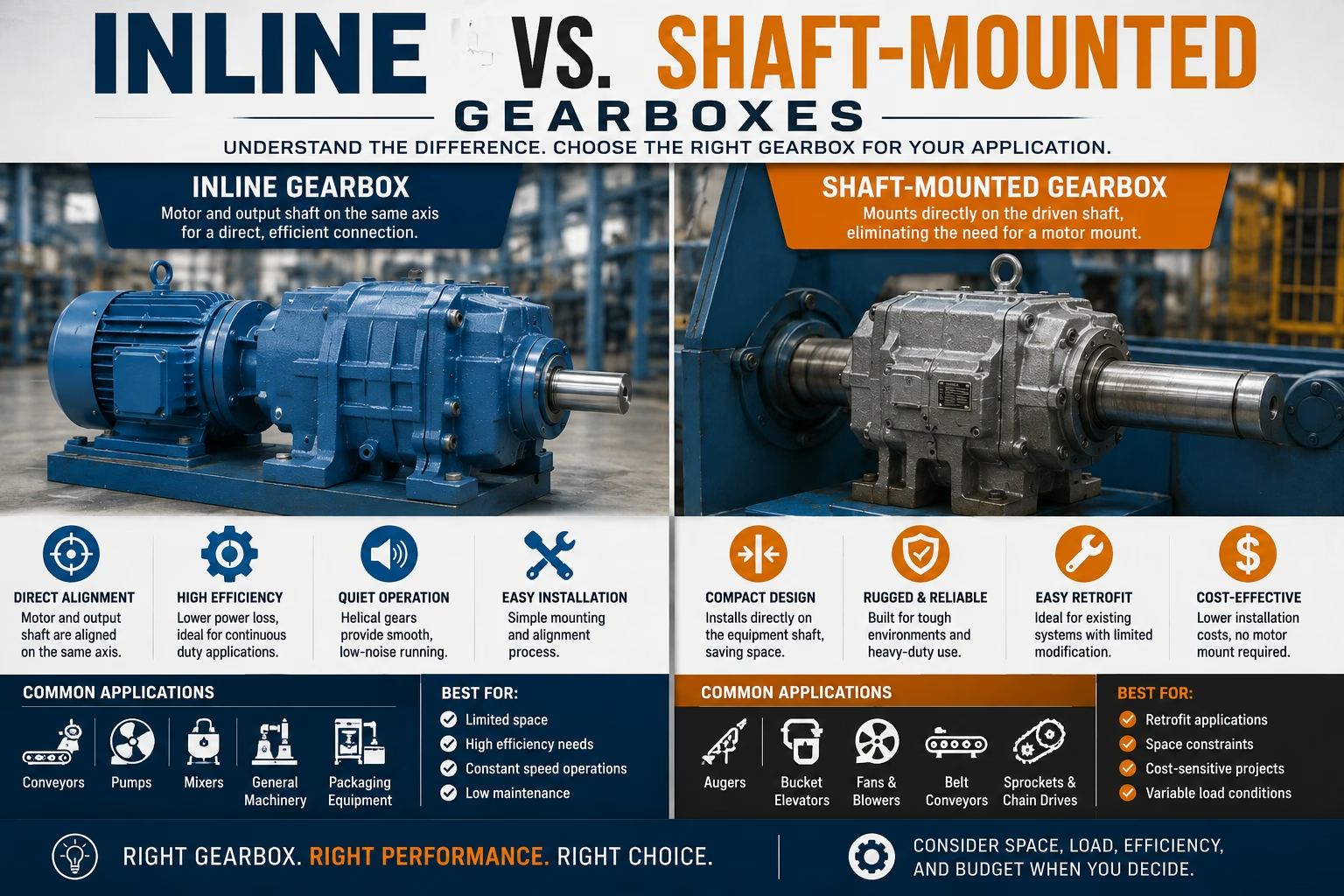
When you’re looking at ways to transfer power and change speed in your machinery, gearboxes are usually the star of the show. But which type is right for your specific setup? Two common contenders you’ll hear about are inline and shaft-mounted gearboxes. So, what’s the difference, and why should you care?
Simply put, the main difference lies in how the gearbox connects to your motor and the driven equipment, and this fundamentally impacts their application, installation, and overall performance. Inline gearboxes keep the motor and output shaft aligned, while shaft-mounted gearboxes hang off the driven shaft. Understanding this distinction is key to making the best choice for your project.
The Fundamentals: How They Work and What They’re For
Before diving into the specifics of inline versus shaft-mounted, let’s get a handle on what a gearbox actually does and why we use them.
What is a Gearbox?
At its core, a gearbox is a mechanical system designed to transmit rotational power from a prime mover (like an electric motor or an engine) to a driven machine. It uses a series of gears to achieve one or more of the following:
- Speed Reduction: This is the most common function. Motors typically spin at high speeds but produce low torque (rotational force). Many machines need slower speeds and higher torque. A gearbox uses larger gears to mesh with smaller gears, effectively slowing down the output shaft while increasing its torque.
- Speed Increase: Less common, but sometimes necessary. This is the reverse; a gearbox can increase the output speed at the expense of torque.
- Torque Multiplication: As mentioned, slowing down the output speed directly increases the available torque, allowing a motor to drive heavier loads.
- Change in Shaft Orientation: Some gearboxes can change the direction of rotation or transmit power at an angle.
Why Use a Gearbox?
Without gearboxes, many machines would be impractical or impossible to operate. Imagine trying to power a conveyor belt directly with a high-speed electric motor. It wouldn’t move effectively, and the motor would likely burn out. Gearboxes make powerful, high-speed motors usable for a vast range of applications requiring lower speeds and more force.
When considering the differences between inline and shaft mounted gearboxes, it’s essential to understand their respective applications and advantages. For a deeper insight into the maintenance and repair aspects of industrial gearboxes, you can refer to a related article on industrial gearbox repair in Ohio. This resource provides valuable information on ensuring the longevity and efficiency of your gear systems. To learn more, visit this article.
Inline Gearboxes: The Direct Approach
Inline gearboxes are characterized by their motor and output shaft being aligned on the same axis. Think of it as a straight-line connection from the motor’s input to the driven machine’s output.
Structure and Alignment
In an inline configuration, the motor shaft directly connects to the input shaft of the gearbox, and the output shaft of the gearbox is then connected to the driven equipment. This alignment is maintained throughout the system.
Common Inline Gearbox Types
You’ll find several common designs within the inline category, each with its own set of advantages:
- Helical Gearboxes: These are very popular due to their efficiency and quiet operation. The teeth on helical gears are cut at an angle to the shaft, meaning they engage gradually and smoothly. This reduces shock load and noise. They are excellent for general-purpose applications.
- Spur Gearboxes: Spur gears have teeth cut parallel to the shaft. They are simpler and cheaper to manufacture than helical gears but can be noisier and less efficient, especially at higher speeds. They are often used in lower-speed, less demanding applications.
- Planetary Gearboxes: These are more complex but offer significant advantages in terms of torque density and compactness. They involve a central “sun” gear, surrounded by several “planet” gears that revolve around it, all contained within an outer “ring” gear. This design allows for high torque output in a relatively small package and offers multiple gear reduction ratios.
- Worm Gearboxes: While often considered a type of inline gearbox due to shaft alignment, worm gearboxes also change the shaft orientation by 90 degrees. They use a screw-like “worm” gear meshing with a wheel. They offer very high gear ratios and are self-locking in some configurations, meaning they can hold a load even when the motor is off. However, they are generally less efficient than helical or spur gearboxes.
Installation and Mounting
Installation of an inline gearbox is typically straightforward. The motor is usually mounted directly to the gearbox housing, or a flexible coupling connects the motor shaft to the gearbox input shaft. The output shaft is then coupled to the driven machinery.
Key Installation Considerations
- Shaft Coupling: Proper alignment is crucial to prevent premature wear on bearings and seals. Flexible couplings help to absorb minor misalignments.
- Motor Mounting: The motor needs to be securely attached to the gearbox, ensuring no vibration or stress is transferred inappropriately.
- Base Mounting: The entire assembly (motor + gearbox) is usually mounted to a solid base or frame, providing stability.
Advantages of Inline Gearboxes
Inline gearboxes offer a clean, integrated solution for power transmission.
Efficiency and Performance
- High Efficiency: Particularly with helical and planetary designs, inline gearboxes are known for their excellent efficiency in transferring power, meaning less energy is lost as heat.
- Precise Output: The direct alignment generally leads to very precise control over the output speed and torque.
- Compactness (Specific Types): Planetary gearboxes can be remarkably compact for the amount of torque they can handle.
Application Suitability
- General Industrial Use: They are found in a vast array of applications like conveyors, mixers, pumps, and processing equipment where continuous, reliable operation is needed.
- Space Constraints (Specific Types): Planetary gearboxes are ideal when space is limited, but high torque is required.
Disadvantages of Inline Gearboxes
Despite their advantages, inline gearboxes aren’t always the perfect fit.
Cost and Complexity
- Higher Initial Cost: Compared to some shaft-mounted options, the precision manufacturing for inline units can lead to a higher upfront cost, especially for high-torque or advanced designs like planetary.
- More Complex to Repair: If a motor needs to be removed or replaced, it often requires disconnecting the coupling and potentially disassembling part of the gearbox setup.
Installation Challenges
- Alignment Sensitivity: While couplings help, maintaining perfect alignment between the motor, gearbox, and driven equipment is critical and can sometimes be challenging, especially in older or less precise machinery.
Shaft-Mounted Gearboxes: The Hanging Solution
Shaft-mounted gearboxes are designed to mount directly onto the driven shaft of a piece of equipment and are driven by a separate motor, often via a belt and pulley system or a chain drive.
Structure and Mounting
The defining feature here is that the gearbox’s input shaft is essentially the driven machine’s output shaft itself. The gearbox then connects to a motor through a separate drive mechanism.
How They Connect
Instead of direct coupling, shaft-mounted gearboxes typically utilize:
- Torque Arm/Backstop: A key component is the torque arm, which is attached to the gearbox and then to a stationary point on the machine’s frame. This arm resists the rotational forces generated by the gearbox, preventing it from spinning with the shaft and ensuring the gearbox casing remains static. In many cases, a backstop mechanism is also integrated to prevent back-driving of the load, crucial for applications like inclined conveyors.
- Motor Drive: The motor is mounted separately and connected to the gearbox input shaft (which is the driven shaft) via a belt and pulley system, or a chain and sprocket system. This allows for easy adjustment of the overall gear ratio by changing pulley or sprocket sizes.
Types of Shaft-Mounted Gearboxes
While the fundamental mounting principle is the same, you’ll still encounter different internal gear designs.
Common Shaft-Mounted Gearbox Designs
- Helical Shaft Mount: Similar to inline helical gearboxes, these use angled teeth for efficient and quiet operation. They are very common for their robustness.
- Spur Shaft Mount: Less common than helical for shaft mounts, but they exist for lower-cost, less demanding applications.
- Bevel-Helical Shaft Mount: These combine bevel gears (for changing shaft angle) with helical gears, offering good ratios and efficiency.
Installation and Maintenance
Installation is distinct from inline units and offers its own set of considerations.
Key Installation Features
- Ease of Mounting: The primary appeal is how easily they slide onto the driven shaft. A hollow bore on the gearbox input shaft fits directly over the machine’s shaft, secured by a taper lock bushing or similar mechanism.
- Motor Placement: The motor’s placement is flexible. It can be mounted on a base near the driven equipment or even suspended, depending on the setup and available space.
- Belt/Chain Tensioning: Proper tensioning of the belt or chain drive is critical for efficient power transfer and longevity of the components.
Maintenance and Accessibility
- Simplified Motor Maintenance: Because the motor is a separate unit, servicing or replacing it is generally much simpler and quicker. You don’t need to disturb the gearbox or the driven machine’s shaft.
- Torque Arm and Bushing Checks: Regular checks of the torque arm’s integrity and the tightness of the taper lock bushing are essential to prevent slippage or detachment.
Advantages of Shaft-Mounted Gearboxes
Shaft-mounted gearboxes excel in specific scenarios, particularly where flexibility and ease of installation are paramount.
Installation and Flexibility
- Rapid Installation: This is their biggest selling point. They can often be fitted onto existing shafts without significant modification to the driven equipment, saving considerable time and labor during installation or upgrades.
- No Motor Base Required: The motor can be positioned flexibly, often eliminating the need for a dedicated, heavy motor mounting base.
- Adjustable Drive Ratios: Easily change the overall speed ratio by swapping out pulleys or sprockets, offering great flexibility in adapting to different operational needs.
Space and Layout
- Excellent for Cramped Spaces: Because the motor can be mounted remotely, shaft-mounted gearboxes are fantastic for applications where space around the driven equipment is at a premium.
- Clean Layout: The motor can be positioned out of the way, leading to a cleaner and potentially safer work environment.
Disadvantages of Shaft-Mounted Gearboxes
The hanging design and separate motor drive do come with certain trade-offs.
Efficiency and Wear
- Lower Efficiency: The belt and pulley or chain drive system introduces additional mechanical losses, making them generally less energy-efficient than directly coupled inline gearboxes.
- Increased Wear on Drive Components: Belts, chains, and sprockets are wear items. They require regular inspection, tensioning, and eventual replacement, adding to ongoing maintenance costs.
- Vibration and Noise: Belt or chain drives can sometimes introduce more vibration and noise compared to a direct shaft coupling.
Load Distribution
- Overhang Load: The gearbox is mounted off-center on the driven shaft, creating an overhang or cantilevered load on the shaft bearings. This can lead to increased wear on the driven equipment’s shaft bearings and requires careful consideration of bearing capacity.
- Torque Arm Reliance: The entire torque is resisted by the torque arm. If this arm or its anchoring point fails, the gearbox can spin freely and cause significant damage.
Sure, here is the sentence with the clickable link:
contact Industrial Gearbox Solutions for all your gearbox needs.
Comparing the Two: Head-to-Head
Now that we’ve broken down each type, let’s put them side-by-side to highlight the key differences that will influence your decision.
Installation and Mounting Differences
This is often the most significant deciding factor.
Ease of Mounting
- Inline: Requires precise alignment between motor, gearbox, and driven equipment. Can involve couplings and potentially more complex base mounting.
- Shaft-Mounted: Slips directly onto the driven shaft. Motor is flexibly mounted. Generally much faster and simpler to install on existing machinery.
Space Requirements
- Inline: Motor and gearbox are a single unit, which can be more space-efficient if directly aligned and compact designs (like planetary) are used.
- Shaft-Mounted: Motor can be mounted remotely, making it ideal for very tight spaces around the driven equipment.
Performance and Efficiency Metrics
How do they stack up in terms of power transfer?
Energy Efficiency
- Inline: Generally more efficient due to direct coupling and fewer transmission losses, especially helical and planetary types.
- Shaft-Mounted: Less efficient due to losses in belts/chains and pulleys/sprockets.
Torque and Load Handling
- Inline: Can handle very high torques directly. Planetary designs are particularly good for high torque density.
- Shaft-Mounted: Designed to handle significant torque but the cantilevered load on the driven shaft bearings is a critical consideration.
Maintenance and Longevity
What’s involved in keeping them running?
Routine Maintenance
- Inline: Primarily lubrication checks and bearing inspection. Motor maintenance is separate from gearbox maintenance.
- Shaft-Mounted: Lubrication, bearing checks, but also critical inspection and tensioning of belts/chains. Taper lock bushing must remain tight. Torque arm integrity is vital.
Component Wear
- Inline: Wear concentrated on internal gears and bearings. Long lifespan when properly maintained.
- Shaft-Mounted: Wear on internal gears and bearings, plus the belts/chains/sprockets used for motor drive. Shaft bearings on the driven equipment can experience increased wear due to overhang.
Cost Considerations
Initial investment and long-term expenses.
Upfront Cost
- Inline: Can range from moderate (spur) to high (planetary, high-efficiency helical).
- Shaft-Mounted: Often more affordable for the gearbox unit itself, but the overall system cost includes motor mounting hardware and the belt/chain drive. Installation labor savings might offset initial gearbox cost differences.
Total Cost of Ownership
- Inline: Higher initial cost for premium units, but often lower long-term operating costs due to higher efficiency and potentially longer component life if alignment is perfect.
- Shaft-Mounted: Lower initial gearbox cost, but ongoing costs for belt/chain replacement and potentially higher bearing wear on the driven equipment. Lower efficiency also means higher energy bills over time.
When considering the differences between inline and shaft mounted gearboxes, it can be beneficial to explore various tools that enhance their performance and maintenance. A related article discusses essential gearbox repair tools that every manufacturer should have, which can greatly aid in ensuring the longevity and efficiency of these systems. For more insights on this topic, you can read the article on gearbox repair tools. Understanding these tools can help optimize the use of both inline and shaft mounted gearboxes in various applications.
Choosing the Right Gearbox for Your Application
The decision between inline and shaft-mounted isn’t always black and white. It depends heavily on the specifics of your project.
Key Application Scenarios
Let’s look at some typical situations where one might be favored over the other.
Scenario 1: New Equipment Design
When designing a brand-new piece of machinery, you have the most flexibility.
- Inline Might Be Preferred If:
- Maximum efficiency is critical.
- Space allows for a direct motor-gearbox-load alignment.
- You want the most integrated and compact solution for a given torque.
- Precise shaft alignment can be engineered from the start.
- The machine will operate in a well-controlled environment where vibration needs to be minimized.
- Shaft-Mounted Might Be Preferred If:
- The driven equipment’s design limits space for a traditional motor mount.
- Easy motor replacement or servicing is a priority.
- The overall ratio may need to be changed frequently.
- Installation speed and simplicity are paramount during initial assembly.
Scenario 2: Upgrading Existing Machinery
When modifying older equipment, the existing layout often dictates the choice.
- Inline Might Be Preferred If:
- The existing motor mount and driven shaft can be adapted to accommodate a direct-coupled inline gearbox with proper alignment.
- You’re looking to significantly upgrade efficiency and reliability and are willing to invest in potential modifications for alignment.
- Shaft-Mounted Often Shines If:
- There’s very limited space around the driven machinery for a new motor base.
- The driven equipment’s shaft is already robust and can handle an overhang load, or you’re comfortable with potential bearing upgrades.
- You need a quick, bolt-on solution with minimal disruption to the existing setup.
- The existing motor can be repurposed or easily relocated to drive the shaft-mounted gearbox via a belt or chain.
Scenario 3: Specific Industry Needs
Certain industries have recurring applications that favor one type.
- Conveyor Systems: Shaft-mounted gearboxes are extremely popular for inclined belt conveyors. The integrated backstop provides essential load holding, and the ease of mounting on the conveyor head pulley shaft is a major advantage.
- Material Handling: Both types are used extensively, but shaft-mounted is often chosen for ease of integration into existing conveyor lines or smaller material handling equipment where direct coupling might be complex.
- Food Processing: Inline gearboxes, especially those with stainless steel housings or specialized sealing, are often preferred for hygiene reasons and their efficiency in continuous operation.
- Agriculture: Shaft-mounted gearboxes are common on PTO-driven farm equipment due to their direct connection to the implement’s shaft and the ability to use standard PTO components.
Factors to Consider When Deciding
Here’s a checklist to help you narrow down your options:
- Available Space: How much room do you have around the motor and the driven equipment?
- Torque Requirements: How much rotational force does your application need?
- Speed Reduction Ratio: What is the desired difference between motor speed and output speed?
- Efficiency Needs: How important is energy conservation for your operation?
- Installation Time and Cost: How quickly do you need it installed, and what’s your budget for labor?
- Maintenance Capabilities: What level of maintenance can your team perform, and what are the replacement part availabilities?
- Environmental Conditions: Will the gearbox be exposed to harsh elements, dust, or moisture?
- Noise and Vibration Limits: Are there strict requirements for low noise and vibration?
- Overhang Load Capacity of Driven Shaft: Can the shaft of your driven equipment withstand the forces from a shaft-mounted gearbox?
Conclusion: The Best Choice Depends on Your Project
Ultimately, there’s no single “better” gearbox type. Both inline and shaft-mounted gearboxes are crucial in modern industry, serving distinct purposes.
Inline gearboxes offer efficiency, direct power transfer, and often a more compact, integrated solution when alignment is feasible. They are workhorses for many continuous, demanding applications.
Shaft-mounted gearboxes provide unparalleled ease of installation, flexibility in motor placement, and are ideal for retrofitting or when space is severely limited. Their use in applications like conveyors is testament to their practical advantages for specific tasks.
Your decision should be driven by a thorough analysis of your specific application’s constraints, performance requirements, and long-term operational goals. By understanding the fundamental differences in their design, installation, and performance characteristics, you can confidently select the gearbox that will best serve your needs.
FAQs
What is an inline gearbox?
An inline gearbox is a type of gearbox where the input and output shafts are in line with each other. This type of gearbox is commonly used in applications where space is limited and a compact design is required.
What is a shaft mounted gearbox?
A shaft mounted gearbox is a type of gearbox that is mounted directly onto the driven shaft. This type of gearbox is often used in applications where the driven shaft is already in place and it is not feasible to use a gearbox with a different mounting configuration.
What are the advantages of an inline gearbox?
Some advantages of an inline gearbox include its compact design, ease of installation, and ability to handle high speeds and high torque loads. It is also easier to maintain and service compared to other types of gearboxes.
What are the advantages of a shaft mounted gearbox?
Shaft mounted gearboxes are advantageous because they are easy to install, require less space, and are cost-effective. They also provide a direct connection to the driven shaft, which can result in higher efficiency and reduced maintenance.
Which type of gearbox is better for my application?
The choice between an inline gearbox and a shaft mounted gearbox depends on the specific requirements of the application. Factors to consider include space limitations, mounting options, torque and speed requirements, and maintenance considerations. Consulting with a gearbox expert can help determine the best option for a particular application.