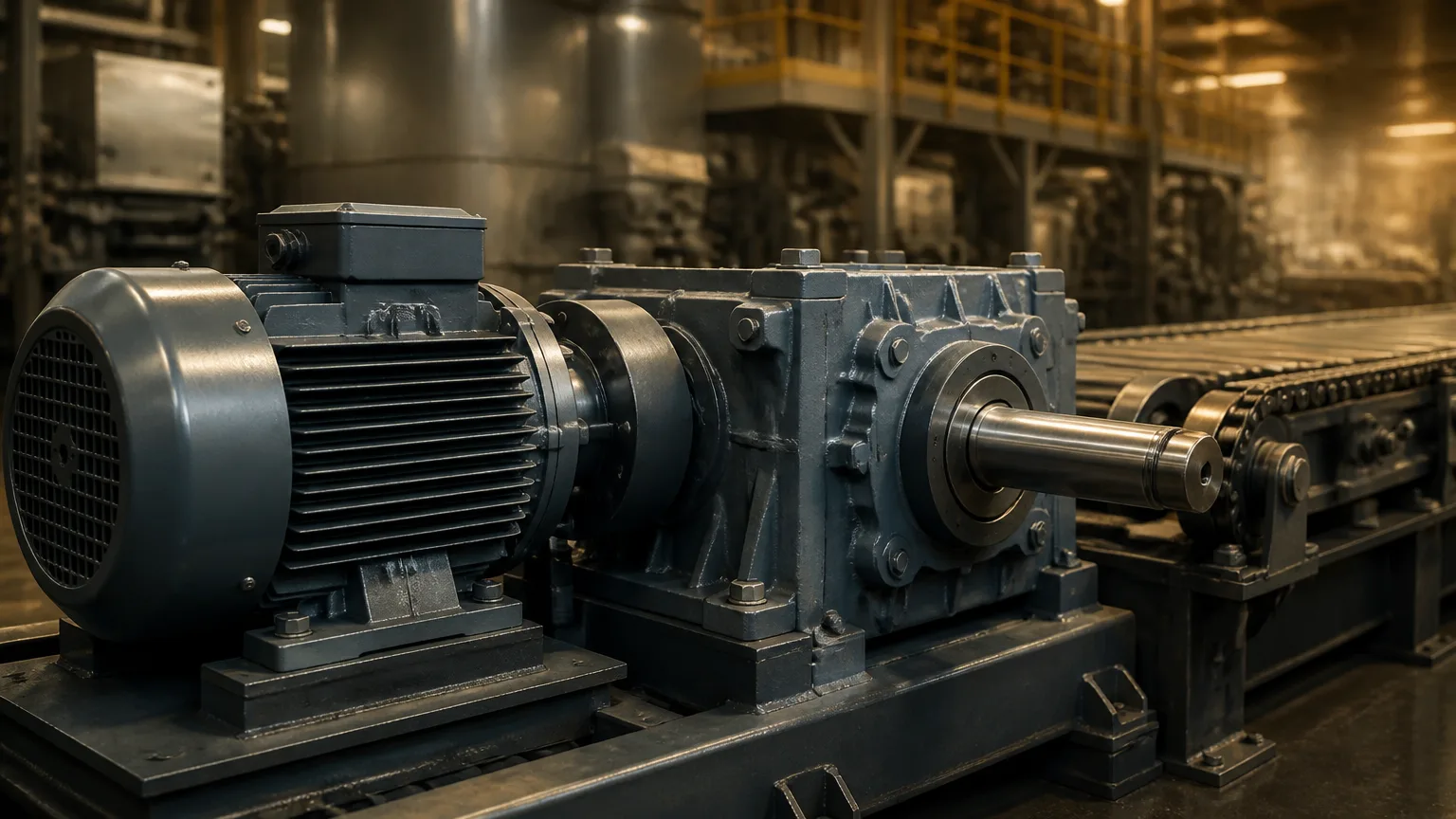
Electric motor applications power nearly every industrial environment, from manufacturing lines to processing plants. Yet selecting a motor alone does not guarantee reliable performance. The motor supplies rotational power, while the gearbox controls how that power reaches conveyors, mixers, pumps, crushers, elevators, and other equipment.
A gearbox adjusts motor speed and torque to match the machine’s load, operating cycle, and production demands. This motor-and-gearbox combination forms the core of an industrial drive system, making proper selection essential for efficiency, safety, and uptime.
This guide focuses on practical decisions: matching components, monitoring operating condition, and responding to wear before failures reduce production capacity. When damage occurs, an industrial gearbox rebuild may restore performance more economically than replacement. Understanding these systems helps maintenance and engineering teams protect output and plan repairs with confidence.
1. Conveyors and Material-Handling Equipment
Conveyors rely on electric motors to move materials steadily through mines, aggregate plants, cement facilities, grain terminals, and factories. Belt conveyors, screw conveyors, bucket elevators, and related systems require high starting torque, controlled speed, and continuous-duty performance. Motors must also withstand dust, shock loads, moisture, and changing material flow.
A gear reducer converts the motor’s high rotational speed into the lower speed and higher torque needed to move heavy loads safely. Correct sizing helps prevent belt slippage, product surges, and excessive mechanical stress. For demanding mining applications, selecting gearboxes for mining conveyors can improve reliability and service life.
Maintenance teams should investigate abnormal noise, overheating, vibration, oil leakage, or a slipping output. These warning signs can quickly lead to conveyor stoppages and costly production interruptions. Depending on the damage, repairing an existing gearbox may address a minor issue, while rebuilding can restore worn internal components. Replacement is often the better choice when the housing is damaged, parts are obsolete, or the unit is incorrectly rated. Selecting a properly rated gearbox supports reliable performance across essential electric motor applications.
2. Mixers, Agitators, and Process Equipment
Mixers and agitators support essential electric motor applications in chemical, food, pharmaceutical, wastewater, and other process facilities. These systems often require precise low-speed control and sustained torque to maintain consistent blending, suspension, or circulation. Gearboxes must also handle radial loads from shaft assemblies and thrust loads created by impellers or changing fluid resistance.
Selection depends on product viscosity, batch size, operating temperature, corrosive substances, and washdown requirements. A high-viscosity product may require greater torque capacity, while sanitary processes demand hygienic materials, protected seals, and compatible surface finishes. Variable-speed drives can further improve control across changing recipes and process stages.
Worn bearings, damaged gears, misalignment, inadequate lubrication, or seal failure can reduce mixing performance. These problems may also contaminate products, damage connected equipment, or interrupt production. Specialized inspection and repair can identify the failure source and restore dependable operation while preserving compatible mounting, shaft, and output specifications. For supported equipment, Lightnin gearbox repair for mixers and agitators can help return critical mixing systems to service without unnecessary replacement.
3. Pumps, Fans, and Air-Handling Systems
Pumps, fans, blowers, and ventilation equipment are central electric motor applications in industrial facilities. Motors drive centrifugal pumps for steady flow, while positive-displacement pumps deliver controlled volume at higher pressure. Fans and blowers move air through process, cooling, and extraction systems.
Direct-drive arrangements connect the motor directly to the equipment. They are efficient and mechanically simple when motor speed matches operating requirements. A geared arrangement is useful when the system needs lower speed, higher torque, or a different shaft orientation to fit the equipment layout.
Gearbox condition directly affects flow, pressure, and energy use. Cavitation can create damaging vibration in pumps, while fluid contamination can wear gears, bearings, and seals. Misalignment, changing flow demand, and continuous operation also increase mechanical stress. Guidance on pump gearbox repair can help identify common faults before failure.
Warning signs include declining pump output, unstable fan speed, excessive heat, and unusual vibration. Evaluate the complete drive train, including the motor, coupling, shafts, bearings, lubrication, and alignment. Replacing one component without finding the root cause may only delay another breakdown.
4. Crushers, Elevators, and Heavy-Duty Production Machinery
Crushers, conveyors, elevators, and production machinery place exceptional demands on electric motor applications. Mining, aggregates, recycling, steel, and cement facilities require drives that tolerate shock loads, dust, vibration, and frequent starts or reversals.
Selecting the right motor and gearbox requires more than matching horsepower. Engineers should verify torque capacity, service factor, thermal performance, impact resistance, and enclosure protection. Ratio, output speed, mounting orientation, and duty cycle must also match the equipment’s operating conditions.
Undersizing, overloads, poor alignment, contamination, and delayed lubrication can accelerate tooth wear and bearing failure. These issues may also damage shafts, couplings, and housings. Routine inspections, clean lubricant, correct guarding, and vibration monitoring help identify problems before they stop production.
When damage occurs, gearbox refurbishment versus replacement depends on the unit’s condition and lifecycle value. Repair may be practical when the housing and shafts remain serviceable. Replacement is often preferable when damage is extensive, parts are obsolete, or repeated failures indicate an unsuitable design.
Before ordering, confirm lead time, dimensional compatibility, ratio, motor horsepower, output speed, and mounting orientation. Check the availability of replacement parts and technical support as well. These factors can determine whether a drive returns to service quickly or creates a prolonged production delay.
Build Reliability Around the Complete Motor-and-Gearbox Assembly
Reliable electric motor applications begin with matching horsepower, speed, torque, duty cycle, environment, and gearbox configuration to the driven equipment. This approach supports sound maintenance and capital-planning decisions while reducing avoidable downtime.
Use condition-based inspections, vibration and temperature monitoring, proper lubrication, alignment checks, and documented maintenance histories. When repair or replacement is needed, an experienced provider can diagnose root causes, verify compatibility, and recommend the most economical path to dependable operation.