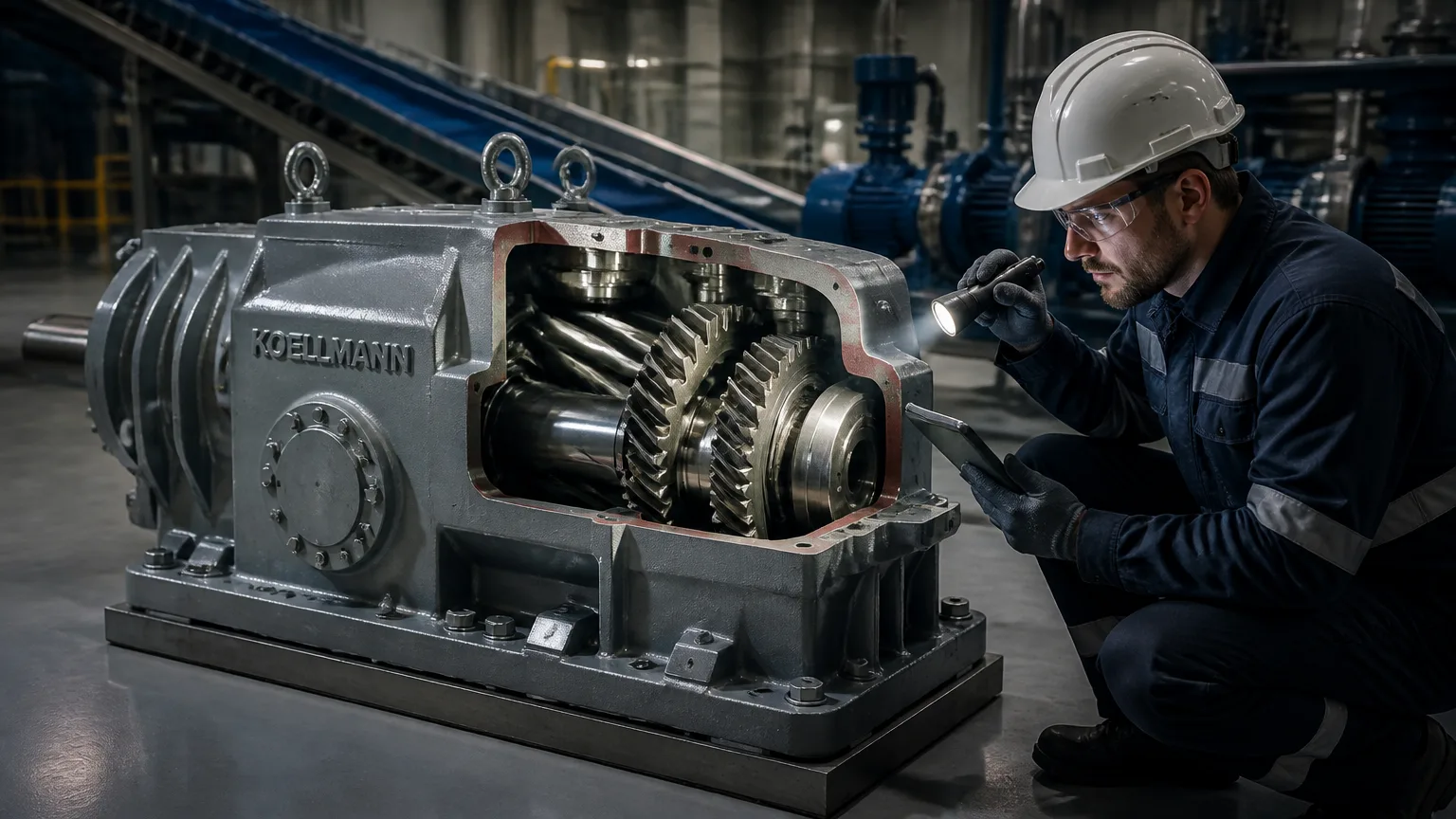
A Koellmann gearbox is a critical link in many industrial drive systems, supporting conveyors, mixers, pumps, mills, and processing equipment. When it develops a fault, the impact can extend beyond the gearbox, reducing throughput, affecting product quality, increasing energy use, and creating safety risks for plant personnel.
This guide helps maintenance managers, plant engineers, and procurement teams diagnose failures and choose the right response. The decision depends on damage severity, equipment age, parts availability, downtime limits, and the gearbox’s role within the complete drive system. Use this practical gearbox repair guidance to assess common faults, then determine when repair remains reliable and when replacement offers better long-term value. Expect clear steps for planning restoration, sourcing components, and minimizing operational disruption.
Recognizing Koellmann Gearbox Failure and Confirming the Cause
A Koellmann gearbox may require inspection when it develops abnormal noise, increased vibration, overheating, or oil leakage. Other warning signs include excessive backlash, inconsistent output speed, rising power consumption, and visible wear on gears, bearings, seals, or housings. These symptoms often indicate developing damage, even when production continues.
Before disassembly, document the operating conditions carefully. Record recent load changes, lubrication history, alignment measurements, shaft and coupling condition, and when each symptom first appeared. Note whether the problem occurs during startup, under peak load, at a specific speed, or continuously. This information helps technicians separate gearbox faults from issues in the motor, coupling, shaft, brake, or driven machine.
Several causes can produce similar symptoms. Contamination, misalignment, overloading, poor lubrication, bearing failure, and damaged gear teeth may all create noise, heat, vibration, or speed variation. A root-cause diagnosis is therefore essential before repairing or replacing the koellmann gearbox.
Technicians can confirm the source through oil analysis, vibration monitoring, temperature checks, and backlash measurement. Visual examination of the gears, bearings, seals, and housing can reveal scoring, pitting, cracks, looseness, or lubricant breakdown. Comparing these findings with motor current, coupling condition, and driven-equipment performance helps identify the true failure point.
When Repair or Rebuilding Is the Better Option
Repair is often economical when damage is limited and the gearbox housing remains sound. Typical work includes replacing seals, bearings, fasteners, or individual damaged components. This approach can restore reliable operation without disturbing the complete drive arrangement.
A full rebuild is appropriate when wear is widespread or the failure requires deeper inspection. It typically includes cleaning, dimensional inspection, gear replacement, shaft repair or machining, and controlled reassembly. The decision should consider load, operating hours, speed, lubrication history, and the condition of the motor, coupling, and driven equipment.
Refurbishing a koellmann gearbox can reduce installation changes when its housing, mounting arrangement, ratio, and shaft configuration remain suitable. Existing interfaces may eliminate base modifications, coupling changes, and alignment delays. This can shorten the return-to-service timeline compared with sourcing and installing a different gearbox.
Quality control determines whether rebuilding delivers lasting value. The repair provider should use correct replacement parts, consult engineering drawings, and verify critical dimensions before assembly. Technicians must also set backlash accurately, follow the specified lubrication requirements, and document testing under appropriate load or operating conditions.
Refurbishment is especially attractive when the gearbox is correctly sized and the original failure’s root cause can be verified and corrected. For a broader cost and risk comparison, review gearbox refurbishment versus replacement before authorizing major work.
When Koellmann Gearbox Replacement Makes More Sense
Repair may no longer be practical when the housing is cracked, severely worn, or unable to hold bearing and seal tolerances. Replacement also deserves serious consideration after repeated failures, extensive gear or shaft damage, or when critical components are obsolete or unavailable. If repair costs approach the price of a suitable replacement, continued restoration may increase downtime without improving reliability.
Capacity is another important trigger. A correctly maintained Koellmann gearbox may still be unsuitable if production demands have increased or the original unit was undersized. Engineers should compare options from established gearbox manufacturers in the USA and verify torque, ratio, speed, service factor, duty cycle, thermal requirements, mounting dimensions, shaft orientation, and environmental conditions.
Do not select a unit based only on horsepower or physical fit. It must operate correctly with the motor, coupling, brake, conveyor, mixer, pump, or other driven equipment. Finally, compare total lifecycle cost, including installation modifications, alignment, commissioning, spare parts, efficiency, downtime, and future maintainability. A higher purchase price may deliver lower operating risk and better long-term value.
Planning the Repair or Replacement Project
Before contacting a provider, collect the Koellmann gearbox nameplate, model, serial number, photographs, drawings, application details, operating speed, torque, lubricant data, failure history, and maintenance records. This information supports accurate diagnosis and helps with choosing a gearbox rebuild service.
Plan removal and installation before the unit reaches the repair shop. Confirm lifting equipment, flushing requirements, alignment procedures, coupling inspection, foundation condition, and spare-part availability. Coordinate these tasks with production so the replacement window limits downtime.
Request a written scope covering inspection findings, repair-versus-replace recommendations, lead time, testing, warranty terms, and acceptance criteria. For a repaired or replacement koellmann gearbox, verify lubrication, rotation direction, alignment, fastener torque, temperature, vibration, noise, and load performance during commissioning. Schedule a follow-up inspection after initial operation to identify developing problems early.
Keeping a Koellmann Gearbox Reliable After Service
Reliable service starts with confirming the failure and correcting its root cause. Assess the housing and internal components, compare repair and replacement costs, verify compatibility, and plan a controlled installation. Proper alignment, commissioning, and load testing then confirm the gearbox is ready for operation.
Prevent another unplanned shutdown with defined lubrication intervals, vibration and temperature baselines, alignment checks, inspection records, and critical-spares planning. These controls help identify wear before it affects production. Experienced industrial gearbox specialists can validate the repair or replacement scope and protect both equipment reliability and production continuity.