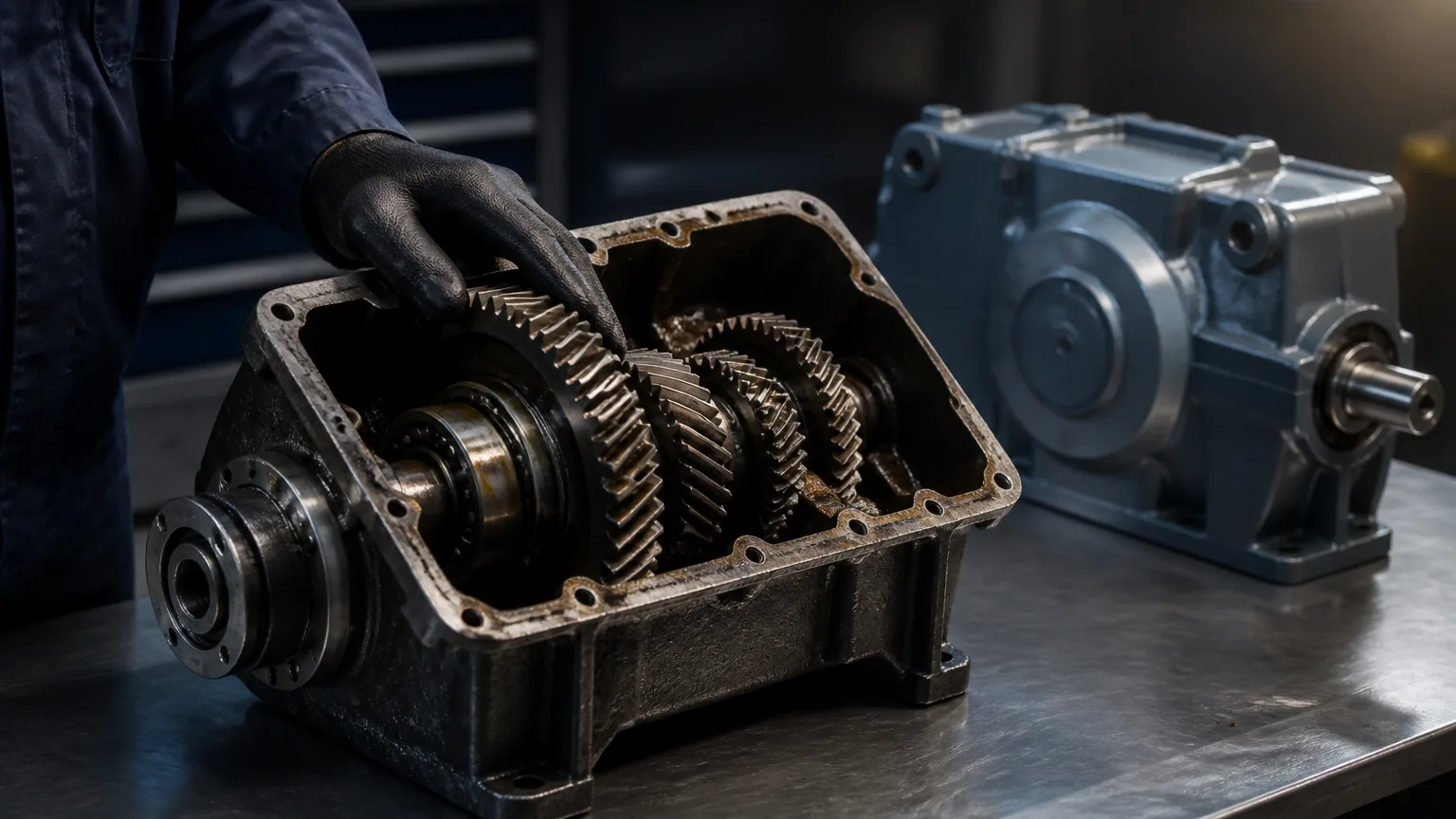
When a link belt gearbox develops noise, vibration, overheating, leakage, or reduced performance, manufacturers must decide quickly: repair it or replace it. The right answer rarely comes from the initial repair quote alone. Failure severity, equipment age, parts availability, downtime risk, and total lifecycle cost all deserve careful consideration.
A gearbox is only one part of the power-transmission system. Motor condition, alignment, lubrication, and driven-load demands can create or worsen gearbox symptoms, so inspect the complete system. Understanding different electric motor types can also help identify related causes. Emergency troubleshooting may restore operation temporarily, but it is not a full repair-versus-replace evaluation. A structured inspection can prevent an unnecessary replacement—or an uneconomical rebuild—and guide a cost-effective decision.
Start With a Condition Assessment and Failure Diagnosis
Before repairing or replacing a Link Belt gearbox, maintenance teams should complete a structured condition assessment. Begin with a visual inspection for oil leaks, cracked housings, loose fasteners, damaged seals, and signs of overheating. Record operating speed, torque, load cycles, lubrication type, maintenance history, and the circumstances surrounding the failure. This information supports accurate gearbox failure diagnosis.
Check the oil for the correct level, viscosity, contamination, metal particles, water, and unusual odor. Measure operating temperature and compare it with normal readings. Overheating can result from poor lubrication, overload, misalignment, or inadequate ventilation. Abnormal noise may indicate gear-tooth damage, bearing wear, or another internal fault.
Inspect shafts for scoring, bending, excessive runout, or looseness. Evaluate bearing condition, gear-tooth wear patterns, backlash, pitting, and surface cracking. Housing damage may reveal impact, distortion, or a mounting problem that makes rebuilding uneconomical.
Do not judge the gearbox in isolation. Inspect the coupling, motor, foundation, and driven equipment for misalignment, imbalance, soft foot, or excessive loads. Vibration measurements and operating history can help separate internal damage from external causes. Correcting these related problems is essential to prevent repeat failures after repair or replacement.
When Repairing a Link Belt Gearbox Makes Sense
Repairing a link belt gearbox often makes sense when its housing remains structurally sound. A rebuild is also practical when core components are available and damage is limited to replaceable wear parts. Bearings, seals, shafts, damaged gears, and other serviceable components can often be replaced without changing the gearbox’s proven design or existing installation.
An experienced rebuild begins with complete disassembly and cleaning. The technician should inspect housing dimensions, shafts, bearing seats, and gear condition. Gear-contact patterns and backlash checks can reveal alignment or tooth-wear problems that may not appear during a basic visual inspection.
The rebuild should include new bearings and seals when wear or contamination is present. Correct lubrication is equally important, followed by no-load and load testing when appropriate. These steps verify smooth operation, temperature control, noise levels, and torque transmission before the unit returns to service.
Repair can also reduce procurement delays. A replacement gearbox may require changes to mounting points, shaft dimensions, couplings, or gear ratios. Rebuilding the existing unit preserves these established interfaces and can limit installation work. This advantage is especially valuable when production downtime carries a high cost or a suitable replacement is not readily available.
When Replacement Is the Safer, More Economical Choice
Replacement is often the better decision when a Link Belt gearbox has catastrophic gear, shaft, bearing, or housing damage. If several major components require replacement, the repair scope may approach the cost of a new or remanufactured unit. A rebuild or replace a gearbox assessment should compare total costs, downtime, warranty coverage, and expected service life.
An obsolete design can also make rebuilding impractical. Replacement parts may be unavailable, lead times may be unacceptable, or specialized machining may delay production for weeks. Repeated failures, poor efficiency, inadequate torque capacity, or an unsuitable speed ratio are further signs that rebuilding will not solve the underlying problem.
Review operating conditions before selecting a replacement. Chronic overload, higher duty cycles, changed production requirements, recurring contamination, and poor lubrication can exceed the original gearbox’s design limits. A new unit should address these causes rather than reproduce the same weaknesses.
Specify the replacement by torque, ratio, input and output speed, mounting arrangement, shaft configuration, service factor, and operating environment. Confirm compatibility with the motor, coupling, foundation, and driven equipment. Correct specification prevents installation problems and protects the new link belt gearbox from premature failure.
Compare Total Cost, Downtime, and Long-Term Reliability
Make the final decision by comparing at least two scenarios: a documented rebuild and a correctly specified replacement. Include the total installed cost, not just the repair invoice. Account for labor, freight, alignment, commissioning, spare parts, and expected downtime.
Production losses can quickly outweigh the initial price difference. A low-cost rebuild may provide poor value if it leaves unresolved root causes, requires frequent maintenance, or offers limited remaining service life. Compare each option’s lead time, expected life, energy performance, warranty coverage, maintenance requirements, and risk of repeat failure. These factors support stronger industrial gearbox reliability solutions.
Match reliability and maintainability to production criticality. Repair may be practical for a noncritical spare-drive application, especially when interfaces are sound. A bottleneck asset may justify replacement or a ready-to-install spare, reducing exposure to another failure. For any link belt gearbox decision, document assumptions and use verified inspection findings rather than price alone. Ensure the selected option also addresses alignment, loading, lubrication, and operating conditions that caused the original failure.
Make the Link Belt Decision With Evidence
Neither repair nor replacement is automatically correct for a link belt gearbox. Base the decision on inspection findings, engineering requirements, lifecycle cost, capacity changes, obsolescence, and the financial risk of extended downtime.
Request a written inspection report, repair scope, replacement specification, estimated lead time, warranty, and commissioning plan from a qualified gearbox repair provider. Repair a structurally sound, serviceable gearbox with manageable damage. Replace it when damage, obsolescence, capacity changes, or downtime risk make rebuilding uneconomical.
Preventive vibration monitoring, oil analysis, alignment checks, and scheduled inspections can improve the next decision—and help prevent another failure.