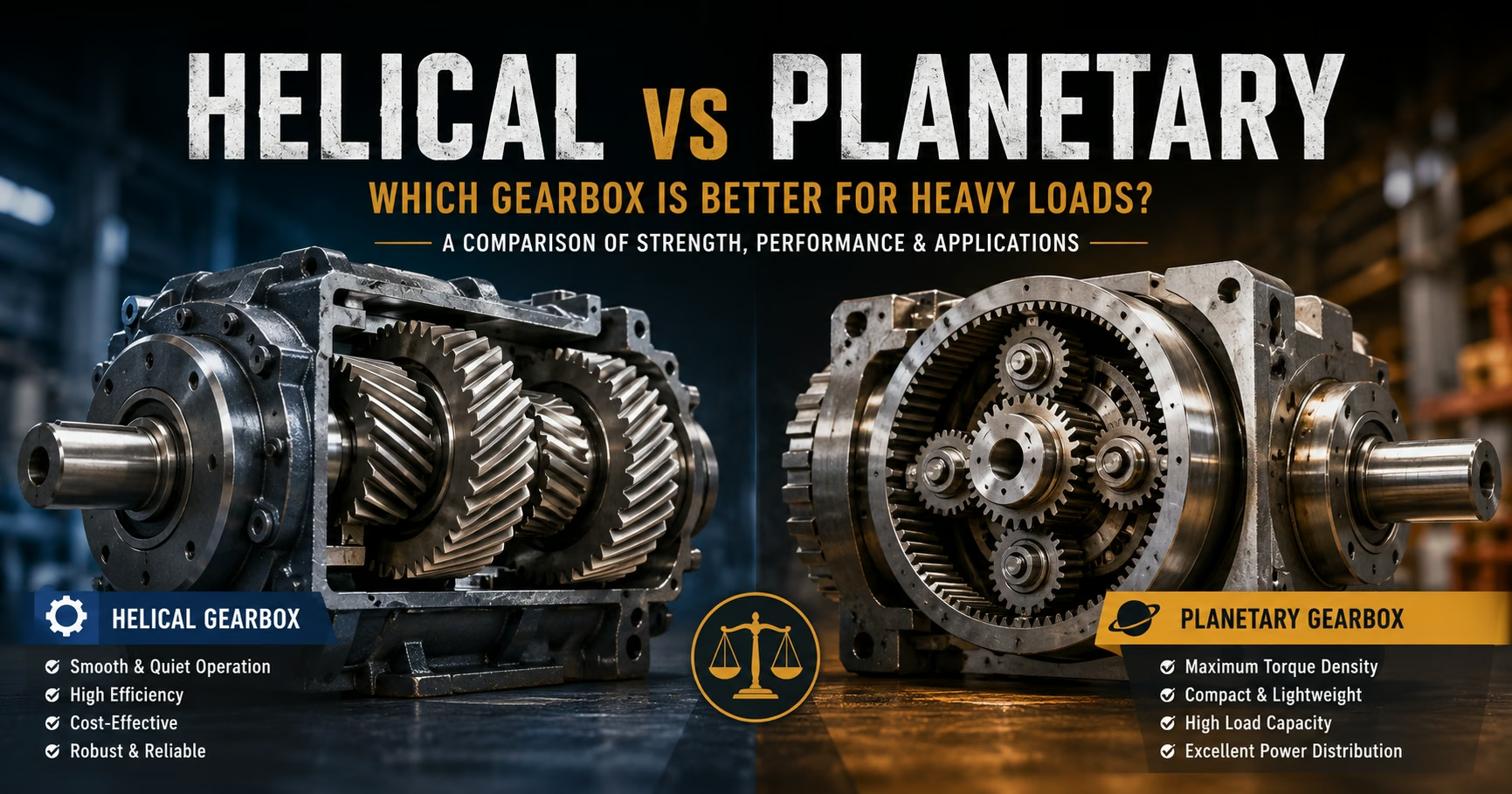
When you’re dealing with really heavy loads, choosing the right gearbox is a big deal. You’ve probably heard of helical and planetary gearboxes, and each has its strengths when it comes to brute force. So, which one’s better for those demanding applications?
In short, for sheer torque density and compact size under very heavy loads, planetary gearboxes often have an edge. However, helical gearboxes can be more cost-effective and robust for certain high-torque, lower-speed applications. The “better” choice really boils down to the specifics of your project. Let’s break down what makes each tick and when you’d lean one way or the other.
Before we dive into which is “better,” it’s helpful to remember a bit about how these gearboxes work and what their key components are. It’s not about memorizing diagrams, but understanding the fundamental differences that lead to their performance characteristics.
Helical Gearboxes: The Angled Approach
Think of helical gears as the refined cousins of spur gears. Instead of teeth cut straight across the gear face, they’re cut at an angle, or helix. This angled tooth meshing is the key to their effectiveness, especially when you’re pushing things around.
How the Angled Teeth Help
This slight twist in the teeth means that the load is distributed across multiple teeth at any given moment. It’s not an instant, all-or-nothing engagement like with spur gears. This gradual engagement spreads the force, leading to smoother operation and reduced noise. For heavy loads, this means less shock and vibration, which translates to longer component life.
Common Configurations
Helical gearboxes come in various arrangements. You’ll often see single-stage (one set of helical gears) and multi-stage (multiple sets) units. The type you’ll encounter for heavy loads are typically multi-stage helical reducers, where each stage adds to the reduction ratio and torque output. The shafts can be arranged parallel to each other, which is common for driving two parallel shafts.
Planetary Gearboxes: The Compact Powerhouses
Planetary gearboxes are a bit more complex in their arrangement, but that complexity is where their strength lies, especially for high torque in a small package. They get their name from how they are constructed, mimicking the solar system.
The Sun, Planets, and Ring
A planetary gearbox has three main components: a central “sun” gear, several “planet” gears that revolve around the sun, and an outer “ring” gear that encloses everything. The planet gears are typically mounted on a carrier, which is what rotates and transmits power.
How the Load Distribution Works
The genius of the planetary design is that the input torque from the sun gear (or sometimes the ring gear) is distributed evenly across all the planet gears. This means that the load is shared among multiple gear teeth simultaneously, just like with helical gears, but often in a more concentrated and efficient way due to the compact arrangement.
When considering the best gearbox options for heavy loads, it’s essential to explore various types, including helical and planetary gearboxes. For a deeper understanding of gear systems and their maintenance, you might find the article on Amarillo gears particularly insightful. It provides comprehensive information on repair and replacement solutions that can enhance the performance and longevity of your gear systems. You can read more about it in this article: The Ultimate Guide to Amarillo Gears Repair & Replacement Solutions.
Helical Gearboxes: Strength and Simplicity for the Long Haul
Helical gearboxes are often the go-to for many industrial applications, and for good reason. They offer a solid balance of performance, durability, and cost, especially when dealing with substantial forces.
Torque Handling Capabilities
While planetary gearboxes are often lauded for their torque density, helical gearboxes are still very capable of handling significant loads. Their strength comes from the continuous, overlapping contact between the angled teeth. This distributes the stress over a larger surface area compared to spur gears, making them more resilient to the demands of heavy machinery.
When “Good Enough” is Great
For many heavy-duty scenarios where extreme compactness isn’t the absolute highest priority, a well-engineered helical gearbox can provide more than enough torque and longevity. Think of conveyor systems, large mixers, or even certain types of material handling equipment.
Advantages in Specific Scenarios
There are certain situations where a helical gearbox might actually be the preferred choice, even when load capacity is a primary concern. Thinking about these nuances can save you time and money in the long run.
Cost-Effectiveness: The Budget-Conscious Choice
Generally speaking, helical gearboxes tend to be more cost-effective than planetary gearboxes, especially for similar torque ratings. The manufacturing process for helical gears is often less intricate, and the overall assembly can be simpler, leading to lower initial purchase prices. This is a significant factor when you’re equipping multiple machines or dealing with projects with tight budgets.
Robustness and Durability: Built to Last
The relatively simpler construction of helical gearboxes can also contribute to their robustness. With fewer moving parts and a straightforward design, they can often withstand harsh operating environments, shocks, and vibrations effectively. This resilience makes them a reliable choice for continuous operation in demanding industrial settings where reliability is paramount.
Ease of Maintenance and Repair
When maintenance or repair is required, helical gearboxes often present a more straightforward solution. Their design usually allows for easier access to individual gear sets or bearings. This can translate to reduced downtime and lower labor costs for servicing, which is a practical consideration for any heavy-duty application.
Planetary Gearboxes: The Torque Kings of Compactness
Planetary gearboxes are where you go when you need a serious amount of torque packed into the smallest possible footprint. Their unique design allows them to deliver impressive power without becoming ridiculously large, which is a huge advantage in many space-constrained heavy-duty applications.
Unmatched Torque Density: Power in a Small Package
This is the headline feature of planetary gearboxes. The way the load is shared among the sun, planet, and ring gears allows them to handle incredibly high torque outputs relative to their size. This is crucial for applications where space is at a premium, but the power requirements are immense.
The “Surrounding” Effect
Imagine the sun gear being hugged by the planet gears, which are themselves embraced by the ring gear. Each tooth on every gear is working together to transmit the torque. This concentric arrangement is incredibly efficient at concentrating torque into a small volume.
High Efficiency and Smooth Operation
Beyond just packing a punch, planetary gearboxes are also known for their efficiency. Because the load is distributed so well, there’s less slippage and friction compared to some other gearbox designs when dealing with high torque. This means more of the input power is actually translated into useful output power, and less is wasted as heat. This efficiency also contributes to their smooth running characteristics.
Minimizing Energy Loss
Every bit of energy saved through efficient gear meshing directly translates into operational cost savings and reduced wear and tear. For heavy loads that are constantly operating, this efficiency can add up significantly over time.
Advantages in Specific Scenarios
While compactness and torque density are their main selling points, their design offers other benefits that make them a strong contender for heavy loads.
Handling Shock Loads: Absorbing the Blow
The distributed nature of torque transmission in planetary gearboxes makes them surprisingly good at absorbing shock loads. When a sudden jolt or impact occurs on the output shaft, the force is spread across multiple teeth and gears, preventing a single point of failure and reducing the stress on the entire system. This is invaluable for applications that experience dynamic forces.
High Reduction Ratios: Big Changes in Speed
Planetary gearboxes excel at achieving very high gear reduction ratios within a single unit. This means you can achieve a significant drop in output speed while simultaneously increasing the output torque. This is essential for applications that require a slow, powerful output, like industrial robots, crane operations, or heavy-duty winches.
Quiet Operation: Less Noise, More Focus
The smooth, continuous engagement of teeth in a planetary gearbox, coupled with the distributed load, generally results in quieter operation compared to some other gearbox types, especially under heavy load. This can be beneficial in environments where noise pollution is a concern or where operator comfort is important.
Sure, here is the sentence with the clickable link:
Please feel free to contact Industrial Gearbox Solutions for any inquiries.
Helical vs. Planetary: Direct Comparison for Heavy Loads
Now, let’s put them head-to-head specifically for those demanding, heavy-load situations. It’s less about which is universally better and more about which is better for your specific needs.
Torque Capacity: Who Reigns Supreme?
When we talk about raw torque output relative to size, planetary gearboxes often take the crown. Their ability to distribute immense forces across multiple gear sets within a compact housing is a significant advantage.
Torque Density Defined
Torque density refers to how much torque a gearbox can handle for its physical size and weight. Planetary gearboxes are designed to maximize this. The sun gear is driven, and its torque is multiplied and distributed through the planet gears to the output carrier. This inherent sharing of load across multiple elements allows for very high torque capacity in a small envelope.
Helical’s Torque Story
Helical gearboxes also offer substantial torque capacity, especially when configured with multiple stages and larger gear sizes. However, to achieve the same torque output as a planetary gearbox, a helical unit might need to be physically larger and heavier.
Size and Weight: The Space Factor
This is where the distinctions become very clear. If you’re tight on space, planetary gearboxes are often the only viable option.
Compactness is Key
For mobile machinery, robotic arms, or any application where a small footprint is critical, a planetary gearbox can often fit where a comparable helical gearbox simply wouldn’t. The concentric arrangement is incredibly efficient in this regard.
Weight Considerations
The compact nature of planetary gearboxes also means they are often lighter for a given torque output compared to their helical counterparts. This can be an important factor in weight-sensitive designs.
Efficiency: Pushing More Power
Both offer good efficiency, but their strengths lie in different areas.
Planetary’s High-Stage Efficiency
Planetary gearboxes tend to maintain very high efficiency even at high reduction ratios and high torque loads. This is due to the smooth, consistent meshing and load distribution.
Helical’s Broad Efficiency
Helical gearboxes are efficient across a wide range of speeds and loads, but their efficiency can sometimes dip slightly at very high reduction ratios compared to planetary units. However, for many common heavy-duty applications, their efficiency is more than adequate.
Cost: The Practical Reality
When budget is a significant driver, the differences become even more pronounced.
Initial Investment
As mentioned earlier, helical gearboxes often have a lower upfront cost. The simpler manufacturing and assembly process for helical gears makes them a more economical choice for many standard heavy-duty applications.
Long-Term Value
However, for applications where space is extremely limited and very high torque is required, the cost of a planetary gearbox might be justified by its ability to meet those critical design requirements. The long-term efficiency of a planetary unit can also lead to savings in energy consumption.
Noise and Vibration: The Comfort Factor
The nature of the gear meshing has a direct impact on the acoustic and vibration profile of the gearbox.
Helical’s Smoothness
The angled teeth of helical gears inherently produce smoother and quieter operation due to the gradual engagement and load distribution. This leads to reduced vibration transmitted to the connected machinery.
Planetary’s Quiet Power
Planetary gearboxes are also typically very quiet and smooth-running, especially under load. The multiple teeth engaging simultaneously and the well-balanced design contribute to minimal noise and vibration. In many cases, they can be quieter than helical gearboxes for equivalent torque output.
When considering the best gearbox for heavy load applications, the debate between helical and planetary gearboxes is crucial. Each type offers distinct advantages in terms of efficiency and load distribution. For those looking to delve deeper into the intricacies of gearbox performance and maintenance, a related article on industrial gearbox repair provides valuable insights. You can explore this topic further by visiting this link, which discusses the importance of proper maintenance to ensure optimal performance of gear systems.
When to Choose Helical for Heavy Loads
| Criteria | Helical Gearboxes | Planetary Gearboxes |
|---|---|---|
| Load Capacity | Good for heavy loads | Excellent for heavy loads |
| Efficiency | High efficiency | Very high efficiency |
| Noise Level | Higher noise level | Lower noise level |
| Size and Weight | Bulky and heavy | Compact and lightweight |
| Cost | Lower initial cost | Higher initial cost |
While planetary gearboxes get a lot of attention for heavy-duty applications, there are still many scenarios where a robust helical gearbox is the optimal choice. It’s about understanding where its strengths align perfectly with your needs.
High Torque, Moderate Speed Requirements
If your application demands high torque but doesn’t necessarily require extremely high reduction ratios or ultra-high speeds, a helical gearbox can be an excellent fit. The power output is substantial, and the durability is well-proven.
Think Conveyor Systems
Large industrial conveyor belts, for example, often require significant torque to move heavy materials. A multi-stage helical gearbox can provide this reliably and cost-effectively without needing the extreme compactness of a planetary unit.
Cost-Sensitive Large-Scale Deployments
When you’re outfitting a large facility or a fleet of machines, the cost savings associated with helical gearboxes can be substantial. If the application doesn’t demand the absolute highest torque density or the most compact footprint, going with helical can significantly reduce your capital expenditure.
Strategic Investment
It’s about making smart investments. If a slightly larger helical gearbox will perform the job adequately and at a substantially lower cost, it’s often the more practical decision.
Robustness in Challenging Environments
Helical gearboxes are known for their inherent toughness. The simpler design can sometimes mean fewer potential failure points in extremely harsh environments involving dust, dirt, or significant impact.
Simplicity as a Strength
In some extremely rugged settings, a well-sealed and robust helical gearbox might be preferred for its straightforward mechanical reliability.
When considering the best gearbox solution for heavy loads, it’s essential to understand the differences between helical and planetary gearboxes. A related article that delves deeper into the intricacies of gearbox repair and maintenance can provide valuable insights for those looking to optimize their machinery performance. For more information on this topic, you can check out the article on industrial gearbox repair in Buffalo, NY. This resource can help you make informed decisions regarding your gearbox needs.
When to Choose Planetary for Heavy Loads
Planetary gearboxes truly shine when you have demanding requirements that other gearboxes struggle to meet. Their unique design unlocks capabilities that are essential in modern, high-performance machinery.
Extreme Torque in Limited Space
This is the quintessential planetary gearbox application. When you need massive torque but have very little room to work with, a planetary unit is often the only solution.
Robotics and Automation
The arms and joints of industrial robots, for instance, require immense torque for precise and powerful movements, all within a confined space to allow for maneuverability.
Mobile Equipment
In construction vehicles, agricultural machinery, or other mobile equipment where space is at a premium, planetary gearboxes are essential for powering drive systems, winches, and lifting mechanisms.
High Shock Load Absorption
Applications that experience sudden, significant impacts or jolts benefit greatly from the inherent shock load capabilities of planetary gearboxes.
Crane Operations
Lifting heavy loads with cranes can involve dynamic forces and sudden stops. The planetary design helps to absorb these shocks, protecting the drivetrain.
Material Handling with Impacts
Think of applications where heavy items are dropped or impact a conveyor. The planetary gearbox’s ability to distribute these forces is critical for longevity.
Applications Requiring Very High Reduction Ratios
Achieving extremely high gear reduction ratios is fundamental to many heavy-duty applications, and planetary gearboxes excel at this.
High-Torque, Low-Speed Drives
Many industrial processes require very slow, powerful rotation. Planetary gearboxes can provide these high reduction ratios efficiently within a single stage or a compact multi-stage unit.
Specialized Machinery
For bespoke machinery that needs precise, slow, and powerful rotation, planetary gearboxes offer the necessary performance characteristics.
Making the Final Decision: Key Considerations
You’ve got the breakdown of helical and planetary, but how do you actually decide? It’s about asking the right questions about your specific project. Don’t just pick one based on a general statement; dig into the details.
1. What are the Exact Torque Requirements?
This is the most obvious. Don’t guess. Get precise figures for your peak torque, continuous torque, and any shock loads.
Peak vs. Continuous Torque
Understand the difference between the absolute maximum torque your application might briefly encounter (peak) and the torque the gearbox will regularly transmit (continuous).
Dynamic Load Factors
Consider if your load is constant or if it involves fluctuating demands and potential shock inputs. This influences the safety factors you need to apply.
2. How Much Space is Available?
Measure it, don’t estimate it. The physical constraints of your installation are a critical deciding factor.
Footprint and Length
Consider both the circular space (footprint) and the linear space (length) the gearbox will occupy, along with any necessary mounting arrangements.
Mounting Orientation
How will the gearbox be mounted? Vertically, horizontally, or at an angle? This can affect lubrication and cooling, and influences the available space.
3. What is the Required Output Speed and Reduction Ratio?
High reduction means slow output speed. The ratio directly impacts the gearbox design.
Speed Reductions
If you need to go from a high-speed motor to a very slow output, the reduction ratio will be a significant factor. Planetary gearboxes often excel at achieving very high ratios in a compact package.
Operational Speed Range
Consider the full range of speeds the gearbox will operate at, not just the nominal speed.
4. What is the Operating Environment Like?
Harsh conditions demand robust solutions.
Temperature Extremes
Will the gearbox be exposed to high or low temperatures? This impacts lubricant choice and sealing.
Contamination (Dust, Water, Chemicals)
Is the environment dusty, wet, or exposed to corrosive chemicals? Proper sealing and material selection are vital.
Vibration and Shock
Will there be constant heavy vibration or occasional significant impacts? This points towards designs with better shock absorption.
5. What is Your Budget?
This is always a practical consideration. Balance upfront cost with long-term value.
Initial Purchase Price
Helical gearboxes are often cheaper initially. Planetary gearboxes tend to be more expensive upfront.
Total Cost of Ownership
Consider maintenance, energy consumption (efficiency), and expected lifespan. A more expensive gearbox might save money in the long run.
6. What are the Maintenance and Serviceability Needs?
Think about who will be servicing the gearbox and how often.
Ease of Access
Some gearbox designs are easier to access for routine checks and maintenance.
Availability of Parts and Expertise
Consider the availability of spare parts and the expertise needed for repairs in your location.
By carefully considering these factors, you can move beyond generalities and make an informed decision about whether a helical or planetary gearbox is the right workhorse for your heavy-load application.
FAQs
What are helical gearboxes?
Helical gearboxes are a type of gearbox that uses helical gears to transmit power and motion. These gears have teeth that are cut at an angle to the face of the gear, allowing for smoother and quieter operation compared to other types of gears.
What are planetary gearboxes?
Planetary gearboxes are a type of gearbox that uses a system of gears, including a central sun gear, planet gears, and a ring gear, to achieve high gear reduction in a compact space. This design allows for high torque transmission and efficiency.
What are the advantages of helical gearboxes for heavy loads?
Helical gearboxes are known for their ability to handle heavy loads and high torque applications. They offer smooth and quiet operation, high efficiency, and the ability to handle shock loads and vibrations, making them suitable for heavy-duty industrial applications.
What are the advantages of planetary gearboxes for heavy loads?
Planetary gearboxes are also well-suited for heavy loads due to their high torque transmission capabilities and compact design. They offer high efficiency, precise motion control, and the ability to handle shock loads, making them ideal for heavy-duty applications in industries such as mining, construction, and material handling.
Which type of gearbox is better for heavy loads: helical or planetary?
The choice between helical and planetary gearboxes for heavy loads depends on specific application requirements. Helical gearboxes are known for their smooth and quiet operation, while planetary gearboxes offer high torque transmission and compact design. Both types have their advantages, and the decision should be based on factors such as load capacity, space constraints, efficiency, and cost.