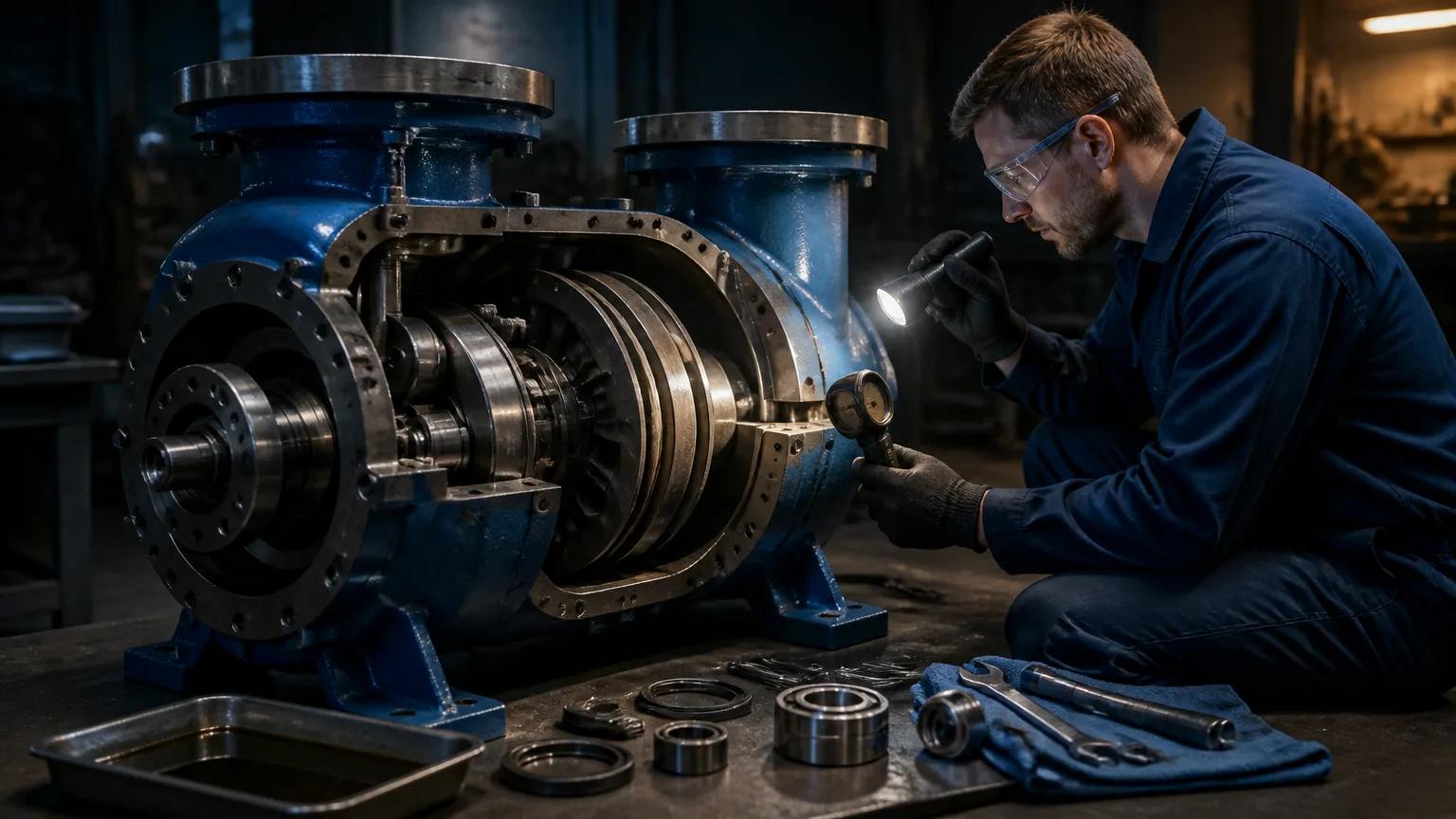
Nash vacuum pump repair deserves prompt attention because these pumps support critical manufacturing and industrial processes. Abnormal noise, vibration, overheating, oil contamination, or declining vacuum performance may signal developing mechanical problems—not normal operating variation. Early action protects uptime and reliability.
Professional diagnosis should come first. Continuing to run a damaged pump can turn a seal, bearing, or lubrication issue into major gearbox or rotor failure. Repair planning also benefits from broader pump-service experience, including emergency pump repair services when production risks are high. However, each failure requires a response matched to the pump’s condition, drive components, and operating demands.
Common Nash Vacuum Pump Problems to Recognize Early
Early warning signs include loss of vacuum, reduced capacity, and excessive power draw. These symptoms may result from worn bearings, damaged gears, shaft misalignment, or inadequate lubrication. They can also originate in the motor, clogged filters, process restrictions, or connected piping.
Unusual vibration and abnormal gear or bearing noise often indicate mechanical wear or alignment problems. Rising operating temperature may point to incorrect oil levels, poor lubrication, overloaded components, or process contamination. Oil leaks commonly result from deteriorated seals, damaged housings, or excessive internal pressure.
Symptoms frequently overlap, so diagnosis should match the pump’s specific Nash configuration and duty cycle. Different industrial gearbox types support different applications, loads, and cooling requirements. A symptom caused by the gearbox in one installation may involve the motor or process system in another.
Before disassembly, operators should record vacuum levels, flow, power consumption, sound changes, temperature trends, and recent maintenance. This information helps technicians separate pump faults from gearbox, motor, and system issues. It also supports faster, more accurate Nash vacuum pump repair planning.
How Technicians Diagnose Nash Pump and Gearbox Failures
Technicians begin with a safe inspection and review of operating history. They record vibration readings, bearing and casing temperatures, oil condition, and recent vacuum and flow data. They also check coupling alignment, motor condition, belts or other drives, and suction and discharge conditions. These checks can separate pump problems from system, motor, or gearbox faults.
Next, technicians inspect the assembly for leaks, unusual noise, loose fasteners, and signs of overheating. If external checks do not identify the fault, they remove and document components during teardown. Gears, shafts, bearings, seals, housings, and keyways are examined for scoring, pitting, cracks, excessive wear, and heat damage. Dimensional checks confirm shaft runout, bearing fits, gear backlash, and critical clearances.
Accurate gearbox failure diagnosis must identify the original cause before rebuilding. Misalignment, overload, contamination, lubrication breakdown, and improper installation can otherwise cause repeat failures.
For reliable nash vacuum pump repair, the final report should include measured clearances, replacement parts, inspection photos, and test results. This documentation helps the facility compare repair costs, risks, and expected service life against replacement.
Nash Vacuum Pump Repair Options: Rebuild, Component Replacement, or Exchange
A standard rebuild is often suitable when the gearbox or pump remains structurally sound. Technicians clean and inspect the assembly, replace bearings and seals, evaluate gears, check shafts, repair the housing, then reassemble, align, and operationally test the unit. This option can restore dependable performance while preserving the existing equipment.
Selective component replacement may reduce cost and lead time when major components remain serviceable. For example, technicians may replace worn bearings, seals, couplings, or damaged gears without replacing the housing, shafts, or complete drive assembly. This approach requires accurate inspection and clear evidence that retained components can support continued operation.
Complete gearbox repair or replacement is more appropriate when gears, shafts, housings, or bearing seats have extensive damage. Machining may be required, and repair lead times can increase when replacement parts are unavailable. A like-for-like replacement may reduce installation risk by limiting modifications to mounting, alignment, and connected systems.
When evaluating nash vacuum pump repair options, compare more than the initial quote. Consider total downtime, parts availability, warranty coverage, machining requirements, and the cost of an unplanned repeat failure. Facilities can also review what to expect from a professional gear repair service before selecting a repair partner.
When Gearbox Repair or Replacement Is the Better Choice
Repair is often practical when the gearbox housing remains intact, replacement gears are available, and the shafts are serviceable. Manageable wear and a known failure cause also support restoration, especially when technicians can correct the underlying lubrication, alignment, or loading problem.
Replacement may be safer when the housing has extensive damage, components are obsolete, or failures continue after previous repairs. Severe tooth loss, unavailable parts, or repair lead times longer than replacement availability can also favor a new gearbox. These factors matter greatly when the Nash pump supports a continuous, high-value process.
A replacement requires more than matching horsepower. Verify the speed ratio, torque capacity, shaft dimensions, mounting geometry, rotation, lubrication requirements, and compatibility with the motor and pump. Comparable industrial gearbox decisions show that reliability, documentation, and precise fit should guide selection—not simply the lowest upfront price. For effective nash vacuum pump repair, compare expected service life, downtime, warranty coverage, and repeat-failure risk before approving the work.
Preventing Repeat Nash Vacuum Pump Failures
After Nash vacuum pump repair or replacement, establish scheduled oil analysis, lubrication checks, vibration monitoring, temperature trending, seal inspections, and periodic alignment verification. Use the manufacturer-specified lubricant and quantity. Keep contaminants, moisture, and process debris out of the pump and gearbox.
Record baseline vibration, temperature, noise, and power readings after commissioning. Trending these values helps operators detect alignment, bearing, sealing, or lubrication changes early. This preventive approach supports reliable industrial automation by reducing emergency shutdowns, protecting production output, and extending rotating-equipment life.
Choose a Nash Vacuum Pump Repair Strategy That Protects Uptime
Prompt diagnosis can prevent a manageable issue from becoming a costly gearbox failure. Qualified technicians should evaluate the complete drive system before recommending repair or replacement. Choose a provider that can inspect, rebuild, machine, test, and source components for dependable Nash vacuum pump repair.