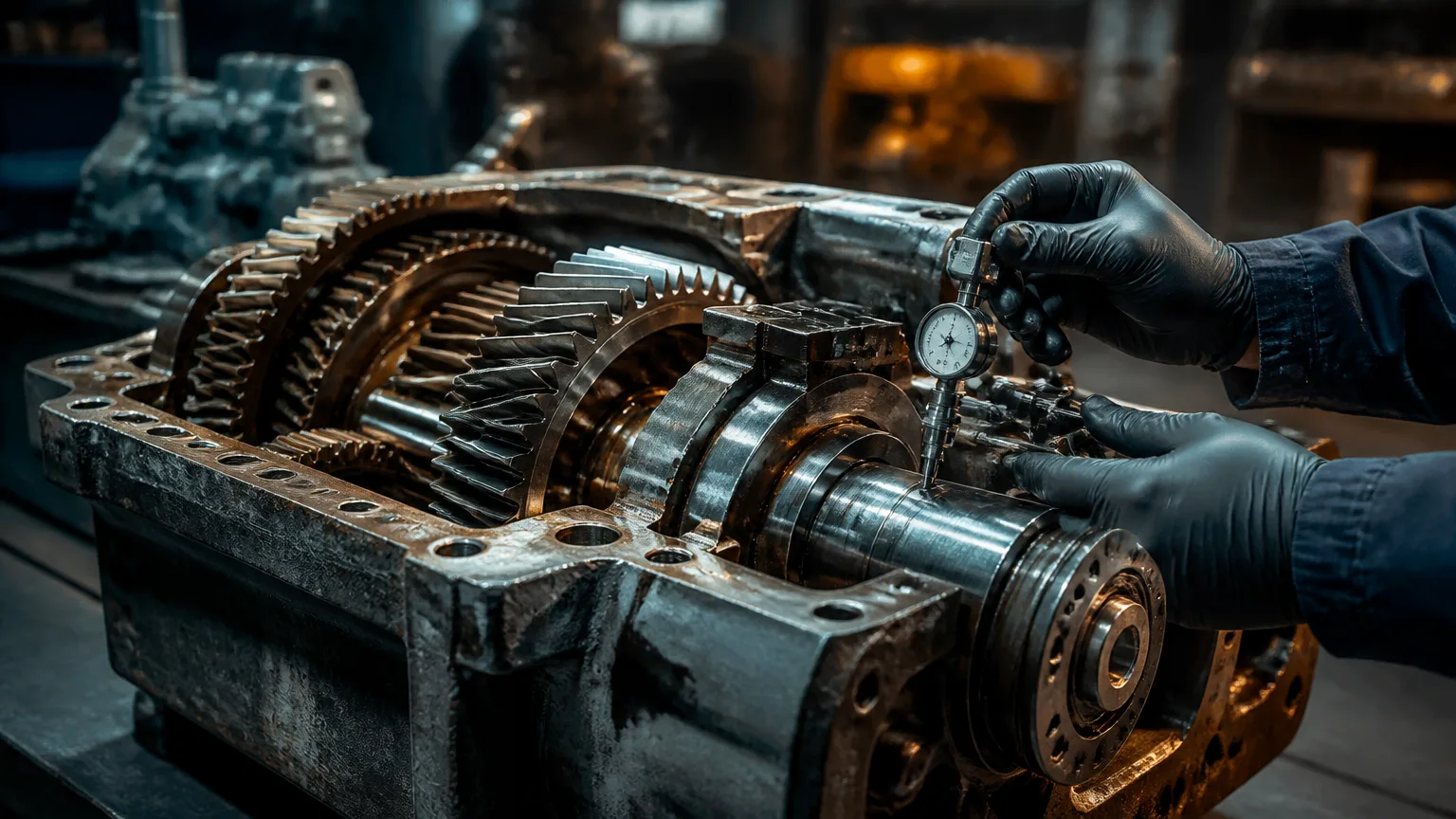
Precision engineering in industrial gearbox repair protects the assets that keep production moving. These mission-critical systems influence uptime, product consistency, energy consumption, and workplace safety. A repair must restore reliable performance—not merely return the gearbox to motion.
Successful repair begins with the gearbox’s duty cycle, load profile, operating environment, and failure history. This context helps engineers identify root causes and address alignment, lubrication, bearing, and load-transfer issues. Reactive fixes may provide temporary relief while allowing deeper problems to continue.
Manufacturers and facility managers need more than replacement parts. They need a repair partner with inspection expertise, sound engineering judgment, clear documentation, and dependable turnaround. Industrial Gearbox Solutions applies this disciplined approach to help extend equipment life, reduce disruption, and restore confidence in critical operations.
Failure Diagnosis Starts With Evidence
Precision engineering begins with evidence, not assumptions. Before disassembly, technicians review operating data, load history, duty cycles, and maintenance records. Vibration and temperature trends can reveal developing bearing damage, gear mesh problems, or abnormal loading. Changes in noise, oil condition, backlash, and shaft movement add further clues.
The inspection also includes connected equipment. Couplings, shafts, brakes, driven machinery, and mounting structures can create forces that appear to originate inside the gearbox. A damaged gear or bearing may be only a symptom of overload, misalignment, contamination, inadequate lubrication, or an installation problem. For example, recurring tooth wear may indicate excessive loading rather than a defective gear.
A documented inspection establishes the failure pattern and supports sound repair decisions. Findings may include:
- Focused repair when damage is isolated and the housing, shafts, and remaining components remain serviceable.
- Full rebuild when wear, contamination, or multiple damaged components threaten reliable operation.
- Replacement when the unit has extensive structural damage, poor repair economics, or an unsuitable design.
This evidence-based approach is especially valuable during GE gearbox repair, where accurate diagnosis can prevent repeated downtime. Clear records also give operators a defensible basis for selecting the right solution.
Dimensional Accuracy and Component Restoration
Precision engineering restores more than individual gearbox parts. Technicians measure gear tooth condition, shaft journals, bearing seats, housing bores, clearances, and runout. These results are compared with manufacturer tolerances or approved engineering specifications.
Restoration may require replacing gears, bearings, seals, or shafts. Worn journals and bearing seats can be machined to recover accurate fits. Housing damage may require boring, line boring, bushing, or other controlled machining processes. Engineers also verify material grades and heat-treatment requirements, particularly for gears and loaded shafts.
Component quality alone cannot restore gearbox performance. Fits, bearing preload, gear backlash, and shaft alignment must work together as a complete system. Technicians therefore check gear contact patterns under controlled conditions. These patterns reveal misalignment, uneven loading, incorrect tooth engagement, or distortion within the housing.
Accurate records support reliable decisions, from targeted machining to complete component replacement. They also help operators compare repair findings with proven Western gearbox solutions and applicable design practices. Final verification confirms that restored dimensions preserve the original relationships between gears, shafts, bearings, seals, and housings. This control reduces noise, heat, accelerated wear, and the risk of repeated downtime.
Rebuild or Replace: An Engineering-Based Decision
Choosing between a gearbox rebuild and replacement requires more than comparing quoted prices. A sound decision considers total cost, lead time, compatibility, remaining service life, parts availability, efficiency, warranty coverage, and the consequences of another failure. This when to rebuild or replace assessment should reflect both engineering evidence and production risk.
A rebuild is often attractive when the housing remains structurally sound and shafts can be recovered through precision engineering. It also makes sense when replacement gears, bearings, seals, and other components are available. A known operating history helps engineers identify the original failure and confirm that the restored gearbox will meet current duty requirements. Rebuilding may preserve fit, mounting, and process compatibility while reducing lead time.
Replacement is generally preferable when damage extends into the housing, shafts, or major structural features. Obsolete designs can create long-term parts and support risks. Repeated failures may indicate an unsuitable design, poor capacity, or changed process demands. Replacement also deserves priority when repair costs approach the value of a modern equivalent.
Compare both options using:
- Total installed cost and downtime exposure
- Expected service life and efficiency
- Delivery schedule and compatibility
- Warranty terms and technical support
- Risk and cost of another failure
This structured evaluation helps operations teams select the most reliable economic solution, not merely the lowest initial price.
Testing, Installation, and Commissioning Protect the Repair
Precision engineering continues after machining and assembly. Technicians verify component fit, gear mesh, fastener torque, lubrication levels, and seal condition. They also rotate the shafts by hand to confirm smooth movement and detect binding before operation.
Controlled no-load testing can reveal abnormal noise, friction, or leakage. Load testing then confirms performance under operating conditions. Teams record vibration, temperature, speed, and other acceptance results to create a clear service record.
Correct field installation is equally important. Before commissioning, technicians must address foundation damage, coupling defects, misalignment, soft-foot conditions, lubrication problems, and issues within the driven equipment. A properly repaired gearbox can still fail quickly when these conditions remain unresolved.
Establish baseline readings during commissioning, including vibration and operating temperature. Schedule an early follow-up inspection to compare results and identify developing problems before they cause another unplanned outage. This disciplined process confirms that the repair performs as engineered.
Build Reliability Into Every Gearbox Repair
Precision engineering turns gearbox repair into a measurable reliability strategy. Accurate diagnosis, controlled restoration, fit-for-duty decisions, and disciplined commissioning reduce downtime, support predictable maintenance planning, lower lifecycle cost, and improve safety. Provide equipment records, failure symptoms, duty information, and installation constraints early to define the correct scope.
Choose a provider that supports immediate recovery and long-term performance, including Eagle Iron Works gearbox repair. Require documented inspection findings, repair recommendations, testing results, and warranty expectations before returning the gearbox to service.