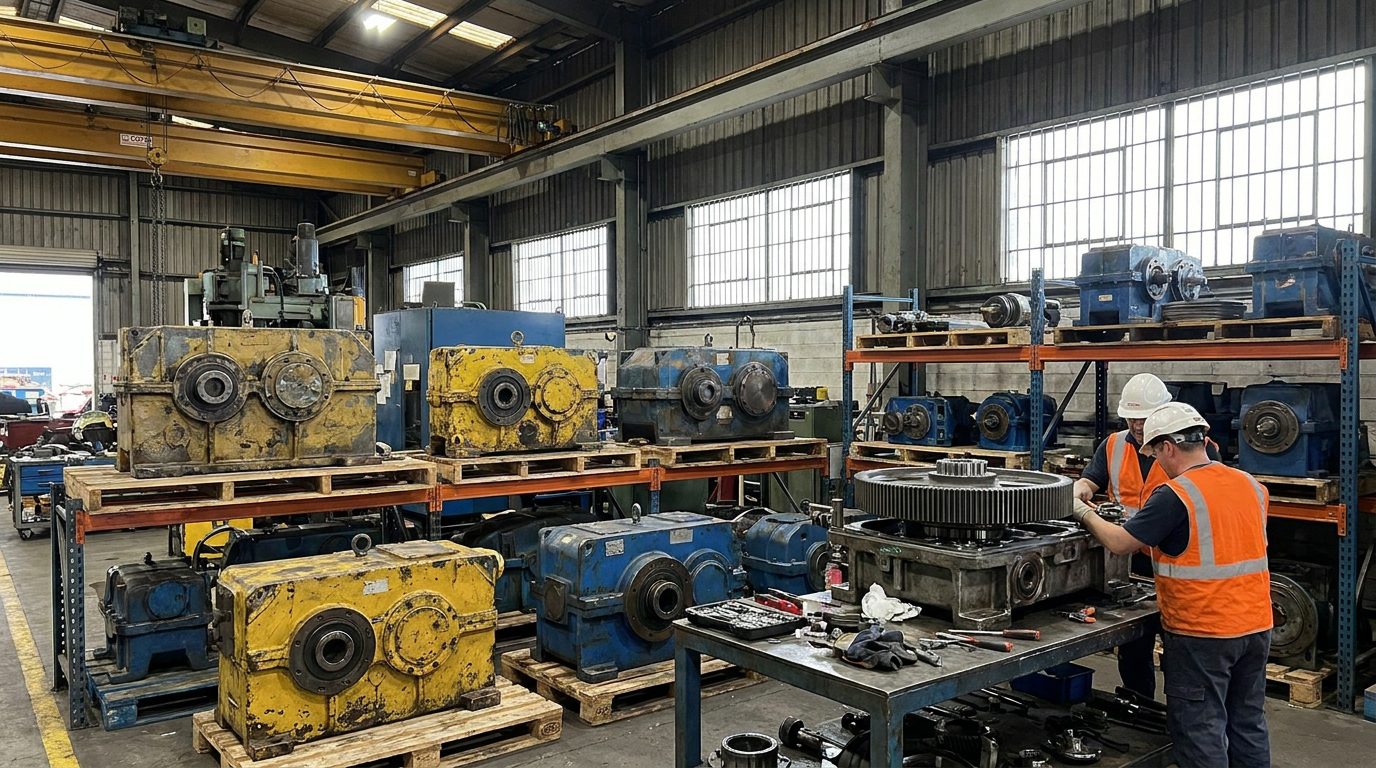
Choosing the right industrial gearbox is one of the most important decisions for any facility that depends on rotating equipment, conveyors, mixers, crushers, pumps, extruders, or heavy-duty production machinery. A gearbox that is properly specified can improve uptime, reduce energy consumption, extend equipment life, and lower total cost of ownership. A poorly selected gearbox can lead to overheating, premature bearing failure, misalignment, excessive vibration, and expensive downtime.
This complete industrial gearbox buying guide is written for maintenance professionals, engineers, plant managers, OEMs, and industrial buyers who need a practical, reliable process for selecting, replacing, or sourcing an industrial gearbox. Whether you are replacing an obsolete reducer, designing a new drive system, or upgrading a high-load application, the goal is to help you make a confident, cost-effective purchasing decision.
If you are not sure what gearbox you have, what ratio you need, or whether a direct replacement is available, Industrial Gearbox Solutions can help identify, cross-reference, repair, rebuild, or source the right unit for your application.
Submit your gearbox details, nameplate photos, drawings, or application requirements below, and a gearbox specialist can help you determine the best next step.
When considering the purchase of an industrial gearbox, it’s essential to also understand the importance of maintenance and repair to ensure longevity and optimal performance. For insights on maintaining your gearbox, you can refer to a related article on industrial gearbox repair in Michigan, which provides valuable information on the best practices and services available. To learn more, visit Industrial Gearbox Repair in Michigan.
What Is an Industrial Gearbox?
An industrial gearbox is a mechanical power transmission device used to change speed, torque, and direction between a driving motor and driven equipment. In most industrial applications, the gearbox reduces motor speed while increasing output torque.
For example, an electric motor may run at 1,750 RPM, but a conveyor may only need 60 RPM at the head pulley. A gearbox reduces the motor speed to the correct output speed while multiplying torque to move the load reliably.
Industrial gearboxes are commonly used in:
- Conveyors and material handling systems
- Mixers and agitators
- Crushers and shredders
- Pumps and compressors
- Extruders and pelletizers
- Cooling towers
- Kilns and dryers
- Steel mills and rolling equipment
- Food processing machinery
- Mining, aggregate, and cement equipment
Why Gearbox Selection Matters
A gearbox is not just a catalog item. It is a critical component in a larger mechanical system. The right gearbox must match the application’s torque, speed, duty cycle, environment, mounting arrangement, lubrication requirements, and service factor.
If the gearbox is undersized, it may fail prematurely. If it is oversized, it may increase upfront cost and reduce system efficiency. The best gearbox is one that balances performance, reliability, availability, and lifecycle cost.
Common Signs You Need a New or Replacement Gearbox
Maintenance teams often begin looking for a replacement gearbox after performance problems appear. Common warning signs include:
- Excessive noise or gear whine
- High operating temperature
- Oil leaks around seals or inspection covers
- Metal particles in the lubricant
- Shaft vibration or misalignment
- Premature bearing failure
- Broken gear teeth
- Difficulty sourcing replacement parts
- Obsolete model numbers or discontinued brands
- Frequent unplanned downtime
In many cases, the gearbox may be repairable or rebuildable. However, if housing damage, gear wear, shaft damage, or obsolete parts make repair impractical, replacement may be the better long-term option.
Key Factors to Consider Before Buying an Industrial Gearbox
Before contacting a supplier or comparing gearbox options, gather as much technical information as possible. Accurate data helps prevent sizing errors and delays.
Application Requirements
Start with the driven equipment. The gearbox must be selected based on the actual application, not just the motor horsepower.
Important application details include:
- Type of driven machine
- Load type: uniform, moderate shock, heavy shock
- Operating hours per day
- Starts and stops per hour
- Ambient temperature
- Indoor or outdoor installation
- Exposure to dust, moisture, chemicals, or washdown
- Required output speed
- Required torque
- Mounting position
- Available space envelope
A gearbox used on a lightly loaded conveyor operating eight hours per day has different requirements than a gearbox used on a rock crusher running continuously in a dusty environment.
Horsepower and Torque
Horsepower is important, but torque is often the more critical value. Industrial gearboxes transmit torque, and torque demand varies depending on load conditions.
The basic relationship is:
| Variable | Meaning |
|||
| HP | Motor horsepower |
| RPM | Rotational speed |
| Torque | Twisting force required to drive the load |
| Ratio | Speed reduction between input and output |
A high-horsepower motor running at high speed may not require as much output torque as a lower-speed, heavy-load application. Always verify torque requirements, especially for high-inertia or shock-loaded equipment.
Gear Ratio and Output Speed
Gear ratio determines how much the gearbox reduces input speed. For example, a 25:1 ratio gearbox reduces a 1,750 RPM motor input to approximately 70 RPM output, before considering efficiency losses.
Common ratio considerations include:
- Required output speed of the driven equipment
- Motor speed
- Belt, chain, or coupling arrangements
- Variable frequency drive usage
- Process speed requirements
- Future speed adjustment needs
If the ratio is incorrect, the equipment may run too fast or too slow, creating production issues or mechanical stress.
Service Factor
Service factor is a multiplier used to account for operating conditions. It helps ensure the gearbox can handle real-world loads beyond ideal catalog ratings.
Typical service factor influences include:
- Continuous operation
- Frequent starts and stops
- Shock loads
- Reversing loads
- High ambient temperatures
- Poor lubrication conditions
- Heavy contamination
For demanding applications, a higher service factor is often required. This is especially important in mining, aggregate, steel, pulp and paper, wastewater, and heavy manufacturing environments.
Check out our latest posts at https://industrialgearboxsolutions.com/blog/ for valuable industry insights.
Types of Industrial Gearboxes
There are several major types of industrial gearboxes. Each has advantages, limitations, and best-fit applications.
Helical Gearboxes
Helical gearboxes use angled gear teeth that mesh gradually, providing smooth and efficient power transmission. They are widely used in industrial applications because they offer high efficiency, durability, and quiet operation.
Common uses include:
- Conveyors
- Mixers
- Packaging lines
- Pumps
- General industrial machinery
Benefits include high load capacity, smooth operation, and good efficiency. However, helical gears create axial thrust, so proper bearing design is important.
Bevel Gearboxes
Bevel gearboxes transmit power between intersecting shafts, often at a 90-degree angle. They are useful when space constraints require a change in power direction.
Common applications include:
- Right-angle drives
- Cooling towers
- Printing equipment
- Material handling systems
- Food processing machinery
Spiral bevel gearboxes provide smoother operation than straight bevel gears and are often preferred for heavy-duty industrial applications.
Worm Gearboxes
Worm gearboxes use a worm screw and worm wheel to provide high reduction ratios in a compact design. They are commonly used where space is limited and self-locking or high-ratio reduction may be beneficial.
Typical uses include:
- Lifts and hoists
- Gates and actuators
- Small conveyors
- Packaging machinery
- Light to moderate-duty applications
Worm gearboxes are compact and cost-effective, but they are generally less efficient than helical or bevel gearboxes due to sliding friction. Heat generation should be considered in continuous-duty applications.
Planetary Gearboxes
Planetary gearboxes use a sun gear, planet gears, and ring gear to deliver high torque density in a compact package. They are often selected for applications requiring precision, high torque, or compact size.
Common applications include:
- Robotics
- Servo drives
- Heavy mobile equipment
- Extruders
- Wind turbines
- Industrial automation
Planetary gearboxes offer excellent torque capacity and compact design, but they can be more expensive than other gearbox types.
Shaft-Mounted Gear Reducers
Shaft-mounted reducers install directly onto the driven shaft, often eliminating the need for a separate base, coupling, and alignment process. They are common in bulk material handling.
Typical applications include:
- Belt conveyors
- Screw conveyors
- Bucket elevators
- Quarry and aggregate equipment
- Grain handling systems
These reducers are popular because they simplify installation and reduce alignment issues. Torque arms are typically used to control reaction forces.
Parallel Shaft Gearboxes
Parallel shaft gearboxes have input and output shafts that run parallel to each other. They are well-suited for applications requiring high efficiency and robust torque transmission.
Common uses include:
- Industrial conveyors
- Roll drives
- Mixers
- Mills
- Heavy processing equipment
They are available in many configurations and can be designed for high-load, continuous-duty service.
When considering the purchase of an industrial gearbox, it’s essential to also understand the importance of maintenance and repair services to ensure longevity and optimal performance. For instance, you might find it helpful to explore the related article on industrial gearbox repair in Corpus Christi, Texas, which provides valuable insights into keeping your equipment in top shape. By combining knowledge from both buying guides and repair resources, you can make informed decisions that enhance the reliability of your industrial operations.
How to Size an Industrial Gearbox
Proper gearbox sizing is essential for long service life. While a gearbox specialist or engineer should verify final selection, understanding the basics can help you avoid common mistakes.
Step 1: Define the Driven Load
Identify what the gearbox will drive and how the load behaves. A fan or centrifugal pump usually has a smoother load profile than a crusher, hammer mill, or reciprocating pump.
Load categories often include:
| Load Type | Examples | Gearbox Consideration |
||||
| Uniform load | Fans, light conveyors, centrifugal pumps | Lower service factor may be acceptable |
| Moderate shock | Mixers, screw conveyors, rotary dryers | Increased torque capacity recommended |
| Heavy shock | Crushers, shredders, mills, reciprocating pumps | High service factor and heavy-duty design required |
Step 2: Determine Input and Output Speeds
You need to know the motor speed and desired equipment speed. The gear ratio can then be calculated by dividing input speed by output speed.
Example:
- Motor speed: 1,750 RPM
- Required output speed: 70 RPM
- Required ratio: 1,750 ÷ 70 = 25:1
In real applications, also account for drive belts, chains, sheaves, sprockets, and variable frequency drives.
Step 3: Calculate Required Torque
Torque is often calculated from horsepower and speed. If you know the required horsepower and output RPM, you can estimate torque.
For U.S. units:
Torque in lb-in = (HP × 63,025) ÷ RPM
Example:
- Horsepower: 20 HP
- Output speed: 70 RPM
- Torque =
(20 × 63,025) ÷ 70 - Torque = approximately 18,007 lb-in
Then apply the appropriate service factor.
Step 4: Apply Service Factor
If the application requires a service factor of 1.5, multiply the calculated torque by 1.5.
Example:
- Calculated torque: 18,007 lb-in
- Service factor: 1.5
- Required rated torque: 27,011 lb-in
This ensures the gearbox is not operating at its maximum theoretical rating during normal service.
Step 5: Confirm Thermal Capacity
A gearbox may be mechanically strong enough to handle the torque but still overheat if it cannot dissipate heat. Thermal capacity is especially important in continuous-duty, high-ratio, or high-ambient-temperature applications.
Consider:
- Ambient temperature
- Airflow around the gearbox
- Duty cycle
- Lubricant type
- Gearbox efficiency
- Cooling options
- Enclosure ventilation
If thermal capacity is exceeded, options may include a larger gearbox, synthetic lubricant, cooling fan, heat exchanger, or forced lubrication system.
Step 6: Verify Overhung and Thrust Loads
If belts, chains, sprockets, or sheaves are mounted on the gearbox shaft, they create overhung loads. Some applications also generate axial thrust loads.
These forces affect bearing life and shaft durability. Always provide pulley or sprocket diameter, distance from shaft shoulder, belt tension, and load direction when selecting a gearbox.
New, Rebuilt, or Replacement Gearbox: Which Should You Buy?
Industrial buyers often have three main options: buy new, repair/rebuild the existing unit, or source a replacement equivalent. Each option has advantages.
Buying a New Gearbox
A new industrial gearbox is often the best choice for new equipment, major upgrades, or situations where reliability is the top priority.
Advantages include:
- Full manufacturer warranty
- Latest design improvements
- New gears, bearings, shafts, and seals
- Better efficiency options
- Custom configurations available
- Long expected service life
Potential disadvantages include longer lead times, higher upfront cost, and the need to confirm dimensional compatibility.
Rebuilding an Existing Gearbox
Gearbox repair or rebuilding may be ideal when the existing unit has a specialized housing, custom ratio, or long OEM lead time.
A quality rebuild may include:
- Disassembly and inspection
- Cleaning and blasting
- Gear inspection or replacement
- Bearing and seal replacement
- Shaft repair or replacement
- Housing inspection
- Backlash and contact pattern checks
- Load testing when available
- Repainting and documentation
Rebuilding can reduce cost and lead time, especially for large gearboxes. However, if the housing is cracked or major components are unavailable, replacement may be more practical.
Sourcing a Drop-In Replacement
A drop-in replacement gearbox is selected to match the existing unit’s shaft locations, mounting dimensions, ratio, and torque capacity as closely as possible.
This option is useful when:
- The original gearbox is obsolete
- OEM lead time is too long
- The current brand is no longer supported
- A plant wants to standardize gearbox inventory
- Minimal installation modification is required
When sourcing a drop-in replacement, provide nameplate photos, dimensional drawings, shaft measurements, mounting details, and application data.
Gearbox Materials, Construction, and Quality Features
Not all industrial gearboxes are built the same. Construction quality directly affects reliability, performance, and service life.
Housing Design
Gearbox housings are commonly made from cast iron, ductile iron, fabricated steel, or aluminum for lighter-duty units. Heavy-duty industrial reducers often use cast iron or fabricated steel housings for strength and vibration resistance.
A good housing should provide:
- Structural rigidity
- Accurate bearing alignment
- Proper oil containment
- Heat dissipation
- Easy inspection access
- Adequate mounting support
Poor housing rigidity can lead to gear misalignment, bearing stress, and premature failure.
Gear Quality
Industrial gears may be carburized, hardened, ground, shaved, or precision machined depending on the application. Gear tooth quality affects noise, efficiency, load distribution, and wear life.
Look for gearboxes with:
- Proper heat treatment
- Quality tooth geometry
- Accurate contact patterns
- Adequate face width
- High-grade alloy steel for heavy-duty service
- Documented manufacturing standards
For critical applications, ask about AGMA ratings, gear quality class, and inspection procedures.
Bearings and Seals
Bearings support shafts and maintain gear alignment. Seals keep lubricant in and contaminants out. Many gearbox failures begin with bearing or seal problems.
Important considerations include:
- Bearing type and rating life
- Seal material compatibility
- Dust and moisture exposure
- Shaft surface finish
- Labyrinth or heavy-duty sealing options
- Grease-purge or taconite seal options for harsh environments
In dirty or wet environments, upgraded sealing can significantly extend gearbox life.
Lubrication System
Most industrial gearboxes use splash lubrication, but high-speed, high-load, or large gearboxes may require forced lubrication.
Lubrication options include:
- Mineral gear oil
- Synthetic gear oil
- Food-grade lubricant
- EP gear oil
- Circulating oil systems
- Oil heaters
- Oil coolers
- Filtration systems
Always follow the manufacturer’s viscosity recommendations and lubricant change intervals.
Environmental and Application Considerations
The operating environment can dramatically affect gearbox selection. A gearbox in a clean indoor packaging plant has different requirements than one in a cement mill or wastewater facility.
High Temperature Environments
High ambient temperatures reduce lubricant life and increase the risk of overheating. Applications near ovens, kilns, furnaces, or outdoor installations in hot climates may require thermal review.
Possible solutions include:
- Larger gearbox frame size
- Synthetic lubricant
- External cooling
- Increased oil capacity
- Temperature monitoring
- Heat-resistant seals
Dusty and Dirty Environments
Dust and abrasive particles can enter the gearbox through breathers, seals, or inspection covers. Once contamination enters the oil, it accelerates wear.
For dusty applications, consider:
- Desiccant breathers
- Labyrinth seals
- Taconite seals
- Positive pressure systems
- Regular oil analysis
- Improved maintenance procedures
Mining, cement, aggregate, grain, and wood processing operations often require enhanced contamination control.
Washdown and Corrosive Environments
Food processing, chemical plants, wastewater facilities, and marine environments may expose gearboxes to water, chemicals, and corrosion.
Recommended features may include:
- Stainless steel components
- Epoxy coatings
- Washdown-duty seals
- Corrosion-resistant hardware
- Food-grade lubricants
- IP-rated enclosures
- Smooth housing surfaces
Corrosion can damage seals, fasteners, shafts, and housings, so environmental protection is not optional in these applications.
Explosion-Hazard Areas
Some facilities require equipment suitable for hazardous locations. This may involve ATEX, IECEx, or other regional compliance requirements.
Applications may include:
- Chemical processing
- Grain handling
- Oil and gas
- Paint and coatings
- Dust-producing manufacturing environments
Always verify compliance requirements before purchasing a gearbox for hazardous areas.
Industrial Gearbox Buying Checklist
A structured checklist can help maintenance and purchasing teams collect the information needed for accurate gearbox selection.
Nameplate Information
If replacing an existing gearbox, start with the nameplate. Capture:
- Manufacturer
- Model number
- Serial number
- Ratio
- Input speed
- Output speed
- Service factor
- Horsepower rating
- Torque rating
- Mounting position
- Lubrication type
- Manufacturing date if available
Take clear photos of the nameplate from multiple angles.
Dimensional Information
If a drop-in replacement is needed, dimensions are critical.
Measure or document:
- Input shaft diameter and length
- Output shaft diameter and length
- Keyway size
- Shaft orientation
- Center distance
- Mounting hole pattern
- Base dimensions
- Overall length, width, and height
- Flange dimensions if applicable
- Distance from shaft centerline to mounting base
- Hollow bore size if shaft-mounted
Even small dimensional differences can affect installation time and alignment.
Performance Requirements
Provide the supplier with:
- Motor horsepower
- Motor RPM
- Desired output RPM
- Operating hours per day
- Starts and stops per hour
- Load type
- Ambient temperature
- Duty cycle
- Driven equipment type
- Shock or reversing loads
- Brake or backstop requirements
- Overhung load data
The more complete the information, the better the final recommendation.
Commercial Requirements
Industrial buyers should also consider purchasing and logistics requirements.
Key questions include:
- What is the required lead time?
- Is downtime already occurring?
- Is expedited manufacturing available?
- Is a repair option available?
- Is a rental or temporary solution possible?
- What warranty is offered?
- Are drawings available before purchase?
- Are installation instructions included?
- Is technical support available after delivery?
For critical production equipment, the lowest purchase price may not be the best value if lead time or support is poor.
Comparing Gearbox Brands and Suppliers
Selecting the right supplier is just as important as selecting the gearbox itself. Industrial gearbox purchases often require technical support, cross-referencing, application review, and after-sales service.
OEM vs. Independent Gearbox Supplier
OEMs can provide exact replacement parts for original equipment, but they may have long lead times or premium pricing. Independent gearbox suppliers may offer cross-referenced replacements, rebuilt units, or alternative brands with shorter delivery.
| Buying Source | Advantages | Considerations |
||||
| OEM | Exact original specification, brand continuity | May have long lead times or higher cost |
| Independent supplier | Cross-reference options, repair support, faster sourcing | Must verify technical capability |
| Repair facility | Can rebuild custom or obsolete units | Quality depends on inspection and workmanship |
| Distributor | Access to multiple brands | Application expertise varies |
A qualified supplier should ask detailed questions about your application rather than simply quoting a part number.
Questions to Ask a Gearbox Supplier
Before buying, ask:
- Can you verify the gearbox rating for my application?
- Is this a direct drop-in replacement?
- What modifications may be required?
- What is the actual lead time?
- Is the gearbox new, rebuilt, or surplus?
- What warranty is included?
- Are drawings or data sheets available?
- What lubricant is recommended?
- Are spare parts available?
- Can you support future repairs or replacements?
Suppliers who provide documentation and application support can help reduce risk.
Evaluating Total Cost of Ownership
The purchase price is only one part of the gearbox’s total cost. A cheaper gearbox may cost more over time if it fails early, consumes more energy, or requires frequent maintenance.
Total cost of ownership includes:
- Purchase price
- Freight and handling
- Installation labor
- Alignment time
- Downtime cost
- Lubrication cost
- Maintenance intervals
- Spare parts availability
- Energy efficiency
- Expected service life
- Repairability
For production-critical equipment, reliability and lead time often matter more than the lowest initial quote.
Installation Best Practices for Industrial Gearboxes
Even the best gearbox can fail early if it is installed incorrectly. Proper installation protects bearings, seals, shafts, and gears.
Foundation and Mounting
The gearbox must be mounted on a rigid, flat, and properly supported foundation. Soft foot, uneven mounting surfaces, or loose bolts can cause housing distortion and misalignment.
Best practices include:
- Clean the mounting surface
- Verify flatness
- Use proper shims if needed
- Torque mounting bolts correctly
- Avoid forcing the gearbox into position
- Recheck bolt torque after initial operation
For large gearboxes, foundation integrity is especially important.
Alignment
Misalignment is one of the leading causes of gearbox failure. Couplings, belts, chains, and shafts must be aligned according to manufacturer specifications.
Alignment issues can cause:
- Bearing overload
- Shaft fatigue
- Seal leakage
- Coupling wear
- Excessive vibration
- Gear mesh problems
Use laser alignment tools or precision dial indicators for critical applications.
Lubricant Fill and Startup
Before startup, confirm that the gearbox contains the correct lubricant at the proper level. Many gearboxes are shipped without oil or with preservative oil only.
Startup checklist:
- Verify oil type and viscosity
- Fill to correct level for mounting position
- Check breathers and plugs
- Rotate shafts by hand if possible
- Confirm motor rotation direction
- Inspect for leaks
- Monitor temperature during initial operation
- Listen for abnormal noise
- Recheck oil level after startup
A controlled startup can identify problems before they become failures.
Maintenance Tips to Extend Gearbox Life
A well-maintained industrial gearbox can operate reliably for many years. Preventive and predictive maintenance are essential for reducing downtime.
Regular Inspections
Create a routine inspection schedule based on operating conditions.
Check for:
- Oil leaks
- Unusual noise
- Excessive vibration
- High temperature
- Loose mounting bolts
- Damaged breathers
- Contaminated lubricant
- Seal wear
- Coupling or belt issues
Document readings and observations so changes can be identified early.
Oil Analysis
Oil analysis is one of the most effective predictive maintenance tools for gearboxes. It can detect wear metals, contamination, viscosity breakdown, and lubricant degradation.
Oil analysis can reveal:
- Gear wear
- Bearing wear
- Water contamination
- Dirt contamination
- Oxidation
- Additive depletion
- Incorrect lubricant viscosity
For critical gearboxes, scheduled oil sampling can prevent catastrophic failures.
Vibration Monitoring
Vibration analysis helps detect bearing defects, gear mesh issues, misalignment, looseness, and imbalance.
Useful monitoring methods include:
- Portable vibration data collection
- Permanently mounted sensors
- Route-based condition monitoring
- Continuous monitoring for critical assets
When combined with oil analysis and temperature monitoring, vibration data provides a strong picture of gearbox health.
Lubrication Management
Lubrication problems are a major cause of gearbox failure. Common issues include using the wrong oil, underfilling, overfilling, contamination, and missed change intervals.
Best practices:
- Use the recommended lubricant
- Store oil properly
- Use clean transfer containers
- Filter oil when needed
- Replace breathers regularly
- Label lubricants clearly
- Train maintenance personnel
- Follow oil change intervals based on conditions
Clean, correct lubricant is one of the simplest ways to extend gearbox life.
Common Gearbox Buying Mistakes to Avoid
Industrial gearbox purchases can be expensive, and mistakes can lead to downtime or repeated failures.
Buying Based Only on Horsepower
Horsepower alone does not define the application. Torque, speed, service factor, duty cycle, thermal capacity, and load characteristics must also be considered.
A gearbox rated for the same horsepower may not be suitable if the output speed, shock load, or operating hours differ.
Ignoring Mounting Position
Gearboxes are designed for specific mounting orientations. Lubrication levels, breather locations, and seal arrangements depend on mounting position.
Installing a gearbox in the wrong orientation can cause oil starvation, overheating, and seal leakage.
Overlooking Lead Time
Some industrial gearboxes have long manufacturing lead times, especially custom, large, or imported units. Waiting until failure occurs can leave a plant without options.
For critical assets, consider keeping a spare gearbox or maintaining a repair plan.
Failing to Confirm Dimensions
A gearbox may have the right ratio and torque rating but still fail to fit the application. Always confirm shaft sizes, mounting dimensions, and space constraints before ordering.
Choosing the Lowest Price Without Technical Review
Low-cost gearboxes may be appropriate for some applications, but critical equipment requires careful evaluation. Poor support, limited parts availability, or inadequate ratings can create higher long-term costs.
When to Keep a Spare Gearbox in Inventory
For production-critical equipment, spare gearbox inventory can prevent extended downtime. Plant managers and maintenance teams should evaluate the cost of carrying a spare against the cost of a production outage.
Good Candidates for Spare Gearboxes
Consider stocking a spare if the gearbox:
- Drives a critical production line
- Has a long replacement lead time
- Is custom or obsolete
- Operates in harsh conditions
- Has a history of failure
- Is difficult to remove or install
- Supports equipment with no redundancy
Spare Gearbox Storage Tips
A spare gearbox must be stored properly to remain ready for service.
Recommended storage practices:
- Store indoors in a clean, dry area
- Protect shafts and machined surfaces
- Rotate shafts periodically
- Maintain proper internal protection
- Seal openings against contamination
- Follow manufacturer storage recommendations
- Tag with application and installation information
A poorly stored spare can fail shortly after installation.
Conclusion: Choose the Right Industrial Gearbox With Confidence
Buying an industrial gearbox requires more than matching a model number or selecting the lowest quote. The right decision depends on torque, ratio, speed, service factor, mounting, environment, lubrication, thermal capacity, lead time, and long-term support.
For maintenance professionals, engineers, plant managers, OEMs, and industrial buyers, a structured buying process helps reduce risk and improve reliability. Gather complete application data, verify dimensions, evaluate service conditions, compare supplier capabilities, and consider total cost of ownership before making a purchase.
If you need help identifying an existing gearbox, replacing an obsolete unit, sourcing a drop-in replacement, or evaluating whether repair or replacement is the better option, Industrial Gearbox Solutions can help. Contact our team today to review your application and find the right gearbox solution for your operation.
FAQs
What is an industrial gearbox?
An industrial gearbox is a mechanical device that is used to transmit power from one component to another within a machine. It is commonly used in industrial applications to control the speed, torque, and direction of a machine’s output.
What are the different types of industrial gearboxes?
There are several types of industrial gearboxes, including helical gearboxes, worm gearboxes, bevel gearboxes, planetary gearboxes, and spur gearboxes. Each type has its own unique design and is suitable for specific applications.
What factors should be considered when buying an industrial gearbox?
When buying an industrial gearbox, it is important to consider factors such as the required torque and speed, the operating environment, the mounting and installation requirements, as well as the maintenance and serviceability of the gearbox.
What are the common applications of industrial gearboxes?
Industrial gearboxes are commonly used in a wide range of applications, including conveyor systems, mixers, agitators, cranes, hoists, wind turbines, and various types of machinery used in manufacturing, mining, and construction.
What are the maintenance requirements for industrial gearboxes?
Maintenance requirements for industrial gearboxes typically include regular lubrication, inspection of gears and bearings, monitoring of operating temperatures, and periodic alignment checks. Proper maintenance is essential for ensuring the longevity and performance of the gearbox.