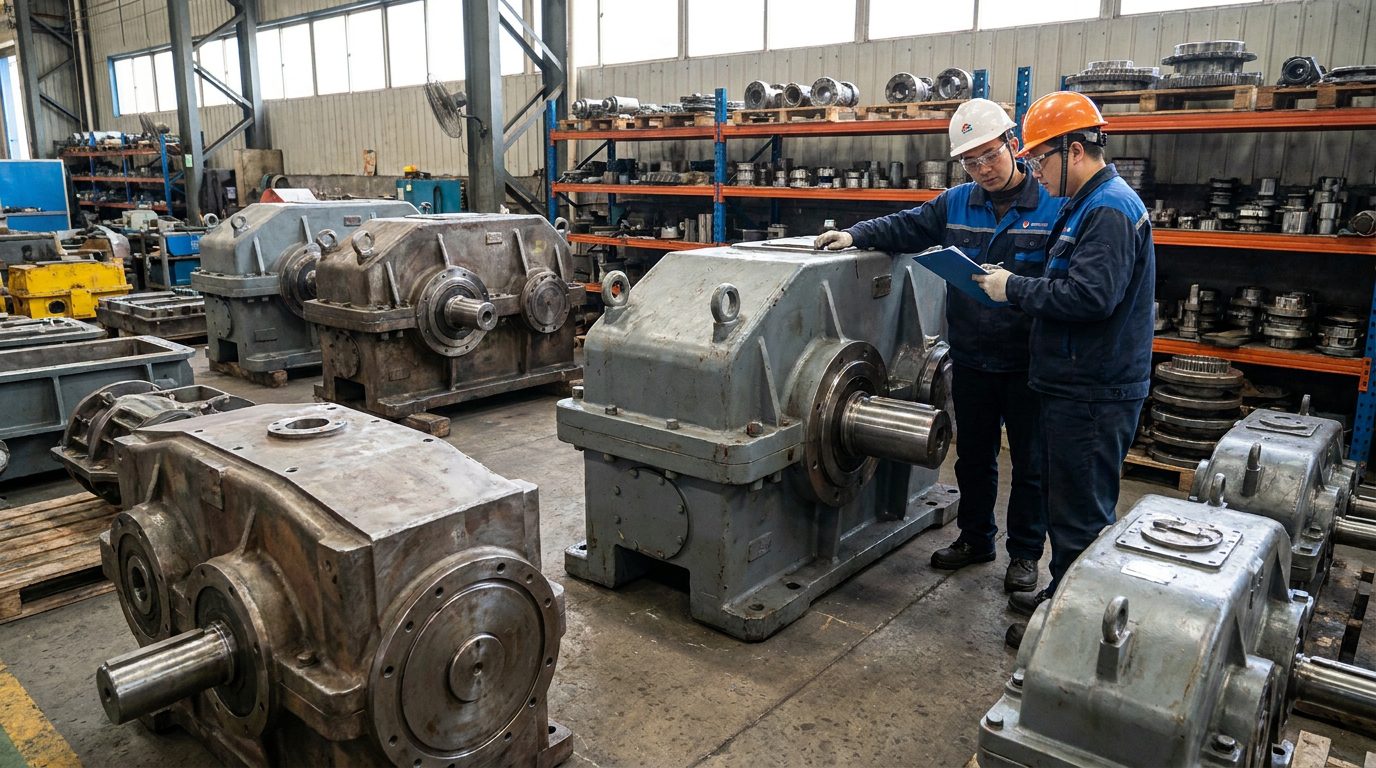
Industrial gearboxes are mission-critical components in conveyors, mixers, crushers, extruders, pumps, hoists, packaging lines, and heavy-duty process equipment. Choosing the wrong gearbox can lead to premature failure, excessive downtime, safety risks, and higher total cost of ownership.
An Essential Industrial Gearbox Buying Checklist helps maintenance professionals, engineers, plant managers, OEMs, and industrial buyers evaluate gearbox requirements before making a purchase. The goal is not just to find a gearbox that fits—it is to select a reliable power transmission solution that matches your torque, speed, duty cycle, environment, mounting arrangement, and long-term maintenance strategy.
Whether you are replacing a failed unit, upgrading an obsolete gearbox, or specifying a gearbox for new equipment, the checklist below will help you make a confident, technically sound buying decision.
If you are unsure which gearbox you need, start by collecting the nameplate data, photos, shaft measurements, mounting details, and application information. An experienced gearbox specialist can help cross-reference obsolete models, identify equivalent replacements, and recommend upgrades that reduce downtime.
For assistance with gearbox identification, replacement, or sourcing, submit your information below.
When considering the purchase of an industrial gearbox, it’s essential to weigh the options of repair versus replacement. For a deeper understanding of this critical decision-making process, you can refer to the article on the topic, which provides valuable insights and guidance. To learn more, visit Repair vs. Replace: Gearbox. This resource complements the Industrial Gearbox Buying Checklist by helping you assess whether investing in a new gearbox or repairing an existing one is the best choice for your operational needs.
Understand the Application Before Selecting a Gearbox
The first step in any industrial gearbox buying checklist is understanding the application. A gearbox cannot be selected accurately without knowing how it will operate in real-world conditions.
Identify the Driven Equipment
Different machines place different loads on a gearbox. For example, a conveyor may require steady torque, while a rock crusher or mixer may experience repeated shock loads. The gearbox must be matched to the type of equipment it drives.
Common driven equipment includes:
- Belt conveyors
- Screw conveyors
- Crushers and shredders
- Mixers and agitators
- Pumps and compressors
- Hoists and cranes
- Extruders
- Cooling towers
- Packaging machinery
- Rotary kilns
- Food processing equipment
Knowing the equipment type helps determine torque demands, load characteristics, service factor, and suitable gearbox style.
Define the Operating Conditions
A gearbox that performs well in a clean, indoor, moderate-duty application may fail quickly in a hot, wet, dusty, or corrosive environment.
Before buying, document:
- Hours of operation per day
- Number of starts and stops per hour
- Continuous or intermittent duty
- Ambient temperature
- Exposure to water, washdown, chemicals, dust, or debris
- Indoor or outdoor installation
- Vibration or shock loading
- Reversing operation
- Required life expectancy
For example, a gearbox on a 24/7 mining conveyor requires a more robust selection than a gearbox on a light-duty packaging line operating one shift per day.
Determine the Consequences of Downtime
Not all gearbox failures have the same operational impact. A failed gearbox on a non-critical auxiliary conveyor may be inconvenient. A failed gearbox on a main production line can shut down an entire plant.
Ask:
- Is the gearbox installed on critical equipment?
- Is there a spare gearbox on site?
- How long would replacement take?
- What is the hourly cost of downtime?
- Is expedited delivery required?
- Should a premium gearbox be selected to reduce risk?
In many cases, paying more upfront for a higher-quality gearbox is justified when downtime costs are significant.
Confirm Torque, Speed, and Power Requirements
Gearboxes are designed to convert speed and torque. Selecting the correct ratio, horsepower, and torque rating is essential for reliable operation.
Calculate Input Horsepower
Input horsepower typically comes from the motor or prime mover. If you are replacing an existing gearbox, the motor nameplate provides important information.
Collect the following:
| Requirement | Why It Matters |
|||
| Motor horsepower | Determines baseline power input |
| Motor RPM | Used to calculate gearbox output speed |
| Motor frame size | Helps confirm mounting compatibility |
| Voltage and phase | Useful for complete drive system review |
| Full-load amps | Helps evaluate motor loading |
| Service factor | Indicates motor overload capacity |
A gearbox should not be selected based on horsepower alone. Torque, ratio, service factor, and application severity must also be considered.
Verify Gear Ratio and Output Speed
The gear ratio determines how much the gearbox reduces speed and increases torque.
Basic formula:
Output RPM = Input RPM ÷ Gear Ratio
For example, if a 1,750 RPM motor drives a 25:1 gearbox:
1,750 ÷ 25 = 70 RPM output speed
If the replacement gearbox has the wrong ratio, the driven equipment may run too fast or too slow, causing production issues, overload, or poor process performance.
When replacing an existing unit, confirm the ratio from:
- Gearbox nameplate
- Manufacturer documentation
- Equipment manual
- Output speed measurement
- Tooth count, if disassembled
- OEM part number cross-reference
Determine Output Torque
Torque is one of the most important gearbox selection criteria.
A simplified torque formula is:
Torque (lb-in) = (HP × 63,025) ÷ RPM
For example, a 10 HP motor at 70 RPM output speed provides:
(10 × 63,025) ÷ 70 = 9,004 lb-in
However, this is theoretical torque. Actual gearbox selection must account for efficiency, service factor, shock loads, and duty cycle.
Apply the Correct Service Factor
Service factor adjusts gearbox selection based on application severity. A higher service factor provides additional capacity for shock, frequent starts, long operating hours, and harsh conditions.
Typical service factor considerations include:
- Uniform load: lower service factor
- Moderate shock: medium service factor
- Heavy shock: higher service factor
- 8-hour operation: lower factor
- 24-hour operation: higher factor
- Frequent starts/stops: higher factor
- Reversing loads: higher factor
For example, a lightly loaded fan may use a lower service factor than a crusher, bucket elevator, or heavy mixer.
Check out our latest posts at https://industrialgearboxsolutions.com/blog/ for valuable industry insights.
Choose the Right Gearbox Type
Different gearbox designs are better suited for different applications. The right gearbox type depends on torque, space, efficiency, mounting, shaft configuration, and maintenance preferences.
Helical Gearboxes
Helical gearboxes are widely used in industrial applications because they offer smooth, efficient, and quiet operation. Their angled gear teeth provide gradual engagement, reducing noise and vibration.
Best for:
- Conveyors
- Pumps
- Mixers
- Packaging equipment
- General industrial machinery
Advantages:
- High efficiency
- Smooth operation
- Good torque capacity
- Long service life
- Multiple mounting options
Helical gearboxes are a strong choice when efficiency and reliability are top priorities.
Bevel Gearboxes
Bevel gearboxes are used when power must be transmitted at an angle, commonly 90 degrees. Spiral bevel designs offer smoother operation than straight bevel gears.
Best for:
- Right-angle drives
- Material handling equipment
- Food processing machinery
- Packaging systems
- Printing and converting equipment
Advantages:
- Compact right-angle configuration
- Efficient power transfer
- Flexible shaft orientation
- Good durability in industrial use
Bevel gearboxes are often selected when space constraints require a directional change in the drivetrain.
Worm Gearboxes
Worm gearboxes are compact, cost-effective, and capable of high reduction ratios in a small package. They are common in conveyors, lifts, gates, and light-to-medium-duty equipment.
Best for:
- Small conveyors
- Hoists and lifts
- Indexing equipment
- Packaging machinery
- Low-speed applications
Advantages:
- Compact design
- High reduction ratios
- Quiet operation
- Cost-effective
- Possible self-locking characteristics in some ratios
Limitations:
- Lower efficiency than helical or bevel gearboxes
- More heat generation
- May require careful lubrication and thermal review
Worm gearboxes are useful, but they should be properly sized for heat dissipation and continuous-duty operation.
Planetary Gearboxes
Planetary gearboxes provide high torque density in a compact design. They are commonly used in precision machinery, robotics, mobile equipment, and high-performance industrial systems.
Best for:
- Servo applications
- Robotics
- Heavy-duty drives
- Compact machinery
- High-torque applications
Advantages:
- High torque capacity
- Compact size
- High efficiency
- Good load distribution
- Low backlash options available
Planetary gearboxes are ideal when space is limited and high torque is required.
Shaft-Mounted Gearboxes
Shaft-mounted gearboxes are commonly used in conveyor systems. They mount directly onto the driven shaft, reducing the need for couplings, baseplates, and complex alignment.
Best for:
- Belt conveyors
- Aggregate conveyors
- Mining equipment
- Grain handling systems
- Bulk material handling
Advantages:
- Simplified installation
- Reduced alignment requirements
- Compact layout
- Good for harsh conveyor applications
When buying a shaft-mounted gearbox, confirm bore size, torque arm arrangement, backstop requirements, and mounting orientation.
When considering the purchase of an industrial gearbox, it’s essential to be well-informed about not just the buying process but also the maintenance and repair aspects that can impact its longevity and performance. For instance, understanding the intricacies of gearbox repair can significantly enhance your decision-making. You might find the article on industrial gearbox repair in Norwalk, Connecticut particularly helpful, as it provides insights into common issues and solutions that can arise after your purchase. This knowledge can help you ensure that your investment remains efficient and reliable over time.
Check Mounting, Shaft, and Dimensional Compatibility
A replacement gearbox must physically fit the equipment. Even if the torque and ratio are correct, dimensional mismatches can delay installation or require costly modifications.
Review Mounting Style
Common gearbox mounting styles include:
- Foot mounted
- Flange mounted
- Shaft mounted
- Hollow shaft
- Face mounted
- Torque arm mounted
- Vertical mounting
- Horizontal mounting
When replacing a gearbox, compare the existing unit’s mounting holes, center height, flange dimensions, and shaft location.
A small difference in mounting dimensions may require new baseplates, coupling adjustments, belt changes, or driven equipment modifications.
Confirm Shaft Size and Configuration
Shaft details are critical for proper fit.
Verify:
- Input shaft diameter
- Output shaft diameter
- Shaft length
- Keyway size
- Keyway location
- Hollow bore diameter
- Tapered bore or straight bore
- Splined shaft requirements
- Shaft rotation direction
- Double output shaft, if required
For shaft-mounted gearboxes, bore size and keyway must match the driven shaft. For solid shaft gearboxes, coupling or pulley compatibility must be confirmed.
Measure the Gearbox Envelope
The gearbox envelope refers to the overall physical space occupied by the unit.
Check:
- Overall length, width, and height
- Distance from shaft centerline to base
- Distance between mounting holes
- Clearance for motor, coupling, and guards
- Clearance for oil fill, drain, and inspection ports
- Access for maintenance
- Vent location
- Fan or cooling clearance
This is especially important when replacing obsolete gearboxes, where a modern equivalent may not be dimensionally identical.
Confirm Rotation Direction
Some gearboxes are direction-sensitive, especially units with backstops, internal lubrication paths, or application-specific designs.
Before purchasing, confirm:
- Input rotation direction
- Output rotation direction
- Reversible operation requirements
- Backstop orientation
- Conveyor travel direction
- Motor wiring implications
Incorrect rotation can damage equipment or create safety hazards during startup.
When considering the purchase of an industrial gearbox, it’s essential to be well-informed about the various factors that can influence your decision. A valuable resource that complements the Industrial Gearbox Buying Checklist is an article on gearbox repair services, which can provide insights into maintaining the longevity and efficiency of your equipment. You can read more about this topic in the article on industrial gearbox repair, where you will find useful information that can help you make a more informed choice.
Evaluate Load Characteristics and Duty Cycle
The gearbox must survive actual operating loads, not just ideal design conditions. Load profile is a major part of the Essential Industrial Gearbox Buying Checklist.
Uniform, Moderate, and Heavy Shock Loads
Industrial loads generally fall into three categories:
| Load Type | Description | Example Applications |
||||
| Uniform load | Steady torque with minimal shock | Fans, light conveyors, centrifugal pumps |
| Moderate shock | Some impact or variable loading | Mixers, screw conveyors, packaging machinery |
| Heavy shock | Frequent impact, jam risk, high inertia | Crushers, shredders, hoists, bucket elevators |
Heavy shock applications require gearboxes with higher service factors, stronger bearings, durable gearing, and possibly overload protection.
Starts, Stops, and Reversing Loads
Frequent starts and stops increase mechanical stress. Reversing loads are especially demanding because the gear teeth, bearings, keys, and shafts experience changing force directions.
Applications with frequent cycling may require:
- Higher service factor
- Stronger shafts
- Upgraded bearings
- Hardened gearing
- Low-backlash design
- Soft starters or variable frequency drives
- Torque limiters or overload clutches
For example, an indexing conveyor that starts and stops hundreds of times per hour should not be selected the same way as a conveyor running continuously at steady speed.
Thermal Capacity
Gearboxes generate heat during operation. If a gearbox cannot dissipate heat fast enough, oil temperature rises and lubrication breaks down.
Thermal capacity is affected by:
- Input horsepower
- Gearbox efficiency
- Ambient temperature
- Operating hours
- Gearbox size
- Lubricant type
- Mounting orientation
- Airflow around the unit
- Cooling fans or heat exchangers
Worm gearboxes are especially important to review for thermal performance because they are typically less efficient than helical or bevel units.
Review Lubrication and Maintenance Requirements
Lubrication is one of the most common causes of gearbox failure. A gearbox buying decision should include a realistic review of maintenance practices and lubricant requirements.
Select the Correct Lubricant
Gearbox lubricants reduce friction, remove heat, protect against wear, and prevent corrosion.
Common lubricant types include:
- Mineral gear oil
- Synthetic gear oil
- Food-grade lubricant
- Extreme pressure gear oil
- Grease, for some small or sealed units
Selection depends on:
- Gear type
- Operating temperature
- Load
- Speed
- Manufacturer recommendation
- Environmental exposure
- Food safety requirements
- Compatibility with seals and coatings
Using the wrong oil can cause overheating, foaming, seal damage, micropitting, and premature gear wear.
Confirm Oil Fill and Drain Access
A gearbox that is difficult to service is more likely to be neglected.
Before buying, check:
- Fill plug location
- Drain plug accessibility
- Oil level sight glass or dipstick
- Breather location
- Inspection cover availability
- Sampling port options
- Clearance for maintenance tools
For hard-to-reach installations, consider remote drain kits, oil sight gauges, desiccant breathers, and condition monitoring accessories.
Understand Maintenance Intervals
Ask the supplier or manufacturer:
- What is the initial oil change interval?
- What are the regular oil change intervals?
- Are synthetic lubricants recommended?
- Are there special break-in requirements?
- Does the gearbox require relubrication of bearings?
- Are seals field-replaceable?
- Are spare parts readily available?
A low-cost gearbox with difficult maintenance requirements may be more expensive over its life than a premium unit designed for serviceability.
Consider Condition Monitoring
For critical gearboxes, condition monitoring can prevent unexpected failures.
Useful monitoring methods include:
- Vibration analysis
- Oil analysis
- Temperature monitoring
- Acoustic monitoring
- Wear debris analysis
- Infrared thermography
- Online sensors
These tools help detect bearing wear, gear damage, misalignment, lubrication issues, and overload conditions before catastrophic failure occurs.
Verify Environmental and Industry Requirements
The operating environment can strongly influence gearbox selection. Industrial buyers should evaluate not only mechanical performance but also environmental suitability and compliance needs.
Harsh and Contaminated Environments
Gearboxes used in mining, cement, steel, wastewater, chemical processing, and outdoor conveyor systems may face extreme conditions.
Consider upgrades such as:
- Heavy-duty seals
- Labyrinth seals
- Stainless steel components
- Corrosion-resistant coatings
- Breather filtration
- Washdown protection
- Dust-tight enclosures
- Protective shaft covers
- Cooling fans or heat exchangers
Dust, moisture, and chemical exposure can shorten gearbox life if sealing and materials are not properly specified.
Washdown and Food Processing Applications
Food and beverage facilities often require gearboxes that can withstand high-pressure washdown, sanitation chemicals, and strict hygiene standards.
Look for:
- Stainless steel housings
- Smooth exterior surfaces
- Food-grade lubricants
- IP-rated sealing
- White epoxy coatings
- USDA or FDA-compatible materials where applicable
- Corrosion-resistant output shafts
- Sealed-for-life options in smaller gearboxes
A standard painted cast iron gearbox may not be suitable for repeated washdown environments.
High-Temperature and Low-Temperature Applications
Temperature extremes affect lubrication, seals, bearings, and gearbox efficiency.
For high temperatures, consider:
- Synthetic high-temperature oil
- Viton or high-temperature seals
- Larger gearbox frame
- Cooling fan
- Oil cooler
- Thermal monitoring
For low temperatures, consider:
- Low-temperature synthetic lubricant
- Proper seal materials
- Heater options
- Startup procedures
- Reduced initial load during warmup
Temperature should always be included in the gearbox specification process.
Compare Quality, Brand Support, and Availability
Gearbox cost matters, but the lowest upfront price is not always the best value. A strong buying checklist compares reliability, support, lead time, and total ownership cost.
Evaluate Manufacturer Reputation
Reliable gearbox manufacturers provide consistent quality, published ratings, technical documentation, and parts support.
Ask:
- Is the manufacturer known in your industry?
- Are ratings based on recognized standards?
- Are drawings and manuals available?
- Is technical support accessible?
- Are replacement parts stocked?
- Are repair services available?
- Is the gearbox supported long-term?
For critical equipment, buying from an unknown or unsupported source can create problems when parts, drawings, or warranty support are needed.
Confirm Lead Time and Stock Availability
Gearbox availability can be a deciding factor, especially during breakdowns.
Options include:
- In-stock replacement gearbox
- Drop-in equivalent
- Factory-built unit
- Rebuilt gearbox
- Custom-engineered gearbox
- Emergency repair
- Expedited manufacturing
If your facility uses many similar gearboxes, consider standardizing units and keeping critical spares in inventory.
Review Warranty and Documentation
Before purchasing, request:
- Warranty terms
- Installation manual
- Lubrication instructions
- Maintenance schedule
- Certified drawings
- Performance ratings
- Parts list
- Nameplate data
- Test documentation, if required
- Compliance certificates, if applicable
Documentation is especially important for OEMs, regulated industries, and facilities with formal maintenance programs.
Consider Replacement, Retrofit, or Repair Options
When an existing gearbox fails, buying a new replacement is not the only option. Depending on urgency, budget, and equipment condition, repair or retrofit may be better.
Direct Replacement Gearboxes
A direct replacement is ideal when the existing gearbox model is still available or a true drop-in equivalent exists.
Benefits:
- Fast installation
- Minimal engineering changes
- Existing guards and couplings may fit
- Reduced downtime
- Familiar maintenance procedures
However, direct replacement may not solve recurring failure problems if the original gearbox was undersized or poorly suited to the application.
Gearbox Retrofit or Upgrade
A retrofit may be appropriate when:
- The original gearbox is obsolete
- Failures are recurring
- Production speed has increased
- Load has changed
- Maintenance access is poor
- Efficiency improvements are desired
- Spare parts are unavailable
Retrofit projects may involve new mounting plates, couplings, shaft adapters, torque arms, or motor changes. While more involved, a retrofit can significantly improve reliability.
Industrial Gearbox Repair
Repair may be cost-effective for large, expensive, or custom gearboxes.
Common gearbox repair services include:
- Bearing replacement
- Seal replacement
- Gear inspection
- Shaft repair or replacement
- Housing repair
- Gear remanufacturing
- Reassembly and testing
- Failure analysis
Repair is often worthwhile for large parallel shaft, right-angle, planetary, and custom-engineered gearboxes. However, for small standard reducers, replacement may be faster and more economical.
Industrial Gearbox Buying Checklist
Use this practical checklist before approving a gearbox purchase.
Application Data
- Driven equipment type
- Operating hours per day
- Starts and stops per hour
- Load type: uniform, moderate shock, or heavy shock
- Reversing operation
- Ambient temperature
- Indoor or outdoor use
- Exposure to water, dust, chemicals, or washdown
- Criticality of equipment
- Downtime cost
Performance Requirements
- Motor horsepower
- Motor RPM
- Required output RPM
- Gear ratio
- Required output torque
- Service factor
- Thermal rating
- Efficiency requirements
- Backlash requirements, if applicable
- Overload protection needs
Mechanical Fit
- Gearbox type
- Mounting style
- Foot or flange dimensions
- Shaft diameter
- Shaft length
- Keyway size
- Hollow bore size
- Rotation direction
- Backstop requirements
- Overall envelope dimensions
- Coupling, pulley, or sprocket compatibility
Lubrication and Maintenance
- Recommended lubricant
- Oil viscosity
- Oil capacity
- Food-grade requirement
- Fill and drain access
- Breather type
- Oil change interval
- Seal type
- Spare parts availability
- Condition monitoring options
Purchasing and Support
- Manufacturer reputation
- Lead time
- Stock availability
- Warranty
- Technical documentation
- Installation support
- Repair support
- Replacement parts availability
- Total cost of ownership
- Emergency replacement options
Common Mistakes to Avoid When Buying an Industrial Gearbox
Even experienced teams can overlook important details during urgent replacements. Avoid these common errors.
Buying Based Only on Horsepower
Horsepower alone does not determine gearbox suitability. A gearbox must also match torque, speed, service factor, duty cycle, and shock load requirements.
Two applications may both use a 10 HP motor, but one may be a smooth-running fan while the other is a heavily loaded screw conveyor. They may require very different gearboxes.
Ignoring Service Factor
Underspecifying service factor is a frequent cause of premature gearbox failure. If your application involves shock loading, frequent starts, long operating hours, or high ambient temperature, the gearbox needs additional capacity.
Overlooking Mounting Dimensions
A replacement gearbox that is mechanically correct but dimensionally different can delay installation. Always verify mounting hole patterns, shaft heights, bore sizes, and overall dimensions before purchasing.
Reusing Damaged Couplings or Components
A new gearbox can fail quickly if connected to worn couplings, misaligned shafts, damaged sprockets, or improperly tensioned belts.
During replacement, inspect:
- Couplings
- Keys and keyways
- Belts and sheaves
- Chains and sprockets
- Motor bearings
- Driven shaft bearings
- Baseplate condition
- Alignment
Neglecting Root Cause Analysis
If a gearbox failed prematurely, replacing it with the same model may not solve the problem.
Investigate:
- Overloading
- Poor lubrication
- Misalignment
- Contamination
- Incorrect installation
- Excessive vibration
- Thermal overload
- Bearing failure
- Seal failure
- Improper startup procedure
A short root cause review can prevent repeated failures and unnecessary replacement costs.
Questions to Ask a Gearbox Supplier
A knowledgeable gearbox supplier should do more than quote a part number. They should help verify the application, selection, and installation requirements.
Ask these questions before buying:
- Is this gearbox rated for my torque and service factor?
- Does the thermal rating match my operating conditions?
- Is this a drop-in replacement for my existing unit?
- Are certified drawings available?
- What lubricant is required?
- What is the expected lead time?
- Are seals, bearings, and gears available as spare parts?
- Can this gearbox handle shock loading or frequent starts?
- Is a backstop required or included?
- Are there more efficient or longer-life alternatives?
- What warranty is provided?
- Can the supplier assist with emergency replacement or repair?
The answers will help you compare suppliers based on technical capability, not just price.
Total Cost of Ownership: Look Beyond Purchase Price
The cheapest gearbox may cost more in the long run if it fails early, consumes more energy, requires frequent maintenance, or has poor parts availability.
Cost Factors to Compare
| Cost Factor | Why It Matters |
|||
| Purchase price | Initial budget impact |
| Installation cost | Labor, downtime, modifications |
| Energy efficiency | Long-term operating cost |
| Maintenance needs | Oil changes, inspections, labor |
| Spare parts | Availability and cost of repairs |
| Downtime risk | Production losses from failure |
| Service life | Replacement frequency |
| Warranty support | Protection against defects |
For critical equipment, the best gearbox is often the one that delivers the lowest lifetime cost—not the lowest upfront price.
Efficiency and Energy Savings
High-efficiency gearboxes can reduce energy consumption, especially in continuous-duty applications. Helical, bevel, and planetary gearboxes often offer higher efficiency than worm gearboxes.
In 24/7 operations, even small efficiency gains can produce meaningful savings over time. This is particularly important for large motors, multiple conveyor lines, or plants focused on energy reduction.
Conclusion: Use a Checklist to Buy the Right Gearbox the First Time
An Essential Industrial Gearbox Buying Checklist helps ensure that every important factor is reviewed before purchase: torque, speed, service factor, gearbox type, mounting style, shaft dimensions, lubrication, environment, availability, and long-term support.
For maintenance professionals and plant managers, the right gearbox reduces downtime and maintenance costs. For engineers and OEMs, it improves equipment reliability and performance. For industrial buyers, it helps balance price, lead time, quality, and total cost of ownership.
Before ordering your next gearbox, gather the application data, verify the mechanical fit, confirm performance ratings, and work with a supplier who understands industrial power transmission.
If you need help identifying, replacing, repairing, or upgrading an industrial gearbox, contact Industrial Gearbox Solutions today to get expert support and the right solution for your application.
FAQs
What is an industrial gearbox?
An industrial gearbox is a mechanical device that is used to transmit power from one component to another within a machine. It is commonly used in industrial applications such as manufacturing, construction, and transportation.
What are the key factors to consider when buying an industrial gearbox?
When buying an industrial gearbox, it is important to consider factors such as the required torque and speed, the type of load the gearbox will be handling, the environmental conditions it will be exposed to, and the maintenance requirements.
What are the different types of industrial gearboxes available in the market?
There are several types of industrial gearboxes available, including helical gearboxes, worm gearboxes, bevel gearboxes, planetary gearboxes, and parallel shaft gearboxes. Each type has its own unique characteristics and is suitable for specific applications.
What are the maintenance requirements for industrial gearboxes?
Industrial gearboxes require regular maintenance to ensure optimal performance and longevity. This may include lubrication, inspection of gears and bearings, alignment checks, and monitoring of operating temperatures and vibrations.
What are some reputable manufacturers of industrial gearboxes?
Some reputable manufacturers of industrial gearboxes include Siemens, SEW-Eurodrive, Bonfiglioli, Nord Drivesystems, and Sumitomo Drive Technologies. It is important to research and choose a manufacturer that has a proven track record of producing high-quality gearboxes.