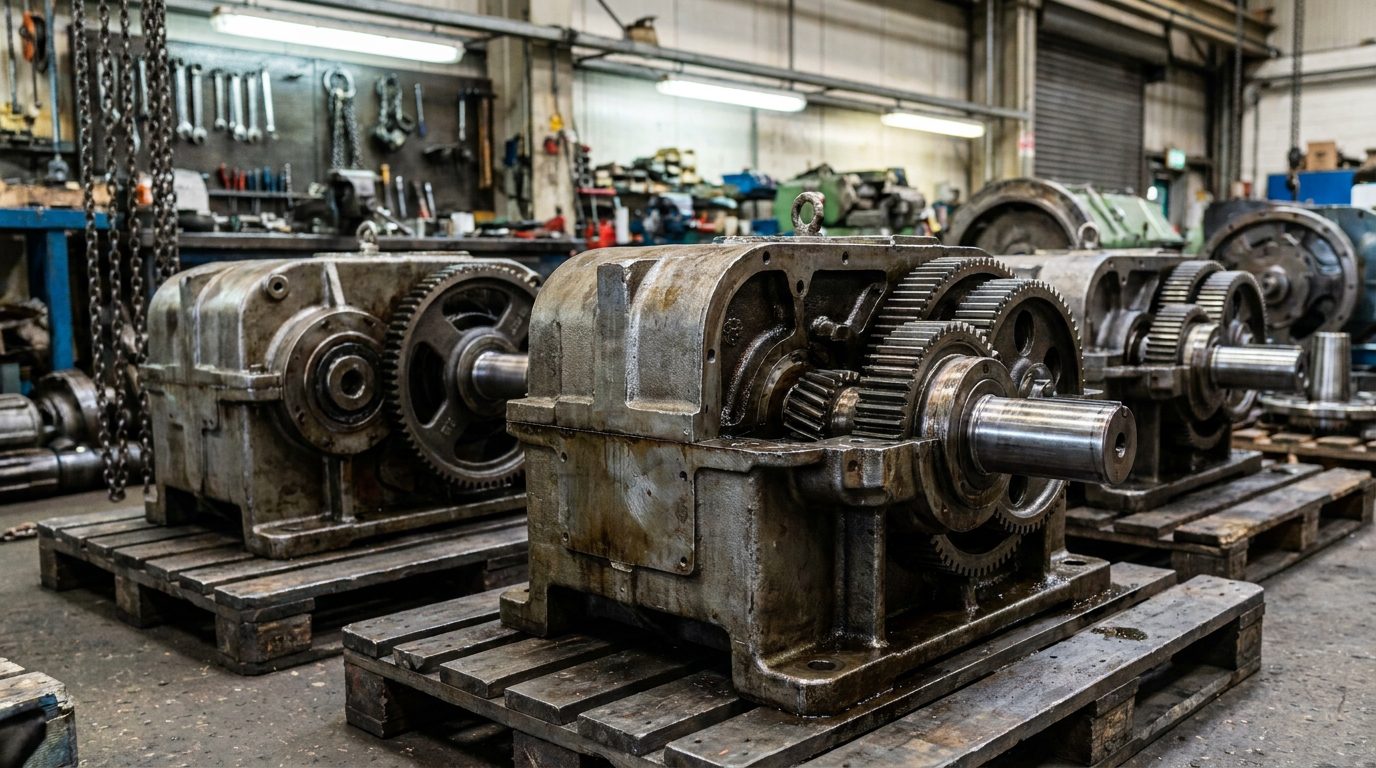
Choosing between custom vs standard industrial gearboxes is one of the most important decisions a maintenance team, OEM, plant engineer, or industrial buyer can make. The gearbox affects torque delivery, equipment uptime, energy efficiency, installation cost, lead time, and long-term maintenance requirements.
A standard industrial gearbox may be the fastest and most economical solution when operating conditions are predictable and mounting requirements are conventional. A custom industrial gearbox may be the better choice when the application involves unusual loads, restricted space, harsh environments, legacy equipment, or performance requirements that off-the-shelf units cannot meet.
This guide explains how to compare custom and standard industrial gearboxes, when each option makes sense, and what factors to evaluate before making a purchasing decision.
If you are unsure whether your application requires a standard gearbox replacement or a custom-engineered solution, Industrial Gearbox Solutions can help identify the right path. Our team can review nameplate data, photos, drawings, operating conditions, and failure history to recommend a practical solution.
Whether you need a direct replacement, reverse-engineered gearbox, retrofit, rebuild, or custom gearbox design, the first step is understanding your application requirements.
When considering the differences between custom and standard industrial gearboxes, it’s essential to understand how efficiency plays a crucial role in their performance. For a deeper insight into optimizing gearbox efficiency, you can refer to the article on motor gearbox efficiency calculations. This resource provides valuable information that can help you make informed decisions regarding the selection and design of gearboxes for your specific applications. For more details, visit this article.
Understanding Standard Industrial Gearboxes
Standard industrial gearboxes are pre-engineered units designed to meet common power transmission requirements. They are typically available in established frame sizes, ratios, shaft arrangements, mounting configurations, and housing styles.
These gearboxes are widely used in conveyors, mixers, pumps, fans, crushers, packaging equipment, food processing lines, and general manufacturing systems.
What Is a Standard Industrial Gearbox?
A standard industrial gearbox is a catalog-based reducer or speed increaser manufactured in repeatable designs. Common types include:
- Helical gearboxes
- Bevel gearboxes
- Worm gear reducers
- Planetary gearboxes
- Shaft-mounted reducers
- Parallel shaft gearboxes
- Right-angle gearboxes
- Inline gear reducers
Manufacturers design these units for broad industrial use. They often come with defined torque ratings, service factors, gear ratios, input options, and output shaft configurations.
Advantages of Standard Gearboxes
Standard gearboxes are often the best choice when the application fits within existing product specifications.
Key advantages include:
- Shorter lead times: Many standard units are available from stock or with relatively quick delivery.
- Lower upfront cost: Standardized manufacturing reduces engineering and production expenses.
- Proven designs: Catalog gearboxes are often field-tested across many applications.
- Simpler replacement: Maintenance teams can reorder the same model or cross-reference it with another brand.
- Easier documentation: Drawings, manuals, parts lists, and performance data are usually readily available.
- Broad vendor support: Many distributors and service providers can source or repair common gearbox models.
For many facilities, a standard gearbox provides the most efficient balance between cost, availability, and performance.
Limitations of Standard Gearboxes
Although standard gearboxes are practical, they are not always ideal.
Common limitations include:
- Limited mounting flexibility
- Fixed housing dimensions
- Restricted ratio options
- Inadequate torque capacity for severe-duty applications
- Compatibility issues with older equipment
- Insufficient sealing for harsh environments
- Limited material or coating options
- Potential need for adapter plates, couplings, or structural modifications
A standard unit may work mechanically but still create installation or reliability issues if it does not truly match the application.
Understanding Custom Industrial Gearboxes
Custom industrial gearboxes are engineered or modified to meet specific application requirements. They may be designed from the ground up, reverse-engineered from an obsolete unit, or adapted from an existing gearbox platform.
Custom solutions are especially valuable when standard options cannot meet dimensional, performance, environmental, or integration requirements.
What Is a Custom Industrial Gearbox?
A custom industrial gearbox is a gearbox built or modified for a specific operating need. Customization may involve:
- Unique housing dimensions
- Special gear ratios
- Custom shaft sizes or shaft locations
- Drop-in replacement dimensions
- Heavy-duty bearings
- Upgraded sealing systems
- Special lubrication systems
- Stainless steel or coated housings
- Explosion-proof or washdown-compatible features
- Reverse engineering of obsolete gearboxes
- Integration with existing motors, couplings, or driven equipment
Custom does not always mean entirely new. In many cases, a semi-custom gearbox based on a proven design can deliver the needed fit and performance without the cost of a fully engineered solution.
Advantages of Custom Gearboxes
Custom gearboxes are designed around the application instead of forcing the application to adapt to the gearbox.
Benefits include:
- Exact fit for existing equipment: Ideal for retrofits and legacy machinery.
- Optimized performance: Gear geometry, bearings, shafts, and lubrication can be engineered for specific loads and duty cycles.
- Improved reliability: Custom designs can correct recurring failure points.
- Reduced installation modifications: A drop-in replacement can minimize downtime and fabrication work.
- Better environmental protection: Seals, coatings, breathers, and materials can be selected for harsh conditions.
- Long-term equipment support: Reverse engineering can keep critical machinery operating after OEM support ends.
For facilities dealing with repeated failures, obsolete gearboxes, or unique production requirements, custom engineering can provide a lower total cost of ownership.
Limitations of Custom Gearboxes
Custom gearboxes can deliver major advantages, but they require careful planning.
Potential drawbacks include:
- Longer engineering and manufacturing lead times
- Higher upfront cost
- Need for accurate application data
- More detailed approval drawings and design reviews
- Potential need for prototype testing or validation
- Greater dependence on a qualified gearbox engineering partner
A custom gearbox is usually justified when the cost of downtime, poor fit, repeat failures, or process limitations outweighs the added investment.
Check out our latest posts at https://industrialgearboxsolutions.com/blog/ for valuable industry insights.
Custom vs Standard Industrial Gearboxes: Key Comparison Factors
The best choice depends on more than price. Maintenance professionals and buyers should compare performance, fit, lifecycle cost, lead time, serviceability, and risk.
Comparison Table
| Factor | Standard Industrial Gearbox | Custom Industrial Gearbox |
||||
| Lead Time | Usually faster | Longer due to engineering and fabrication |
| Upfront Cost | Typically lower | Typically higher |
| Fit | Limited to catalog dimensions | Designed for exact application fit |
| Performance | Good for common applications | Optimized for specific operating conditions |
| Availability | Often stocked or easily sourced | Built to order |
| Reliability | Strong when properly applied | Can be improved for severe duty or chronic failures |
| Maintenance | Standard parts and documentation | May require custom parts, but can be designed for easier service |
| Best Use Case | Conventional equipment and standard duty | Obsolete, critical, severe-duty, or space-constrained applications |
| Long-Term Value | Excellent for straightforward needs | Excellent when downtime or failure costs are high |
Torque and Load Requirements
Torque is one of the most important selection factors. A gearbox must handle normal running torque, startup torque, shock loads, overload events, and braking loads.
Standard gearboxes are rated according to catalog torque values and service factors. If the required torque fits within the available range, a standard unit may be sufficient.
However, if the application includes heavy shock loading, frequent starts and stops, reversing loads, or high inertia, a custom gearbox may be necessary. Custom designs can include larger gears, stronger shafts, upgraded bearings, and higher service factors.
Examples of high-load applications include:
- Crushers
- Kilns
- Steel mills
- Mining conveyors
- Extruders
- Rubber mixers
- Pulp and paper equipment
- Marine and offshore machinery
Space and Mounting Constraints
Many industrial facilities operate equipment that was installed decades ago. The available space may not match modern gearbox dimensions.
A standard gearbox may require:
- New baseplates
- Motor repositioning
- Coupling changes
- Guard modifications
- Structural fabrication
- Shaft alignment changes
These modifications can increase cost and downtime.
A custom gearbox can be designed as a drop-in replacement with matching shaft height, bolt pattern, output shaft diameter, and overall envelope dimensions. This is especially valuable during short shutdown windows where installation time is critical.
Gear Ratio and Speed Requirements
Standard industrial gearboxes are available in common ratios, but not every process can tolerate a close approximation. Some applications require precise output speed to maintain production quality, flow rate, line synchronization, or mixing performance.
Custom gearbox designs allow engineers to specify exact ratios or closer ratio matching. This can be important in:
- Printing and converting lines
- Food processing equipment
- Chemical mixers
- Extrusion systems
- Test stands
- Synchronized conveyor systems
If a slight speed difference affects product quality or machine timing, customization may be the better option.
When considering the differences between custom and standard industrial gearboxes, it’s essential to understand the implications of proper installation and alignment for optimal performance. A related article that delves into this topic is available at gearbox installation best practices, which provides valuable insights on alignment, mounting, and commissioning processes. This information can help ensure that whichever gearbox type you choose operates efficiently and reliably in your specific application.
When a Standard Industrial Gearbox Is the Right Choice
Standard industrial gearboxes are the right choice for many applications. They are cost-effective, proven, and widely supported.
The Application Matches Catalog Specifications
If torque, speed, service factor, mounting style, shaft arrangement, and environmental conditions fall within catalog limits, a standard gearbox is usually appropriate.
For example, a facility replacing a gearbox on a light-duty conveyor may not need a custom design. If the original gearbox is still available or can be cross-referenced easily, a standard replacement can reduce downtime and cost.
Downtime Is Manageable or Spare Units Are Available
If the gearbox is not on a critical production line, or if the plant already has spare units in inventory, a standard gearbox may be the most practical choice.
Standardization also helps reduce spare parts complexity. A plant with many similar reducers may benefit from using common gearbox models across multiple machines.
Budget Is the Primary Constraint
Standard gearboxes generally cost less upfront. For non-critical equipment, light-duty systems, or short-term repairs, the lower initial investment can be attractive.
However, buyers should avoid choosing a standard gearbox based only on purchase price. If the unit is under-rated or poorly fitted, the long-term costs may be much higher.
The Operating Environment Is Conventional
Standard gearboxes are well suited for clean, moderate environments where temperature, moisture, dust, chemicals, and washdown exposure are not extreme.
Examples include:
- General manufacturing
- Warehousing conveyors
- Packaging lines
- Light processing equipment
- HVAC and fan systems
- Pump drives in controlled areas
In these applications, a properly selected standard gearbox can provide years of reliable service.
When considering the best options for your machinery, understanding the differences between custom and standard industrial gearboxes is crucial for optimal performance. For those looking to delve deeper into the topic, a related article on industrial gearbox repair provides valuable insights into maintaining these essential components. You can read more about it in this informative piece, which highlights the importance of proper maintenance and repair techniques to extend the lifespan of your gearboxes.
When a Custom Industrial Gearbox Is the Better Choice
A custom industrial gearbox is often the better investment when the application is critical, unusual, or difficult to support with catalog options.
The Original Gearbox Is Obsolete
Obsolete gearboxes are a common problem in older plants. The OEM may no longer exist, parts may be unavailable, or documentation may be incomplete.
In these situations, reverse engineering can provide a practical solution. A gearbox specialist can measure the existing unit, inspect internal components, create drawings, and manufacture a replacement that fits the original machine.
This approach is often used for:
- Legacy production lines
- Older cranes and hoists
- Mill drives
- Marine equipment
- Power generation equipment
- Specialty manufacturing machinery
Repeated Gearbox Failures Are Occurring
If a gearbox repeatedly fails, replacing it with the same standard unit may only restart the failure cycle.
Common causes of repeated failures include:
- Undersized gear rating
- Bearing overload
- Poor lubrication
- Misalignment
- Excessive heat
- Shock loading
- Contamination
- Inadequate sealing
- Improper service factor
A custom gearbox can be engineered to correct the root cause. For example, a plant experiencing bearing failures on a heavily loaded conveyor may benefit from larger bearings, improved shaft support, and upgraded lubrication pathways.
The Equipment Is Critical to Production
For critical equipment, downtime can cost far more than the gearbox itself. A custom solution may be justified if it reduces failure risk or shortens future replacement time.
Consider a gearbox driving a main production conveyor. If a failure shuts down the entire plant, the cost of lost production, labor, emergency freight, and expedited repairs can quickly exceed the cost difference between standard and custom gearboxes.
Harsh Environments Require Special Features
Some environments demand more than a catalog gearbox can provide.
Custom gearbox features may include:
- Stainless steel housing
- Food-grade lubrication
- Corrosion-resistant coatings
- Labyrinth seals
- Taconite seals
- Positive pressure breathers
- Washdown-duty protection
- High-temperature seals
- Low-temperature lubrication
- Dust-proof enclosures
- Explosion-resistant design considerations
Industries such as food processing, mining, wastewater, chemical processing, cement, pulp and paper, and offshore operations often require application-specific gearbox protection.
Cost Considerations: Upfront Price vs Total Cost of Ownership
Industrial gearbox selection should always consider total cost of ownership, not just purchase price.
A standard gearbox may cost less at the time of purchase, but a poorly matched unit can lead to installation modifications, reduced efficiency, frequent maintenance, and unplanned downtime.
A custom gearbox may cost more initially, but it can reduce lifecycle cost if it improves reliability, fits without modification, and extends service life.
Typical Cost Factors to Compare
When comparing custom vs standard industrial gearboxes, evaluate these costs:
- Purchase price
- Engineering cost
- Installation labor
- Baseplate or mounting modifications
- Couplings, adapters, and guards
- Alignment time
- Downtime during installation
- Spare parts availability
- Lubrication and maintenance requirements
- Energy consumption
- Repair frequency
- Emergency replacement risk
- Expected service life
Example: Standard Gearbox vs Custom Drop-In Replacement
A plant needs to replace an obsolete gearbox on a critical mixer. A standard gearbox is available at a lower price, but it requires a new baseplate, shaft adapter, coupling modification, and piping relocation.
A custom drop-in replacement costs more upfront but matches the original mounting dimensions and shaft arrangement.
In this case, the custom gearbox may be the lower-cost option when installation labor, downtime, and production loss are included.
Lifecycle Value Matters
A gearbox that lasts twice as long, reduces downtime, or eliminates recurring failures can provide substantial value. For critical applications, reliability is often more important than initial purchase price.
Maintenance teams should work with engineering and purchasing departments to evaluate the full lifecycle impact of each option.
Engineering and Application Data Required for Selection
Accurate gearbox selection depends on accurate data. Whether choosing a standard or custom gearbox, incomplete information increases risk.
Essential Gearbox Information
Gather as much of the following as possible:
- Manufacturer and model number
- Nameplate data
- Gear ratio
- Input speed
- Output speed
- Motor horsepower or kilowatts
- Service factor
- Mounting position
- Shaft dimensions
- Bolt pattern
- Center distance
- Lubrication type
- Operating temperature
- Duty cycle
- Load type
- Photos of the gearbox and installation
- Drawings or manuals if available
Even if the nameplate is missing, photos and measurements can help identify the gearbox or support reverse engineering.
Application Conditions
The gearbox must be selected based on how it actually operates, not only what appears on the nameplate.
Important application questions include:
- Is the load uniform, moderate shock, or heavy shock?
- How many hours per day does the equipment run?
- How often does the drive start and stop?
- Is the gearbox exposed to dust, water, chemicals, or heat?
- Are there reversing loads?
- Are there overhung loads from sprockets, pulleys, or gears?
- Is the gearbox mounted horizontally, vertically, or at an angle?
- Has the gearbox failed before?
- What components failed?
- Is vibration or overheating present?
This information helps determine whether a standard gearbox is acceptable or whether a custom design is justified.
Failure Analysis Data
If the gearbox has failed, failure analysis can provide valuable direction.
Signs to inspect include:
- Gear tooth wear patterns
- Pitting or spalling
- Broken teeth
- Bearing damage
- Seal failure
- Oil contamination
- Overheating discoloration
- Shaft wear
- Housing cracks
- Misalignment indicators
A custom gearbox should not simply duplicate a failed design unless the failure was caused by external factors that have been corrected.
Industry-Specific Examples
Different industries have different gearbox priorities. Understanding the operating environment helps determine whether standard or custom gearboxes are most appropriate.
Mining and Aggregate
Mining conveyors, crushers, feeders, and screens often experience shock loading, abrasive dust, and difficult maintenance access.
Standard gearboxes may work in auxiliary equipment, but custom or heavy-duty modified gearboxes are often preferred for critical drives. Features such as upgraded seals, higher service factors, and reinforced housings can improve reliability.
Food and Beverage Processing
Food processing plants often require washdown protection, corrosion resistance, and sanitary design considerations.
A standard gearbox may be suitable in dry packaging areas. A custom stainless steel or washdown-duty gearbox may be better for wet processing zones, meat processing, dairy, or chemical cleaning environments.
Pulp and Paper
Pulp and paper facilities often operate continuously and expose gearboxes to moisture, heat, and heavy loads.
Custom gearboxes are frequently used for legacy machines, large rolls, and critical drives where exact fit and durability are essential.
Power Generation
Power generation facilities require high reliability and careful documentation. Gearboxes may be used in coal handling, cooling systems, auxiliary drives, and renewable energy equipment.
Custom gearbox solutions may be needed for obsolete equipment, high-duty cycles, or special speed requirements.
Manufacturing and Packaging
Many manufacturing and packaging applications can use standard gearboxes effectively. However, custom solutions may be required when synchronization, limited space, or proprietary machine designs are involved.
Practical Decision Checklist
The following checklist can help maintenance teams and buyers make a confident decision.
Choose a Standard Gearbox If:
- The application matches catalog ratings.
- Mounting dimensions are compatible.
- The required ratio is available.
- Lead time is critical and stock is available.
- The environment is not severe.
- The equipment is not highly specialized.
- Installation modifications are minimal.
- Spare parts and service support are readily available.
Choose a Custom Gearbox If:
- The original gearbox is obsolete.
- A drop-in replacement is required.
- Standard units do not fit the available space.
- The application has repeated failures.
- Loads exceed standard gearbox ratings.
- Environmental conditions are severe.
- Exact speed or ratio is required.
- Downtime costs are very high.
- The gearbox is critical to production.
- Long-term reliability is more important than lowest upfront cost.
Questions to Ask Before Buying
Before approving a gearbox purchase, ask:
- Does the gearbox meet actual torque and service factor requirements?
- Will it fit without major machine modifications?
- Is the lead time compatible with the outage schedule?
- Are replacement parts available?
- What is the expected service life?
- Has the failure history been reviewed?
- Are environmental conditions properly addressed?
- What is the total installed cost?
- Will the solution reduce future downtime?
- Is documentation available for maintenance and spare parts planning?
Working With a Gearbox Specialist
Selecting the right gearbox is easier when maintenance, engineering, purchasing, and gearbox specialists work together.
A qualified industrial gearbox partner can help evaluate both standard and custom options, identify risk factors, and recommend the most practical solution.
What a Gearbox Partner Should Provide
Look for a provider that can support:
- Gearbox identification
- Standard gearbox sourcing
- Custom gearbox design
- Reverse engineering
- Gearbox rebuilding
- Failure analysis
- Machining and fabrication
- Bearing and seal upgrades
- Lubrication recommendations
- Field measurements
- Installation support
- Emergency repair assistance
The right partner should not automatically push custom solutions when a standard gearbox will work. Likewise, they should recognize when a standard replacement could create long-term reliability problems.
Documentation and Quality Control
For custom gearboxes, documentation is especially important. Ask for:
- Approval drawings
- Dimensional data
- Gear ratio confirmation
- Material specifications
- Bearing and seal details
- Lubrication recommendations
- Inspection reports
- Test results when applicable
- Maintenance instructions
Strong documentation helps future maintenance teams service the gearbox and reorder components when needed.
Common Mistakes to Avoid
Gearbox selection mistakes can lead to downtime, safety concerns, and unnecessary expenses.
Selecting Based on Horsepower Alone
Horsepower is important, but it is not enough. Torque, speed, shock load, service factor, overhung load, and duty cycle must also be considered.
Two gearboxes with the same horsepower rating may perform very differently in real-world conditions.
Ignoring Installation Costs
A standard gearbox with a lower purchase price may require expensive modifications. Always compare the total installed cost, not just the invoice price.
Replacing a Failed Gearbox Without Finding the Root Cause
If a gearbox failed because it was undersized, misaligned, overheated, or contaminated, installing the same model may lead to another failure.
Failure analysis should guide the replacement strategy.
Over-Customizing When a Standard Unit Will Work
Custom gearboxes are valuable, but not every application requires one. Over-customization can increase cost and lead time unnecessarily.
The best solution is the one that meets operational requirements with the lowest reasonable lifecycle risk.
Neglecting Maintenance Access
Even a well-designed gearbox can become a maintenance problem if drain plugs, inspection covers, breathers, or lubrication points are difficult to access.
Whether standard or custom, the gearbox should be practical to maintain in the field.
Conclusion: Making the Right Gearbox Choice
The decision between custom vs standard industrial gearboxes depends on fit, performance, lead time, budget, reliability, and total cost of ownership. Standard gearboxes are excellent for common applications where catalog specifications meet the operating requirements. They offer fast availability, lower upfront cost, and broad support.
Custom industrial gearboxes are the better choice when applications involve obsolete equipment, exact dimensional requirements, severe-duty operation, harsh environments, repeated failures, or critical production assets. While custom gearboxes may cost more initially, they can reduce downtime, simplify installation, and improve long-term reliability.
Before making a decision, gather complete application data, review the failure history, compare total installed cost, and consider the risk of future downtime.
If you need help identifying, replacing, rebuilding, or custom-engineering an industrial gearbox, contact Industrial Gearbox Solutions today. Our team can help you evaluate the best option for your application and keep your equipment running reliably.
FAQs
What are custom industrial gearboxes?
Custom industrial gearboxes are gearboxes that are specifically designed and manufactured to meet the unique requirements of a particular application or industry. These gearboxes are tailored to fit specific dimensions, power requirements, and operating conditions.
What are standard industrial gearboxes?
Standard industrial gearboxes are pre-designed and mass-produced gearboxes that are readily available for a wide range of general industrial applications. They are manufactured according to standardized specifications and are often used in various industries without the need for customization.
What are the advantages of custom industrial gearboxes?
Custom industrial gearboxes offer the advantage of being tailored to meet the exact needs of a specific application, resulting in optimal performance, efficiency, and reliability. They can also accommodate unique space constraints and operating conditions that may not be suitable for standard gearboxes.
What are the advantages of standard industrial gearboxes?
Standard industrial gearboxes are readily available, cost-effective, and widely used in many applications. They offer quick delivery times, standardized designs, and interchangeable parts, making them a convenient choice for general industrial needs.
How do I choose between custom and standard industrial gearboxes?
The choice between custom and standard industrial gearboxes depends on the specific requirements of the application. Custom gearboxes are ideal for unique or specialized applications, while standard gearboxes are suitable for general industrial needs where off-the-shelf solutions can meet the requirements. It is important to consider factors such as cost, lead time, performance, and compatibility when making this decision.