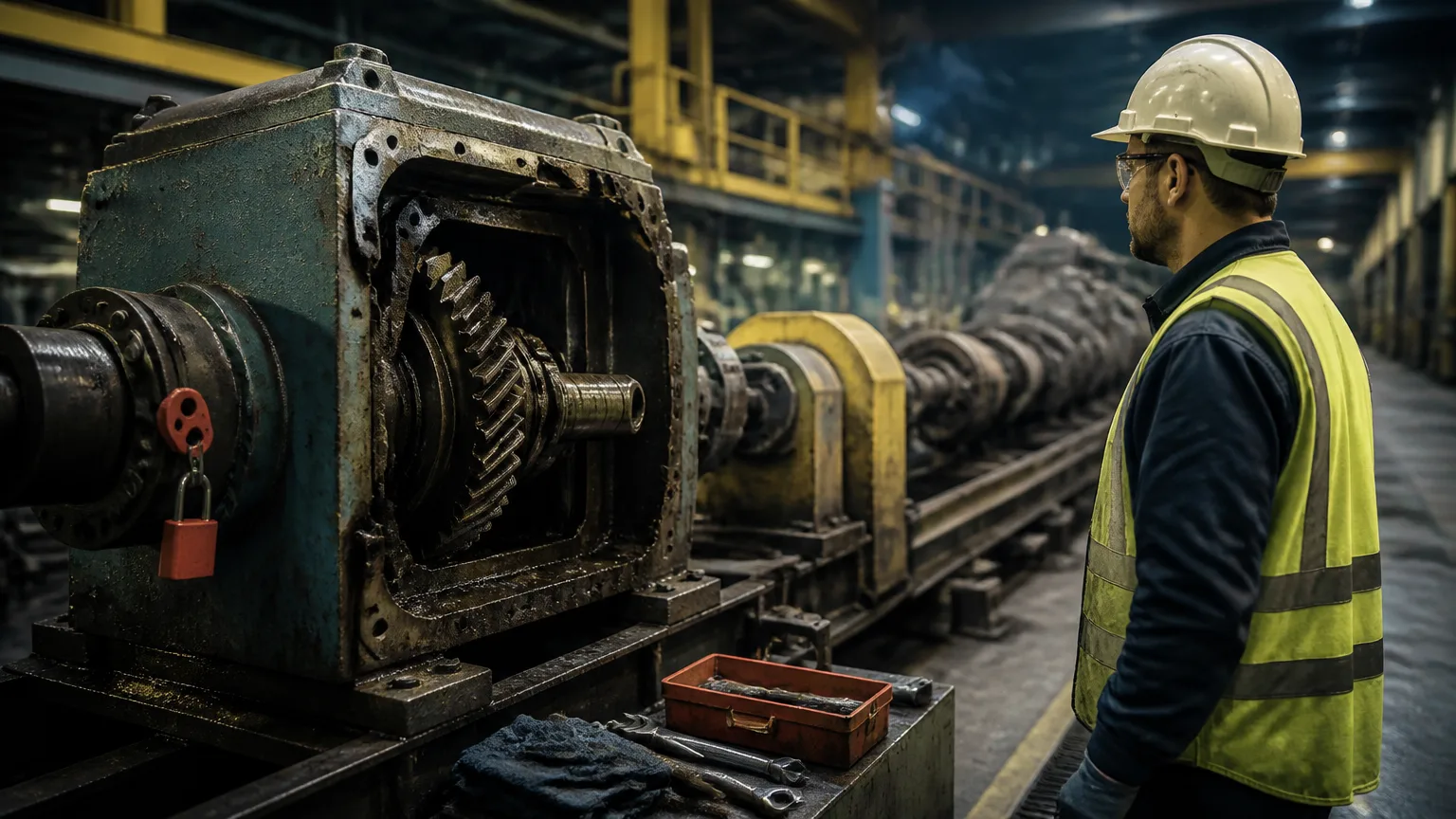
When a gearbox fails without warning, production can stop immediately. Line stoppages may trigger missed delivery commitments, damaged materials, and costly harm to connected equipment. An effective emergency gearbox repair response must begin before the failure creates additional losses.
Protect personnel first through lockout/tagout and verify that stored energy has been isolated. Do not restart, force, or dismantle the gearbox prematurely. Preserving its condition helps technicians identify the failure accurately and prevents secondary damage.
Next, document unusual noise, vibration, heat, leakage, load conditions, and operating history. These details support faster decisions about repair, replacement, and parts availability. This article provides a practical path from failure containment to reliable return to service, including guidance on choosing the right gearbox repair service for the situation.
Step 1: Make the Area Safe and Contain the Failure
After a gearbox stops, jams, overheats, leaks, or makes abnormal noise, initiate an emergency shutdown. Isolate electrical power and apply lockout/tagout procedures before anyone approaches the equipment. Verify that stored energy has been released, including pressure, gravity loads, hydraulic force, and residual motion.
Establish a controlled exclusion zone around the gearbox and connected machinery. Watch for hot oil, rotating components, suspended loads, pressurized systems, and contaminated fluids. Use appropriate personal protective equipment, and prevent leaks from reaching drains, soil, or other equipment.
Do not drain the oil, rotate shafts, or remove inspection covers at this stage. These actions can worsen mechanical damage, release hazardous fluids, or destroy evidence needed for diagnosis. Photograph the unit, controls, oil leaks, alarms, and surrounding components before disturbing anything.
Notify qualified maintenance personnel or your emergency gearbox repair provider. They can assess the failure safely, identify immediate containment measures, and determine whether the gearbox, driven equipment, or auxiliary systems also require isolation.
Step 2: Document Symptoms and Diagnose the Root Cause
Before disassembly, record the gearbox model, serial number, ratio, service factor, load, and operating speed. Note recent maintenance, oil changes, unusual events, and the exact time and conditions of failure. This information helps emergency gearbox repair teams select parts and assess whether the unit was correctly rated.
Capture photographs of the housing, shafts, couplings, seals, and mounting points. Record unusual noise, backlash, tooth damage, bearing seizure, overheating, or oil leakage. Collect a lubricant sample and inspect for metal particles, discoloration, water, or a burnt odor. These clues can suggest wear, contamination, misalignment, overload, or lubrication failure, but symptoms alone do not confirm the root cause.
Review vibration and temperature history, including alarm trends before shutdown. Compare these findings with recent changes in speed, load, process conditions, or maintenance. For guidance on preserving evidence and planning repairs, review these efficient gear repair solutions.
Finally, inspect the complete drive system. Check shaft alignment, coupling condition, lubrication delivery, foundation stiffness, and possible overloads. Investigate driven-equipment problems, such as jams or changing torque demand. Otherwise, the same root cause may damage the repaired gearbox again.
Step 3: Decide Between Emergency Repair, Rebuild, and Replacement
Choose the response based on damage severity, production requirements, parts availability, lead time, and lifecycle cost. An on-site emergency gearbox repair may suit minor failures when gears, shafts, housing bores, and alignment surfaces remain serviceable. Replacing a seal or bearing can restore operation, but these are temporary measures if deeper damage exists.
Remove the gearbox for a complete rebuild when contamination, overheating, tooth damage, shaft wear, or misalignment affects internal components. A quality rebuild should include teardown, cleaning, dimensional inspection, and nondestructive testing where appropriate. It should also include worn-component replacement, backlash checks, lubrication review, and documented testing before return to service. Work with a qualified gearbox rebuilder when damage requires controlled inspection and precision assembly.
Replacement may be faster when the housing is cracked, critical parts are unavailable, or repair lead time threatens operations. However, do not select a unit by horsepower alone. Verify ratio, torque, speed, mounting, shaft geometry, duty cycle, environmental conditions, and compatibility with the motor, couplings, and controls.
Compare the immediate production impact with long-term reliability. A quick intervention may reduce downtime today, while a rebuild or compatible replacement can prevent repeated failures and higher lifecycle costs.
Step 4: Select and Coordinate the Repair or Replacement Provider
Contact providers with a complete failure package. Include photos, nameplate data, drawings, dimensional information, operating history, failure observations, and any oil samples or debris findings. These details reduce diagnostic delays, quotation errors, and unnecessary shipping.
A true emergency gearbox repair provider offers more than replacement parts. Confirm its ability to reverse engineer obsolete or branded equipment, manufacture shafts and gears, perform machining and balancing, and provide field service. It should also support expedited freight, replacement sourcing, and repairs for specialized units, including Bonfiglioli gearbox repair and Davis Standard gearbox repair solutions.
Define the scope before work begins. Agree in writing on inspection gates, approval thresholds for additional work, logistics, and the expected completion date. Clarify whether the provider will repair, replace, or offer both options.
Also specify acceptance testing, balancing and run-test requirements, documentation, and warranty terms. Establish one communication contact and a reporting schedule, especially when production depends on an accurate turnaround estimate.
Step 5: Reinstall, Commission, and Prevent a Repeat Failure
Before installation, inspect the mounting surfaces, foundation, shafts, and connected equipment. Confirm shaft alignment, coupling fit, fastener torque, guards, lubricant type and level, and cooling-system operation. Check that the motor, controls, and driven machine are ready for service.
Use a staged commissioning process. Begin with an unloaded or low-load run, then increase load gradually under qualified supervision. Track vibration, temperature, noise, oil leakage, motor current draw, and signs of abnormal wear. Stop immediately if readings exceed established limits or operating behavior changes unexpectedly.
Record baseline readings after the gearbox reaches normal operating temperature. These measurements help distinguish normal break-in behavior from developing damage and support future emergency gearbox repair decisions.
Close the operational loop after commissioning. Document the failure, confirmed root cause, repairs, test results, and warranty details. Update maintenance intervals, spare-parts strategy, operator inspection routines, and condition-monitoring baselines. If the failure involved overload, contamination, misalignment, or cooling problems, revise procedures and train personnel accordingly. Schedule a follow-up inspection after the initial operating period to verify reliable performance.
Turn an Emergency Failure into a More Reliable System
A disciplined response moves from safe isolation and evidence gathering to repair-versus-replacement analysis, provider coordination, commissioning, and preventive action. The fastest solution is not always the quickest part shipment. It is the response that restores production without repeating the original failure.
Prepare an emergency gearbox repair plan before failure occurs. Include critical spares, service contacts, equipment records, approval authority, and transportation arrangements. After commissioning, verify performance, document the work, and update inspection and monitoring procedures.
Work with a repair partner capable of diagnosing the complete drive system and documenting a reliable return to service. Speed and technical discipline must work together to protect uptime and long-term gearbox performance.