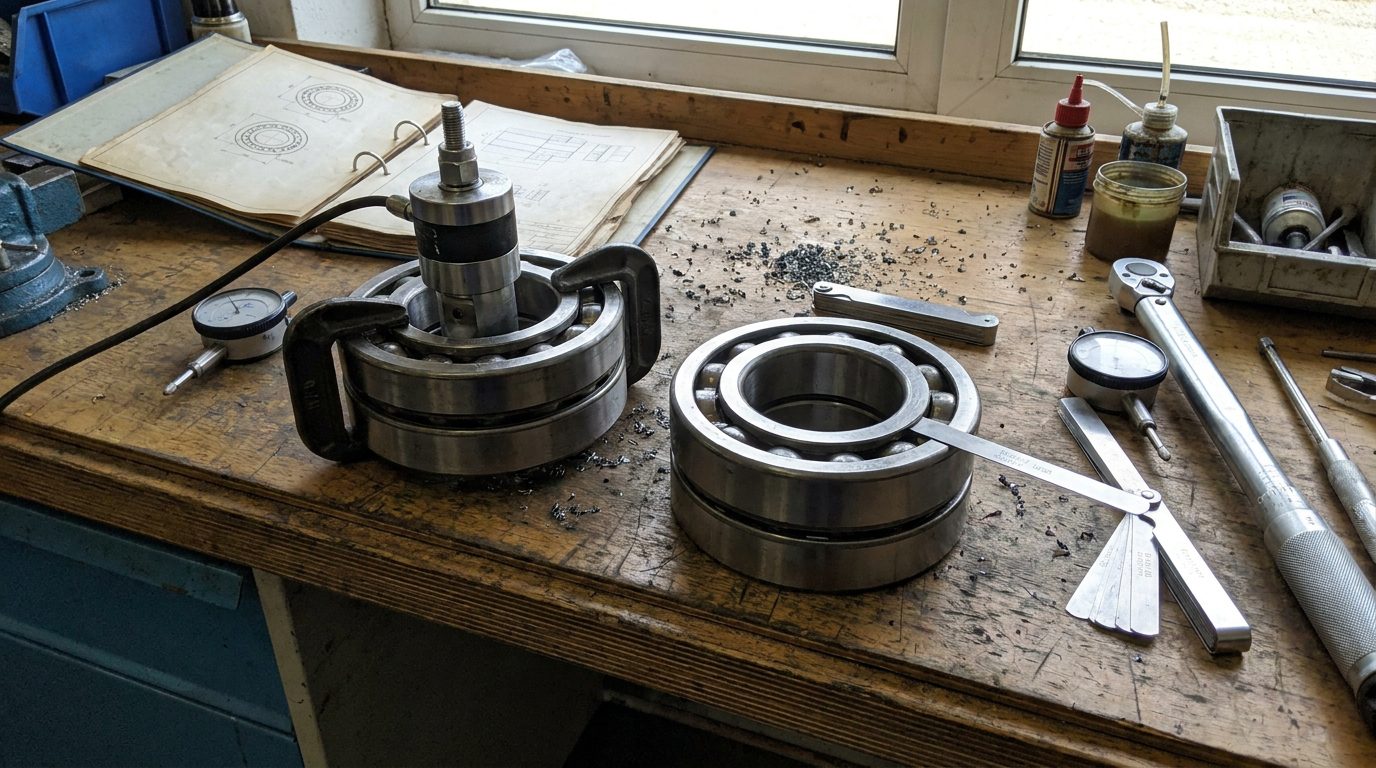
Bearing preload and clearance are critical factors in industrial gearbox reliability because they directly affect bearing life, shaft alignment, gear mesh accuracy, heat generation, vibration, and lubricant film stability. For maintenance managers, plant engineers, reliability teams, mechanics, and purchasing professionals, understanding the difference between preload and clearance can help prevent premature gearbox failures, unplanned downtime, and unnecessary replacement costs. In industrial gearboxes, bearings must support radial and axial loads while maintaining precise shaft positioning under changing speeds, temperatures, and loads. Too much clearance can cause vibration and misalignment; too much preload can cause overheating and rapid wear. The goal is controlled, application-specific bearing operating clearance.
Bearing preload is an intentional axial or radial load applied to a bearing to remove internal looseness and improve stiffness, accuracy, and shaft control. Bearing clearance is the internal free movement between bearing rolling elements and raceways before mounting or during operation. In industrial gearboxes, the correct balance between preload and clearance is essential for reliable gear mesh, reduced vibration, controlled operating temperature, and long bearing life. Excessive clearance can lead to noise, vibration, misalignment, and gear tooth wear. Excessive preload can cause overheating, lubricant breakdown, bearing spalling, and seizure.
Understanding the differences between bearing preload and bearing clearance is crucial for optimizing machinery performance and longevity. For a deeper insight into the implications of these concepts in industrial applications, you can refer to a related article that discusses the intricacies of gearbox repair and maintenance. This article provides valuable information on how proper bearing adjustments can enhance the efficiency of industrial gearboxes. To read more, visit here.
What Bearing Preload and Clearance Mean in Industrial Gearboxes
Industrial gearboxes depend on bearings to keep shafts properly positioned while transmitting torque through gears, pinions, and couplings. Whether the unit uses tapered roller bearings, spherical roller bearings, cylindrical roller bearings, ball bearings, or angular contact bearings, the internal bearing geometry must be matched to the operating conditions.
What Is Bearing Clearance?
Bearing clearance is the amount of internal movement between the rolling elements and raceways before or during operation. It may be measured in the radial direction or axial direction.
Common clearance types include:
- Radial internal clearance: Movement perpendicular to the shaft centerline.
- Axial internal clearance: Movement parallel to the shaft centerline.
- Initial clearance: Clearance before mounting.
- Mounted clearance: Clearance after the bearing is installed on the shaft and in the housing.
- Operating clearance: Clearance after thermal expansion, load, and running conditions are considered.
In many industrial gearbox applications, the most important value is not the catalog clearance, but the operating clearance after the gearbox reaches normal temperature.
What Is Bearing Preload?
Bearing preload is an intentional load applied to a bearing assembly to remove looseness and increase system stiffness. Preload is commonly used in tapered roller bearings and angular contact ball bearings where accurate shaft positioning is required.
Preload may be created using:
- Locknuts
- Shims
- Spacer rings
- Spring washers
- End caps
- Adjusting screws
- Matched bearing sets
- Controlled housing fits and shaft fits
In gearbox applications, preload is often used to control shaft endplay, improve gear contact pattern, reduce vibration, and stabilize the rotating assembly.
Clearance vs. Preload: The Practical Difference
Clearance allows internal movement. Preload removes internal movement by applying a controlled force.
A gearbox bearing can begin with measurable clearance before installation, then have reduced clearance after mounting, and finally operate with either slight clearance or light preload depending on thermal growth and loading.
| Factor | Bearing Clearance | Bearing Preload |
||:|:|
| Primary purpose | Allows space for expansion and lubrication | Removes looseness and increases stiffness |
| Common concern | Too much movement or looseness | Too much heat or load |
| Typical symptom if incorrect | Vibration, noise, shaft movement | Overheating, high torque, lubricant distress |
| Common in | Roller bearings, spherical bearings, cylindrical bearings | Tapered roller and angular contact arrangements |
| Gearbox effect | Can affect alignment and gear mesh | Can improve shaft control if correctly set |
For additional technical background, refer to bearing manufacturers such as SKF at https://www.skf.com and Timken at https://www.timken.com.
Why Bearing Preload and Clearance Matter for Gearbox Reliability
Incorrect preload or clearance is one of the most common hidden causes of recurring gearbox failure. A bearing may be correctly specified but incorrectly installed, adjusted, lubricated, or operated outside its intended thermal range.
Effect on Gear Mesh
Gear teeth require proper contact patterns to distribute load. If bearing clearance is excessive, the shaft can move under load, causing the gear mesh to shift. This may result in:
- Edge loading
- Uneven contact pattern
- Increased backlash variation
- Gear tooth pitting
- Scuffing or scoring
- Increased noise
- Premature gear failure
For gear design and rating principles, the American Gear Manufacturers Association provides standards and technical references at https://www.agma.org.
Effect on Vibration and Noise
Bearings with excessive clearance can create looseness that appears as vibration, knocking, rattling, or unstable frequency signatures. Bearings with excessive preload may create high-frequency vibration associated with distress, friction, or lubrication failure.
Reliability engineers often identify bearing adjustment issues through vibration analysis, oil analysis, temperature trending, and inspection during scheduled outages.
Effect on Lubrication
Bearing preload and clearance influence lubricant film thickness. Too much clearance can allow impact loading and unstable rolling contact. Too much preload can squeeze lubricant film, increase friction, and accelerate oxidation.
Noria Corporation offers extensive lubrication and oil analysis resources at https://www.noria.com.
Effect on Operating Temperature
Temperature changes can reduce or increase internal bearing clearance. A shaft usually expands faster than a housing, especially if the bearing inner ring runs hotter than the outer ring. This can reduce operating clearance and potentially create unwanted preload.
This is why a bearing that feels acceptable during installation may run hot after the gearbox reaches full load.
Industrial gearbox bearing failure can lead to costly downtime and production losses, so it’s important to address the issue promptly. Industrial gearbox bearing failure
Common Causes of Incorrect Bearing Preload and Clearance
Bearing adjustment problems may originate during design, installation, maintenance, repair, or operation.
Incorrect Installation Practices
Many bearing failures begin during assembly. Common mistakes include:
- Over-tightening locknuts
- Incorrect shim pack thickness
- Improper spacer selection
- Failure to measure endplay
- Using impact tools incorrectly
- Pressing through rolling elements
- Mixing unmatched bearing components
- Reusing damaged locknuts or washers
- Ignoring manufacturer torque and setting procedures
Mechanics should always follow the gearbox OEM procedure or bearing manufacturer instructions when setting preload or clearance.
Thermal Expansion Miscalculation
A gearbox may be assembled cold but operate hot. Thermal growth can significantly change clearance. For example, a shaft-mounted inner ring may expand more than the housing-mounted outer ring, reducing radial clearance.
Factors that affect thermal growth include:
- Shaft diameter
- Housing material
- Bearing arrangement
- Oil temperature
- Ambient temperature
- Load
- Speed
- Duty cycle
- Heat generated by nearby gears or seals
Wrong Bearing Clearance Class
Bearings are available with different internal clearance classes, such as normal clearance or greater-than-normal clearance. If the wrong clearance class is installed, the gearbox may run loose or hot.
For example, a bearing with too little internal clearance may become preloaded after installation. A bearing with too much internal clearance may allow shaft movement that damages gear teeth.
Improper Fits on Shaft or Housing
Interference fits reduce bearing clearance. A tight shaft fit expands the inner ring. A tight housing fit compresses the outer ring. If fits are not controlled, operating clearance may differ from the intended value.
Common fit-related problems include:
- Worn bearing seats
- Oversized shafts
- Undersized housings
- Fretting corrosion
- Out-of-round bores
- Improper repair plating or sleeving
- Poor machining tolerances
For gearbox housing and shaft inspection support, see Industrial Gearbox Solutions’ resources on industrial gearbox repair and gearbox inspection services.
Contamination and Lubricant Degradation
Even when preload and clearance are correctly set, contamination can create wear that increases internal clearance over time. Lubricant degradation can also increase friction and heat, making a properly adjusted bearing behave like an overloaded one.
Typical contaminants include:
- Water
- Dirt
- Process dust
- Metal debris
- Cleaning chemicals
- Degraded oil sludge
- Seal fragments
- Wear particles from gears or bearings
Operating Conditions Beyond Design Limits
A gearbox designed for one duty cycle may be pushed into another. Higher loads, shock loading, misalignment, increased speed, or frequent starts and stops can change bearing behavior.
Applications at higher risk include:
- Conveyors
- Crushers
- Mixers
- Extruders
- Cooling towers
- Kilns
- Ball mills
- Paper machines
- Mining equipment
- Steel mill drives
Understanding the differences between bearing preload and bearing clearance is crucial for optimizing machinery performance and longevity. For those looking to delve deeper into this topic, a related article can provide valuable insights into the intricacies of gearbox repair and maintenance. You can explore more about this in the context of industrial applications by visiting gearbox repair in Paducah, Kentucky, which discusses various factors affecting bearing performance.
Symptoms of Incorrect Bearing Preload or Clearance
| Bearing Preload | Bearing Clearance |
|---|---|
| Applied force or displacement to eliminate internal clearance | The amount of internal clearance between the rolling elements and the raceways |
| Increases stiffness and reduces vibration | Allows for thermal expansion and compensates for shaft deflection |
| Requires careful adjustment to avoid excessive heat and premature wear | Must be within specified range to prevent excessive play and noise |
Recognizing early symptoms can prevent catastrophic gearbox failure.
Symptoms of Excessive Bearing Clearance
Excessive clearance means the bearing has too much internal looseness or shaft endplay.
Common signs include:
- Rumbling or rattling noise
- Increased vibration at running speed
- Gear mesh frequency sidebands
- Shaft movement or endplay
- Poor gear contact pattern
- Coupling misalignment changes
- Oil debris from gear tooth wear
- Uneven bearing load zones
- Seal leakage caused by shaft movement
- Impact marks on raceways
In tapered roller bearing arrangements, excessive endplay can allow gear movement that causes poor tooth contact and accelerated pitting.
Symptoms of Excessive Bearing Preload
Excessive preload means the bearing is too tightly adjusted or has insufficient operating clearance.
Common signs include:
- Rapid temperature rise after startup
- High steady-state bearing temperature
- Burnt oil smell
- Darkened lubricant
- High motor amperage
- Bearing discoloration
- Smearing or skidding damage
- Spalling or flaking
- Cage damage
- Reduced coast-down time
- Bearing seizure in severe cases
A gearbox that runs hot shortly after bearing replacement may have excessive preload, incorrect fits, poor lubrication, or misalignment.
Symptoms of Insufficient Preload
Some applications require preload for shaft stability. If preload is insufficient, symptoms may include:
- Axial shaft movement
- Gear tooth contact shift
- Vibration under reversing loads
- Unstable bearing vibration signatures
- Clunking during start-stop cycles
- Fretting on bearing seats
- Poor repeatability in gear alignment
Troubleshooting Bearing Preload and Clearance Problems
Troubleshooting should combine mechanical inspection, operating data, lubrication analysis, and repair history.
Step-by-Step Troubleshooting Process
| Step | Action | What It Reveals |
||||
| 1 | Review gearbox history | Recurring failures, recent repairs, lubricant changes |
| 2 | Check operating temperature | Possible preload, lubrication, or load issue |
| 3 | Perform vibration analysis | Looseness, bearing defects, gear mesh issues |
| 4 | Inspect oil condition | Wear debris, contamination, overheating |
| 5 | Measure shaft endplay | Excessive clearance or improper adjustment |
| 6 | Check gear contact pattern | Shaft movement or misalignment |
| 7 | Inspect bearing seats | Fit problems, fretting, out-of-round conditions |
| 8 | Verify bearing part numbers | Incorrect clearance class or bearing type |
| 9 | Compare to OEM settings | Confirms preload/endplay target |
| 10 | Document findings | Supports repair or replacement decision |
Questions Maintenance Teams Should Ask
When diagnosing preload or clearance issues, ask:
- Was the bearing recently replaced?
- Were shims changed during assembly?
- Was endplay measured and recorded?
- What bearing clearance class was installed?
- Were shaft and housing fits measured?
- Did the gearbox run hot immediately after startup?
- Is the vibration load-dependent?
- Has the operating speed or load changed?
- Is oil viscosity correct for the application?
- Are there signs of contamination or lubricant oxidation?
Common Troubleshooting Mistakes
Avoid these common errors:
- Assuming all heat is caused by lubrication
- Replacing bearings without measuring fits
- Ignoring shaft endplay
- Reusing old shims without verification
- Failing to check bearing clearance class
- Installing bearings by feel only
- Overlooking thermal expansion
- Treating vibration symptoms without correcting mechanical looseness
For more support, Industrial Gearbox Solutions can assist with gearbox failure analysis and emergency gearbox repair.
Inspection Methods for Bearing Preload and Clearance
Accurate inspection is essential because visual checks alone rarely reveal preload or clearance problems.
Shaft Endplay Measurement
Shaft endplay is commonly measured using a dial indicator. The shaft is moved axially in both directions, and total movement is recorded.
Basic process:
- Secure the gearbox or component.
- Mount a dial indicator against the shaft end.
- Apply axial force in one direction.
- Zero the indicator.
- Apply axial force in the opposite direction.
- Record total indicated movement.
- Compare with OEM specification.
Endplay measurement is especially important in tapered roller bearing arrangements.
Radial Clearance Measurement
Radial clearance may be checked using feeler gauges before mounting on certain bearing types, especially spherical roller bearings. For mounted bearings, direct measurement can be more difficult and may require specialized methods.
SKF provides bearing mounting and clearance reduction guidance at https://www.skf.com/group/products/rolling-bearings/principles-of-rolling-bearing-selection/bearing-selection-process/operating-clearance.
Torque-to-Rotate Measurement
Torque-to-rotate can help identify excessive preload. If a bearing assembly requires unusually high torque to rotate, preload may be too high, or components may be misaligned.
This method is useful when:
- Setting tapered roller bearings
- Comparing rebuilt gearboxes
- Verifying assembly consistency
- Checking for binding or seal drag
However, torque-to-rotate should be interpreted carefully because seals, lubricant viscosity, gear mesh, and assembly friction can affect readings.
Temperature Trending
Temperature is one of the easiest field indicators. A bearing running hotter than expected may have excessive preload, inadequate lubrication, contamination, misalignment, or overload.
Recommended practices:
- Record baseline temperatures after startup.
- Trend temperature at normal operating load.
- Compare drive-end and non-drive-end bearing locations.
- Use the same measurement location each time.
- Investigate rapid temperature rise immediately.
Vibration Analysis
Vibration analysis can identify looseness, bearing defects, gear mesh issues, and resonance. Excessive clearance often produces looseness patterns, while excessive preload can accelerate bearing defect frequencies.
Useful vibration indicators include:
- Running speed vibration
- Harmonics of running speed
- Gear mesh frequency
- Sidebands
- Bearing defect frequencies
- High-frequency acceleration
- Time waveform impacts
Oil Analysis and Wear Debris Inspection
Oil analysis helps determine whether bearing distress is active. Key tests include:
- Particle count
- Ferrous wear debris
- Water content
- Viscosity
- Acid number
- Oxidation
- Spectrometric metals
- Analytical ferrography
Wear debris can indicate whether damage is coming from bearings, gears, cages, or seals.
Contact Pattern Inspection
Gear contact patterns reveal whether shafts are staying aligned under load. If bearing clearance allows shaft movement, contact may shift toward the toe, heel, root, or tip of the gear tooth.
Contact pattern issues may indicate:
- Excessive bearing endplay
- Housing distortion
- Misalignment
- Shaft deflection
- Gear manufacturing error
- Incorrect bearing setting
How to Set Bearing Preload and Clearance Correctly
The correct method depends on bearing type, gearbox design, and OEM specifications. Always follow manufacturer instructions when available.
Tapered Roller Bearings
Tapered roller bearings are commonly used where combined radial and axial loads are present. They are often adjusted using endplay or preload.
Common setting methods include:
- Shim adjustment
- Locknut adjustment
- Spacer-controlled setting
- Torque-set procedures
- Measured endplay procedures
- Bearing setting by axial displacement
Timken provides detailed tapered roller bearing technical resources at https://www.timken.com/resources/.
Spherical Roller Bearings
Spherical roller bearings often require correct radial internal clearance and clearance reduction during mounting, especially when installed on tapered seats or adapter sleeves.
Key considerations:
- Measure initial radial clearance.
- Mount bearing carefully.
- Measure clearance reduction.
- Confirm minimum residual clearance.
- Use correct lubrication.
- Avoid excessive drive-up.
Cylindrical Roller Bearings
Cylindrical roller bearings are often used for radial load capacity and may allow axial displacement depending on design. Clearance must be matched to fits, temperature, and speed.
Important checks include:
- Shaft fit
- Housing fit
- Radial internal clearance class
- Axial float requirements
- Lubrication condition
- Cage design suitability
Angular Contact Ball Bearings
Angular contact bearings may be preloaded to improve stiffness and axial positioning. They are often used in matched sets.
Preload may be:
- Light
- Medium
- Heavy
- Spring-applied
- Rigidly set with spacers
Too much preload can rapidly overheat angular contact bearings, especially at higher speeds.
Prevention: How to Avoid Preload and Clearance Failures
Preventing bearing adjustment problems requires controlled assembly, documentation, training, and condition monitoring.
Use the Correct Bearing Specification
Purchasing professionals should verify more than just bearing bore, outside diameter, and width. The complete bearing specification may include:
- Bearing type
- Internal clearance class
- Precision class
- Cage material
- Seal or shield configuration
- Heat stabilization
- Lubrication compatibility
- Matched set arrangement
- Brand and manufacturer equivalency
A substitute bearing may physically fit but fail if the clearance class or internal geometry is wrong.
Document Endplay and Preload Settings
Every gearbox repair should include recorded measurements. Documentation should include:
- Bearing part numbers
- Clearance class
- Shaft fits
- Housing fits
- Shim thicknesses
- Endplay readings
- Torque-to-rotate readings
- Gear backlash
- Contact pattern
- Lubricant used
- Startup temperature
This creates a baseline for future troubleshooting.
Control Cleanliness During Assembly
Contamination can alter bearing performance and reduce life. Use clean work surfaces, proper storage, sealed containers, and lint-free materials.
Best practices include:
- Keep bearings wrapped until installation.
- Do not place bearings on dirty benches.
- Use clean tools.
- Filter new oil before filling.
- Flush contaminated housings.
- Replace breathers and seals as needed.
- Inspect magnetic plugs and strainers.
Train Mechanics on Bearing Setting Procedures
Bearing preload and clearance should not be set by guesswork. Mechanics should be trained on:
- Dial indicator use
- Feeler gauge measurement
- Micrometer and bore gauge use
- Bearing heating methods
- Hydraulic mounting tools
- Shim calculation
- Locknut torque procedures
- Interpretation of OEM instructions
Monitor Operating Conditions
Condition monitoring helps identify changes before failure.
Recommended monitoring methods:
- Vibration analysis
- Oil analysis
- Infrared thermography
- Ultrasound inspection
- Temperature sensors
- Motor current trending
- Routine visual inspections
Repair vs. Replacement: Making the Right Decision
When a gearbox shows preload or clearance-related symptoms, the team must decide whether to adjust, repair, rebuild, or replace the unit.
When Adjustment May Be Enough
Adjustment may be appropriate when:
- Bearings are new or undamaged.
- Endplay is slightly outside specification.
- No significant wear debris is present.
- Gear teeth show acceptable contact.
- Housing and shaft fits are within tolerance.
- Operating temperature has not caused heat damage.
- The root cause is known and correctable.
When Repair or Rebuild Is Recommended
A repair or rebuild is usually recommended when:
- Bearings show spalling, discoloration, or scoring.
- Shaft seats are worn or fretted.
- Housing bores are out of round.
- Gears show abnormal wear patterns.
- Lubricant contains metal debris.
- Seals have failed repeatedly.
- The gearbox has recurring vibration problems.
- Endplay cannot be held within tolerance.
When Replacement May Be Better
Replacement may be the better choice when:
- Housing damage is severe.
- Gear sets are obsolete or uneconomical to manufacture.
- Repair cost approaches replacement cost.
- Lead time for repair exceeds production needs.
- The gearbox is undersized for current duty.
- Multiple failures have occurred after prior repairs.
- Efficiency or reliability upgrades are needed.
| Decision Factor | Adjust | Repair/Rebuild | Replace |
||:|:|:|
| Bearing damage | No | Yes | Severe or repeated |
| Shaft/housing wear | Minimal | Repairable | Severe |
| Gear damage | None/minor | Moderate | Severe |
| Downtime tolerance | Short | Moderate | Depends on availability |
| Cost | Lowest | Medium | Highest upfront |
| Long-term reliability | Good if root cause corrected | High if properly rebuilt | High if correctly specified |
| Best for | Minor setting errors | Mechanical damage | Obsolete or uneconomical units |
For application-specific help, contact Industrial Gearbox Solutions for gearbox rebuild services or replacement gearbox sourcing.
Maintenance Best Practices for Bearing Preload and Clearance
A proactive maintenance program reduces the risk of bearing-related gearbox failures.
Establish Baseline Data
After installation or rebuild, record:
- No-load temperature
- Full-load temperature
- Vibration readings
- Oil sample results
- Motor amperage
- Sound level
- Gearbox speed
- Operating load
- Shaft endplay if accessible
Baseline data helps determine whether future changes are normal or abnormal.
Use the Correct Lubricant
Lubricant selection affects heat, film thickness, wear, and bearing life. Confirm:
- ISO viscosity grade
- Additive type
- Compatibility with seals
- Compatibility with gearbox metallurgy
- Operating temperature range
- OEM approval
- Contamination control requirements
Too low a viscosity may reduce film strength. Too high a viscosity may increase heat and churning losses.
Maintain Proper Oil Level
Incorrect oil level can cause bearing distress.
Low oil level may cause:
- Starvation
- Heat
- Wear
- Bearing noise
- Gear scuffing
High oil level may cause:
- Churning
- Foaming
- Heat
- Oxidation
- Leakage
Protect Against Contamination
Contamination control is one of the most cost-effective reliability improvements.
Recommended actions:
- Install desiccant breathers.
- Use quick-connect filtration.
- Filter oil during transfer.
- Store lubricants indoors.
- Use dedicated transfer containers.
- Replace worn seals.
- Keep inspection covers sealed.
- Use magnetic drain plugs where appropriate.
Inspect During Planned Outages
During outages, inspect:
- Bearing condition
- Shaft endplay
- Gear contact pattern
- Backlash
- Seal condition
- Breathers
- Oil condition
- Magnetic plugs
- Housing fasteners
- Coupling alignment
- Soft foot and base condition
Avoid Uncontrolled Bearing Substitutions
Purchasing teams may be asked to cross-reference bearings quickly during downtime. However, a bearing substitution should be reviewed carefully.
Check:
- Internal clearance
- Load rating
- Speed rating
- Cage design
- Heat treatment
- Precision class
- Manufacturer quality
- Dimensional equivalency
- Application suitability
A lower-cost substitute can become expensive if it changes operating clearance or bearing stiffness.
Tables for Field Reference
Excessive Clearance vs. Excessive Preload
| Observation | Likely Excessive Clearance | Likely Excessive Preload |
||:|:|
| Rattling or knocking | Yes | No |
| Rapid temperature rise | Sometimes | Yes |
| Shaft endplay | Yes | No |
| Gear contact pattern shifts | Yes | Sometimes |
| High torque to rotate | No | Yes |
| Bearing discoloration | Sometimes | Yes |
| Looseness vibration | Yes | No |
| Lubricant oxidation | Sometimes | Yes |
| Seal leakage from shaft movement | Yes | Sometimes |
| Bearing seizure | Rare | Possible |
Inspection Tools and Uses
| Tool | Use |
|||
| Dial indicator | Measure shaft endplay and axial movement |
| Feeler gauge | Check radial clearance on selected bearing types |
| Micrometer | Measure shaft journals and spacers |
| Bore gauge | Check housing bore size and roundness |
| Torque wrench | Apply controlled locknut or fastener torque |
| Infrared thermometer | Trend bearing and housing temperature |
| Vibration analyzer | Detect looseness, defects, and gear mesh issues |
| Oil analysis kit | Identify wear, contamination, and lubricant condition |
| Borescope | Inspect gears and bearings without full disassembly |
| Blueing compound | Check gear tooth contact pattern |
Branded Image Suggestions
Image 1: Bearing Clearance vs. Preload Diagram
Alt text: Diagram showing bearing preload and clearance in an industrial gearbox bearing assembly
Caption: Proper bearing preload and clearance help control shaft movement, gear mesh, vibration, and operating temperature.
Suggested file name: bearing-preload-clearance-industrial-gearbox-diagram.jpg
Image 2: Technician Measuring Shaft Endplay
Alt text: Mechanic using a dial indicator to measure shaft endplay on an industrial gearbox
Caption: Dial indicator measurements help confirm whether bearing endplay is within OEM specification.
Suggested file name: gearbox-shaft-endplay-dial-indicator.jpg
Image 3: Damaged Bearing from Excessive Preload
Alt text: Industrial gearbox bearing with heat discoloration and raceway damage from excessive preload
Caption: Excessive preload can generate heat, break down lubricant, and cause premature bearing failure.
Suggested file name: excessive-bearing-preload-damage.jpg
Image 4: Gear Contact Pattern Inspection
Alt text: Gear tooth contact pattern inspection during industrial gearbox rebuild
Caption: Bearing clearance and preload affect shaft position and gear tooth contact pattern.
Suggested file name: industrial-gearbox-contact-pattern-inspection.jpg
Image 5: Clean Gearbox Rebuild Workstation
Alt text: Clean industrial gearbox rebuild area with bearings, shims, and precision measuring tools
Caption: Clean assembly practices and accurate measurements are essential for reliable bearing setting.
Suggested file name: gearbox-bearing-installation-clean-workstation.jpg
SEO Metadata
SEO Title
Understanding Bearing Preload and Clearance in Industrial Gearboxes
Meta Description
Learn how bearing preload and clearance affect industrial gearbox reliability, symptoms of incorrect settings, inspection methods, troubleshooting, repair decisions, and maintenance best practices.
Primary Keyword
bearing preload and clearance
Secondary Keywords
- bearing preload
- bearing clearance
- gearbox bearing clearance
- gearbox bearing preload
- industrial gearbox bearing failure
- shaft endplay
- tapered roller bearing preload
- radial internal clearance
- gearbox vibration troubleshooting
- gearbox overheating causes
Suggested URL Slug
understanding-bearing-preload-and-clearance
Search Intent
Informational and commercial investigation. The article supports professionals researching gearbox bearing adjustment, troubleshooting recurring failures, and deciding whether to repair, rebuild, or replace an industrial gearbox.
Frequently Asked Questions
What is the difference between bearing preload and bearing clearance?
Bearing clearance is the internal looseness or movement within a bearing before or during operation. Bearing preload is an intentional load applied to remove that looseness and increase stiffness. In gearboxes, clearance allows for thermal expansion and lubrication, while preload improves shaft positioning when correctly applied.
Why does bearing clearance change after installation?
Bearing clearance changes after installation because interference fits expand the inner ring or compress the outer ring. Thermal expansion during operation can further reduce or increase clearance depending on shaft temperature, housing temperature, load, and gearbox design.
What happens if bearing preload is too high?
Excessive preload can cause high friction, rapid temperature rise, lubricant breakdown, bearing discoloration, spalling, cage damage, and seizure. A gearbox that runs hot immediately after bearing replacement should be inspected for excessive preload, incorrect fits, lubrication issues, and misalignment.
What happens if bearing clearance is too large?
Excessive clearance can allow shaft movement, vibration, gear mesh misalignment, noise, seal leakage, uneven bearing loading, and gear tooth wear. In severe cases, it can lead to repeated bearing and gear failures.
How is gearbox shaft endplay measured?
Shaft endplay is usually measured with a dial indicator. The indicator is placed against the shaft end, the shaft is moved axially in one direction, the reading is zeroed, and then the shaft is moved in the opposite direction. The total movement is compared with the gearbox OEM specification.
Can vibration analysis detect preload and clearance problems?
Yes. Vibration analysis can detect looseness caused by excessive clearance and bearing distress caused by excessive preload. However, vibration findings should be confirmed with temperature data, oil analysis, endplay measurements, and mechanical inspection.
Should all gearbox bearings be preloaded?
No. Not all gearbox bearings require preload. Some bearings require controlled clearance or axial float to accommodate thermal expansion. The correct arrangement depends on bearing type, gearbox design, load, speed, and OEM specifications.
Can the wrong bearing clearance class cause failure?
Yes. Installing the wrong internal clearance class can cause overheating, looseness, vibration, or premature bearing damage. Purchasing teams should verify the full bearing specification, not just dimensions.
Is a hot gearbox always caused by excessive preload?
No. Excessive preload is one possible cause, but overheating may also result from incorrect lubricant viscosity, overfilling, underfilling, contamination, misalignment, overload, seal friction, or inadequate cooling.
When should a gearbox be rebuilt instead of adjusted?
A gearbox should usually be rebuilt when bearings are damaged, shaft or housing fits are worn, gear contact patterns are poor, metal debris is present in the oil, or endplay cannot be maintained within specification.
Key Takeaways
- Bearing preload and clearance directly affect gearbox temperature, vibration, gear mesh, and bearing life.
- Clearance is internal bearing movement; preload is intentional loading used to remove looseness.
- Excessive clearance can cause vibration, shaft movement, gear tooth wear, and poor contact patterns.
- Excessive preload can cause overheating, lubricant breakdown, bearing damage, and seizure.
- Operating clearance is more important than catalog clearance because mounting fits and thermal growth change bearing geometry.
- Shaft endplay, torque-to-rotate, vibration analysis, oil analysis, and temperature trending are important inspection methods.
- Correct bearing selection must include internal clearance class, cage design, fits, and application requirements.
- Documentation of shims, endplay, fits, and startup readings improves long-term reliability.
- Repair may be enough for minor adjustment issues, but rebuild or replacement may be required when mechanical damage is present.
- Clean assembly, proper lubrication, contamination control, and condition monitoring are essential best practices.
Conclusion
Understanding bearing preload and clearance is essential for preventing industrial gearbox failure, improving reliability, and reducing unplanned downtime. The correct bearing setting keeps shafts stable, gear teeth properly aligned, lubricant films intact, and operating temperatures under control. Too much clearance can create looseness, vibration, and gear mesh problems. Too much preload can generate heat, accelerate lubricant failure, and destroy bearings quickly. The best results come from accurate measurement, proper bearing selection, controlled installation, clean lubrication practices, and documented maintenance procedures.
If your gearbox is running hot, vibrating, showing abnormal gear wear, or experiencing repeat bearing failures, Industrial Gearbox Solutions can help inspect, troubleshoot, repair, rebuild, or source the right replacement solution.
FAQs
1. What is bearing preload?
Bearing preload is the application of a slight load or force to the bearings in order to remove any internal clearance and eliminate any play between the rolling elements and the raceways.
2. What is bearing clearance?
Bearing clearance refers to the internal gap or space between the rolling elements and the raceways in a bearing. It allows for thermal expansion, lubrication, and the accommodation of any misalignment or deflection.
3. What are the advantages of bearing preload?
Bearing preload helps to reduce vibration, noise, and wear by eliminating any internal clearance and ensuring that the rolling elements are in constant contact with the raceways. This can result in improved precision and rigidity in the bearing system.
4. What are the advantages of bearing clearance?
Bearing clearance allows for thermal expansion, lubrication, and the accommodation of any misalignment or deflection, which can be beneficial in certain applications where flexibility and shock absorption are important.
5. How do I determine whether to use bearing preload or bearing clearance?
The decision to use bearing preload or bearing clearance depends on the specific requirements of the application. Factors such as load, speed, precision, rigidity, and vibration levels need to be considered when determining the appropriate amount of preload or clearance for a given bearing system. Consulting with a bearing manufacturer or engineer can help in making the right decision.