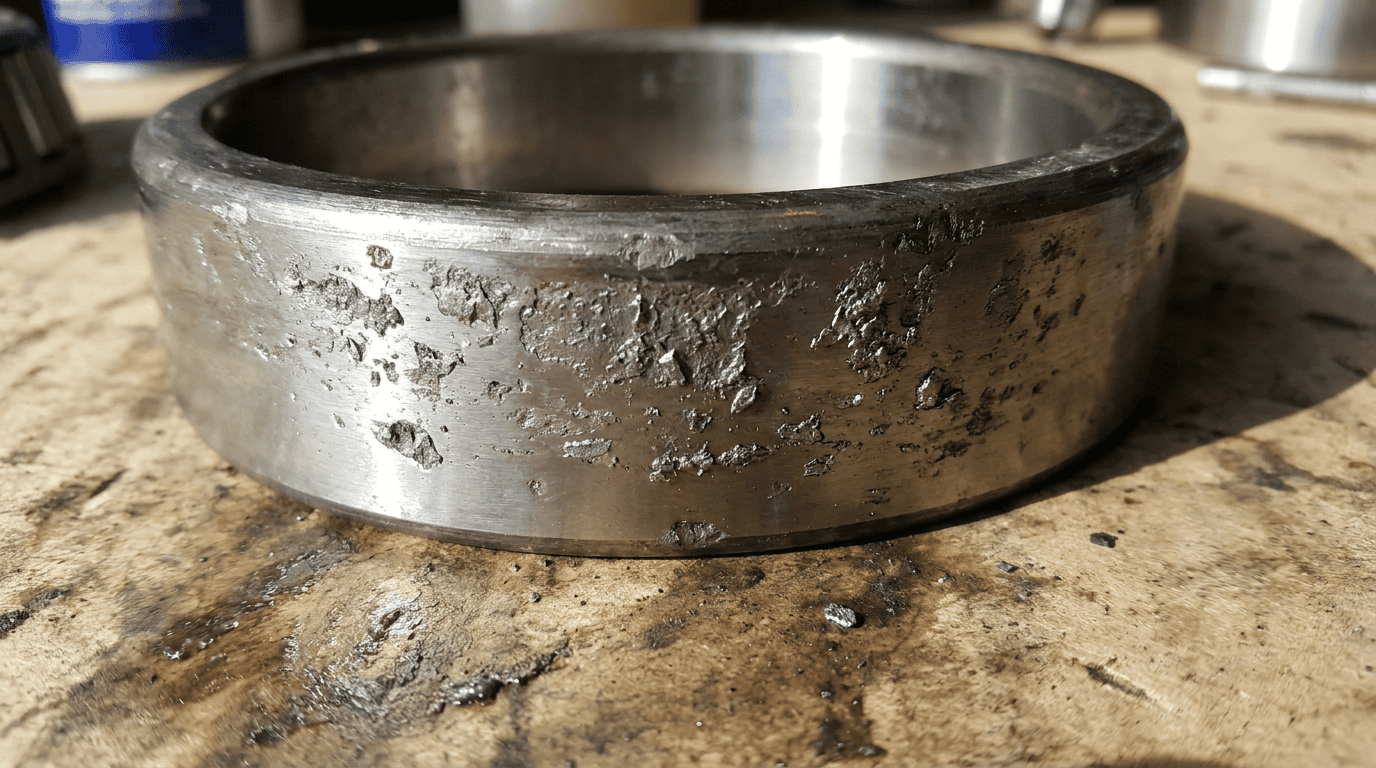
Bearing spalling is a progressive surface fatigue failure where small flakes or pits break away from a bearing raceway or rolling element, often leading to vibration, heat, noise, contamination, and unplanned gearbox downtime. For maintenance managers, plant engineers, reliability teams, mechanics, and purchasing professionals, understanding the early warning signs is critical because spalling usually indicates that the bearing has entered a failure stage that will worsen if left uncorrected. In industrial gearboxes, bearing spalling can damage gears, shafts, seals, housings, and lubricants, turning a relatively contained bearing issue into a costly production outage. This guide explains how to identify, troubleshoot, prevent, and respond to bearing spalling with practical, field-ready recommendations.
Bearing spalling occurs when repeated stress, poor lubrication, contamination, misalignment, overload, improper installation, electrical discharge, or corrosion causes pieces of bearing material to flake away from the raceway or rolling elements. Early symptoms include increased vibration, abnormal noise, rising temperature, metallic debris in oil, and changes in gearbox performance. Once true spalling begins, the bearing generally cannot be restored to like-new condition and should be scheduled for replacement before secondary gearbox damage occurs. The best prevention strategy is proper lubrication, contamination control, alignment, load management, condition monitoring, and correct installation.
Bearing spalling is a critical issue that can lead to significant machinery failures if not addressed promptly. For those interested in understanding the implications of bearing spalling and the importance of timely repairs, a related article can be found at this link: Industrial Gearbox Repair in Dearborn, Michigan. This resource provides insights into the repair processes and preventive measures that can help mitigate the risks associated with bearing spalling in industrial gearboxes.
What Is Bearing Spalling?
Bearing spalling is a type of surface fatigue damage in which material separates from the surface of a bearing raceway or rolling element. It often appears as pits, flakes, craters, or roughened areas on the bearing surface. In industrial gearboxes, spalling is especially concerning because bearings support shafts, maintain gear mesh alignment, and absorb radial and axial loads.
When a bearing begins to spall, the damaged surface creates impact loading every time a rolling element passes over the defect. This generates vibration, noise, heat, and additional debris. Over time, the spall grows and accelerates damage to surrounding components.
For related gearbox failure support, see Industrial Gearbox Solutions’ resources on gearbox repair services and industrial gearbox inspection.
Spalling vs. Pitting vs. Flaking
Although these terms are sometimes used interchangeably, there are useful distinctions:
| Condition | Description | Typical Severity |
||||
| Pitting | Small surface cavities or pinholes, often early-stage fatigue or corrosion-related | Mild to moderate |
| Spalling | Larger flakes or pieces of material breaking away from the surface | Moderate to severe |
| Flaking | Similar to spalling; often used to describe visible detached surface layers | Moderate to severe |
| Brinelling | Permanent indentations caused by static overload or impact | Can lead to spalling |
| False brinelling | Fretting wear caused by vibration without full rotation | Can initiate surface fatigue |
Why Spalling Matters in Industrial Gearboxes
A spalled bearing does not operate smoothly. The defect creates a repeated shock load inside the gearbox, which can cause:
- Gear tooth misalignment
- Increased gear mesh vibration
- Seal failure from shaft movement or heat
- Lubricant contamination
- Shaft journal wear
- Housing bore damage
- Coupling stress
- Catastrophic bearing seizure
In many cases, bearing spalling is not just a bearing problem. It is a system reliability problem.
Common Causes of Bearing Spalling
Bearing spalling can result from one dominant cause or a combination of operating, lubrication, installation, and environmental factors. Correctly identifying the root cause is essential. Replacing the bearing without correcting the underlying problem often leads to repeated failures.
Lubrication Failure
Poor lubrication is one of the most common causes of bearing spalling. A bearing depends on a lubricant film to separate metal surfaces. When that film is too thin, contaminated, degraded, or incorrectly specified, surface stress increases.
Common lubrication-related causes include:
- Insufficient oil level
- Grease starvation
- Incorrect viscosity
- Wrong lubricant type
- Oxidized or degraded oil
- Water-contaminated lubricant
- Excessive grease causing heat buildup
- Inadequate lubricant delivery to the bearing
According to Noria, lubricant contamination and incorrect lubrication practices are major contributors to equipment failure. Maintenance teams can learn more from Noria’s lubrication resources at Noria Corporation.
Contamination
Solid contaminants such as dirt, sand, metal particles, casting debris, and wear particles can indent bearing surfaces. These indentations become stress risers where fatigue cracks begin. Once a crack forms below or near the surface, repeated rolling contact can cause material to break away.
Common contamination sources include:
- Breather failure
- Open inspection covers
- Poor lubricant handling
- Dirty oil transfer containers
- Worn seals
- Inadequate filtration
- Residual debris after repair
- Gear wear particles circulating through the gearbox
Overloading
Bearings are designed for specific radial and axial load limits. If the gearbox is overloaded, shock-loaded, or operated outside design conditions, the bearing may experience excessive contact stress.
Overload-related spalling may result from:
- Increased production demand beyond rated capacity
- Frequent starts and stops
- Jam-ups or shock loads
- Incorrect gearbox selection
- Improper coupling alignment
- Gear mesh problems
- Excessive belt or chain tension
- Process changes without drivetrain review
Misalignment
Misalignment changes how loads are distributed across the bearing. Instead of a balanced contact pattern, the bearing may experience edge loading. This concentrates stress in a smaller area and accelerates fatigue.
Misalignment can come from:
- Poor gearbox installation
- Soft foot
- Foundation movement
- Thermal growth
- Shaft deflection
- Worn housing bores
- Improperly seated bearings
- Coupling misalignment
For plants dealing with repeated drivetrain alignment issues, Industrial Gearbox Solutions can support gearbox field service and inspection programs.
Improper Installation
Even high-quality bearings can fail prematurely when installed incorrectly. Damage during mounting can create small defects that eventually develop into spalling.
Installation mistakes include:
- Hammering directly on bearing rings
- Applying force through rolling elements
- Incorrect bearing heating temperature
- Inadequate shaft or bore fits
- Improper preload or clearance
- Contaminating the bearing during installation
- Mixing incompatible components
- Reusing damaged locknuts, spacers, or seals
SKF provides detailed bearing mounting and maintenance guidance at SKF Bearing Maintenance.
Electrical Discharge Damage
Electrical current passing through a bearing can create microscopic craters. Over time, this can develop into fluting, pitting, and spalling. This is common in motor-driven gearbox applications, especially where variable frequency drives are used without adequate grounding or shaft protection.
Signs of electrical damage may include:
- Washboard-like fluting on raceways
- Gray or frosted raceway appearance
- Repetitive vibration signatures
- Premature bearing noise
- Lubricant darkening from electrical arcing byproducts
Corrosion and Water Ingress
Water reduces lubricant film strength and promotes corrosion. Corrosion pits can become initiation points for fatigue cracks, eventually leading to spalling.
Water contamination may enter through:
- Failed seals
- High-pressure washdown
- Condensation
- Outdoor exposure
- Breather problems
- Improper storage
- Leaking cooling coils
Timken offers technical information about bearing damage modes and lubrication considerations at The Timken Company.
Industrial gearbox bearing failure can lead to costly downtime and repairs, so it’s important to address the issue promptly. Industrial gearbox bearing failure
Symptoms of Bearing Spalling
Recognizing bearing spalling early allows maintenance teams to plan repairs before catastrophic failure. Spalling symptoms may be subtle at first, then become more obvious as damage expands.
Vibration Changes
Vibration analysis is one of the most effective tools for detecting spalling. A localized defect creates impacts as rolling elements pass over the damaged area. These impacts appear at specific bearing fault frequencies.
Common vibration indicators include:
- Increased high-frequency vibration
- Bearing defect frequencies
- Harmonics of defect frequencies
- Sidebands around gear mesh frequency
- Impacting or random vibration spikes
- Rising acceleration or enveloping trends
Abnormal Noise
A spalled bearing may produce:
- Clicking
- Rumbling
- Growling
- Grinding
- Knocking
- Rhythmic ticking
Noise often becomes more pronounced under load or at specific speeds.
Temperature Increase
Spalling increases friction and impact loading. The gearbox or bearing housing may run hotter than normal. A thermal trend is more useful than a single measurement. If a gearbox normally runs at 145°F and begins trending toward 165°F under the same load and ambient conditions, investigation is warranted.
Metallic Debris in Oil
Spalling produces metal particles that circulate through the lubricant. These particles may be captured by filters, magnetic plugs, or oil analysis.
Indicators include:
- Increased iron levels
- Rising particle counts
- Visible shiny flakes
- Ferrous debris on magnetic drain plugs
- Filter element loading
- Dark or contaminated lubricant
Reduced Gearbox Performance
As spalling worsens, gearbox operation may become unstable. Symptoms can include:
- Increased power draw
- Unsteady shaft rotation
- Poor gear mesh contact
- Seal leakage
- Excessive backlash changes
- Intermittent vibration alarms
- Production quality issues
Bearing spalling is a critical issue that can significantly impact the performance and longevity of machinery. Understanding the causes and effects of this phenomenon is essential for maintenance professionals. For those looking to enhance their knowledge on related topics, an insightful article on how to extend the life of industrial gearboxes can provide valuable strategies and tips. You can read more about it here. By implementing these practices, you can help mitigate the risks associated with bearing spalling and ensure smoother operations.
Troubleshooting Bearing Spalling
| Severity | Description |
|---|---|
| Light | Small, localized areas of damage on the bearing surface |
| Moderate | More extensive damage with larger spalls and potential for increased vibration |
| Severe | Extensive damage with large spalls, potential for catastrophic failure |
Troubleshooting should identify both the failed component and the root cause. A structured approach helps avoid unnecessary replacement and repeat failures.
Step-by-Step Troubleshooting Process
| Step | Action | Purpose |
||||
| 1 | Review operating history | Identify overloads, process changes, shock events |
| 2 | Check lubrication records | Confirm lubricant type, viscosity, quantity, and change intervals |
| 3 | Inspect oil condition | Look for water, particles, oxidation, and metal debris |
| 4 | Review vibration data | Determine defect frequencies and progression |
| 5 | Check temperatures | Compare to historical operating trends |
| 6 | Inspect alignment | Identify coupling, shaft, and base issues |
| 7 | Examine seals and breathers | Determine contamination or water ingress paths |
| 8 | Inspect bearing after removal | Confirm damage mode and root cause |
| 9 | Evaluate surrounding components | Check gears, shafts, housings, and fits |
| 10 | Correct root cause before restart | Prevent repeat failure |
Questions Maintenance Teams Should Ask
Before replacing a spalled bearing, ask:
- Has the gearbox load changed?
- Has the lubricant been changed recently?
- Was the correct lubricant used?
- Is there evidence of water contamination?
- Are seals leaking?
- Is the breather working properly?
- Are vibration readings trending upward?
- Is the bearing receiving enough lubricant?
- Has the gearbox been recently repaired or moved?
- Are there signs of electrical discharge?
- Is the bearing fit within specification?
- Is the housing bore worn or out-of-round?
Common Diagnostic Mistakes
Avoid these errors:
- Replacing the bearing without inspecting gears and shafts
- Ignoring lubricant contamination
- Assuming all spalling is normal fatigue
- Overlooking misalignment or soft foot
- Reusing damaged spacers or locknuts
- Failing to document vibration and oil analysis trends
- Installing the same bearing in a damaged housing
- Not flushing the gearbox after a spalling event
Understanding bearing spalling is crucial for maintaining the longevity of machinery, and for those interested in further exploring the topic, a related article on industrial gearbox repair provides valuable insights. This resource discusses the importance of regular maintenance and the implications of neglecting minor issues that can lead to significant failures. You can read more about it in the article on industrial gearbox repair, which highlights best practices for ensuring optimal performance and reliability in your equipment.
Inspection Methods for Bearing Spalling
Inspection can be performed while the gearbox is operating, during planned downtime, or after disassembly. The best programs combine multiple methods.
Visual Inspection
During disassembly, inspect the bearing raceways, rolling elements, cage, and shoulders. Spalling may appear as:
- Flaked surface areas
- Irregular pits
- Crater-like defects
- Rough raceway patches
- Peeling metal
- Discoloration from heat
- Scored surfaces
- Uneven wear patterns
Use clean lighting, magnification, and documented photos. If the bearing is being sent for failure analysis, avoid cleaning it aggressively before evaluation.
Vibration Analysis
Vibration analysis can identify bearing defects before visible failure occurs. Reliability engineers often use:
- Acceleration readings
- Velocity trends
- PeakVue or similar impact detection
- Envelope analysis
- FFT spectrum review
- Time waveform analysis
- Bearing fault frequency calculations
For severe spalling, vibration levels often rise quickly, so alarm thresholds should be based on trend history and machine criticality.
Oil Analysis
Oil analysis is highly valuable for gearbox bearing health. Recommended tests may include:
- Particle count
- Ferrous density
- Wear particle analysis
- Karl Fischer water test
- Viscosity
- Acid number
- Oxidation
- Elemental spectroscopy
- Analytical ferrography
A sudden increase in iron, chromium, or bearing alloy elements may indicate bearing distress.
Thermography
Infrared thermography can detect abnormal heat patterns around bearing locations, housings, and seals. While thermography usually cannot confirm spalling by itself, it is useful as a screening tool.
Borescope Inspection
A borescope may allow limited internal inspection without full gearbox disassembly. It can be useful for inspecting:
- Bearing cages
- Accessible raceways
- Gear tooth condition
- Oil distribution
- Debris accumulation
- Internal corrosion
Magnetic Plug and Filter Inspection
Magnetic drain plugs and filter elements provide valuable evidence. If shiny flakes or ferrous chunks are present, spalling or gear tooth damage may be underway.
Repair vs. Replacement: What Should You Do?
Once bearing spalling has started, the damaged bearing surface cannot be fully restored in service. The key decision is not whether the bearing will need replacement, but when and how to perform the repair.
When Replacement Is Required
Replacement is generally required when:
- Spalling is visible on raceways or rolling elements
- Vibration shows progressing bearing defect frequencies
- Metallic debris is present in lubricant
- Bearing noise is increasing
- Bearing temperature is rising
- Cage damage is observed
- The machine is critical to production
- Secondary gear or shaft damage is likely
When Continued Operation May Be Temporarily Acceptable
In some non-critical applications, a plant may continue operating temporarily with close monitoring if:
- Damage is early-stage
- Vibration levels are stable
- Oil analysis is not rapidly worsening
- Replacement parts are not immediately available
- Load can be reduced
- A planned outage is scheduled soon
- Risk has been approved by maintenance and operations leadership
This should be a controlled decision, not a default response.
Components to Inspect During Bearing Replacement
When replacing a spalled bearing, inspect:
- Shaft journals
- Housing bores
- Gear teeth
- Bearing shoulders
- Spacers and sleeves
- Locknuts and lockwashers
- Seals
- Oil passages
- Breathers
- Couplings
- Foundations
- Lubrication system
- Cooling system
Industrial Gearbox Solutions can help with gearbox rebuilds where bearing spalling has progressed into shaft, gear, or housing damage.
Cost Considerations for Purchasing Professionals
Purchasing teams should consider total cost of ownership, not just bearing price.
| Option | Lower Initial Cost | Lower Downtime Risk | Best Use Case |
||:|:||
| Replace bearing only | Yes | Moderate | Minimal secondary damage, known root cause |
| Bearing plus seals and lubricant | Moderate | Better | Contamination or lubrication issue suspected |
| Full gearbox inspection and rebuild | Higher | Highest | Critical assets, repeated failures, major debris |
| Replacement gearbox | Highest | High if available | Severe damage, obsolete unit, urgent production need |
A low-cost bearing replacement can become expensive if the root cause remains uncorrected.
Prevention Strategies for Bearing Spalling
Preventing bearing spalling requires controlling stress, lubrication, contamination, installation quality, and operating conditions.
Optimize Lubrication Practices
Best practices include:
- Use the OEM-recommended lubricant type and viscosity
- Verify viscosity for actual speed, load, and temperature
- Maintain correct oil levels
- Avoid overgreasing and undergreasing
- Use dedicated, clean transfer containers
- Filter new oil before use when appropriate
- Label lubricants clearly
- Train personnel on lubricant compatibility
- Establish oil change intervals based on condition, not guesswork
For lubrication best practices, see Noria’s practical resources at Machinery Lubrication.
Control Contamination
Contamination control is one of the highest-value reliability improvements.
Recommended actions:
- Install quality breathers
- Use desiccant breathers in humid environments
- Upgrade seals where washdown or dust is present
- Keep inspection covers closed
- Use clean oil transfer equipment
- Flush gearboxes after major failures
- Monitor ISO cleanliness codes
- Store bearings in clean, dry areas
- Keep new bearings sealed until installation
Improve Installation Quality
Installation quality has a direct impact on bearing life.
Best practices:
- Use proper bearing heaters
- Avoid open flames
- Measure shaft and housing fits
- Use calibrated tools
- Apply force only to the correct ring
- Follow torque specifications
- Verify internal clearance or preload
- Maintain cleanliness during assembly
- Document installation measurements
- Rotate shafts by hand after assembly where possible
Maintain Alignment and Balance
Alignment should be verified:
- After gearbox installation
- After motor replacement
- After coupling replacement
- After foundation repair
- After significant process changes
- When vibration trends change
- After thermal growth analysis, if applicable
Laser alignment, soft foot correction, and base inspection can greatly reduce bearing stress.
Manage Loads and Operating Conditions
Plant engineers should review drivetrain loading when production conditions change.
Consider:
- Actual horsepower vs. gearbox rating
- Start/stop frequency
- Shock loads
- Torque spikes
- Service factor
- Thermal limits
- Shaft-mounted loads
- Belt or chain tension
- Process jams
- Reverse loading
AGMA provides standards and technical resources for gear design, rating, and application. Visit the American Gear Manufacturers Association for additional guidance.
Maintenance Best Practices for Industrial Gearbox Bearings
A proactive maintenance program can detect early bearing distress before spalling causes catastrophic failure.
Recommended Maintenance Checklist
| Frequency | Task | Notes |
||||
| Daily/Shift | Listen for abnormal noise | Operator rounds are valuable |
| Weekly | Check for leaks and temperature changes | Use consistent measurement points |
| Monthly | Inspect breather and oil level | Replace clogged breathers |
| Monthly/Quarterly | Collect vibration data | Adjust frequency based on criticality |
| Quarterly/Semiannual | Perform oil analysis | Include particle count and water test |
| Annually | Inspect alignment and foundation | More often for critical assets |
| During outage | Inspect filters, magnetic plugs, seals | Document findings with photos |
| After repair | Baseline vibration and temperature | Establish new normal operating data |
Condition Monitoring Program Elements
A strong condition monitoring program includes:
- Vibration analysis
- Oil analysis
- Thermography
- Ultrasonic inspection
- Visual inspections
- Maintenance history review
- Failure mode tracking
- Root cause analysis
- Critical spare parts planning
Spare Bearing Storage Best Practices
Improper storage can cause corrosion or false brinelling before the bearing is even installed.
Store bearings:
- In original packaging
- In a clean, dry location
- Away from vibration
- Away from corrosive chemicals
- At stable temperature
- Horizontally or as recommended
- With inventory rotation controls
- Without opening packaging until needed
Documentation Matters
Maintenance teams should document:
- Bearing manufacturer and part number
- Installation date
- Lubricant type
- Oil analysis results
- Vibration baseline
- Load conditions
- Alignment readings
- Failure photos
- Root cause findings
- Corrective actions
This documentation supports better purchasing decisions, reliability improvement, and warranty claims.
Bearing Spalling Failure Patterns and What They Mean
The appearance and location of spalling can help identify the root cause.
Inner Raceway Spalling
Inner raceway spalling may suggest:
- Excessive radial load
- Shaft fit issues
- Misalignment
- Fatigue from normal operation
- Improper mounting
- Electrical current damage
Outer Raceway Spalling
Outer raceway spalling may indicate:
- Housing bore problems
- Poor support
- Misalignment
- Load zone concentration
- Contamination
- Loose outer ring fit
Rolling Element Spalling
Rolling element spalling can result from:
- Contamination
- Lubrication breakdown
- Skidding
- Overload
- Improper cage function
- Heat damage
Edge Spalling
Edge spalling often points to misalignment or improper load distribution. It may also indicate shaft deflection, housing distortion, or incorrect bearing setting.
Widespread Spalling
Widespread damage may indicate advanced fatigue, severe contamination, poor lubrication, or continued operation after initial damage began.
Tables for Fast Field Reference
Bearing Spalling Symptoms and Likely Causes
| Symptom | Possible Cause | Recommended Action |
||||
| Rhythmic clicking | Localized raceway spall | Perform vibration analysis and schedule inspection |
| Rising temperature | Lubrication failure, overload, spalling | Check oil level, load, and bearing condition |
| Metal flakes in oil | Advanced spalling or gear damage | Shut down if critical; inspect immediately |
| High vibration at bearing frequencies | Bearing defect | Trend severity and plan replacement |
| Dark lubricant | Oxidation, heat, contamination | Conduct oil analysis |
| Seal leakage | Heat, shaft movement, pressure issue | Inspect bearing, shaft, seals, breather |
| Repeated bearing failures | Root cause not corrected | Perform RCA and full gearbox inspection |
Preventive Actions by Failure Driver
| Failure Driver | Preventive Action |
|||
| Poor lubrication | Correct viscosity, oil level, filtration, and intervals |
| Contamination | Better seals, breathers, clean handling, oil analysis |
| Misalignment | Laser alignment, soft foot correction, foundation inspection |
| Overload | Load study, service factor review, process control |
| Installation damage | Proper tools, heating, fit measurements, training |
| Electrical discharge | Shaft grounding, insulated bearings, VFD mitigation |
| Water ingress | Seal upgrades, desiccant breathers, washdown controls |
Key Takeaways
- Bearing spalling is a serious surface fatigue failure that usually progresses once it begins.
- Early warning signs include vibration, noise, heat, metallic debris, and oil analysis changes.
- Common causes include lubrication failure, contamination, overload, misalignment, installation damage, corrosion, and electrical discharge.
- Replacing the bearing without correcting the root cause often leads to repeat failure.
- Vibration analysis and oil analysis are two of the most effective tools for early detection.
- Once visible spalling is confirmed, bearing replacement should be planned before secondary gearbox damage occurs.
- Prevention depends on proper lubrication, contamination control, alignment, installation quality, and condition monitoring.
- Critical gearboxes should have documented baselines for vibration, oil condition, temperature, and alignment.
Frequently Asked Questions
What does bearing spalling look like?
Bearing spalling usually looks like flakes, pits, craters, or rough patches on the raceway or rolling elements. The damaged area may appear dull, cracked, or uneven compared to the surrounding polished surface.
Can a spalled bearing be repaired?
In most industrial applications, a spalled bearing should not be repaired and returned to service. Once material has broken away from the raceway or rolling element, the bearing surface is permanently damaged. Replacement is the normal corrective action.
How long can a gearbox run with bearing spalling?
It depends on machine criticality, load, speed, defect size, lubrication condition, and vibration severity. Some bearings may run for a limited time with close monitoring, while others can fail rapidly. If metal debris, rising vibration, or increasing temperature is present, plan immediate corrective action.
Is bearing spalling caused by poor lubrication?
Poor lubrication is one of the leading causes, but it is not the only cause. Spalling may also result from contamination, overload, misalignment, improper installation, electrical discharge, corrosion, or normal fatigue life.
What is the difference between spalling and brinelling?
Spalling is material flaking caused by fatigue or surface damage progression. Brinelling is permanent indentation caused by overload or impact. Brinelling can create stress concentrations that eventually lead to spalling.
Can oil analysis detect bearing spalling?
Yes. Oil analysis can detect wear metals, particle counts, ferrous debris, and contamination that may indicate bearing spalling. Analytical ferrography can be especially useful for identifying fatigue particles.
Can vibration analysis detect spalling early?
Yes. Vibration analysis can detect bearing defect frequencies and impact patterns associated with raceway or rolling element damage. Envelope analysis and high-frequency acceleration are commonly used for early detection.
Should the gearbox be flushed after a bearing spalling failure?
Usually, yes. Spalling generates hard metallic debris that can damage gears, seals, and new bearings. A proper flush, filter change, and inspection should be considered before returning the gearbox to service.
What type of bearings are most affected by spalling?
Any rolling element bearing can experience spalling, including ball bearings, spherical roller bearings, tapered roller bearings, cylindrical roller bearings, and thrust bearings. The failure risk depends on load, lubrication, contamination, installation, and operating conditions.
How can purchasing teams reduce bearing failure risk?
Purchasing teams can reduce risk by sourcing quality bearings from approved suppliers, verifying correct part numbers and internal clearances, avoiding counterfeit products, maintaining proper storage, and coordinating with maintenance on complete repair kits rather than buying bearings alone.
Suggested Branded Images
Image 1: Close-Up of Bearing Spalling on Raceway
Alt text: Close-up of bearing spalling on an industrial gearbox bearing raceway
Caption: Visible spalling on a bearing raceway indicates advanced surface fatigue and should trigger root cause analysis.
Image 2: Mechanic Inspecting Gearbox Bearing During Rebuild
Alt text: Industrial gearbox mechanic inspecting a spalled bearing during gearbox rebuild
Caption: Proper inspection during gearbox rebuild helps identify whether spalling was caused by lubrication, contamination, overload, or misalignment.
Image 3: Oil Analysis Sample with Metallic Debris
Alt text: Gearbox oil sample showing metallic debris from bearing spalling
Caption: Oil analysis and debris inspection can reveal bearing spalling before catastrophic gearbox failure.
Image 4: Vibration Analyst Testing Industrial Gearbox
Alt text: Reliability engineer performing vibration analysis on industrial gearbox bearings
Caption: Vibration monitoring is one of the most effective tools for detecting bearing spalling early.
Image 5: Industrial Gearbox Bearing Replacement
Alt text: Replacement bearing being installed in an industrial gearbox housing
Caption: Correct installation practices are essential to prevent premature bearing spalling after repair.
SEO Metadata
SEO title: Understanding Bearing Spalling: Causes, Symptoms, Inspection, and Prevention
Meta description: Learn what bearing spalling is, what causes it, how to identify symptoms, troubleshoot gearbox bearing failures, and prevent costly industrial downtime.
Primary keyword: bearing spalling
Secondary keywords: gearbox bearing failure, bearing spalling symptoms, bearing spalling causes, bearing inspection, industrial gearbox maintenance, bearing failure analysis, gearbox repair
Suggested URL slug: understanding-bearing-spalling
Search intent: Informational and commercial investigation for maintenance, reliability, engineering, and purchasing teams evaluating bearing failure risks and gearbox repair options.
Authoritative Sources and Further Reading
- SKF bearing maintenance and failure analysis resources: https://www.skf.com/
- Timken bearing damage and lubrication information: https://www.timken.com/
- AGMA gear design and application standards: https://www.agma.org/
- Noria lubrication and oil analysis resources: https://www.noria.com/
- Machinery Lubrication technical articles: https://www.machinerylubrication.com/
Conclusion
Bearing spalling is a warning that should never be ignored. In an industrial gearbox, a spalled bearing can quickly progress from a localized defect to widespread damage involving gears, shafts, seals, housings, and lubricant systems. The most effective response is to confirm the symptoms, inspect the bearing and lubricant, identify the root cause, and correct the underlying issue before returning the gearbox to service.
For maintenance managers, plant engineers, reliability engineers, mechanics, and purchasing professionals, the goal is not simply to replace a failed bearing. The goal is to prevent repeat failures, reduce downtime, protect production, and extend gearbox life. A disciplined program built around lubrication control, contamination prevention, alignment, proper installation, oil analysis, and vibration monitoring will dramatically reduce the risk of bearing spalling.
If your gearbox is showing signs of bearing spalling, abnormal vibration, overheating, or metallic debris, schedule an expert inspection before the damage spreads.
FAQs
What is bearing spalling?
Bearing spalling is a type of damage that occurs on the surface of a bearing, typically in the form of small, localized patches of material loss. This can be caused by a variety of factors including inadequate lubrication, contamination, or excessive loading.
What are the common causes of bearing spalling?
Common causes of bearing spalling include inadequate lubrication, contamination from dirt or debris, excessive loading, improper installation, and misalignment. These factors can lead to increased friction and heat, which can result in the breakdown of the bearing surface.
How can bearing spalling be prevented?
Bearing spalling can be prevented by ensuring proper lubrication, regular maintenance, and monitoring of operating conditions. Using high-quality bearings, proper installation techniques, and addressing any misalignment issues can also help prevent spalling.
What are the signs of bearing spalling?
Signs of bearing spalling include unusual noise or vibration, increased operating temperature, and visible damage to the bearing surface such as pitting or flaking. Regular inspection and monitoring of bearings can help identify spalling before it leads to more serious issues.
What are the consequences of bearing spalling?
The consequences of bearing spalling can include reduced bearing life, increased downtime, and potential damage to other components in the machinery. If left unaddressed, bearing spalling can lead to catastrophic failure and costly repairs. Regular maintenance and monitoring can help mitigate these consequences.