An unreliable gearbox can put production schedules, product quality, and equipment safety at risk. When a Falk unit begins failing, a falk gearbox rebuild may seem like the quickest answer—but repair is not always the best long-term choice. For compatible replacement options, see our Falk gearbox replacement and cross-reference guide.
The right decision depends on the damage, operating demands, downtime, parts availability, and total lifecycle cost—not just the repair bill or purchase price. A thorough inspection and a side-by-side comparison of repair and replacement scenarios can reveal the most practical path. For context on common warning signs and gear reducer repair options, start with the basics before committing to a solution.
Start With the Failure: What Inspection Can Reveal
Before choosing a Falk gearbox rebuild or replacement, start with a qualified inspection. Noise, vibration, overheating, lubricant contamination or leakage, and metal debris all warrant investigation. None proves on its own that the gearbox must be replaced.
Inspection should assess gears, bearings, shafts, seals, housing, and lubrication. A technician may find, for example, that damaged bearings have affected nearby gears, or that wear is limited to one component. Checking clearances, tooth contact, lubricant condition, and debris can help establish the damage’s extent and whether it is localized or systemic.
The inspection should also look for what caused the failure. Misalignment, overload, poor lubrication, and installation problems can damage otherwise serviceable components. Evidence such as uneven wear, scoring, heat discoloration, or contamination can help identify the cause and guide the repair scope.
Even a sound rebuild may fail again if the underlying issue remains. Correcting the operating or installation problem is essential, whether the gearbox is repaired or replaced. This gives decision-makers a clearer basis for comparing options and estimating the risk of recurring downtime.
When a Falk Gearbox Rebuild Makes Sense
A Falk gearbox rebuild can restore dependable service when the housing and major components remain serviceable, damage is limited, and the unit still fits the application. In these conditions, rebuilding may preserve a suitable gearbox while addressing wear that threatens reliability. It is especially worth evaluating when replacement would require substantial changes to mounting, shafts, or connected equipment.
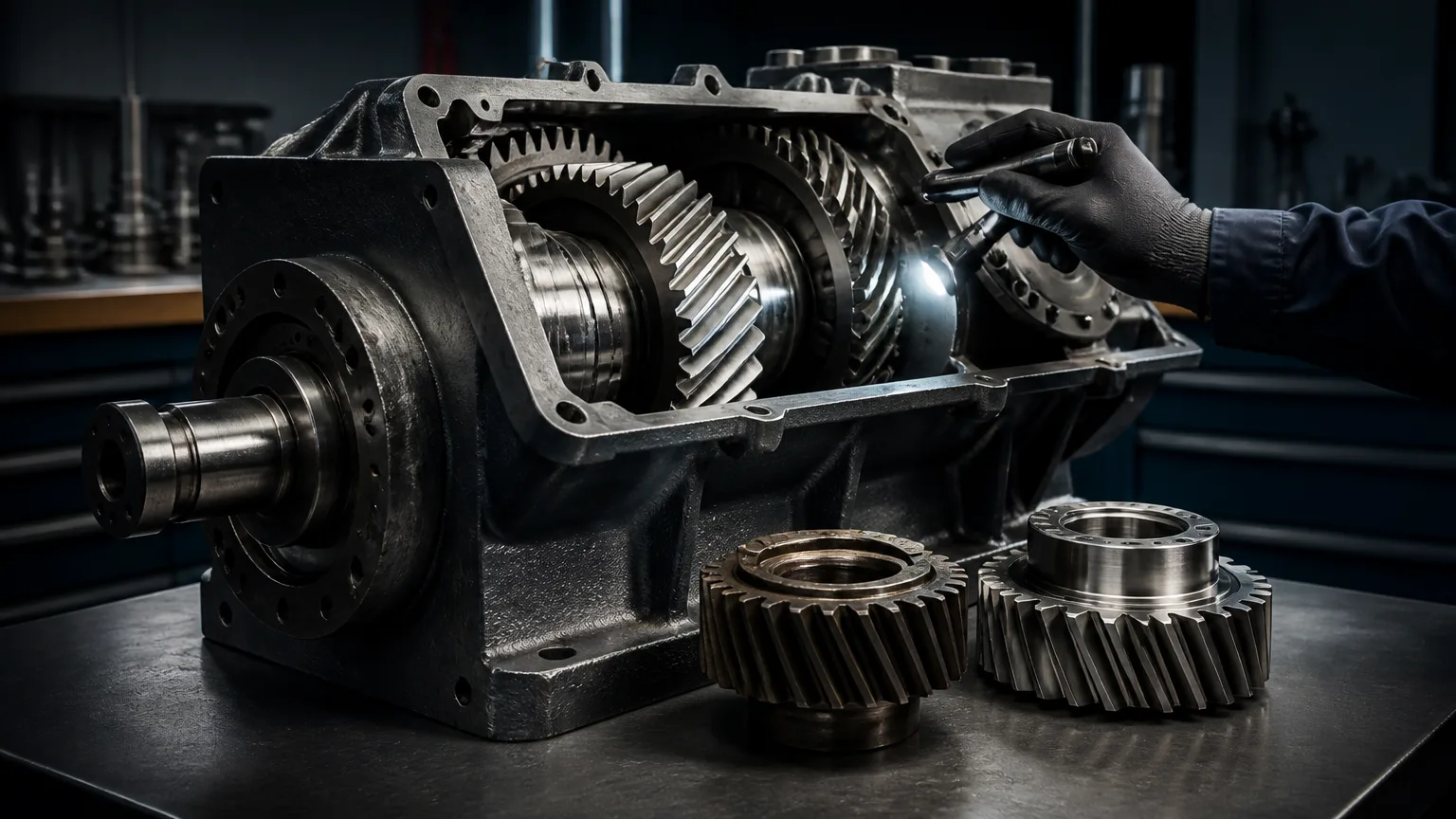
A comprehensive rebuild typically starts with disassembly and cleaning, followed by dimensional inspection of the housing, shafts, gears, and other critical parts. Technicians replace worn bearings and seals, then repair or replace gears as inspection findings require. After reassembly, the gearbox should be tested to confirm it operates as expected.
Ask for a repair quote that separates confirmed work from possible findings after teardown. Some damage, such as internal wear or scoring, may not be clear until the gearbox is opened. This distinction helps you understand the expected scope and budget for the rebuild, as well as the potential for added costs. If replacement parts may be needed, see the details to include in a gearbox parts quote to help suppliers identify the right components.
When Replacement Is the Better Investment
Replacement may be the safer choice when the housing or critical components are irreparable, essential parts are unavailable, or repeated rebuilds have not corrected reliability problems. Severe gear or shaft damage can make repairs costly without restoring dependable service. If failures keep returning, investigate the cause and compare a new unit’s expected service life with another rebuild.
Compare total cost of ownership, not just the repair estimate or purchase price. Include the repair scope, parts and lead times, installation, commissioning, energy use, performance, and the cost of future downtime. A replacement with a higher upfront cost may be more economical if it reduces production risk over time.
A machine or process change can also make the existing gearbox unsuitable. Do not choose a substitute based on horsepower alone: confirm load, speed, torque, mounting, shaft configuration, duty cycle, and environmental requirements. For demanding applications, review how to choose a high-torque gearbox to assess the operating requirements.
Before authorizing a Falk gearbox rebuild or replacement, have the supplier verify compatibility with the machine and operating conditions. A correct match supports reliable performance and helps avoid preventable downtime.
Compare the Options for Your Production Reality
Compare proposals on the same scope. Check what inspection, labor, parts, testing, warranty, and commissioning each includes. Ask about parts provenance, expected service life, and any limits on warranty coverage. A low initial price may not represent the better value if major components are excluded.
Then compare each option with your facility’s outage window. A rebuild may be practical if the gearbox can be returned before production resumes. If repair depends on uncertain parts or further inspection, replacement may offer a more predictable schedule. Consider the cost of waiting, including lost production, temporary workarounds, and the risk of extending an outage.
For an accurate comparison, give the evaluating provider the Falk model and serial details, nameplate information, failure symptoms, operating conditions, and service history. Ask for the expected delivery date and commissioning requirements for each option. That information helps teams judge whether a Falk gearbox rebuild or replacement fits the machine, timeline, and production constraints.
Make the Decision on Condition, Cost, and Uptime
A falk gearbox rebuild makes sense when inspection confirms a sound foundation and a repair scope that can restore reliable operation. Replacement is usually the stronger long-term choice when damage is extensive, parts are obsolete, or operating needs have changed.
Compare expected reliability and downtime—not just the immediate quote. A documented, application-specific evaluation can clarify the risks and costs of each option. For a clear comparison, consult an experienced industrial gearbox service provider to inspect the unit and review your choices.