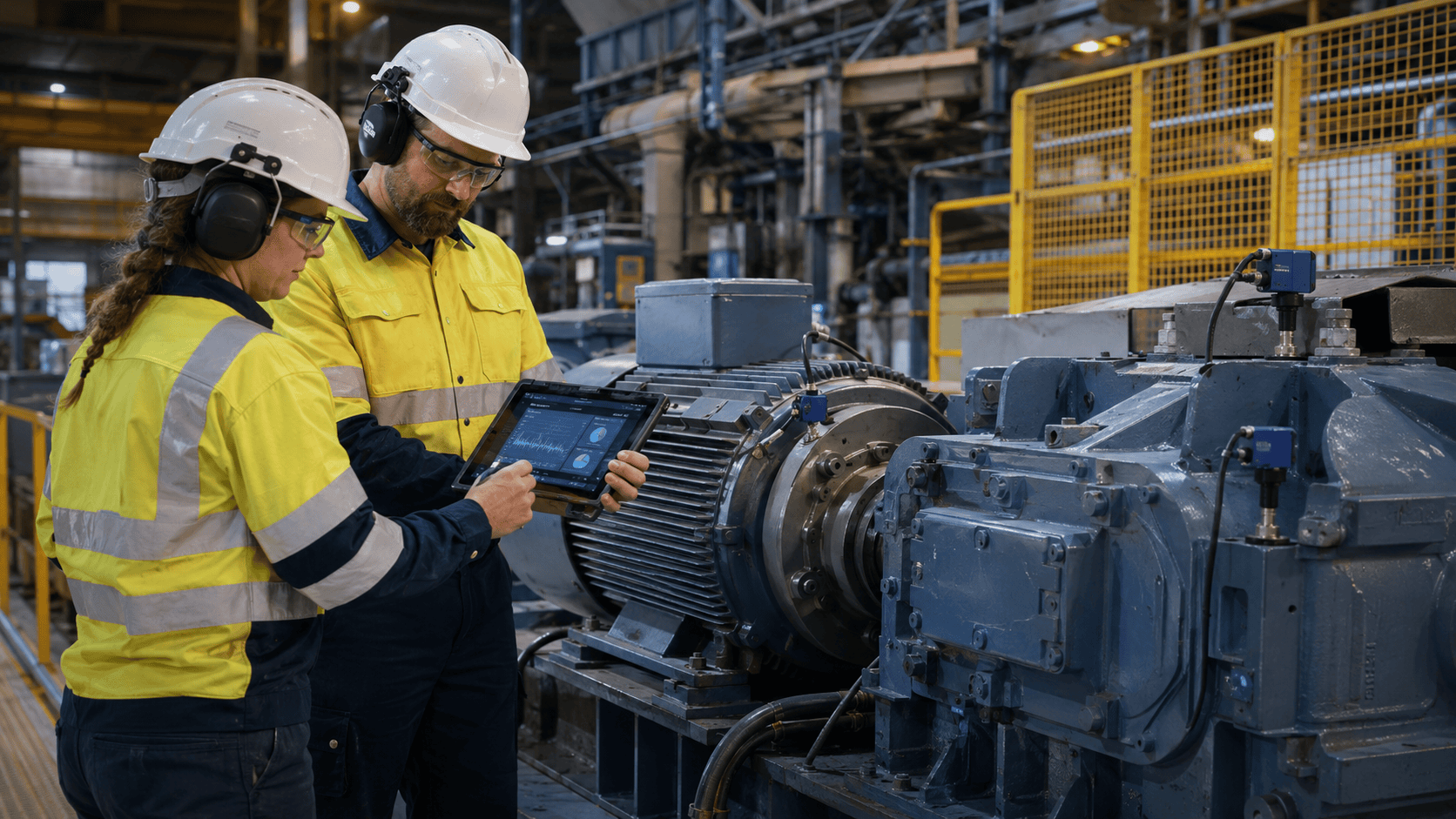
Domtar estimates that its Kingsport mill avoided 1,546.65 hours of unplanned downtime after changing how people—not just algorithms—handled condition-monitoring data. The number is not independently audited, but the workflow behind it offers a useful lesson for plants investing in AI-assisted maintenance.
Quick Take
- Domtar’s Kingsport mill expanded from roughly 450 to 748 vibration-monitoring sensors, but more data initially created an analysis bottleneck.
- The reported breakthrough came from weekly plant-vendor reviews, human validation, thermal and ultrasonic confirmation, broad internal visibility and a rule that action items should not remain open beyond 30 days.
- Domtar reliability superintendent Matthew McLaughlin estimates the program prevented 1,546.65 hours of unplanned downtime; Domtar did not disclose program cost or the calculation behind that estimate.
- The transferable lesson is that an AI predictive-maintenance platform should be managed as a closed-loop work process, not as a stand-alone sensor project.
Early in Matthew McLaughlin’s tenure as a reliability engineer at Domtar’s Kingsport, Tennessee, mill, a motor failed. His manager asked him to review a full day of data from about 450 vibration sensors and recommend a fix. McLaughlin calculated that manually analyzing the volume generated in one day would take him 32 weeks, according to Business Insider’s Sept. 1 report.
The episode captures a problem many plants discover after installing connected condition-monitoring systems: sensor coverage can scale faster than the organization’s capacity to act. Domtar responded by using more of the analyst support included with its Waites Sensor Technologies program, shifting partner calls from monthly to weekly, adding thermal and ultrasonic evidence, tracking responses, and distributing daily summaries. McLaughlin said improvement became evident within three months.
The central lesson is straightforward: predictive maintenance creates value only when detection is connected to diagnosis, ownership, corrective work and verification. AI can compress a large signal stream into a manageable set of potential problems. It cannot, by itself, confirm the operating context, secure a repair window, order a long-lead component, correct a lubrication practice or close a work order.
Pull quote: More sensors increase visibility. A closed-loop workflow turns that visibility into reliability.
Why the Kingsport Result Matters
Kingsport is not a laboratory-scale application. Domtar says the site has annual paper-production capacity of 600,000 short tons and operates the second-largest containerboard machine in North America. The company converted the mill in January 2023 into its first 100% recycled packaging facility. The Tennessee Department of Economic and Community Development said the conversion represented a planned investment of $300 million to $350 million.
In a continuous-process environment of that scale, a motor, bearing, fan, pump or drive failure can affect throughput, crew scheduling and downstream stability. Early warning matters because it creates time to decide—not simply because it predicts a defect.
Vibration monitoring is well suited to rotating assets because changing signatures can reveal imbalance, misalignment, looseness, bearing defects and other mechanical conditions. But interpretation depends on sensor placement, baseline quality, machine speed and load, operating state, alarm logic and analyst judgment. IGS’s guide to gearbox vibration analysis explains why a trend and its operating context are generally more useful than a single overall vibration value.
The case matters less as a claim about one sensor brand than as a look at the operating system around it.
From a Data Pipeline to a Work Pipeline
McLaughlin told Business Insider that Domtar already had access to a full-service offering from Waites, including an analyst who could learn the mill’s equipment, constraints and staffing. The mill began using that relationship more actively. Monthly discussions became weekly. Plant personnel shared information from thermal cameras and ultrasonic instruments. Waites’ machine-learning system performed initial analysis, while a vendor analyst, onsite vibration specialists and Domtar maintenance personnel participated in diagnosis.
Vibration may point to a developing condition, but a second technology or field inspection can strengthen—or challenge—the diagnosis. Temperature, ultrasound, lubricant condition, process load and maintenance history add context. Our gearbox predictive maintenance guide outlines how these methods complement one another.
NIST’s 2025 guidance on industrial AI reaches a similar conclusion at the system level. It advises manufacturers to determine whether an AI application has access to pertinent sources such as operator notes and maintenance records, to validate models regularly, and to establish ongoing processes for monitoring, testing and improvement. NIST also warns that equipment, sensors and operating conditions change over time.
The practical shift at Kingsport can be represented as a six-stage loop:
- Detect: Continuously screen vibration and temperature data for meaningful change.
- Triage: Use algorithms to reduce the data stream to prioritized exceptions.
- Validate: Add analyst review, operating context and complementary measurements.
- Assign: Give the finding an owner, due date and recommended next action.
- Correct: Inspect, lubricate, align, balance, repair, replace or monitor more closely.
- Verify and learn: Confirm the post-maintenance condition and feed the result back into the program.
If any link is missing, a technically accurate alert can still produce no reliability benefit.
Common mistake: Tracking how many sensors are installed while failing to track how many credible findings are assigned, completed on time and verified.
The 30-Day Rule May Be More Important Than the Algorithm
One of the most transferable details in the report is administrative rather than technical. McLaughlin’s team tracks network and equipment action items and aims to keep them from becoming more than 30 days old.
Every plant need not use the same limit. A critical bearing defect may require action within hours, while a stable low-severity condition may be monitored for months. The principle is that every validated finding needs an explicit disposition. “Continue trending” is valid when it includes a review trigger; an unowned dashboard alert is not.
A stronger plant metric is therefore not simply model accuracy or sensor uptime. It is the conversion of findings into controlled work. Useful measures include:
- median time from alert to technical review;
- percentage of validated findings with an assigned owner;
- percentage completed within the risk-based due date;
- false-positive and false-negative findings confirmed through inspection;
- percentage of repairs followed by a verification measurement;
- avoided failures documented with a defined counterfactual and approval method; and
- recurring defects that indicate the root cause was not removed.
These measures expose an attention bottleneck before it becomes a maintenance backlog. They also help plants decide whether to add sensor coverage, analysis capacity or execution resources.
Human Review Is Not a Rejection of AI
The Kingsport workflow challenges the idea that successful industrial AI removes people from the decision chain. Here, automation handles a task people cannot perform at scale: continuously screening hundreds of data streams. People contribute equipment history, process knowledge, risk judgment and corrective action.
Waites describes its own platform as combining AI-assisted diagnostics with certified analyst review. That is a vendor claim and should be evaluated through a plant’s own validation process, but the architectural idea aligns with broader guidance. NIST says manufacturers should create mechanisms for operators and engineers to evaluate AI performance and provide feedback. In a separate Domtar account of AI use in its sawmills, the company says supervisors run field tests, employees flag misclassification and personnel work with the machine supplier to adjust models.
Human oversight is not a temporary bridge until the algorithm becomes perfect. It is part of the control structure. Conditions change after overhaul, process modification or product changes, so models still need performance checks against known plant conditions.
Pull quote: The goal is not to remove human judgment. It is to reserve human judgment for the findings that deserve it.
What the Reported Downtime Number Does—and Does Not—Prove
McLaughlin estimated that the program saved 1,546.65 hours of unplanned downtime. He also said Domtar now uses 748 sensors and bases some multimillion-dollar planning decisions on the data. Those are substantial claims, but readers should understand the evidence boundary.
Business Insider reported the estimate from McLaughlin; it did not publish the underlying event log, baseline period, cost model or calculation method. Domtar declined to disclose the program’s cost. The article also does not state whether the 1,546.65 hours were measured over one year or a longer interval, how simultaneous risks were handled, or how the team estimated the downtime that would have occurred without intervention.
It is an internally attributed operational estimate, not an audited return-on-investment study.
Measurement note: Before publishing an “avoided downtime” total internally, document the threatened asset, evidence, likely failure mode, expected outage duration, confidence level, corrective action and approving reviewer. Avoid double-counting multiple alerts tied to the same event.
McLaughlin also described using analytics to refine lubricant viscosity and reduce motor load. Lubricant selection must still account for OEM requirements, load, speed, temperature and film thickness. Lower viscosity is not a universal prescription; any change needs application-specific engineering and verification.
A Practical Test for Your Plant
Before adding more sensors, trace 20 recent alerts from detection to verification. If the record stops at the dashboard, the constraint may be workflow rather than sensing.
For each alert, ask:
- Was the machine operating in a comparable load and speed range?
- Did a qualified person review the spectrum, waveform or other underlying evidence?
- Was the finding confirmed with inspection or another condition-monitoring method where appropriate?
- Did the recommendation identify severity, ownership and a due date?
- Was corrective work tied to the original finding in the CMMS or reliability platform?
- Was a post-work measurement taken?
- Did the result improve alarm logic, the model, the asset strategy or technician knowledge?
For gearboxes, verification may include vibration, temperature, lubricant condition, wear debris and alignment checks. IGS’s gearbox bearing failure troubleshooting guide helps connect an alert to likely physical causes rather than treating the alert as the root cause.
Questions for Your Plant
- Who owns an AI-generated maintenance alert after the software issues it?
- What is the maximum acceptable age for a critical, high, medium and low-severity finding?
- Can technicians see the evidence behind a recommendation, or only the conclusion?
- Which complementary methods—ultrasound, thermography, oil analysis, motor current or inspection—are available for confirmation?
- How are false alarms, missed faults and post-repair results fed back to analysts or models?
- Is avoided downtime calculated consistently enough to withstand a finance or operations review?
- If sensor count doubled next quarter, would the current team close findings faster or simply create a larger queue?
IGS Editorial Perspective
The headline number at Kingsport is 748 sensors. The management number is 1,546.65 estimated hours of avoided unplanned downtime. But the reliability number worth watching may be 30 days: the maximum age Domtar tries to allow for open action items.
That contrast captures the case’s real value. Plants do not fail to benefit from predictive maintenance only because their sensors lack resolution or their algorithms lack sophistication. They also fail when no one validates the alert, no one owns the response, no repair window is negotiated, or no post-work measurement confirms the result.
Kingsport’s reported experience offers a credible operating hypothesis, not a universal ROI guarantee: use automation to scale detection, use people to supply context and accountability, and measure the rate at which findings become verified work. Plants considering AI-assisted monitoring should evaluate the entire loop—including service support, data access, workflow integration and outcome measurement—not just the device specification or dashboard demonstration.
Related Reading on Industrial Gearbox Solutions
- Gearbox Predictive Maintenance Guide
- Gearbox Vibration Analysis: What the Data Really Means
- Gearbox Bearing Failure: Troubleshooting Guide
- Understanding Metal Particles in Gearbox Oil
- Gearbox Bearing Temperature Guide
Source and Evidence Summary
Primary reporting
- Business Insider — “A paper manufacturer got more out of its AI sensors with a simple administrative fix,” Sept. 1, 2026. Original interview reporting with Domtar reliability superintendent Matthew McLaughlin and Waites CEO Rob Ratterman. Source for the 450-to-748 sensor count, 32-week manual-review estimate, weekly calls, multimodal data sharing, action-item aging, internal trust measures and the 1,546.65-hour avoided-downtime estimate. This is credible journalism, but the outcome claims come from participants in the implementation and were not independently audited.
https://www.businessinsider.com/simple-administrative-fix-manufacturing-ai-sensors-predictive-maintenance-2026-9
Company and facility sources
- Domtar — Kingsport Mill profile. Primary source for facility history, January 2023 conversion, 600,000-short-ton annual capacity, machine scale and current employment.
https://www.domtar.com/our-location/kingsport-mill/ - Domtar — “AI Modeling Boosts Quality and Efficiency in Our Sawmills,” Aug. 11, 2025. Primary company account supporting Domtar’s broader practice of human-guided model training, field testing, error correction and supplier feedback. It concerns sawmill quality systems, not the Kingsport vibration program, so it is used only as organizational context.
https://www.domtar.com/domtar-ai-modeling/ - Domtar Packaging Kingsport — facility conversion site. Primary source confirming the January 2023 recycled-containerboard conversion and approximate 600,000-ton capacity.
https://domtarpackagingkingsport.com/
Government and technical authorities
- National Institute of Standards and Technology — “Industrial Artificial Intelligence: Key Considerations and Effective Implementation Strategies,” 2025. Authoritative guidance for goal alignment, team capacity, relevant data, validation, feedback, model monitoring and changing operating conditions.
https://www.nist.gov/document/artificial-intelligence-key-consideration-and-effective-implementation-strategies - NIST — “A Review of Diagnostic and Prognostic Capabilities and Best Practices for Manufacturing,” 2016. Government research review used as technical background on prognostics and health management in manufacturing; no Kingsport performance claim relies on it.
https://tsapps.nist.gov/publication/get_pdf.cfm?pub_id=917304 - U.S. Department of Energy, Federal Energy Management Program — “Operations and Maintenance Best Practices: A Guide to Achieving Operational Efficiency.” Government guidance used for the broader principle that condition-based and predictive methods belong within an integrated O&M program.
https://www.energy.gov/cmei/femp/articles/operations-and-maintenance-best-practices-guide-achieving-operational-efficiency - Tennessee Department of Economic and Community Development — Kingsport conversion announcement, Aug. 7, 2020. Government source for the announced $300 million to $350 million conversion investment and project context.
https://tnecd.com/news/domtar-to-convert-kingsport-manufacturing-operations/
Vendor technical context
- Waites Sensor Technologies — “Human-Verified Predictive Maintenance.” Primary vendor description of its sensor, machine-learning and analyst-review architecture. All performance and scale statements on this page are vendor claims; the article uses it only to describe the supplier’s stated approach, not to validate Domtar’s outcomes.
https://waites.net/how-waites-built-the-predictive-maintenance-ecosystem-you-can-trust