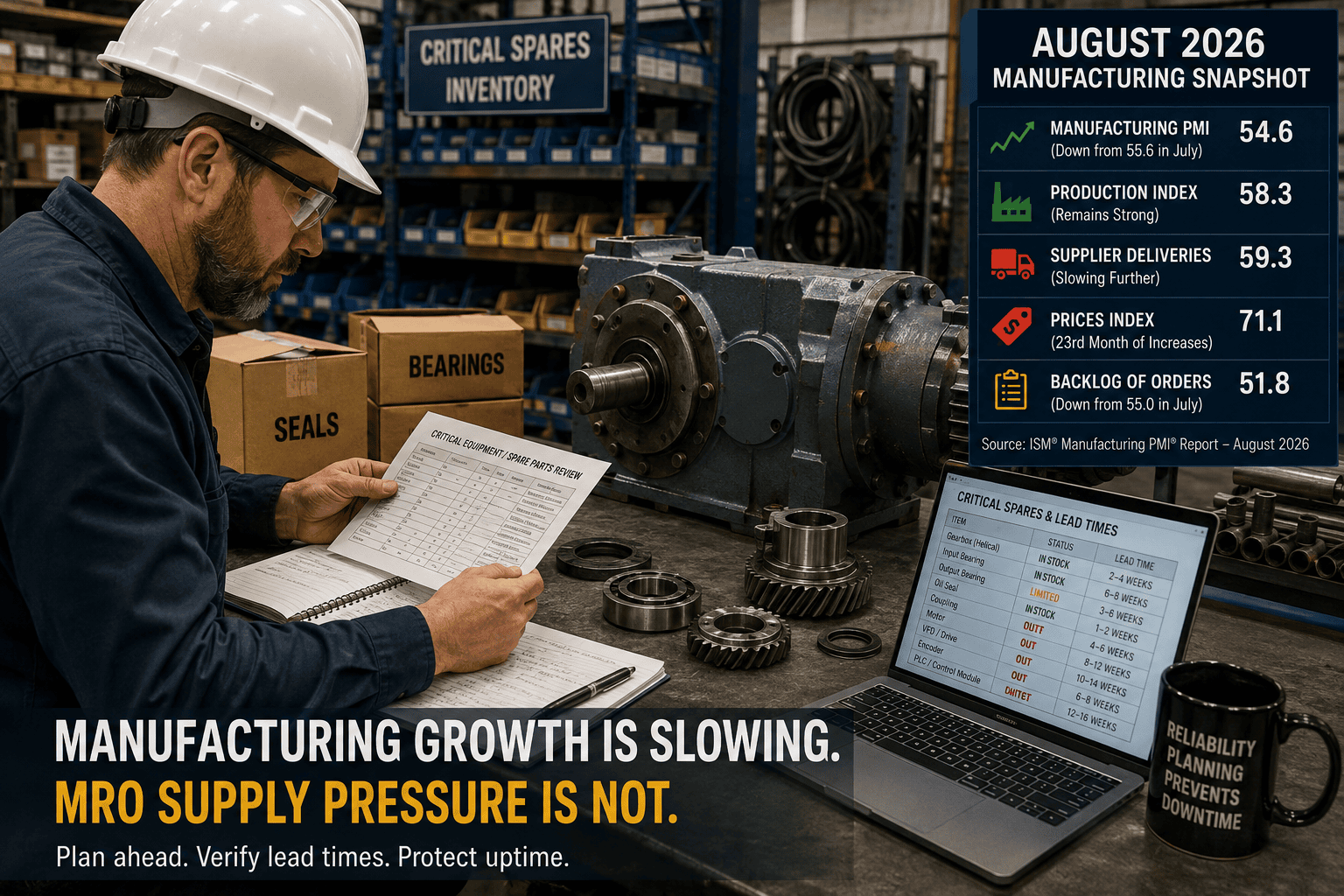
U.S. manufacturing remained in expansion territory in August 2026, but new orders and backlogs lost momentum. For maintenance and purchasing teams, however, the bigger signal may be what did not improve: supplier deliveries slowed further, raw-material prices remained elevated, and key industrial inputs continued to be reported in short supply.
Quick Take
- The ISM Manufacturing PMI fell from 55.6 in July to 54.6 in August, indicating continued—but slower—manufacturing growth.
- Production remained strong at 58.3, only slightly below July’s 58.5.
- New Orders declined to 53.7, while Backlog of Orders fell from 55.0 to 51.8.
- The Supplier Deliveries Index increased to 59.3, indicating that deliveries slowed further.
- The Prices Index remained at 71.1, marking the 23rd consecutive month of increasing raw-material prices.
- Electrical components, electronic components, memory, printed circuit boards and steel were among the materials reported in short supply.
- For gearbox and rotating-equipment teams, slower demand growth should not be confused with easier sourcing or lower MRO risk.
Source: Institute for Supply Management, August 2026 Manufacturing PMI Report.
The U.S. manufacturing sector entered September with an unusual combination of signals.
Growth is slowing, but factories are still expanding. New orders and backlogs are cooling, but production remains comparatively strong. Meanwhile, suppliers are taking longer to deliver, critical components remain constrained, and raw-material prices continue to rise.
For maintenance managers, reliability engineers and industrial buyers, that combination deserves attention.
A slightly slower factory economy may create additional opportunities to schedule maintenance. But it does not necessarily mean that bearings, replacement gearboxes, motors, electrical components or repair materials will suddenly become easier—or cheaper—to obtain.
That distinction could determine whether the next developing gearbox problem becomes a controlled maintenance event or an expensive unplanned shutdown.
The August report also follows an unusually strong July. As Industrial Gearbox Solutions explained in U.S. Manufacturing Accelerates in July—but Slower Deliveries and High Input Prices Raise MRO Risk, stronger production can reduce maintenance flexibility precisely when supply-chain conditions make rapid repairs harder to execute.
August Manufacturing Growth Slowed From July’s Four-Year High
The Institute for Supply Management’s August 2026 Manufacturing PMI report placed the headline index at 54.6, down one percentage point from July’s 55.6.
Any reading above 50 indicates expansion in the manufacturing sector, and August represented the eighth consecutive month of growth.
| Index | August 2026 | July 2026 | Change |
|---|---|---|---|
| Manufacturing PMI | 54.6 | 55.6 | -1.0 |
| New Orders | 53.7 | 56.7 | -3.0 |
| Production | 58.3 | 58.5 | -0.2 |
| Employment | 51.2 | 52.8 | -1.6 |
| Supplier Deliveries | 59.3 | 58.9 | +0.4 |
| Customers’ Inventories | 42.8 | 40.7 | +2.1 |
| Prices | 71.1 | 71.1 | 0.0 |
| Backlog of Orders | 51.8 | 55.0 | -3.2 |
Five of the six largest manufacturing industries—Transportation Equipment, Petroleum & Coal Products, Computer & Electronic Products, Machinery, and Food, Beverage & Tobacco Products—reported expansion in August.
The Federal Reserve’s latest hard-production data reinforce the point that this is a slowdown, not a manufacturing collapse. According to the Federal Reserve’s July 2026 Industrial Production and Capacity Utilization release, manufacturing production increased 0.2 percent in July after increasing 0.3 percent in June. Manufacturing output excluding motor vehicles and parts increased 0.4 percent, while manufacturing capacity utilization edged up to 76.0 percent.
New data released September 2 add another layer. The U.S. Census Bureau’s July Manufacturers’ Shipments, Inventories, and Orders report showed that new orders for manufactured goods increased 0.9 percent to $663.6 billion after a 0.2 percent decline in June. Shipments increased 0.8 percent, while unfilled orders increased 0.6 percent.
Industrial Gearbox Solutions Editorial Insight
The August data suggest that demand momentum has cooled, but the supply-side risks surrounding maintenance have not. Plants may gain a little scheduling flexibility without gaining the same flexibility in parts availability, cost or repair lead time.
Supplier Deliveries Actually Got Slower
For industrial maintenance teams, one of the most important August numbers may be 59.3.
That was the reading for ISM’s Supplier Deliveries Index, up from 58.9 in July. Unlike most PMI components, a higher Supplier Deliveries reading indicates that deliveries are slowing. August marked the ninth consecutive month in which supplier deliveries were reported as slowing.
This matters because gearbox maintenance rarely depends upon a single component.
A repair may require some combination of bearings, seals, shafts, gears or pinions, steel stock, fasteners, lubrication-system components, couplings, motors, sensors, electrical controls or variable-frequency-drive components.
Even when the gearbox itself can be repaired locally, one unavailable bearing, seal, electronic control or specially machined component can extend the outage.
Maintenance teams should therefore be careful about assuming that softer new-order growth will immediately shorten industrial lead times. Supply-chain conditions often lag changes in demand.
For a deeper explanation of why lead times vary so much between stock, modified, drop-in and custom units, see Understanding Industrial Gearbox Lead Times.
Prices Remain a Bigger Warning Than the PMI Decline
The ISM Prices Index remained at 71.1 in August, exactly where it stood in July. Raw-material prices have now increased for 23 consecutive months.
ISM reported price increases for aluminum, copper, electrical components, electronic components, freight, memory components, metal products, printed circuit boards, semiconductors, steel, cold-rolled steel, hot-rolled steel, stainless steel and steel products, among other inputs.
That has direct implications for industrial power transmission.
Gearboxes are material-intensive products. Housings, shafts, gears and bearings depend heavily on metals and precision manufacturing. Motors, VFDs, condition-monitoring equipment and automation systems add electrical and electronic supply chains to the equation.
A plant purchasing or repairing an entire drivetrain therefore faces exposure to several categories currently experiencing price pressure at the same time.
This is one reason a repair-versus-replace decision should consider more than the quoted price of the reducer. Industrial Gearbox Solutions’ Repair vs. Replace Gearbox: A Practical Decision Guide outlines how cost, downtime, structural condition, application fit and long-term reliability should be evaluated together.
Some Critical Components Are Still in Short Supply
The August ISM report identified several commodities in short supply, including:
- Copper
- Electrical components
- Electronic components
- Memory
- Printed circuit boards
- Steel
- Tungsten products
Not every gearbox repair depends upon electronics, of course. But modern industrial drive systems increasingly do.
A mechanically sound gearbox may still be unable to operate if the associated motor starter, VFD, encoder, sensor, PLC interface or other control component cannot be replaced.
This is why critical-spares planning should consider the entire drivetrain, rather than treating the reducer as an isolated component.
A useful audit should include the gearbox, motor, coupling, brake, bearings, lubrication system, instrumentation and controls required to return the equipment to service.
Customer Inventories Are Still Too Low
Another number worth watching is 42.8, the August Customers’ Inventories Index.
Although that was higher than July’s exceptionally low 40.7 reading, ISM still classified customer inventories as “too low.” The index has now remained in that condition for 23 months.
Low customer inventories can complicate maintenance planning.
When customers have limited finished-goods inventory, manufacturers may face pressure to keep production equipment running rather than release machines for preventive work.
That can create a familiar reliability dilemma.
A vibration trend begins increasing. A gearbox starts leaking. Bearing temperature moves gradually upward. Oil analysis reveals abnormal wear particles.
Technically, the best decision may be to stop the asset during a controlled maintenance window. Operationally, however, the plant may be reluctant to take the line down when customer inventories are already low.
This is precisely why early detection matters. The more advance warning maintenance teams have, the more options they retain.
For practical guidance on converting condition data into maintenance decisions, see the Gearbox Predictive Maintenance Guide and Gearbox Vibration Analysis: What the Data Really Means.
The August Slowdown Could Be a Maintenance Opportunity
There is another way to interpret the weaker New Orders and Backlog readings.
They may provide some facilities with a valuable maintenance window.
New Orders fell three percentage points in August, while Backlog of Orders declined 3.2 points. That does not guarantee lower production at any individual facility. But plants experiencing even a modest reduction in scheduling pressure should consider whether previously deferred maintenance can now be moved forward.
Priority candidates include gearboxes showing:
- Increasing overall vibration
- New gear-mesh sidebands
- Elevated bearing frequencies
- Rising operating temperature
- Repeated oil leakage
- Abnormal wear metals
- Increasing particle counts
- Coupling misalignment
- Lubrication contamination
- Unusual noise
- Previous overload events
When visible metal or a rising wear-metal trend appears in lubricant samples, Understanding Metal Particles in Gearbox Oil provides a useful next diagnostic step. For suspected bearing problems, see Troubleshooting Gearbox Bearing Failures.
Maintenance Opportunity
When operations temporarily have more scheduling flexibility, use it to remove known mechanical risk—not simply to defer maintenance until production accelerates again.
Recheck Critical Gearbox Lead Times Now
Industrial gearbox lead times vary dramatically.
Standard reducers may be available from inventory, while modified, drop-in, custom and obsolete units can require considerably more time.
The same is true of repair components.
A maintenance team that checked availability six months ago should not assume that the answer is still valid.
For each critical gearbox, identify:
- Manufacturer and model
- Ratio and output speed
- Motor horsepower and input speed
- Mounting configuration
- Shaft sizes and orientation
- Service factor and duty cycle
- Critical bearings and seals
- Available replacement gearbox options
- Potential drop-in or dimensional interchange options
- Current repair and replacement lead times
The objective is not necessarily to purchase a spare for every gearbox. It is to eliminate uncertainty before a failure occurs.
Repair-versus-Replace Decisions Should Happen Before the Breakdown
Supply-chain volatility also strengthens the case for pre-planning repair-versus-replace decisions.
When a gearbox fails catastrophically, purchasing teams often begin evaluating options at the worst possible moment: production is down, internal pressure is high and the clock is running.
A better strategy is to classify critical gearboxes in advance.
Likely Repair Candidates
Repair may be attractive when the gearbox is:
- Large or custom
- Obsolete
- Difficult to replace dimensionally
- Structurally sound
- Supported by available repair parts
- Substantially faster to rebuild than replace
Likely Replacement Candidates
Replacement may be preferable when:
- A standard equivalent is readily available
- The existing gearbox is undersized
- Failures are recurring
- The housing or gearing is severely damaged
- Efficiency improvements justify upgrading
- A replacement eliminates an obsolete design
Lead time should be considered alongside purchase price. The cheapest solution on paper can quickly become the most expensive solution if it adds weeks of unplanned downtime.
Five Actions Maintenance Teams Should Take From the August Report
1. Do Not Reduce Critical-Spares Planning Simply Because PMI Declined
A move from 55.6 to 54.6 represents slower expansion—not contraction. Production remains strong, while deliveries remain slow.
2. Refresh Supplier Lead Times
Ask suppliers to reconfirm availability for critical gearboxes, bearings, seals, motors, couplings and electronic controls. Old quotations may no longer reflect current conditions.
3. Convert Condition-Monitoring Findings Into Work
Review unresolved vibration, temperature, oil-analysis and inspection findings. Identify which assets can be addressed during available maintenance windows.
4. Identify Approved Alternatives Before an Emergency
For critical assets, document acceptable replacement manufacturers, dimensional interchanges, bearing equivalents and repair options before failure. Engineering approval is easier to obtain when the production line is still running.
5. Treat the Entire Drivetrain as One Reliability System
A spare gearbox does little good if the required motor, coupling, brake, VFD or control component prevents startup. Evaluate the complete equipment chain.
What August Really Means for Industrial Gearbox Buyers
The headline from August is that U.S. manufacturing growth slowed.
The more useful MRO conclusion is more nuanced.
Production is still expanding. Customer inventories remain low. Supplier deliveries became slower. Raw-material prices remain elevated. Steel, electrical and electronic components continue to appear among constrained inputs.
That is not an environment in which maintenance teams should become complacent.
If anything, the modest cooling in new orders and backlogs may offer plants an opportunity to catch up on deferred gearbox work while they still have control over the schedule.
Condition-monitoring data should be reviewed. Critical spares should be verified. Repair-versus-replace strategies should be established. Supplier lead times should be refreshed.
Because when a gearbox fails, the most important question is rarely whether national manufacturing PMI is 54.6 or 55.6.
The question is whether the plant already knows what it needs, where it can get it, and how quickly the equipment can be returned to service.
Need Help With a Gearbox Repair or Replacement?
If you are dealing with a failing, obsolete or long-lead-time industrial gearbox, Industrial Gearbox Solutions can help evaluate repair, replacement and cross-reference options.
Contact Industrial Gearbox Solutions to discuss your application, or send photos and nameplate information so the team can help identify the fastest practical path back to reliable operation.
Recommended Reading on Industrial Gearbox Solutions
- U.S. Manufacturing Accelerates in July—but Slower Deliveries and High Input Prices Raise MRO Risk
- Understanding Industrial Gearbox Lead Times
- Repair vs. Replace Gearbox: A Practical Decision Guide
- Gearbox Vibration Analysis: What the Data Really Means
- Gearbox Predictive Maintenance Guide
- Understanding Metal Particles in Gearbox Oil
- Troubleshooting Gearbox Bearing Failures
Frequently Asked Questions
Is U.S. manufacturing contracting in August 2026?
No. The August ISM Manufacturing PMI was 54.6. A reading above 50 indicates expansion in the manufacturing sector, although growth slowed compared with July’s 55.6 reading.
Are industrial supplier lead times improving?
Not broadly according to the August ISM survey. The Supplier Deliveries Index increased to 59.3, indicating that deliveries were slowing rather than improving.
Are manufacturing material prices falling?
Not broadly. ISM’s Prices Index remained at 71.1 in August, indicating continued raw-material price increases for the 23rd consecutive month.
Which industrial materials remain in short supply?
Manufacturers reported shortages involving electrical components, electronic components, memory, printed circuit boards, steel, copper and several other categories.
Why does this matter for industrial gearbox maintenance?
Gearbox repair and replacement can depend on bearings, seals, steel, motors, controls, electronic components and specialized machining. Supply constraints can therefore extend downtime even when the gearbox itself is repairable.
Should plants stock spare industrial gearboxes?
Not every gearbox requires a complete spare. Criticality, replacement lead time, repair options, redundancy and downtime cost should determine whether a complete spare, repair kit or documented replacement strategy is appropriate.
Sources
- Institute for Supply Management — August 2026 Manufacturing PMI Report. Primary source for the August PMI, New Orders, Production, Supplier Deliveries, Prices, customer inventories, backlogs and commodity shortage data.
- U.S. Census Bureau — Manufacturers’ Shipments, Inventories, and Orders, July 2026. Primary source for the September 2 report showing manufactured-goods orders, shipments and unfilled orders.
- Federal Reserve Board — Industrial Production and Capacity Utilization, July 2026. Primary source for manufacturing-production and capacity-utilization data.
- Reuters — U.S. factory activity slows in August; input prices remain elevated. Independent reporting and economic context on the August ISM release.
- Reuters — Rise in U.S. factory orders beats expectations in July. Independent reporting on the September 2 Census manufacturing-orders release.
- Institute for Supply Management — July 2026 Manufacturing PMI Report. Primary source for month-over-month comparisons with July.