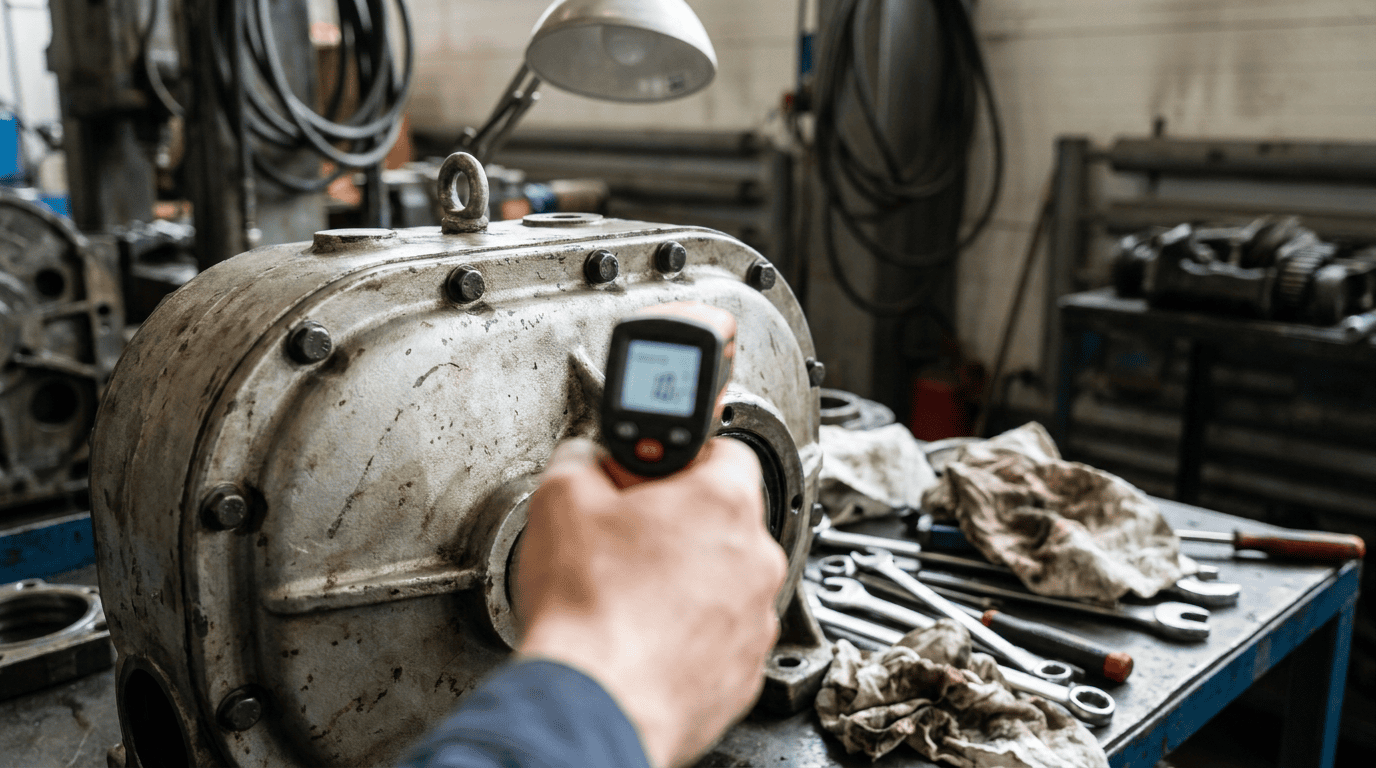
Gearbox bearing temperature is one of the fastest, clearest indicators of gearbox health, lubrication condition, load issues, and developing bearing failure. For maintenance managers, plant engineers, reliability engineers, mechanics, and purchasing teams, understanding what temperatures are normal, what is warning-level, and what requires immediate shutdown can prevent unplanned downtime, secondary gear damage, shaft failure, and costly emergency rebuilds. This guide explains acceptable gearbox bearing temperature ranges, common causes of overheating, symptoms to watch for, inspection and troubleshooting methods, prevention strategies, and how to decide between repair and replacement. Use it as a practical reference for industrial gear reducers, speed reducers, enclosed drives, and heavy-duty gearbox applications.
For many industrial gearboxes, bearing temperatures commonly run between 140°F and 180°F during normal operation, depending on load, speed, ambient temperature, lubrication, gearbox design, and bearing type. Temperatures above 180°F should trigger investigation, while sustained temperatures above 200°F may indicate lubrication failure, misalignment, overload, contamination, bearing damage, or cooling problems. A rapid temperature increase is often more serious than a single elevated reading. Always compare readings to the gearbox OEM’s limits, lubricant specifications, and historical operating baseline.
For those interested in understanding the intricacies of gearbox maintenance, the Gearbox Bearing Temperature Guide is an essential resource. It provides valuable insights into monitoring and managing bearing temperatures to ensure optimal performance and longevity of your equipment. To further enhance your knowledge on this topic, you may find the article on industrial gearbox repair in Meridian, Idaho, particularly useful. It discusses common issues and solutions related to gearbox maintenance, which complements the information in the Gearbox Bearing Temperature Guide. You can read more about it here: Industrial Gearbox Repair in Meridian, Idaho.
Understanding Gearbox Bearing Temperature
Gearbox bearing temperature is not just a number on a thermal gun or sensor display. It reflects the combined effects of friction, lubrication film strength, load distribution, alignment, shaft speed, cooling efficiency, lubricant cleanliness, and internal mechanical condition.
When a gearbox is healthy, bearing temperature typically stabilizes after startup and remains relatively consistent under similar operating conditions. When a problem develops, temperature often trends upward before catastrophic failure occurs.
Why Bearing Temperature Matters
Bearings support rotating shafts and help maintain proper gear mesh. If a bearing overheats, several problems can follow:
- Lubricant viscosity drops and oil film weakens
- Bearing rollers or balls experience metal-to-metal contact
- Cage deformation or failure may occur
- Seals harden, leak, or fail
- Gear alignment changes due to shaft movement
- Gear tooth contact patterns become abnormal
- Contamination and oxidation accelerate
- Total gearbox failure becomes more likely
A hot bearing is often an early warning sign. Ignoring it can turn a relatively simple bearing replacement into a complete gearbox rebuild.
Normal Gearbox Bearing Temperature Ranges
There is no single “perfect” gearbox bearing temperature because operating conditions vary widely. However, the following table provides general guidance for many industrial applications.
| Bearing Temperature | General Condition | Recommended Action |
|:|||
| Below 140°F | Typically normal for lightly loaded or well-cooled units | Continue routine monitoring |
| 140°F–180°F | Common normal operating range | Track trends and compare to baseline |
| 180°F–200°F | Caution range | Inspect lubrication, load, alignment, and cooling |
| 200°F–220°F | High-risk condition | Troubleshoot immediately; consider controlled shutdown |
| Above 220°F | Potential severe damage risk | Shut down if safe and inspect before restart |
These ranges are general guidelines. Always verify acceptable limits with the gearbox manufacturer, bearing manufacturer, and lubricant supplier.
For more detailed service support, visit Industrial Gearbox Solutions’ resources on industrial gearbox repair and gearbox inspection services.
Common Causes of High Gearbox Bearing Temperature
High bearing temperature usually comes from friction, lubrication breakdown, excessive load, installation issues, or mechanical damage. Identifying the root cause is essential because replacing a hot bearing without solving the underlying issue can lead to repeat failure.
Inadequate Lubrication
Lubrication problems are among the most common causes of gearbox bearing overheating. Bearings require a proper oil film to separate rolling elements from raceways.
Common lubrication-related causes include:
- Low oil level
- Incorrect lubricant viscosity
- Wrong oil type
- Oil oxidation
- Water contamination
- Dirt, metal particles, or process contamination
- Foaming or aeration
- Blocked oil passages
- Failed oil pump
- Plugged filter
- Improper grease quantity in grease-lubricated bearings
According to Noria, lubricant selection, cleanliness, and condition are critical to equipment reliability. Even a high-quality gearbox can fail prematurely if the lubricant is contaminated or unsuitable for the operating environment.
Excessive Load or Overload
A gearbox operating beyond its rated torque or horsepower capacity generates additional heat. Overload increases contact stress on bearings and gears, raising operating temperatures.
Overload may result from:
- Increased production demand
- Jammed downstream equipment
- Incorrect motor size
- Shock loading
- Frequent starts and stops
- Process changes
- Material buildup on conveyors, mixers, or crushers
- Improper gearbox selection
If the gearbox was originally selected for one duty cycle but now operates under more severe conditions, bearing temperatures may rise even if the gearbox is mechanically sound.
Misalignment
Misalignment between the gearbox, motor, coupling, driven equipment, or foundation can create uneven bearing loading. This increases friction and heat.
Types of misalignment include:
- Angular misalignment
- Parallel offset misalignment
- Soft foot
- Baseplate distortion
- Thermal growth misalignment
- Coupling installation error
Misalignment may show up as high bearing temperature on one end of the gearbox, elevated vibration, coupling wear, seal leakage, or unusual noise.
Bearing Wear or Damage
A worn or damaged bearing creates excessive friction. As damage progresses, temperature may rise rapidly.
Common bearing defects include:
- Spalling
- Pitting
- Brinelling
- False brinelling
- Cage wear
- Roller skewing
- Raceway cracking
- Corrosion
- Electrical fluting
- Lubricant starvation damage
Bearing manufacturers such as SKF and Timken provide extensive technical references on bearing damage modes, lubrication requirements, and failure analysis.
Incorrect Bearing Installation
Improper installation can cause premature overheating even in a new or recently rebuilt gearbox.
Installation-related problems include:
- Incorrect bearing preload
- Excessive endplay
- Improper shaft fit
- Improper housing fit
- Bearing cocked during installation
- Contaminated assembly environment
- Hammer damage during mounting
- Incorrect heating method for installation
- Failure to follow torque specifications
A bearing installed too tightly may run hot from excessive preload. A bearing installed too loosely may allow shaft movement, vibration, and abnormal gear mesh.
Contamination
Contamination damages lubricant and bearing surfaces. Even microscopic particles can cause abrasive wear and heat generation.
Common contaminants include:
- Dust
- Sand
- Water
- Process chemicals
- Metal wear particles
- Cleaning solvent residue
- Coolant
- Grease incompatibility residue
Water contamination is especially dangerous because it reduces lubricant film strength, promotes rust, and accelerates additive depletion.
Cooling System Problems
Some industrial gearboxes rely on external cooling systems, oil coolers, fans, water jackets, or forced lubrication systems. If cooling is compromised, bearing temperatures can climb.
Cooling-related problems include:
- Blocked oil cooler
- Failed cooling fan
- Dirty heat exchanger
- Low cooling water flow
- High ambient temperature
- Oil flow restriction
- Failed pump
- Clogged breather
- Enclosure ventilation issues
A gearbox that runs normally in winter but overheats in summer may need improved ventilation, oil cooling, or lubricant review.
Industrial gearbox bearing failure can lead to costly downtime and production losses, so it’s important to address the issue promptly. Industrial gearbox bearing failure
Symptoms of Gearbox Bearing Overheating
Temperature is often one of several warning signs. A comprehensive reliability program looks for multiple symptoms together.
Temperature-Related Warning Signs
Watch for these temperature patterns:
- Bearing housing too hot to touch
- Rapid increase after startup
- Temperature continues rising instead of stabilizing
- One bearing location runs hotter than others
- Temperature rises after a process change
- Higher temperature after lubrication change
- Higher temperature after rebuild or installation
- Temperature spikes during peak load
- Repeated high-temperature alarms
A sudden change is often more important than the absolute number. For example, a gearbox that normally runs at 155°F and suddenly operates at 185°F deserves investigation even if it has not exceeded 200°F.
Vibration and Noise Symptoms
Bearing problems usually create vibration changes before complete failure. Look for:
- Rumbling
- Grinding
- Whining
- Clicking
- Growling
- Increased vibration amplitude
- High-frequency vibration signatures
- Changes in gear mesh frequency
- Impacts or modulation in vibration data
Vibration analysis is one of the most effective predictive maintenance tools for gearbox bearings.
Lubricant and Seal Symptoms
Lubricant condition can confirm overheating or mechanical distress.
Signs include:
- Darkened oil
- Burnt odor
- Foaming
- Milky appearance from water contamination
- Metal particles in oil
- Sludge or varnish
- Leaking seals
- Hardened seals
- Excessive pressure at breather
- Filter plugging
Oil analysis can reveal wear metals, viscosity change, oxidation, water, particle count, and additive depletion.
Operational Symptoms
Gearbox overheating may also appear as production or drive system issues:
- Reduced output torque
- Increased motor current
- Tripping overloads
- Inconsistent speed
- Coupling failures
- Belt or chain problems
- Shutdowns during peak load
- Repeated bearing replacement
- Reduced gearbox efficiency
If the motor amperage increases along with bearing temperature, investigate load, alignment, lubrication, and internal mechanical condition.
For those interested in understanding the intricacies of gearbox maintenance, the Gearbox Bearing Temperature Guide is an essential resource. It provides valuable insights into how temperature variations can affect bearing performance and longevity. Additionally, you may find it beneficial to explore a related article on industrial gearbox repair, which discusses common issues and solutions for gearboxes in New York City. This article can be accessed through this link for more comprehensive information.
Troubleshooting High Gearbox Bearing Temperature
“`html
| Bearing Type | Temperature Range (°C) |
|---|---|
| Ball Bearings | 70-90 |
| Roller Bearings | 80-100 |
| Thrust Bearings | 90-110 |
“`
Troubleshooting should be systematic. Avoid replacing components before confirming the cause. A structured approach saves time and prevents recurring failures.
Step 1: Confirm the Temperature Reading
Before making a repair decision, verify the temperature measurement.
Check:
- Sensor calibration
- Infrared thermometer emissivity setting
- Measurement location consistency
- Ambient temperature
- Recent operating load
- Startup versus steady-state condition
- Surface coating or reflective metal affecting readings
- Whether the sensor is measuring bearing housing, oil, or nearby casing
Infrared readings on shiny surfaces can be inaccurate. Use consistent marked measurement points or permanently installed sensors for better trending.
Step 2: Compare Against Baseline
A baseline is the normal operating temperature under known conditions. Compare current readings with historical data.
Ask:
- What temperature does this gearbox normally run?
- Has the load changed?
- Has the lubricant changed?
- Was the gearbox recently rebuilt?
- Was the motor or coupling replaced?
- Has ambient temperature increased?
- Are other similar gearboxes running cooler?
A 20°F–30°F increase from baseline may be significant, even if the temperature remains within broad industry ranges.
Step 3: Inspect Lubrication
Lubrication inspection should be one of the first troubleshooting actions.
Check:
- Oil level at operating condition
- Oil type and viscosity
- Last oil change date
- Oil color and odor
- Filter differential pressure
- Breather condition
- Oil sampling results
- Grease quantity and compatibility
- Evidence of water or foam
- Oil flow to bearings
If oil appears dark, burnt, milky, or full of particles, send a sample for analysis and consider flushing the gearbox.
Step 4: Evaluate Load and Process Conditions
Confirm whether the gearbox is operating within design limits.
Review:
- Motor horsepower
- Gearbox service factor
- Output torque
- Driven equipment condition
- Production rate
- Shock loading
- Startup frequency
- Duty cycle
- Ambient environment
- Recent process changes
The American Gear Manufacturers Association provides standards and technical guidance related to gear design, rating, lubrication, and performance.
Step 5: Check Alignment and Foundation
Misalignment can create localized bearing heat. Inspect the full drive train.
Recommended checks include:
- Laser alignment
- Coupling inspection
- Soft foot measurement
- Baseplate inspection
- Anchor bolt torque
- Pipe strain or external forces
- Thermal growth compensation
- Shaft runout
- Coupling hub fit
If alignment was performed cold, verify whether thermal growth changes alignment during operation.
Step 6: Use Vibration Analysis
Vibration analysis can identify bearing defects, gear mesh problems, imbalance, looseness, and misalignment.
Useful vibration indicators include:
- Bearing defect frequencies
- Overall vibration velocity
- High-frequency acceleration
- Envelope analysis
- Gear mesh frequency
- Sidebands
- Looseness patterns
- Misalignment indicators
Vibration data should be trended over time and compared to alarm limits, similar assets, and historical baselines.
Step 7: Inspect Internals When Needed
If temperature remains high after external checks, an internal inspection may be required.
Internal inspection may reveal:
- Bearing discoloration
- Spalling or pitting
- Gear tooth distress
- Shaft scoring
- Endplay problems
- Oil starvation marks
- Broken cage components
- Debris in housing
- Incorrect bearing contact
- Seal damage
For critical gearboxes, borescope inspection can reduce downtime by allowing preliminary internal assessment without full disassembly.
For those interested in understanding the intricacies of gearbox maintenance, the Gearbox Bearing Temperature Guide is an essential resource. It provides valuable insights into how temperature variations can affect the performance and longevity of gearboxes. Additionally, you may find it helpful to explore a related article on industrial gearbox repair in Cincinnati, which discusses common issues and solutions faced by professionals in the field. You can read more about it here.
Gearbox Bearing Temperature Inspection Methods
A reliable inspection program uses multiple technologies. Temperature readings alone are useful, but they are most powerful when combined with oil analysis, vibration, and visual inspection.
Infrared Thermography
Infrared thermography is a fast way to locate hot spots across gearbox housings, bearings, couplings, motors, and nearby equipment.
Benefits:
- Non-contact measurement
- Quick route-based inspections
- Easy hot spot comparison
- Useful for electrical and mechanical systems
- Good visual documentation
Limitations:
- Surface readings may differ from internal bearing temperature
- Reflective surfaces can distort readings
- Emissivity settings matter
- Airflow, sunlight, and ambient changes can affect results
Use thermography as a screening tool, not the only basis for a shutdown decision.
Installed Temperature Sensors
For critical gearboxes, permanent sensors provide continuous monitoring.
Common options include:
- RTDs
- Thermocouples
- Bearing temperature probes
- Oil temperature sensors
- Wireless condition monitoring sensors
- PLC-connected alarms
- SCADA monitoring
Recommended alarm strategy:
| Alarm Type | Example Trigger | Purpose |
||:||
| Advisory alarm | 10°F–15°F above baseline | Prompt inspection |
| Warning alarm | 20°F–30°F above baseline | Schedule corrective action |
| Critical alarm | Above OEM limit or rapid rise | Controlled shutdown or immediate response |
The best alarm limits are based on OEM guidance, historical trends, lubricant limits, and process risk.
Oil Analysis
Oil analysis can explain why bearing temperature is rising.
Important tests include:
- Viscosity at 40°C and 100°C
- Water content
- Particle count
- Acid number
- Oxidation
- Wear metals
- Ferrous density
- Additive levels
- FTIR analysis
- ISO cleanliness code
Oil analysis is especially valuable for large gearboxes, hard-to-access units, and critical production assets.
Visual and Mechanical Inspection
Routine visual inspections are still essential.
Inspect for:
- Oil leaks
- Loose bolts
- Damaged breathers
- Blocked vents
- Foundation cracks
- Coupling wear
- Abnormal shaft movement
- Discolored paint near bearings
- Burnt oil smell
- Fan or cooler issues
- Unusual noise
A mechanic’s observation can often catch early problems before sensors alarm.
Preventing Gearbox Bearing Overheating
Prevention depends on controlling lubrication, load, alignment, contamination, and maintenance quality.
Maintain Correct Lubrication
Lubrication best practices include:
- Use OEM-recommended lubricant type and viscosity
- Confirm lubricant compatibility before switching products
- Maintain correct oil level
- Use proper filtration
- Install desiccant breathers where appropriate
- Sample oil at regular intervals
- Avoid over-greasing bearings
- Store lubricants in clean, dry conditions
- Label transfer containers
- Filter new oil before adding it to critical gearboxes
Lubricant viscosity is especially important. If viscosity is too low, the oil film may be inadequate. If viscosity is too high, churning losses and heat can increase.
Control Contamination
Contamination control is one of the most cost-effective reliability improvements.
Recommended practices:
- Use high-quality seals
- Replace damaged breathers
- Keep inspection ports closed
- Use clean oil transfer equipment
- Filter oil during fill
- Avoid open buckets and funnels
- Implement color-coded lubrication tools
- Control washdown water exposure
- Repair leaks promptly
A clean gearbox usually runs cooler, lasts longer, and requires fewer emergency repairs.
Align Equipment Properly
Precision alignment reduces bearing stress and operating temperature.
Best practices include:
- Perform laser alignment after installation
- Correct soft foot before alignment
- Account for thermal growth
- Check alignment after foundation repairs
- Recheck after coupling replacement
- Verify pipe strain or driven equipment forces
- Document alignment results
Alignment should be part of commissioning, rebuild installation, and major maintenance events.
Monitor Operating Conditions
Gearboxes are often pushed beyond original design assumptions. Regularly review operating conditions.
Track:
- Load
- Motor current
- Speed
- Temperature
- Vibration
- Oil condition
- Ambient temperature
- Duty cycle
- Starts per hour
- Process upsets
If production requirements have increased, the gearbox may need a higher service factor, auxiliary cooling, or replacement with a more suitable design.
Improve Cooling
If heat is caused by environmental or duty-cycle demands, cooling improvements may be needed.
Options include:
- Clean existing coolers
- Improve airflow around gearbox
- Add cooling fan
- Install oil cooler
- Increase oil circulation
- Improve enclosure ventilation
- Shield gearbox from radiant heat
- Upgrade lubricant where appropriate
- Review gearbox sizing
Never add cooling as a substitute for correcting bearing damage, overload, or lubrication failure. Cooling helps only when the root cause supports that solution.
Repair vs. Replacement: When Bearing Temperature Signals a Bigger Decision
A hot gearbox bearing may require a simple adjustment, a bearing replacement, a full rebuild, or complete gearbox replacement. The right choice depends on damage severity, criticality, lead time, age, parts availability, and total cost of downtime.
When Repair May Be the Best Option
Repair may be appropriate when:
- Damage is limited to bearings and seals
- Gears and shafts are reusable
- Housing bores are within tolerance
- Replacement gearbox lead time is long
- Gearbox is custom or obsolete
- Downtime window allows rebuild
- Cost is significantly lower than replacement
- Root cause can be corrected
A quality gearbox repair should include cleaning, inspection, dimensional checks, bearing replacement, seal replacement, gear inspection, backlash verification, contact pattern checks, and test run when possible.
Learn more about Industrial Gearbox Solutions’ gearbox rebuild services for worn, overheated, or failed units.
When Replacement May Be Better
Replacement may be the better choice when:
- Housing is cracked or distorted
- Gear teeth are severely damaged
- Shafts are bent or cracked
- Bearing seats are beyond repair
- Gearbox is undersized for current duty
- Parts are unavailable
- Repeated failures occur
- Efficiency upgrade is justified
- Downtime risk is too high
- Repair cost approaches replacement cost
Purchasing professionals should evaluate total cost of ownership, not only purchase price. A cheaper gearbox with inadequate service factor can cost far more in downtime and repeat failures.
Decision Table: Repair or Replace?
| Condition | Repair | Replace |
||||
| Bearing damage only | Usually practical | Not always necessary |
| Gear damage present | Possible depending on severity | Consider if extensive |
| Cracked housing | Sometimes weld/machine if feasible | Often recommended |
| Obsolete gearbox | Repair may be best | Replace if retrofit is possible |
| Repeated overheating | Repair only after root cause analysis | Consider redesign or upgrade |
| Long OEM lead time | Repair often preferred | Keep spare if critical |
| Undersized gearbox | Not ideal unless duty is reduced | Recommended |
Maintenance Best Practices for Gearbox Bearing Temperature Control
A good maintenance program combines preventive, predictive, and corrective actions.
Recommended Inspection Frequency
Inspection frequency depends on criticality, duty cycle, and failure history.
| Task | Suggested Frequency | Notes |
||:||
| Visual inspection | Daily or weekly | Check leaks, noise, temperature, breathers |
| Temperature reading | Weekly or route-based | Trend at same location each time |
| Vibration analysis | Monthly or quarterly | More often for critical assets |
| Oil level check | Weekly | Verify under correct operating condition |
| Oil analysis | Quarterly or semiannual | Increase frequency for critical gearboxes |
| Breather inspection | Monthly | Replace when saturated or clogged |
| Alignment verification | After installation or major work | Also check after repeated failures |
| Internal inspection | During planned outage | Use borescope when practical |
Temperature Monitoring Checklist
Use this checklist during routine rounds:
- Record bearing housing temperature at marked locations
- Record oil sump temperature if available
- Note ambient temperature
- Note operating load or production rate
- Compare to previous readings
- Listen for abnormal noise
- Check for leaks
- Inspect breather condition
- Check oil level
- Look for discoloration or burnt smell
- Verify cooling fan or oil cooler operation
- Report sudden changes immediately
Startup After Repair or Rebuild
After gearbox repair, bearing temperature should be closely monitored during startup.
Recommended startup checks:
- Verify correct lubricant before startup
- Confirm oil level
- Rotate shafts by hand if possible
- Check coupling alignment
- Confirm guards and cooling systems are installed
- Start unloaded if possible
- Monitor temperature every 15–30 minutes initially
- Watch for abnormal vibration or noise
- Inspect for leaks
- Recheck fasteners and alignment as required
A new bearing may run slightly warmer during initial operation, but temperature should stabilize. Continuous temperature rise is not normal.
Gearbox Bearing Temperature Reference Table by Situation
The following table helps maintenance teams quickly interpret common temperature scenarios.
| Situation | Possible Causes | Recommended Response |
||||
| All bearings gradually hotter than normal | Ambient heat, overload, oil viscosity issue, cooling problem | Check load, oil, ventilation, cooler |
| One bearing much hotter than others | Bearing damage, misalignment, preload issue, oil starvation | Inspect bearing, alignment, lubrication path |
| Temperature rises after oil change | Wrong viscosity, overfill, incompatible oil, foaming | Verify lubricant and oil level |
| Temperature rises after rebuild | Incorrect preload, misalignment, tight fit, assembly error | Stop and inspect if severe |
| Temperature spikes under load | Overload, shock loading, gear mesh issue | Review process and gearbox rating |
| Hot bearing plus vibration | Bearing damage, misalignment, looseness | Perform vibration analysis and inspection |
| Hot bearing plus leaking seal | Overheating, pressure buildup, shaft movement | Check breather, bearing condition, shaft movement |
| Hot gearbox in summer only | Ambient heat, poor airflow, marginal cooling | Improve ventilation or cooling |
Branded Image Suggestions
Use original, branded images to improve user engagement, topical authority, and AI search visibility.
Image 1: Technician Measuring Gearbox Bearing Temperature
Alt text: Industrial Gearbox Solutions technician measuring gearbox bearing temperature with infrared thermal gun
Caption: Routine temperature checks help identify gearbox bearing problems before failure occurs.
Image 2: Thermal Image of Industrial Gearbox Hot Spot
Alt text: Thermal camera image showing hot bearing location on industrial gearbox
Caption: Infrared thermography can quickly reveal abnormal heat patterns on gearbox housings.
Image 3: Gearbox Bearing and Oil Contamination Inspection
Alt text: Close-up of gearbox bearing inspection with contaminated lubricant and wear debris
Caption: Contaminated or degraded lubricant is a common cause of elevated bearing temperature.
Image 4: Rebuilt Industrial Gearbox on Test Stand
Alt text: Rebuilt industrial gearbox on Industrial Gearbox Solutions test stand after bearing replacement
Caption: Proper rebuild procedures and test runs help confirm stable bearing temperature before installation.
Image 5: Gearbox Maintenance Checklist in Plant Environment
Alt text: Maintenance technician recording gearbox temperature readings during preventive maintenance route
Caption: Consistent data collection allows teams to identify temperature trends early.
SEO Metadata
Meta title: Gearbox Bearing Temperature Guide: Causes, Limits, Troubleshooting & Prevention
Meta description: Learn normal gearbox bearing temperature ranges, overheating causes, symptoms, troubleshooting steps, inspection methods, prevention tips, and repair vs. replacement guidance.
Primary keyword: gearbox bearing temperature
Secondary keywords:
- gearbox bearing overheating
- industrial gearbox temperature
- gearbox temperature limits
- gearbox bearing failure symptoms
- gearbox troubleshooting
- gearbox lubrication problems
- gearbox maintenance best practices
- industrial gearbox repair
- gearbox vibration and temperature
- bearing temperature monitoring
Suggested URL slug: gearbox-bearing-temperature-guide
Search intent: Informational and commercial investigation
Recommended internal links:
- Industrial Gearbox Repair
- Gearbox Rebuild Services
- Gearbox Inspection
- Emergency Gearbox Repair
- Gearbox Maintenance
Authoritative external sources:
- SKF bearing knowledge and lubrication resources
- Timken bearing engineering resources
- AGMA standards and gear industry guidance
- Noria machinery lubrication resources
FAQs About Gearbox Bearing Temperature
What is a normal gearbox bearing temperature?
Many industrial gearbox bearings operate between 140°F and 180°F under normal conditions. However, normal temperature depends on gearbox design, bearing type, load, speed, lubricant, cooling system, and ambient temperature. The best reference is the OEM limit plus your site-specific historical baseline.
When is gearbox bearing temperature too high?
A sustained temperature above 180°F should be investigated. Temperatures above 200°F are usually a serious warning, especially if accompanied by vibration, noise, oil discoloration, leakage, or rising motor current. Temperatures above 220°F may risk bearing and lubricant damage and should be treated as critical unless the OEM specifies otherwise.
Can too much oil make a gearbox run hot?
Yes. Overfilling a gearbox can cause oil churning, foaming, increased drag, and higher operating temperature. Always check oil level according to the manufacturer’s procedure, because the correct level may differ when the gearbox is running versus stopped.
Can the wrong oil cause bearing overheating?
Yes. Oil that is too thin may fail to provide adequate film strength, while oil that is too thick can increase churning and heat. Incorrect additive chemistry, incompatible lubricants, or degraded oil can also increase bearing temperature and wear.
Why is only one gearbox bearing hotter than the others?
A single hot bearing may indicate localized damage, oil starvation, misalignment, incorrect preload, excessive endplay, improper fit, or uneven loading. Compare vibration data, oil analysis, and alignment results before deciding on repair.
Should I shut down a gearbox if the bearing temperature is high?
If temperature is rising rapidly, exceeds OEM limits, or is accompanied by abnormal vibration, noise, leakage, smoke, or burnt oil smell, a controlled shutdown is usually the safest option. For critical production assets, follow plant safety procedures and consult gearbox specialists.
How often should gearbox bearing temperature be checked?
Critical gearboxes may need continuous monitoring. General industrial gearboxes should be checked during routine maintenance rounds, often weekly or monthly depending on duty and criticality. Temperature readings are most useful when trended over time.
What is the best way to measure gearbox bearing temperature?
Installed RTDs or thermocouples provide the best continuous data for critical gearboxes. Infrared thermometers and thermal cameras are useful for routine inspections, but readings must be taken consistently from the same location and corrected for surface conditions when possible.
Can a bearing run hot after replacement?
A newly installed bearing may run slightly warmer during initial operation, but it should stabilize. If temperature continues to rise or exceeds expected limits, investigate preload, endplay, fit, lubrication, alignment, and installation quality.
Does high gearbox temperature always mean bearing failure?
No. High temperature can result from overload, lubricant problems, cooling issues, misalignment, or environmental conditions. However, sustained heat can quickly damage bearings, seals, and gears, so the cause should be identified promptly.
Key Takeaways
- Gearbox bearing temperature is a critical indicator of gearbox reliability.
- Many industrial gearboxes operate normally between 140°F and 180°F, but OEM limits and historical baselines matter most.
- Sustained temperatures above 180°F require investigation; temperatures above 200°F may indicate serious risk.
- Common causes of overheating include lubrication problems, overload, misalignment, contamination, bearing damage, and cooling failures.
- Temperature trends are often more important than single readings.
- Use infrared thermography, installed sensors, vibration analysis, oil analysis, and visual inspection together.
- Correct lubrication and contamination control are essential for preventing hot bearings.
- Repeated bearing overheating may indicate a gearbox sizing, alignment, or process problem.
- Repair may be cost-effective when damage is limited; replacement may be better for undersized, cracked, obsolete, or repeatedly failing gearboxes.
- A structured maintenance program reduces downtime, repair costs, and catastrophic gearbox failures.
Conclusion
Gearbox bearing temperature is one of the most practical condition indicators for industrial gearboxes. When temperatures remain stable within the expected range, the gearbox is more likely to operate reliably. When temperatures rise, especially rapidly or repeatedly, maintenance teams should respond with structured troubleshooting rather than guesswork. Check lubrication, load, alignment, contamination, cooling, vibration, and internal condition before deciding on repair or replacement.
For maintenance managers, reliability engineers, mechanics, and purchasing professionals, the goal is not simply to lower temperature. The goal is to find and correct the root cause so the gearbox can operate safely, efficiently, and predictably. Whether you need inspection, bearing replacement, emergency repair, or a complete rebuild, Industrial Gearbox Solutions can help evaluate the condition of your equipment and recommend the most cost-effective path forward.
FAQs
What is the importance of monitoring gearbox bearing temperature?
Monitoring gearbox bearing temperature is important because it can indicate potential issues such as overloading, misalignment, or lack of lubrication. By monitoring the temperature, maintenance can be scheduled to prevent costly downtime and repairs.
What are the typical operating temperatures for gearbox bearings?
The typical operating temperature for gearbox bearings is between 140°F and 160°F (60°C and 71°C). It is important to monitor the temperature regularly and be aware of any significant deviations from this range.
What are the common causes of high gearbox bearing temperatures?
Common causes of high gearbox bearing temperatures include overloading, inadequate lubrication, misalignment, and contamination. These factors can lead to increased friction and heat generation, resulting in higher bearing temperatures.
How can gearbox bearing temperature be monitored and controlled?
Gearbox bearing temperature can be monitored using temperature sensors or infrared thermometers. To control the temperature, it is important to ensure proper lubrication, alignment, and load distribution within the gearbox.
What are the potential consequences of ignoring high gearbox bearing temperatures?
Ignoring high gearbox bearing temperatures can lead to premature bearing failure, increased maintenance costs, and unplanned downtime. It can also result in damage to other components within the gearbox, leading to more extensive repairs. Regular monitoring and prompt action are essential to prevent these consequences.