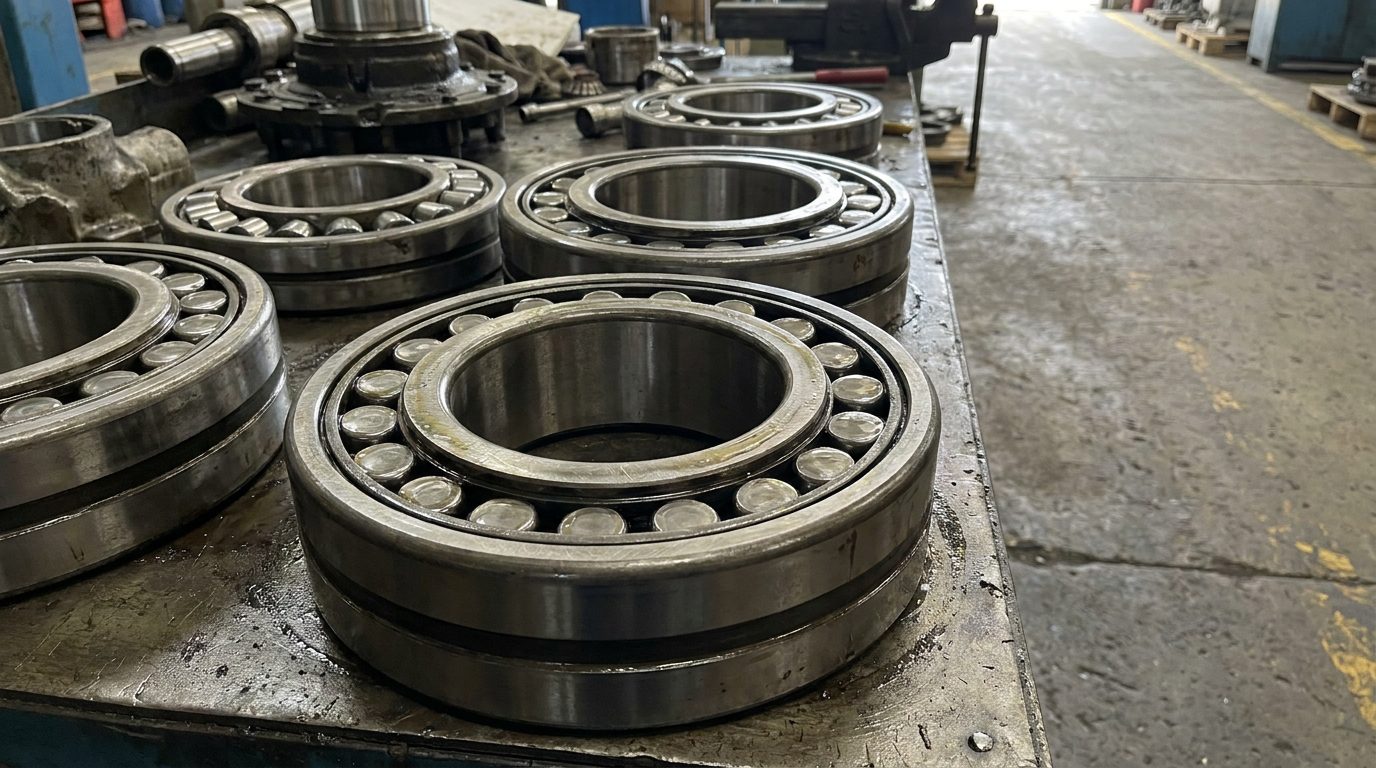
Spherical roller bearings are heavy-duty rolling-element bearings designed to support high radial loads, moderate-to-high axial loads, and shaft misalignment in demanding industrial gearbox and rotating equipment applications. For maintenance managers, plant engineers, reliability teams, mechanics, and purchasing professionals, understanding where these bearings excel—and how they fail—is essential to improving uptime, controlling repair costs, and extending gearbox service life. In industrial gearboxes, conveyors, crushers, mixers, paper machines, fans, and mining equipment, spherical roller bearings often operate under shock loading, contamination, vibration, and variable speeds. Selecting, installing, lubricating, and inspecting them correctly can make the difference between predictable reliability and costly unplanned downtime.
Spherical roller bearings are self-aligning bearings with two rows of barrel-shaped rollers running on a common spherical raceway in the outer ring. Their main advantages are high radial load capacity, tolerance for shaft misalignment, durability under shock loads, and suitability for harsh industrial environments. They are commonly used in industrial gearboxes, crushers, conveyors, pumps, fans, paper machines, mining equipment, and steel mills. The most common failure causes include poor lubrication, contamination, incorrect mounting, excessive load, misalignment beyond design limits, overheating, and vibration. Proper bearing selection, precision installation, condition monitoring, oil analysis, and scheduled inspections are critical for long service life.
Spherical roller bearings are essential components in various industrial applications, providing significant advantages such as high load capacity and alignment compensation. For a deeper understanding of how these bearings interact with other mechanical systems, you may find it beneficial to read the article on gearbox backlash, which discusses the causes, measurement, and acceptable limits of backlash in gearboxes. This knowledge can help in optimizing the performance and longevity of machinery that utilizes spherical roller bearings. For more information, visit the article here: Gearbox Backlash: Causes, Measurement, and Acceptable Limits.
What Are Spherical Roller Bearings?
Spherical roller bearings are rolling-element bearings engineered for demanding applications where heavy radial loads, axial loads in both directions, and alignment challenges are common. Unlike standard deep groove ball bearings or cylindrical roller bearings, spherical roller bearings use two rows of symmetrical or asymmetrical barrel-shaped rollers. These rollers operate between an inner ring with two raceways and an outer ring with one spherical raceway.
This geometry allows the bearing to accommodate angular misalignment between the shaft and housing. In industrial environments where shafts deflect, housings distort, foundations settle, or thermal growth changes alignment, this self-aligning capability is a major advantage.
How Spherical Roller Bearings Work
The outer raceway of a spherical roller bearing is curved around the bearing centerline. Because the rollers match this spherical profile, the inner ring, cage, and roller assembly can tilt slightly inside the outer ring without creating excessive edge stress.
This design helps distribute loads more evenly across the rollers when minor misalignment occurs. In a gearbox or heavy machine, that can reduce stress concentrations, minimize premature spalling, and improve operational reliability.
Key Components
A spherical roller bearing typically includes:
- Outer ring with a spherical raceway
- Inner ring with two raceways
- Two rows of barrel-shaped rollers
- Cage or retainer, often steel, brass, or polyamide depending on application
- Lubrication grooves and holes in many industrial designs
- Optional seals for contamination control
- Tapered or cylindrical bore depending on mounting requirements
Common Bearing Designs
| Design Feature | Description | Typical Use |
||||
| Cylindrical bore | Mounts directly onto a machined shaft | Gearboxes, pumps, general machinery |
| Tapered bore | Mounted using adapter or withdrawal sleeves | Conveyors, fans, large rotating equipment |
| Sealed spherical roller bearing | Integrated seals help exclude contamination | Dirty, wet, or difficult-to-access equipment |
| Split spherical roller bearing | Split rings and rollers allow installation without removing shaft | Hard-to-service machinery and retrofit projects |
| High-capacity design | Optimized internal geometry for increased load rating | Crushers, mills, heavy gear drives |
For related rotating equipment support, see Industrial Gearbox Solutions’ resources on industrial gearbox repair at https://industrialgearboxsolutions.com/gearbox-repair/ and gearbox maintenance at https://industrialgearboxsolutions.com/industrial-gearbox-maintenance/.
Applications of Spherical Roller Bearings
Spherical roller bearings are used wherever heavy loads, vibration, shock, deflection, and misalignment are likely. Their versatility makes them one of the most common bearing types in industrial power transmission and material handling systems.
Industrial Gearboxes
In industrial gearboxes, spherical roller bearings are often used on input shafts, intermediate shafts, and output shafts where radial loads are high and axial forces may also be present. Gear mesh forces, shaft deflection, thermal expansion, and housing distortion can all create challenging operating conditions.
Typical gearbox applications include:
- Parallel shaft gearboxes
- Right-angle gear drives
- Helical gear reducers
- Bevel gear drives
- Conveyor gearboxes
- Mixer and agitator drives
- Crusher and mill gearboxes
When gear tooth loading changes or alignment shifts, spherical roller bearings help compensate for minor angular displacement. However, they are not a cure for severe misalignment, poor foundation conditions, or improper gearbox assembly.
Mining and Aggregate Equipment
Mining, quarrying, and aggregate processing equipment subject bearings to high shock loads, dust, moisture, vibration, and variable loading. Spherical roller bearings are commonly found in:
- Jaw crushers
- Cone crushers
- Vibrating screens
- Apron feeders
- Ball mills
- Rotary kilns
- Conveyors
Their shock-load resistance and high radial capacity make them well suited for these environments. Sealed or contamination-resistant designs may be preferred where dust and water ingress are persistent problems.
Conveyor Systems
Conveyor pulley bearings frequently use spherical roller bearings because pulleys experience shaft bending, belt tension, and misalignment. Bearings may be mounted in pillow blocks, take-up units, or custom housings.
Common conveyor locations include:
- Head pulleys
- Tail pulleys
- Bend pulleys
- Snub pulleys
- Take-up assemblies
- Drive pulleys
For conveyors, proper sealing, lubrication intervals, and alignment checks are especially important because contamination and over-tensioned belts are common causes of bearing failure.
Pulp, Paper, and Steel Mills
Paper machines and steel mills demand bearings that can handle high loads, elevated temperatures, moisture, and continuous operation. Spherical roller bearings are used in rolls, dryers, presses, continuous casters, and mill stands.
In these industries, even a short shutdown can be extremely expensive. Bearing reliability programs often include vibration monitoring, thermography, oil analysis, and detailed root cause failure analysis.
Fans, Blowers, and Pumps
Large industrial fans and blowers may use spherical roller bearings where rotor weight, belt tension, imbalance, and thermal expansion create high radial loads or alignment variation. Pumps may also use them in certain heavy-duty configurations, though bearing selection depends on axial thrust, speed, and lubrication method.
Marine, Cement, and Power Generation
Spherical roller bearings are also common in:
- Cement kilns and clinker crushers
- Coal pulverizers
- Wind turbine support systems
- Marine propulsion equipment
- Hydro turbines
- Power plant auxiliary drives
- Wastewater treatment equipment
These applications benefit from durability, self-alignment, and strong load-carrying capability.
Industrial gearbox bearing failure can lead to costly downtime and production losses, so it’s important to address the issue promptly. Industrial gearbox bearing failure
Advantages of Spherical Roller Bearings
The advantages of spherical roller bearings explain why they are widely specified in industrial machinery. Their design provides a strong balance of load capacity, flexibility, and ruggedness.
High Radial Load Capacity
Because spherical roller bearings use two rows of large rollers, they provide excellent radial load capacity. The roller contact area is much larger than that of ball bearings, allowing them to carry heavier loads.
This makes them ideal for:
- Gearbox shafts
- Conveyor pulleys
- Crushers
- Mills
- Heavy fans
- Large rotating drums
Axial Load Capacity in Both Directions
Spherical roller bearings can carry axial loads in both directions in addition to radial loads. This is important in gearboxes and rotating machinery where thrust loads may change direction or where gear geometry creates axial forces.
However, axial load capacity depends on bearing size, internal design, operating speed, lubrication, and mounting arrangement. In some applications, tapered roller bearings or thrust bearings may still be more appropriate.
Misalignment Tolerance
One of the most important advantages is self-alignment. Spherical roller bearings can tolerate angular misalignment caused by shaft deflection, housing inaccuracies, or mounting error.
Typical misalignment capacity varies by bearing design and manufacturer, so always consult the manufacturer’s engineering data. SKF and Timken provide detailed technical guidance on permissible misalignment, load ratings, and installation practices.
Authoritative references include:
- SKF Rolling Bearings information: https://www.skf.com
- Timken spherical roller bearing resources: https://www.timken.com
- AGMA standards and technical documents: https://www.agma.org
- Noria lubrication best practices: https://www.noria.com
Durability Under Shock and Vibration
Spherical roller bearings are often selected for applications with shock loading or vibration. Crushers, screens, mills, and conveyors frequently expose bearings to impacts and fluctuating loads. The robust roller geometry and high load rating help them survive where lighter-duty bearings may fail prematurely.
Longer Service Life When Properly Maintained
With correct selection, mounting, lubrication, sealing, and condition monitoring, spherical roller bearings can deliver long service life. Many failures are not caused by the bearing itself but by lubrication errors, contamination, misalignment, improper fit, or installation damage.
Spherical roller bearings are essential components in various industrial applications, providing significant advantages such as high load capacity and the ability to accommodate misalignment. For those interested in understanding how these bearings can enhance machinery performance, a related article discusses the importance of proper maintenance and repair of industrial gearboxes, which often rely on such bearings for optimal functionality. You can read more about this topic in the article on industrial gearbox repair.
Causes of Spherical Roller Bearing Failure
| Application | Benefit |
|---|---|
| Conveyors | High load capacity and self-aligning capability |
| Pumps | Reduced friction and vibration |
| Crushers | Ability to accommodate misalignment and shaft deflections |
| Steel mills | High shock load resistance and long service life |
Even robust bearings can fail early when operating conditions exceed design limits or maintenance practices are inconsistent. Understanding failure causes helps reliability teams prevent repeat problems.
Lubrication Problems
Lubrication failure is one of the leading causes of spherical roller bearing damage. Problems include:
- Insufficient lubricant volume
- Excessive grease causing churning and heat
- Wrong lubricant viscosity
- Incompatible greases
- Oxidized or degraded oil
- Water-contaminated lubricant
- Dirty grease guns or oil transfer containers
- Missed lubrication intervals
Poor lubrication can cause metal-to-metal contact, overheating, smearing, scoring, cage wear, and eventual spalling.
Noria provides excellent guidance on lubrication reliability and contamination control at https://www.noria.com.
Contamination
Contaminants can enter through damaged seals, poor breathers, dirty lubricant handling, washdown practices, or open inspection covers. Common contaminants include:
- Dust
- Sand
- Metal particles
- Water
- Process chemicals
- Fibers
- Sludge
- Coolant
Contamination creates abrasive wear, dents, corrosion, and fatigue initiation points on raceways and rollers.
Incorrect Mounting
Improper installation can damage a bearing before it even enters service. Common mistakes include:
- Applying force through the rolling elements
- Overheating during thermal mounting
- Underheating and forcing the bearing onto the shaft
- Incorrect adapter sleeve tightening
- Improper internal clearance reduction
- Using damaged tools
- Installing on worn or undersized shafts
- Failing to check shaft and housing fits
For gearbox-related bearing installation concerns, Industrial Gearbox Solutions can support gearbox inspection and repair planning at https://industrialgearboxsolutions.com/contact/.
Excessive Load
If equipment is overloaded or operating outside design conditions, bearing life can drop dramatically. Overload may result from:
- Increased production rates
- Plugged crushers or conveyors
- Excessive belt tension
- Gear misalignment
- Process jams
- Incorrect bearing selection
- Unexpected thrust loads
Heat and Thermal Growth
High operating temperatures reduce lubricant viscosity, accelerate oxidation, and may alter bearing internal clearances. Thermal growth can also change shaft alignment and create additional stress.
Potential heat sources include:
- Excessive speed
- Over-greasing
- Low oil level
- High oil level causing churning
- Tight fits
- Inadequate internal clearance
- Misalignment
- External process heat
Vibration and Imbalance
Vibration from imbalance, looseness, resonance, gear mesh problems, or structural weakness can shorten bearing life. Vibration may create false brinelling, cage fatigue, roller skidding, or raceway damage.
Symptoms of Spherical Roller Bearing Problems
Early identification of symptoms allows maintenance teams to plan repairs before catastrophic failure.
Common Warning Signs
| Symptom | Possible Cause | Recommended Action |
||||
| Rising bearing temperature | Lubrication issue, overload, misalignment, internal clearance problem | Check lubricant, load, alignment, and mounting |
| Rumbling or growling noise | Race damage, contamination, poor lubrication | Perform vibration analysis and inspect lubricant |
| High vibration at bearing defect frequencies | Spalling, roller damage, raceway defects | Schedule inspection and replacement planning |
| Grease leakage | Over-greasing, seal failure, excessive temperature | Verify grease quantity and seal condition |
| Discolored lubricant | Heat, oxidation, contamination | Conduct oil or grease analysis |
| Metallic particles in oil | Wear, spalling, gear or bearing damage | Inspect gearbox and bearing components |
| Shaft movement or looseness | Fit issue, housing wear, bearing damage | Check shaft and housing dimensions |
| Premature seal failure | Misalignment, contamination, installation error | Inspect sealing system and shaft finish |
Sounds and Vibration Patterns
A healthy spherical roller bearing should run smoothly with predictable vibration levels. Defects may produce:
- Low-frequency rumbling
- High-frequency impact signals
- Sidebands around running speed
- Bearing defect frequencies in vibration spectra
- Increasing envelope acceleration
- Broadband noise increases
Vibration analysis is one of the best tools for early detection, especially in gearboxes where bearing faults may overlap with gear mesh frequencies.
Temperature Trends
Temperature should be evaluated as a trend, not just a single reading. A sudden increase may indicate lubrication failure, overload, or internal damage. Infrared thermography and permanently installed sensors can help maintenance teams detect abnormal heat early.
Troubleshooting Spherical Roller Bearings
Troubleshooting should be systematic. Replacing a failed bearing without identifying the root cause often leads to repeat failure.
Step-by-Step Troubleshooting Process
- Document operating conditions
Record load, speed, temperature, lubricant type, runtime, recent changes, and maintenance history.
- Inspect external conditions
Check seals, housing bolts, shaft movement, coupling alignment, belt tension, and foundation condition.
- Review lubrication practices
Confirm lubricant type, viscosity, grease quantity, relubrication interval, and contamination controls.
- Perform vibration analysis
Identify bearing defect frequencies, looseness, imbalance, misalignment, gear mesh issues, and resonance.
- Analyze lubricant
Test for water, particle count, viscosity, oxidation, wear metals, and additive depletion.
- Inspect mounting fits
Measure shaft and housing fits, roundness, taper, and surface finish.
- Disassemble carefully
Preserve evidence. Avoid damaging components during removal.
- Conduct failure analysis
Look for spalling, smearing, corrosion, cage wear, brinelling, electrical fluting, and heat discoloration.
- Correct root cause
Address alignment, lubrication, contamination, overload, fit, or design issues before installing the replacement.
Common Troubleshooting Scenarios
| Problem | Likely Root Cause | Corrective Action |
||||
| Bearing fails soon after installation | Incorrect mounting or damaged bearing during installation | Review mounting procedure and tools |
| Bearing overheats after greasing | Over-greasing or incompatible grease | Purge excess grease and verify lubricant compatibility |
| Repeated outer ring damage | Housing fit problem or distortion | Measure housing bore and check mounting surface |
| Inner ring fretting | Loose shaft fit or insufficient interference | Repair shaft and verify fit tolerance |
| Corrosion on raceways | Water ingress or poor storage | Improve seals, breathers, and storage practices |
| Cage damage | Vibration, poor lubrication, excessive acceleration | Review operating conditions and lubricant film strength |
Inspection Methods for Spherical Roller Bearings
Inspection should combine visual assessment, measurements, condition monitoring, and lubricant analysis.
Visual Inspection
During shutdown or rebuild, inspect:
- Rollers for scoring, pitting, smearing, or discoloration
- Inner and outer raceways for spalling or brinelling
- Cage for cracks, wear, or deformation
- Seals for hardening, cuts, or leakage
- Shaft seats for fretting or wear
- Housing bores for out-of-round conditions
- Lubricant condition for metal particles, sludge, or water
Photograph findings and retain failed components for analysis whenever possible.
Dimensional Inspection
Precision measurement is critical. Check:
- Shaft diameter
- Housing bore diameter
- Roundness
- Taper
- Shoulder squareness
- Surface finish
- Bearing internal clearance
- Adapter sleeve position
- Axial location
Improper fits can cause spinning rings, fretting corrosion, excessive heat, and premature fatigue.
Vibration Analysis
Vibration analysis can detect bearing defects before they become visible. Techniques include:
- Overall vibration trending
- Spectrum analysis
- Time waveform analysis
- Envelope detection
- PeakVue or high-frequency stress wave methods
- Bearing defect frequency calculations
For gearbox applications, vibration data should be interpreted alongside gear mesh frequencies and shaft speeds.
Lubricant Analysis
Oil and grease analysis can reveal problems before failure. Useful tests include:
- Particle count
- Ferrous debris analysis
- Water content
- Viscosity
- Acid number
- Oxidation
- Spectrometric wear metals
- Analytical ferrography
Lubricant analysis is especially valuable for enclosed industrial gearboxes where bearing condition may not be externally visible.
Prevention and Maintenance Best Practices
Preventing spherical roller bearing failure requires disciplined maintenance, good installation practices, and condition-based monitoring.
Proper Bearing Selection
Select the bearing based on:
- Radial load
- Axial load
- Speed
- Misalignment
- Operating temperature
- Lubrication method
- Contamination exposure
- Shaft and housing fits
- Required service life
- Mounting and dismounting requirements
Do not select bearings based only on size. Load ratings, internal clearance, cage design, sealing, and lubrication features all matter.
Correct Lubrication
Best practices include:
- Use the correct lubricant viscosity for speed and load
- Avoid mixing incompatible greases
- Store lubricants in clean, sealed containers
- Use dedicated grease guns by lubricant type
- Label lubrication points clearly
- Calculate proper grease volume
- Avoid over-greasing
- Use desiccant breathers where appropriate
- Sample oil from active zones, not dead zones
- Filter oil during transfer
Installation Best Practices
Follow manufacturer procedures and use proper tools. Good installation practices include:
- Inspect shaft and housing fits before mounting
- Keep bearings in original packaging until installation
- Use clean gloves and tools
- Heat bearings evenly using induction heaters
- Never use open flames
- Do not strike bearing rings directly
- Apply mounting force only to the ring being fitted
- Verify internal clearance reduction on tapered bore bearings
- Confirm axial positioning
- Rotate shaft by hand after installation where possible
Contamination Control
Contamination control is essential in dirty industrial environments. Recommended actions:
- Upgrade seals when contamination is recurring
- Use labyrinth or taconite seals in abrasive environments
- Improve gearbox breathers
- Keep inspection covers closed
- Use clean oil transfer carts
- Filter new oil before use
- Avoid pressure washing near bearing seals
- Store spare bearings in clean, dry areas
Condition Monitoring
A strong bearing reliability program may include:
- Vibration monitoring
- Temperature monitoring
- Oil analysis
- Grease analysis
- Ultrasonic lubrication monitoring
- Visual inspection routes
- Motor current analysis for driven equipment
- Infrared thermography
Condition monitoring helps maintenance managers move from reactive repair to planned maintenance.
Repair vs. Replacement: Making the Right Decision
When a spherical roller bearing shows signs of damage, the decision to repair, reuse, or replace depends on severity, criticality, cost, lead time, and risk.
When Replacement Is Usually Required
Replace the bearing if inspection reveals:
- Spalling on rollers or raceways
- Cracked ring
- Cage fracture
- Severe overheating discoloration
- Corrosion pitting
- Electrical fluting
- Significant brinelling
- Excessive internal clearance
- Roller end wear
- Lubrication starvation damage
In most industrial gearbox applications, damaged spherical roller bearings should be replaced rather than reused.
When Reuse May Be Considered
Reuse may be possible only if the bearing is removed carefully and shows no evidence of damage, wear, corrosion, contamination, or overheating. Even then, reuse should be limited to non-critical applications or temporary operation after engineering review.
Gearbox Repair Considerations
If a gearbox bearing fails, do not stop at bearing replacement. Inspect the entire gearbox system, including:
- Gear teeth
- Shafts
- Bearing seats
- Housing bores
- Seals
- Lubrication system
- Breathers
- Couplings
- Foundation and baseplate
- Alignment
- Oil condition
A bearing failure may be the symptom, not the root cause. For support with failure analysis or gearbox rebuild decisions, visit Industrial Gearbox Solutions’ gearbox repair page at https://industrialgearboxsolutions.com/gearbox-repair/.
Cost Comparison Table
| Option | Best For | Advantages | Risks |
|||||
| Bearing replacement only | Isolated bearing damage with known root cause | Lower immediate cost, faster turnaround | Repeat failure if root cause is missed |
| Gearbox rebuild | Multiple worn components or contamination event | Restores reliability, allows full inspection | Higher upfront cost |
| Gearbox replacement | Severe housing damage, obsolete unit, repeated failures | Long-term solution, potential upgrade | Longer lead time and capital cost |
| Temporary repair | Emergency production need | Short-term uptime | High risk if not closely monitored |
Purchasing Considerations for Spherical Roller Bearings
Purchasing professionals play a major role in reliability. A low-cost bearing that does not meet application requirements can create far higher costs through downtime, labor, and secondary damage.
What to Specify When Buying
When requesting quotes, specify:
- Bearing number and manufacturer
- Bore type: cylindrical or tapered
- Internal clearance class, such as C3 or C4
- Cage material and design
- Sealed or open configuration
- Lubrication groove and hole requirements
- Operating speed
- Load conditions
- Temperature range
- Application and equipment type
- Required certifications or documentation
- Country of origin requirements if applicable
OEM vs. Equivalent Bearings
Equivalent bearings may be acceptable if they meet or exceed the original design requirements. However, confirm:
- Dynamic and static load ratings
- Speed ratings
- Internal geometry
- Clearance
- Cage type
- Heat treatment
- Dimensional tolerances
- Lubrication features
- Manufacturer reputation
For critical gearbox applications, consult engineering before substituting brands or designs.
Spare Parts Storage
Improper storage can ruin bearings before installation. Store bearings:
- In original packaging
- In a clean, dry, temperature-controlled area
- Away from vibration
- Away from chemicals and moisture
- Flat and supported properly
- With inventory rotation based on age and packaging condition
Comparison: Spherical Roller Bearings vs. Other Bearing Types
Spherical roller bearings are powerful, but they are not always the best option. Selection should be based on application requirements.
| Bearing Type | Strengths | Limitations | Common Uses |
|||||
| Spherical roller bearing | High radial load, axial load both directions, misalignment tolerance | Higher friction than some alternatives, speed limits | Gearboxes, conveyors, crushers |
| Cylindrical roller bearing | High radial load, good speed capability | Limited axial load unless specially designed | Motors, gearboxes, machine tools |
| Tapered roller bearing | High radial and axial load, precise shaft control | Sensitive to setting and alignment | Gearboxes, wheel hubs, heavy equipment |
| Deep groove ball bearing | High speed, low friction, economical | Lower load capacity, limited misalignment | Motors, pumps, light machinery |
| Self-aligning ball bearing | Misalignment tolerance, low friction | Lower load capacity than spherical roller bearings | Light shafts, fans, agricultural equipment |
FAQs About Spherical Roller Bearings
What is the main purpose of a spherical roller bearing?
The main purpose of a spherical roller bearing is to support heavy radial loads while also accommodating axial loads and shaft misalignment. This makes it valuable in industrial gearboxes, conveyors, crushers, fans, and heavy rotating machinery.
Are spherical roller bearings good for misalignment?
Yes. Spherical roller bearings are designed to tolerate angular misalignment better than many other bearing types. However, misalignment should still be minimized. Excessive misalignment can reduce bearing life, increase heat, and damage seals or adjacent components.
What causes spherical roller bearings to overheat?
Common causes include over-greasing, under-lubrication, incorrect lubricant viscosity, excessive load, improper internal clearance, misalignment, contamination, high speed, and tight shaft or housing fits.
How often should spherical roller bearings be lubricated?
Lubrication frequency depends on speed, load, temperature, bearing size, grease type, environment, and operating hours. Follow manufacturer recommendations and refine intervals using condition monitoring, ultrasound, and lubricant analysis.
Can spherical roller bearings handle axial loads?
Yes. Spherical roller bearings can support axial loads in both directions. However, the allowable axial load depends on bearing design, size, speed, lubrication, and operating conditions.
What is C3 clearance in a spherical roller bearing?
C3 clearance means the bearing has greater internal clearance than normal. It is often used where interference fits, heat, or operating conditions reduce internal clearance during operation. The correct clearance should be selected based on application requirements.
Should a failed spherical roller bearing be analyzed?
Yes. Failure analysis helps identify root causes such as lubrication starvation, contamination, improper fit, misalignment, overload, or electrical damage. Without root cause analysis, the replacement bearing may fail the same way.
Are sealed spherical roller bearings worth it?
Sealed spherical roller bearings can be valuable in contaminated or hard-to-maintain environments. They help retain lubricant and exclude contaminants, but they must be evaluated for speed, temperature, and application compatibility.
Key Takeaways
- Spherical roller bearings are ideal for heavy radial loads, axial loads, shock loading, and moderate shaft misalignment.
- Common applications include industrial gearboxes, conveyors, crushers, vibrating screens, mills, fans, paper machines, and steel processing equipment.
- The leading causes of failure are lubrication problems, contamination, incorrect mounting, overload, heat, vibration, and improper fits.
- Early warning signs include rising temperature, abnormal noise, increasing vibration, grease leakage, metal particles, and lubricant discoloration.
- Troubleshooting should include vibration analysis, lubricant analysis, visual inspection, dimensional checks, and root cause analysis.
- Proper installation, lubrication, contamination control, and condition monitoring are essential to long bearing life.
- Purchasing teams should specify clearance, cage design, bore type, sealing, load ratings, and manufacturer quality—not just price.
- In gearbox applications, bearing failure should trigger a complete inspection of gears, shafts, housings, seals, lubrication systems, and alignment.
Suggested Branded Images for IndustrialGearboxSolutions.com
Image 1: Spherical Roller Bearing Cutaway
Alt text: Spherical roller bearing cutaway showing two rows of rollers and spherical outer raceway
Caption: Spherical roller bearings use two rows of barrel-shaped rollers to carry heavy loads and tolerate misalignment.
Image 2: Gearbox Bearing Inspection
Alt text: Industrial Gearbox Solutions technician inspecting spherical roller bearing in gearbox housing
Caption: Proper inspection of shafts, housings, seals, and bearings helps prevent repeat gearbox failures.
Image 3: Bearing Failure Analysis
Alt text: Close-up of damaged spherical roller bearing raceway with spalling and contamination marks
Caption: Bearing damage patterns can reveal root causes such as contamination, lubrication failure, or overload.
Image 4: Lubrication Best Practices
Alt text: Clean oil transfer cart and labeled lubrication tools for industrial gearbox maintenance
Caption: Clean lubricant handling is one of the most effective ways to extend bearing and gearbox life.
Image 5: Conveyor Pulley Bearing Assembly
Alt text: Spherical roller bearing mounted in conveyor pulley bearing housing
Caption: Conveyor pulley applications rely on spherical roller bearings to manage belt loads and shaft deflection.
SEO Metadata
Meta title: Exploring Spherical Roller Bearings: Applications and Advantages
Meta description: Learn how spherical roller bearings work, where they are used, why they fail, and how to inspect, troubleshoot, lubricate, and maintain them in industrial gearboxes and heavy equipment.
Primary keyword: spherical roller bearings
Secondary keywords: spherical roller bearing applications, spherical roller bearing advantages, bearing failure analysis, gearbox bearing failure, industrial gearbox bearings, bearing lubrication, bearing inspection
Suggested URL slug: /spherical-roller-bearings-applications-advantages/
Search intent: Informational and commercial investigation for maintenance, reliability, engineering, and purchasing teams evaluating bearing performance in industrial equipment.
Conclusion
Spherical roller bearings are among the most capable bearing designs for heavy-duty industrial machinery. Their ability to carry high radial loads, support axial loads in both directions, and tolerate shaft misalignment makes them especially valuable in gearboxes, conveyors, crushers, mills, fans, and process equipment. However, their reliability depends on more than bearing design. Correct selection, clean lubrication, precision mounting, contamination control, condition monitoring, and root cause analysis are essential.
For maintenance managers and reliability engineers, the goal is not simply to replace failed bearings faster. The goal is to understand why failures happen and eliminate the conditions that cause them. For purchasing professionals, the lowest-cost bearing is rarely the lowest-cost solution if it leads to downtime or repeat repairs.
If your facility is dealing with recurring gearbox bearing failures, rising vibration, overheating, lubricant contamination, or uncertain replacement decisions, Industrial Gearbox Solutions can help evaluate the problem and recommend a practical path forward.
FAQs
What are spherical roller bearings?
Spherical roller bearings are a type of rolling-element bearing that is designed to accommodate heavy radial loads and axial loads in both directions. They have two rows of symmetrical barrel rollers, which align themselves freely in the outer ring raceway.
What are the applications of spherical roller bearings?
Spherical roller bearings are commonly used in heavy machinery, such as mining equipment, paper mills, crushers, and vibrating screens. They are also used in industries such as aerospace, automotive, and construction.
What are the benefits of using spherical roller bearings?
Spherical roller bearings offer high load-carrying capacity, long service life, and the ability to accommodate misalignment. They also have a high degree of shock resistance and are suitable for high-speed applications.
How do spherical roller bearings differ from other types of bearings?
Spherical roller bearings have a self-aligning capability, which allows them to compensate for misalignment and shaft deflections. This sets them apart from other types of bearings, such as cylindrical roller bearings or ball bearings.
What factors should be considered when selecting spherical roller bearings?
When selecting spherical roller bearings, factors such as load capacity, speed, operating temperature, and lubrication requirements should be taken into consideration. Additionally, the bearing’s fit and clearance, as well as the surrounding environment, should be evaluated to ensure optimal performance.