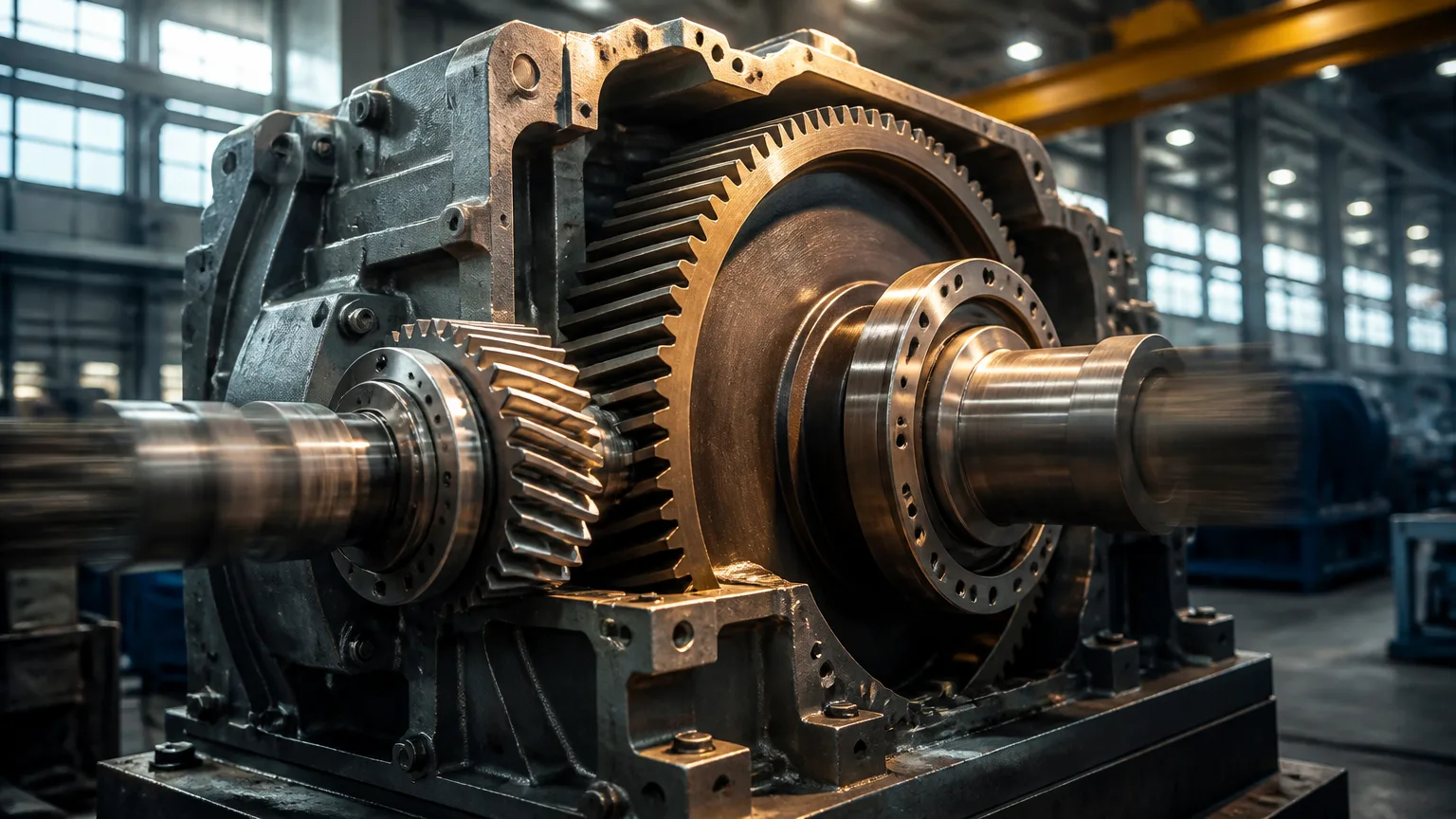
Speed reduction is the controlled lowering of motor speed before power reaches a driven machine. It helps manufacturers and facility operators match a fast electric motor with equipment that needs slower, stronger, and more controlled motion.
A gearbox uses a ratio to manage this change. For example, a 10:1 reduction turns a 1,800 rpm motor into an output speed of about 180 rpm. As speed decreases, available torque increases, allowing the machine to handle heavier loads with greater control.
This is not simply a loss of speed. It is a practical way to deliver the right performance for conveyors, mixers, pumps, compressors, and other electric motor applications in industry. Understanding speed reduction helps teams select suitable gearboxes, improve equipment reliability, and prevent costly mismatches between motors and driven machinery.
How Gearboxes Reduce Speed and Increase Torque
A gearbox uses gear ratios to lower the speed from an input shaft and transfer power through an output shaft. When a smaller driving gear turns a larger driven gear, the output rotates more slowly but delivers greater torque, or turning force.
For example, a 1,800-rpm motor paired with a 30:1 reduction gearbox produces an output speed of approximately 60 rpm. In an ideal system, torque increases in proportion to the reduction ratio. Real gearboxes provide less torque because friction, heat, lubrication conditions, and gear geometry create efficiency losses.
This speed-and-force tradeoff is essential for industrial equipment. Conveyors, mixers, and lifting systems often need lower output speed and higher starting torque to overcome heavy loads. However, the correct ratio depends on the driven machine’s required speed, starting load, duty cycle, and operating conditions.
Gearbox configurations support different application demands. Helical and parallel-shaft designs provide efficient power transmission, while bevel gearboxes change the direction of shaft rotation. Worm gearboxes offer high reduction in a compact layout, and planetary designs deliver high torque density. For guidance on choosing the right gearbox for power transmission, evaluate the complete operating profile rather than selecting a ratio by speed alone.
Why Industrial Equipment Needs Speed Reduction
Industrial equipment often requires lower output speed than the connected electric motor provides. Speed reduction delivers controlled movement for conveyors, mixers, extruders, pumps, crushers, hoists, packaging lines, and material-handling systems.
A suitable reducer prevents driven components from overspeeding. It also limits shock loads during starts and stops, helping machines process materials accurately and consistently. For example, a packaging line needs precise timing, while an extruder must maintain steady screw speed to produce uniform output.
Gear reduction also multiplies torque at the output shaft. This added force helps motors start heavy loads, such as loaded conveyors or crushers, and maintain motion as production conditions change. The required gearbox torque capacity depends on load weight, starting demands, duty cycle, and operating environment.
Correct speed control supports safer operation and extends equipment life by reducing excessive stress on gears, bearings, couplings, and shafts. It can also improve productivity by maintaining stable throughput instead of forcing operators to compensate for inconsistent motion.
However, an incorrectly sized reducer creates new problems. Insufficient capacity may cause overheating, vibration, premature wear, inconsistent throughput, or repeated production stoppages. Selecting the correct ratio and load rating is therefore essential for reliable, efficient operation.
How to Identify Speed-Reduction Problems
A failing speed reduction system often provides clear warning signs. Listen for abnormal noise, monitor rising vibration or operating temperature, and inspect for oil leakage. Inconsistent output speed, excessive backlash, or reduced load-handling ability can also indicate developing faults.
These symptoms may not originate in the reduction ratio alone. Worn gears or bearings, damaged seals, poor lubrication, loose couplings, misalignment, motor problems, or issues in the driven machine can produce similar behavior. Compare actual input and output speeds with the gearbox specification before identifying the reducer as the cause.
Document input speed, output speed, load behavior, temperature, lubrication condition, and maintenance history. This information helps technicians isolate the fault and supports what to check before arranging gearbox repairs. Record when symptoms occur, especially during startup, steady operation, and peak loads.
Early diagnosis can prevent minor wear from becoming severe gear tooth damage. It also helps teams plan corrective work before a complete gearbox failure causes extended downtime, lost production, and emergency repair costs.
Repair or Replace a Speed-Reduction Gearbox?
When a reducer shows signs of failure, compare repair, rebuilding, and replacement before making a decision. Gear and bearing damage may be repairable when the housing, shafts, and major components remain serviceable. A rebuild can restore performance and extend service life at lower cost than a new unit.
Replacement may be more practical when the housing is cracked, gears are severely worn, or parts are obsolete or unavailable. Repeated failures, long parts lead times, and limited remaining service life also increase the risk of rebuilding. Review gearbox rebuilding versus replacement alongside current operating requirements.
A replacement must match more than the nominal speed reduction ratio. Confirm torque capacity, service factor, shaft arrangement, mounting dimensions, motor compatibility, duty cycle, lubrication needs, and environmental protection. A mismatch can cause overheating, vibration, or premature failure.
Base the decision on total cost of ownership, not the lowest initial price. Compare repair costs, efficiency, delivery time, expected service life, maintenance needs, and production risk. A new or upgraded gearbox may justify its cost when it improves efficiency and prevents extended downtime. Conversely, a timely rebuild can restore reliable operation when the existing unit remains fundamentally sound.
Using Speed Reduction to Protect Industrial Performance
Speed reduction connects motor selection, torque delivery, gearbox condition, and production reliability. A speed reducer is a critical power-transmission component that converts motor speed into usable machine motion and torque. The correct reducer helps conveyors, mixers, pumps, compressors, and other equipment operate within their required load and speed ranges.
Reliable performance depends on more than selecting the correct ratio. The gearbox must also match the motor, load profile, duty cycle, mounting arrangement, and operating environment. Proper sizing supports efficient torque delivery, while timely maintenance helps prevent overheating, wear, and unexpected stoppages.
Treat changes in noise, temperature, vibration, or output performance as diagnostic signals—not normal aging. These symptoms may indicate lubrication problems, misalignment, bearing damage, gear wear, or an incorrect operating condition. Early investigation can prevent minor issues from becoming major production failures.
When performance declines, consult a qualified gearbox repair or replacement provider. An accurate assessment can identify the most practical solution, reduce downtime, and support a properly matched gearbox for dependable long-term operation.