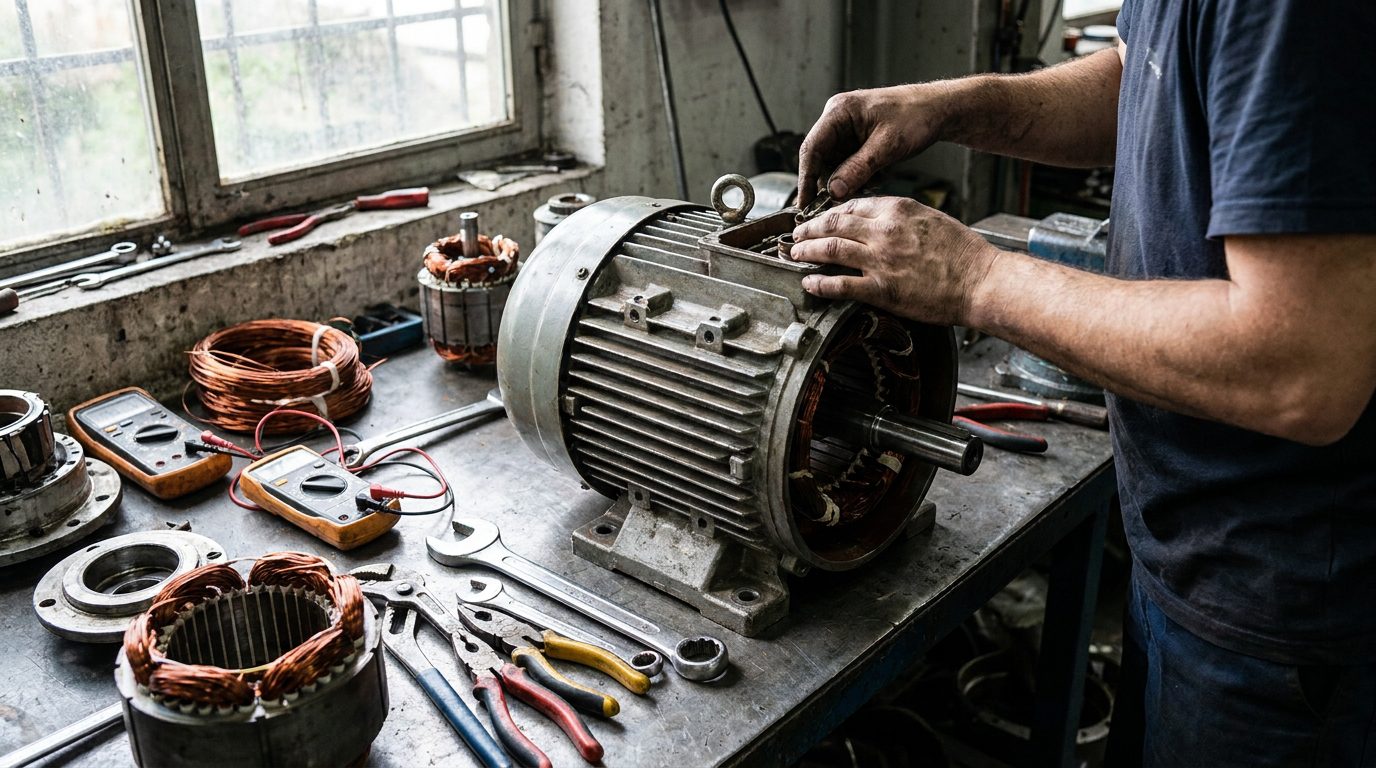
Here’s an article for IndustrialGearboxSolutions.com, focusing on electric motor repair, designed to be practical and informative for your target audience.
Electric motors are the workhorses of modern industry, powering everything from conveyor belts to complex manufacturing machinery. When these essential components falter, the impact on production, efficiency, and profitability can be immediate and severe. Understanding the early indicators of motor distress is crucial for proactive maintenance and minimizing costly downtime. This article will delve into the seven critical signs that your electric motor is signaling a need for professional attention. By recognizing these warning signs, plant managers, maintenance teams, engineers, buyers, and operators can make informed decisions, optimize repair strategies, and ultimately safeguard their operations against unexpected failures. Timely intervention, guided by expert knowledge, can transform a potential breakdown into a controlled maintenance event, saving time, money, and valuable production capacity.
If you’re concerned about the performance of your electric motor, it’s essential to recognize the signs that indicate it may need professional repair. For further insights on maintaining industrial equipment, you can check out a related article on gearbox repair services in St. Augustine, Florida, which discusses common issues and solutions for industrial gearboxes. This resource can provide valuable information to help ensure your machinery operates efficiently. For more details, visit Industrial Gearbox Repair in St. Augustine, Florida.
1. Unexplained Overheating: A Motor’s Fever
Overheating is perhaps the most common and alarming symptom of an electric motor in distress. It signifies that the motor is working harder than it should or that its internal components are failing to dissipate heat effectively. Ignoring this “fever” can lead to rapid degradation of insulation, bearing failure, and ultimately, catastrophic motor seizure.
Causes of Overheating
Several factors can contribute to an electric motor overheating:
- Overloading: This is a primary culprit. When a motor is subjected to a load that exceeds its rated capacity, it draws more current, generating excessive heat. This can happen due to a production increase, a mechanical issue in the driven equipment, or an incorrect motor selection for the application.
- Research Insight: According to the National Electrical Manufacturers Association (NEMA), overloading is responsible for a significant percentage of motor failures, often leading to premature insulation breakdown.
- Insufficient Ventilation: Motors rely on air circulation to dissipate the heat generated during operation. Blocked vents, accumulated dirt and debris, or operating in excessively hot ambient temperatures can all impede airflow, causing the motor to overheat.
- Industry Best Practice: Regular cleaning of motor enclosures and ensuring adequate clearance around the motor are fundamental preventative measures recommended by ASHRAE (American Society of Heating, Refrigerating and Air-Conditioning Engineers) in their industrial ventilation guidelines.
- Bearing Issues: Worn, damaged, or improperly lubricated bearings generate friction. This friction converts mechanical energy into heat, which can then spread throughout the motor, leading to a rise in overall temperature.
- Technical Note: Bearing friction can increase exponentially as wear progresses. Early detection of bearing noise or vibration is key to preventing associated overheating.
- Electrical Imbalances or Faults: Issues within the motor’s windings, such as short circuits or degraded insulation, can cause uneven current distribution, leading to hot spots and increased temperature. Single-phasing (loss of one phase in a three-phase motor) is a common cause of severe overheating.
- Authoritative Source: IEEE (Institute of Electrical and Electronics Engineers) publications frequently detail the thermal effects of electrical faults on motor performance and lifespan.
- Low Voltage or Voltage Imbalance: Operating a motor on a voltage significantly below its rating or experiencing significant voltage imbalance between phases can cause it to draw excessive current to compensate, leading to overheating.
- Practical Implication: Maintenance teams should regularly check voltage levels at the motor terminals.
Warning Signs of Overheating
Beyond simply feeling the heat, several observable signs indicate a motor is overheating:
- Discoloration of Motor Casing: A bluish or blackish discoloration on the motor’s exterior, particularly around vents or the frame, is a strong indicator of excessive heat exposure.
- Burning Odor: The smell of burning insulation is a critical warning sign. This indicates that the motor’s internal insulation is degrading due to excessive heat.
- Maintenance Alert: This smell is often described as acrid or like burnt plastic. It signifies immediate danger to the motor’s integrity.
- Increased Amperage Draw: Using a clamp-on ammeter to measure the motor’s current draw can reveal if it’s operating at higher than normal amperage, especially under no-load or reduced-load conditions.
- Thermal Imaging: Utilizing an infrared camera can pinpoint hot spots within the motor that may not be immediately visible or detectable by touch. This is a powerful diagnostic tool for identifying localized overheating.
- Advantage of Technology: Thermal imaging allows for non-contact inspection, enabling early detection of developing issues before they become critical.
Diagnosis and Repair
Diagnosing the cause of overheating requires a systematic approach. This typically involves:
- Visual Inspection: Checking for obvious signs like dirt buildup, blocked vents, or physical damage.
- Electrical Testing: Measuring winding resistance, insulation resistance (megger testing), and voltage/current at the terminals.
- Mechanical Inspection: Checking bearings for play, roughness, or signs of wear. Listening for unusual noises.
- Load Testing: Observing motor performance under its normal operating load.
- Thermal Imaging: As mentioned, this is invaluable for locating precise hot spots.
Repair options for overheating motors depend on the root cause:
- Cleaning and Ventilation Improvement: If dirt or obstructions are the issue, thorough cleaning and ensuring proper airflow can resolve the problem.
- Bearing Replacement: Worn bearings must be replaced with appropriate equivalents. Proper lubrication is also essential.
- Electrical Repair or Rewinding: If winding insulation has degraded, a motor rewind by a specialized facility is often the most cost-effective solution compared to full replacement.
- Addressing Overload Conditions: This may involve troubleshooting the driven equipment, re-evaluating the application’s requirements, or replacing the motor with a larger frame if it’s consistently undersized.
2. Unusual Noises: A Motor’s Cry for Help
Noises emanating from an electric motor are rarely benign. While some operational hum is normal, any deviation – a squeal, grind, clank, or excessive hum – signifies internal mechanical or electrical problems that require immediate attention.
Types of Noises and Their Causes
Different sounds point to different issues:
- Grinding or Squealing: This is most commonly associated with bearing failure. As the bearing races and rolling elements wear down, they produce a high-pitched squeal or a rough grinding sound.
- Bearing Tribology: The study of friction, lubrication, and wear (tribology) highlights that bearing noise is a direct consequence of material loss and surface degradation.
- Knocking or Clanking: These sounds can indicate issues with the rotor, such as unbalanced components, loose rotor bars, or even foreign objects inside the motor housing. It can also signal severe bearing damage or shaft misalignment.
- Rotor Integrity: A balanced rotor is critical for smooth operation. Any imbalance will cause vibration and potentially impact noises.
- Excessive Humming or Buzzing: While some hum is normal, a significant increase in hum can indicate electrical problems, such as loose laminations in the stator core, a shorted winding, or unbalanced voltage.
- Lamination Resonance: When stator laminations become loose, they can vibrate at the electrical frequency, producing a pronounced hum.
- Clicking or Popping: This can sometimes be an early sign of insulation breakdown within the windings, leading to intermittent electrical arcing.
Warning Signs Associated with Noise
- Intermittent or Constant: Is the noise present all the time, or does it only appear under specific load conditions?
- Changes in Pitch or Volume: Does the noise get louder or change pitch as the motor speeds up or slows down?
- Vibration: Often, unusual noises are accompanied by increased vibration.
Diagnosis and Repair
Diagnosing noise requires careful listening and often involves:
- Pinpointing the Source: Using a mechanic’s stethoscope to isolate the area of the motor where the noise is loudest.
- Vibration Analysis: Sophisticated vibration analysis equipment can identify specific frequencies associated with different types of mechanical faults.
- Load Testing: Observing how the noise changes under different operating loads.
Repair options:
- Bearing Replacement: This is the most common repair for grinding or squealing noises. Proper installation and lubrication are paramount.
- Rotor Repair or Replacement: If the rotor is damaged or unbalanced, it may require specialized repair or replacement.
- Stator Repair: For humming or buzzing caused by loose laminations or winding faults, a professional rewind might be necessary.
- Shaft and Coupling Alignment: If the noise is related to misalignment, proper alignment of the motor shaft and the driven equipment’s shaft is crucial.
Check out our blog for more articles on industrial gearbox solutions: more articles.
3. Increased Vibration: The Unseen Tremor
Vibration is a silent killer of electric motors. While subtle, increased vibration levels are a strong indicator of underlying mechanical or electrical imbalances that, if left unaddressed, will lead to accelerated wear and premature failure.
Sources of Vibration
Vibration can stem from various sources:
- Mechanical Imbalance: This is the most common cause. It can be due to:
- Rotor Imbalance: Uneven mass distribution on the rotor, often caused by manufacturing defects, accumulated dirt, or damage.
- Bent Shaft: A deformed shaft will cause the rotor to rotate eccentrically.
- Loosened Components: Loose fan blades, retaining rings, or even mounting bolts can create imbalance.
- Misalignment: When the motor shaft is not perfectly aligned with the shaft of the driven equipment, significant stress is placed on bearings and couplings, leading to vibration.
- Precision Alignment: The Vibration Institute emphasizes that proper shaft alignment is critical for maximizing equipment life and minimizing energy loss. Modern laser alignment tools are essential for achieving this precision.
- Bearing Defects: As mentioned earlier, worn or damaged bearings will cause vibration as their components move unevenly.
- Electrical Issues:
- Eccentric Air Gap: Uneven spacing between the rotor and stator can lead to magnetic pull, causing vibration. This is often a consequence of bearing failure or a bent shaft.
- Unbalanced Voltage/Current: Imbalances in the power supply can cause uneven magnetic forces within the motor, inducing vibration.
- Short Circuits: Internal winding shorts can create localized magnetic forces that result in vibration.
- Resonance: If the frequency of an operational imbalance matches a natural resonant frequency of the motor or the structure it’s mounted on, the vibration can be amplified significantly.
Detecting and Quantifying Vibration
- Tactile Sensation: Feeling vibrations through the motor housing or surrounding structures.
- Audible Indicators: Vibrations can sometimes be accompanied by unusual noises.
- Vibration Measurement Tools:
- Vibration Pens/Probes: Simple handheld devices that indicate the presence and general severity of vibration.
- Accelerometers: Electronic sensors that measure acceleration, velocity, or displacement. These are used in sophisticated vibration analysis systems.
- Industry Standard: ISO 10816 standards provide guidelines for assessing the severity of vibration in machines based on measured values.
Diagnosis and Repair
- Vibration Analysis: This is the cornerstone of diagnosing vibration issues. By analyzing the frequency spectrum of the vibration, experienced technicians can pinpoint the exact source, whether it’s bearings, imbalance, or misalignment.
- Visual Inspection: Checking for loose parts, dirt buildup, or signs of wear.
- Alignment Checks: Using dial indicators or laser alignment tools to verify shaft alignment.
Repair strategies focus on eliminating the source:
- Balancing: Re-balancing the rotor, either in situ (on the machine) or on a balancing machine.
- Alignment: Performing precision alignment of the motor and driven equipment.
- Bearing Replacement: Replacing worn or damaged bearings.
- Electrical Diagnostics and Repair: Addressing winding shorts or issues with the air gap.
- Mounting and Structural Checks: Ensuring the motor is securely mounted and that no resonant frequencies are being excited.
If you’re noticing unusual noises or decreased performance from your electric motor, it might be time to consider professional repair. Understanding the signs that indicate a need for maintenance can help prevent further damage and costly repairs. For more insights into machinery maintenance, you might find it helpful to read about common gearbox specification mistakes engineers make, which can also impact the overall efficiency of your equipment. Check out the article here for valuable information that complements your knowledge on motor care.
4. Reduced Performance and Efficiency: The Slow Decline
A gradual decline in a motor’s performance and efficiency is often a subtle indicator of a developing problem. This can manifest as slower speeds, reduced torque, or an inability to keep up with demand. While not as dramatic as a breakdown, this “slow decline” can lead to increased energy consumption and ultimately, significant production losses.
Factors Contributing to Reduced Performance
- Worn Bearings: Increased friction in worn bearings directly translates to lost mechanical energy, reducing overall efficiency and torque output.
- Degraded Insulation: As winding insulation weakens, it can lead to increased resistance, requiring more energy to produce the same output. It also increases the risk of electrical faults.
- Partial Winding Shorts: Even a small short circuit can divert current and reduce the effective magnetic field, leading to lower torque and speed.
- Overheating (Cumulative Effect): Persistent, even minor, overheating can degrade insulation and lubricants over time, leading to reduced performance.
- Contamination: Dirt, dust, or moisture ingress can affect bearing lubrication, wind resistance, and overall motor function.
- Incorrect Voltage or Frequency: If the motor is not receiving the correct power supply, its performance will be compromised.
- Mechanical Binding in Driven Equipment: If the machine the motor is powering is experiencing internal issues, it will appear as though the motor itself is underperforming.
Measuring Performance Decline
- Monitoring Output Speed: Using tachometers to track if the motor’s output speed is consistently lower than specified.
- Measuring Torque: Specialized equipment can measure torque output, revealing a gradual reduction.
- Monitoring Energy Consumption: Increased kWh usage for the same level of output is a direct indicator of reduced efficiency.
- Energy Management Systems: Modern facilities often utilize energy monitoring systems to track the power consumption of individual assets, flagging anomalies.
- Production Output: Observing a decrease in the rate of production from the equipment powered by the motor.
Diagnosis and Repair
Diagnosing reduced performance requires a comprehensive assessment:
- Baseline Measurements: Comparing current performance metrics against original design specifications or historical data.
- Electrical Tests: Including insulation resistance, winding resistance, and voltage/current checks.
- Mechanical Checks: Inspecting bearings, lubrication, and the driven equipment for any binding or increased resistance.
- Load Testing: Evaluating motor performance under its typical operating load.
Repair options often involve addressing the underlying issues:
- Bearing Replacement and Lubrication: Restoring proper bearing function.
- Motor Rewinding: For significant insulation degradation or winding faults.
- Cleaning and Sealing: Removing contaminants and improving ingress protection.
- Troubleshooting Driven Equipment: Identifying and repairing issues in the connected machinery.
- Power Supply Verification: Ensuring the motor is receiving the correct voltage and frequency.
5. Electrical Faults and Failures: The Critical Breakdown
Electrical faults are the most common cause of catastrophic electric motor failure. These issues can arise from a variety of factors, often stemming from insulation breakdown, external power disturbances, or internal component damage. Recognizing the signs of electrical distress is paramount for preventing costly downtime and safety hazards.
Common Electrical Faults
- Short Circuits:
- Turn-to-Turn Shorts: A fault within a single winding, where insulation between adjacent turns breaks down. This creates a low-resistance path, drawing excessive current and generating localized heat.
- Phase-to-Phase Shorts: A fault between two different windings. This is a more severe short circuit.
- Ground Faults (Phase-to-Ground Shorts): A fault where a winding comes into contact with the motor’s grounded frame. This is a common safety hazard and a primary cause of circuit breaker tripping.
- Safety Standards: NFPA 70E (Standard for Electrical Safety in the Workplace) mandates specific protective measures against electrical faults.
- Open Circuits (Open Windings): A break in one or more windings. In a three-phase motor, this leads to “single-phasing,” where the motor attempts to run on only two phases. This causes severe overheating and damage to the remaining windings.
- Insulation Breakdown: Gradual degradation of the insulating material surrounding the windings. This can be caused by heat, moisture, contamination, age, or electrical stress.
- IEEE Standards: IEEE Standard 43 provides guidance on recommended practice for testing insulation resistance of electric machinery.
- Bearing Currents: In some cases, particularly with variable frequency drives (VFDs), currents can flow through the motor bearings, causing pitting and premature failure.
Warning Signs of Electrical Faults
- Tripped Circuit Breakers or Blown Fuses: This is the most obvious sign. Frequent tripping indicates an underlying electrical problem.
- Smoke or Burning Smells: Directly indicative of overheating due to electrical faults.
- Sudden Loss of Power: A motor abruptly stopping can signify an open circuit or a severe short.
- Arcing or Sparking: Visible flashes of light within the motor housing or at connections, often indicating insulation failure.
- Unusual Noises (Electrical Origin): As mentioned earlier, buzzing or popping can sometimes signal electrical issues.
- Motor Not Starting: Failure to start can be due to an open circuit or a severe ground fault.
Diagnosis and Repair
Electrical fault diagnosis requires specialized equipment and expertise:
- Insulation Resistance Testing (Meggering): Measures the resistance of the insulation to detect degradation or shorts to ground.
- Winding Resistance Measurement: Compares the resistance of each winding to detect open circuits or turn-to-turn shorts.
- Surge Testing: Applies high-voltage pulses to the windings to detect internal shorts.
- TTR (Turns Ratio Test): Verifies the turns ratio of windings, helping to identify shorted turns.
- Ground Fault Detection: Specialized testers are used to pinpoint ground faults.
Repair options for electrical faults:
- Motor Rewinding: This is the most common and often most cost-effective solution for damaged windings. A professional rewind shop can replace the windings with new ones, restoring the motor’s electrical integrity.
- Component Replacement: In some cases, minor electrical components within the motor may be replaceable.
- Motor Replacement: If the motor is severely damaged, aged, or the cost of rewinding exceeds a significant portion of a new motor’s cost, replacement might be the best option.
6. Overheating of Bearings: The Primary Suspect
While motor overheating is a general symptom, the specific overheating of bearings warrants its own detailed consideration. Bearings are critical components responsible for smooth rotation, and their failure can cascade into complete motor failure.
Causes of Bearing Overheating
- Improper Lubrication: This is a leading cause.
- Under-lubrication: Insufficient lubricant leads to increased friction and heat.
- Over-lubrication: Too much grease can generate excessive heat as it churns and can also impede lubrication to critical areas.
- Incorrect Lubricant Type: Using a lubricant not suited for the motor’s operating temperature, speed, or load can lead to poor performance.
- Contaminated Lubricant: Dirt, water, or debris in the lubricant drastically increases friction.
- Lubrication Best Practices: Refer to SKF (Svenska Kullagerfabriken) and Timken technical guides for best practices in bearing lubrication.
- Bearing Wear and Damage:
- Brinelling: Indentations on the bearing race caused by excessive static load or impact.
- Pitting: Small craters on the bearing surfaces due to fatigue.
- Corrosion: Damage from moisture or chemical attack.
- Cage Damage: The component that spaces the rolling elements can fail, leading to misalignment and friction.
- Misalignment: As previously discussed, misalignment between the motor and driven shaft places uneven loads on the bearings, causing localized overheating.
- Excessive Load: Overloading the motor, even if the motor itself isn’t critically overheating, can put undue stress on the bearings.
- Electrical Discharge Machining (EDM) Damage: In motors driven by VFDs, stray currents can pass through the bearings, causing microscopic pitting and premature failure. Special insulated bearings or shaft grounding devices may be required.
- VFD Considerations: ABB and Siemens motor documentation often addresses the issue of bearing currents with VFD applications.
Warning Signs of Bearing Overheating
- Excessive Bearing Temperature: Detectable with contact thermometers or infrared cameras directly on the bearing housing.
- Discoloration of Bearing Housing: A blue or dark discoloration on the external housing of the bearing.
- Increased Bearing Noise: Grinding, squealing, or clicking sounds originating from the bearing area.
- Increased Vibration: Particularly localized vibration in the bearing area.
- Leaking Lubricant: Overheated lubricant can break down and leak from seals.
- Bearing Seizure: In extreme cases, the bearing can seize, leading to a locked rotor condition.
Diagnosis and Repair
- Temperature Monitoring: Direct measurement of bearing temperatures.
- Vibration Analysis: Pinpointing vibration frequencies specific to bearing faults.
- Lubricant Analysis: Examining used lubricant for wear particles and contamination.
- Visual Inspection of Bearings: After removal, inspecting bearings for signs of wear, damage, or discoloration.
Repair options:
- Bearing Replacement: This is the primary repair. It’s crucial to use the correct bearing type, size, and quality.
- Lubrication System Audit and Correction: Ensuring the correct lubricant is used, applied in the correct quantity, and that the lubrication schedule is adhered to.
- Alignment Correction: Performing precision shaft alignment.
- Addressing Electrical Discharge: Installing insulated bearings or shaft grounding devices if EDM is suspected.
- Load Reduction: Investigating and correcting overloading conditions in the driven equipment.
Actionable Takeaways for Your Team
- Implement a Robust Predictive Maintenance Program: Don’t wait for failures. Utilize tools like vibration analysis, thermal imaging, and oil analysis to identify issues before they become critical.
- Establish Clear Listening Posts: Train your maintenance teams to recognize the subtle changes in motor sounds and vibrations.
- Regularly Inspect and Clean Motors: Simple actions like keeping vents clear and cleaning housings can prevent overheating and improve efficiency.
- Maintain Accurate Motor Records: Keep detailed records of motor specifications, repair history, and performance data. This is invaluable for diagnosis and replacement decisions.
- Invest in Training: Ensure your maintenance personnel are up-to-date on the latest diagnostic techniques and repair best practices for electric motors.
- Standardize Spare Parts: Have readily available spare bearings and common motor replacement parts to minimize downtime.
- Develop a Motor Management Strategy: This includes identifying critical motors, establishing replacement cycles, and planning for upgrades.
Frequently Asked Questions (FAQ)
- Q: How often should I perform preventive maintenance on my electric motors?
- A: The frequency depends on the motor’s criticality, operating environment, and load. However, a general guideline for critical motors includes monthly visual inspections, quarterly acoustic and vibration checks, and annual detailed inspections (including electrical tests). Always refer to manufacturer recommendations.
- Q: Can a small, persistent noise indicate a major problem?
- A: Yes, absolutely. Subtle changes in sound can be early indicators of bearing wear, rotor imbalance, or electrical issues. Ignoring them allows the problem to escalate, leading to more extensive and costly damage.
- Q: Is it always better to repair a motor than to replace it?
- A: Not necessarily. The decision to repair or replace depends on several factors: the cost of repair (especially rewinding), the age and condition of the motor, the availability of a suitable replacement, and the impact of downtime. A cost-benefit analysis is crucial.
- Q: What is the role of a Variable Frequency Drive (VFD) in motor issues?
- A: VFDs offer significant energy savings and control, but they can also introduce new challenges like bearing currents (EDM) and increased harmonic distortion. It’s essential to use motors designed for VFD operation or take preventative measures against these issues.
- Q: How can I determine if my motor is overloaded?
- A: The most direct way is to measure the motor’s current draw under load. If it consistently exceeds the motor’s nameplate full-load amperage (FLA) rating, it’s likely overloaded. Also, observe if the motor struggles to reach its rated speed or if performance is consistently below expectations.
Conclusion
Electric motors are the linchpin of industrial operations, and their reliable performance is non-negotiable. By understanding and proactively addressing the seven critical signs outlined in this article – unexplained overheating, unusual noises, increased vibration, reduced performance, electrical faults, and bearing overheating – plant managers, maintenance teams, engineers, buyers, and operators can transform their approach to motor management. Moving from reactive repairs to a proactive, diagnostic-driven strategy not only minimizes unexpected downtime and associated costs but also extends the lifespan of valuable assets, enhances operational efficiency, and ensures a safer working environment. Investing in the knowledge and tools to identify these warning signs is an investment in the uninterrupted productivity and profitability of your facility.