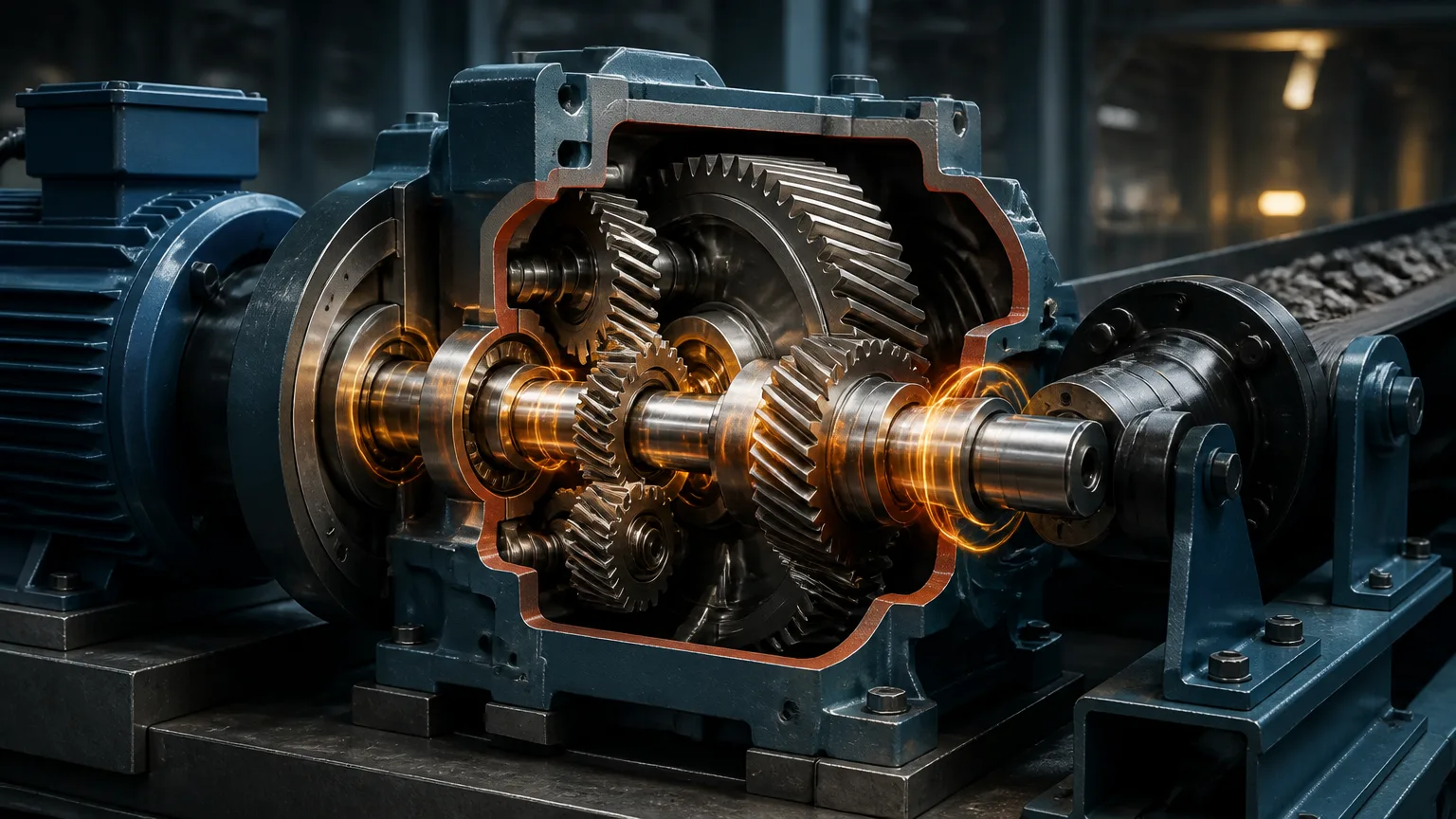
Torque calculation is a critical step when manufacturers and maintenance teams evaluate an existing gearbox or specify a replacement. Torque is the rotational force that turns a shaft, and its value influences gearbox sizing, equipment reliability, motor selection, repair decisions, and replacement compatibility. A gearbox with insufficient torque capacity can suffer premature wear, overheating, or failure.
This guide explains how power, rotational speed, gear ratio, and service conditions affect torque requirements. It also shows why calculated torque is only a starting point. Real operating loads, shock conditions, efficiency losses, duty cycles, and manufacturer ratings must be checked before making a decision. With support from Industrial Gearbox Solutions, you can apply these calculations more confidently when troubleshooting performance or selecting dependable gearbox equipment.
The Core Torque Formulas for Industrial Gearboxes
A reliable torque calculation starts with three inputs: power, rotational speed, and the units used. In metric applications, the standard relationship is:
Torque (N·m) = 9550 × Power (kW) ÷ Speed (rpm)
For example, a 15 kW motor operating at 1,450 rpm produces approximately 99 N·m of input torque. The imperial relationship is:
Torque (lb-ft) = 5252 × Power (hp) ÷ Speed (rpm)
Always keep units consistent. Mixing horsepower with the metric constant, or confusing lb-ft with N·m, can create major sizing errors.
Input torque is the torque delivered to the gearbox by the motor. Output torque is the torque available at the gearbox shaft after the speed reduction. A practical estimate is:
Output torque ≈ Input torque × Gearbox ratio × Efficiency
A 20:1 gearbox operating at 90% efficiency would therefore multiply the input torque by approximately 18. This estimate supports initial gearbox selection, but manufacturer service factors and rated torque must also be verified.
Before beginning a gearbox sizing or replacement assessment, confirm:
- Motor power and starting characteristics
- Input and output speeds
- Required ratio and gearbox efficiency
- Driven load torque and duty cycle
- Starting, acceleration, jam, and shock conditions
Motor nameplate power alone may not represent actual demand. Conveyors, mixers, crushers, and other machinery can require substantially higher torque during startup, acceleration, jams, or changing production loads. Assessing these conditions helps prevent undersizing and premature gearbox failure.
How Gear Ratio, Speed Reduction, and Efficiency Change Torque
A gearbox trades rotational speed for torque. With a 10:1 reduction, the output shaft turns at one-tenth of the motor speed, while ideal torque increases tenfold. This relationship is central to speed reduction in industrial machinery, including conveyors, mixers, pumps, and crushers.
Consider a motor producing 20 N·m at 1,800 rpm. A 10:1 gearbox reduces output speed to approximately 180 rpm. Ideally, output torque would be 200 N·m:
20 N·m × 10 = 200 N·m
However, a gearbox does not create free power. Gear friction, bearing resistance, seal drag, lubricant losses, and heat reduce the torque delivered to the driven shaft. At 90% efficiency, practical output torque is approximately 180 N·m:
20 N·m × 10 × 0.90 = 180 N·m
Efficiency varies with gearbox design, operating speed, lubrication, temperature, alignment, and component condition. Therefore, torque calculation must use realistic efficiency values rather than the ideal ratio alone.
When selecting a gearbox, confirm both the target output speed and the torque required by the load. A ratio that achieves the correct speed may still be unsuitable if available output torque cannot handle startup, acceleration, or changing production demands.
Applying Service Factors to Real Operating Loads
Basic torque calculation establishes nominal running torque, but real applications rarely operate at one steady load. Peak or transient torque can occur during startup, acceleration, reversing, jams, or sudden material changes. A gearbox may therefore fail even when its average calculated torque appears acceptable.
Service factors adjust the required gearbox rating for actual operating severity. They account for operating hours, duty cycle, starts and stops, shock loading, reversing, environmental conditions, and application-specific variability. A lightly loaded conveyor running continuously may need a different factor than a mixer that starts under load or a crusher exposed to repeated impact.
Before selecting or replacing a gearbox, identify the complete driven-load profile:
- Startup torque and acceleration requirements
- Starts per hour, stops, reversing, and intermittent operation
- Possible jams, impact loads, or sudden changes in material
- Overhung, axial, or radial loads not shown in the basic torque equation
- Dust, heat, moisture, and other environmental conditions
Driven equipment behavior matters as much as motor power. For example, cylindrical gearboxes may suit demanding applications, but the final selection still depends on load severity and shaft forces.
These checks are essential during replacement. An equivalent-looking gearbox may be undersized if production demands have increased, the duty cycle has changed, or the original unit operated beyond its intended rating.
Using Torque Calculations to Diagnose Repair or Replacement Needs
Torque calculation provides practical evidence when a gearbox overheats, becomes noisy, slips, or repeatedly damages gears, bearings, and shafts. An unexpected torque increase may indicate misalignment, inadequate lubrication, worn bearings, damaged teeth, excessive belt or chain tension, or a driven machine beginning to seize.
First, inspect the gearbox and connected equipment for these conditions. Then compare calculated load torque with the nameplate rating, manufacturer data, required service factor, shaft arrangement, and actual operating speed. Include startup, acceleration, shock, and peak production loads—not only steady-state demand.
If torque remains within limits and damage is localized, rebuilding the existing unit may be appropriate. Persistent overload, insufficient service factor, or changed production requirements may justify a higher-capacity gearbox, a different ratio, or a redesigned drive system.
Gearbox architecture also affects the inspection strategy. For example, planetary repair requires examining sun gears, planets, carriers, bearings, and load distribution before restoration. Not every application suits the same design.
Turn Torque Calculations Into a Reliable Gearbox Decision
A dependable torque calculation starts with input torque, then applies gear ratio and efficiency. Account for service factors and peak loads before verifying gearbox ratings, shaft forces, bearings, and housing constraints.
Accurate torque data improves replacement compatibility, reduces repeat failures, and supports defensible repair-versus-replacement decisions. It also connects torque assessment with gearbox manufacturing processes, including material selection, heat treatment, gear geometry, bearings, and housing strength.
Before consulting an experienced industrial gearbox service provider, gather motor data, gearbox specifications, operating history, and load symptoms. Validate calculations against actual conditions, equipment documentation, and professional inspection.