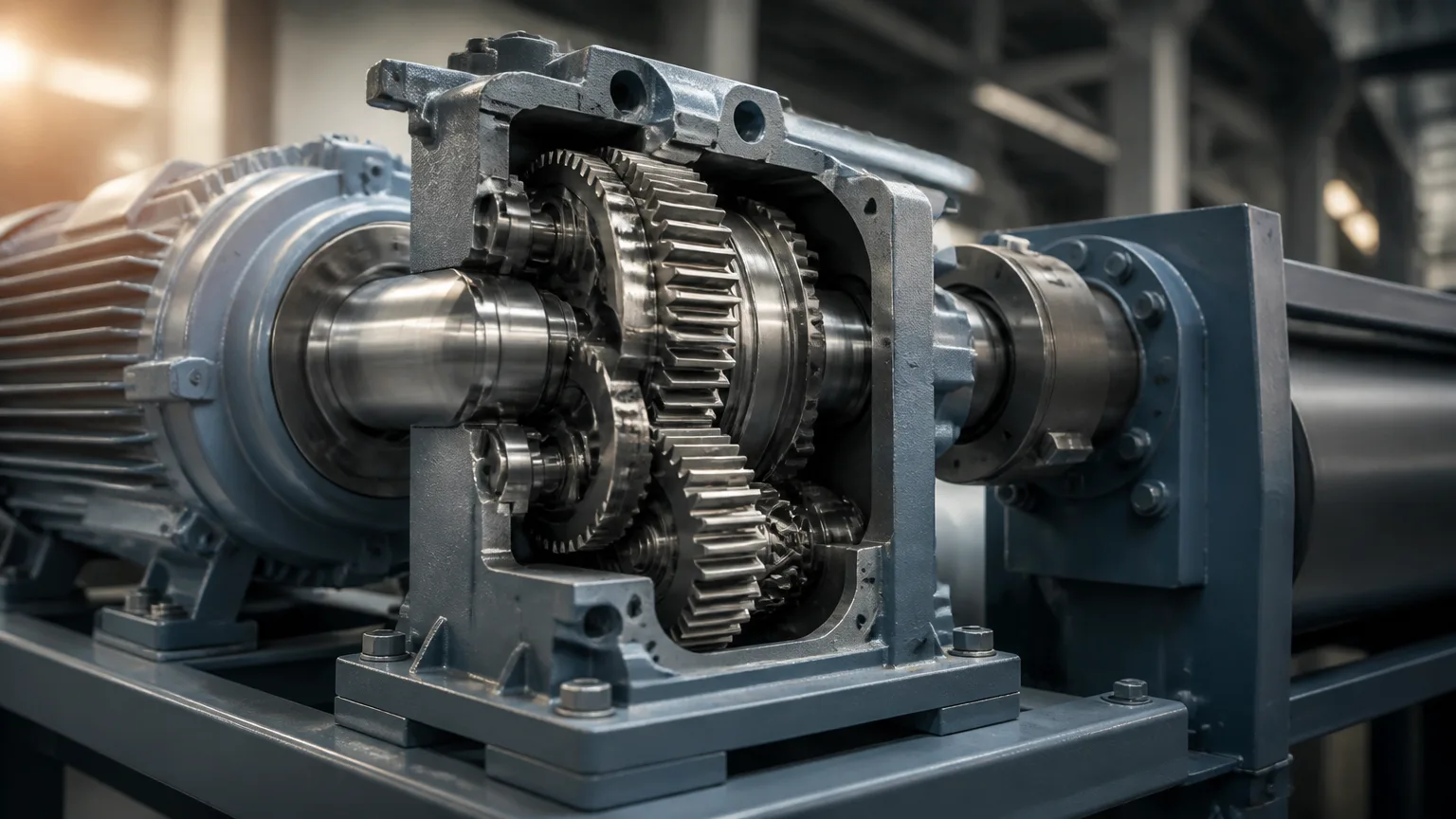
Gear reduction is a fundamental way to match motor performance with industrial equipment demands. It lowers output speed while increasing available torque, helping motors drive conveyors, mixers, pumps, and other demanding machinery safely and efficiently. For a practical overview of how speed reduction works in industrial machinery, the key principle is simple: controlled speed creates usable power for the application.
Choosing the right reducer requires more than comparing ratios. Manufacturers and facility managers must evaluate gearbox loading, duty cycles, operating conditions, and serviceability. The wrong selection can cause inconsistent conveyor performance, mixer overloads, pump problems, or premature component failure.
This guide focuses on making sound repair and replacement decisions. You will learn how reduction ratios affect equipment behavior, what loading conditions mean for gearbox life, and which practical factors help prevent unplanned downtime.
What Gear Reduction Does Inside a Gearbox
Gear reduction lowers output speed while increasing available torque. For example, a motor may turn an input shaft at 1,800 rpm. If its gear drives a gear twice its diameter, the output shaft turns at about 900 rpm. This 2:1 reduction ratio also provides roughly twice the input torque before losses.
Inside the gearbox, meshing gears transfer motor power between shafts. The gear sizes and tooth counts determine the ratio, while the shaft arrangement controls output direction and load alignment. Bearings support the shafts, manage radial and axial forces, and reduce unwanted movement during operation. Proper alignment helps prevent uneven tooth contact, vibration, and premature wear.
Torque multiplication does not create unlimited power. Friction at the gear mesh, heat, bearing drag, and seal resistance reduce efficiency. The gearbox must therefore be sized for the motor’s power, the required output speed, starting loads, and the driven equipment’s load direction.
Gearbox designs apply these principles differently. Helical units provide smooth, efficient transmission, while bevel units redirect power between intersecting shafts. Worm gearboxes offer high reduction in a compact package, and planetary units handle high torque density. Inline gearboxes keep input and output shafts aligned. Understanding these industrial drive mechanism components helps identify how each part supports reliable power transfer.
When Industrial Equipment Needs Gear Reduction
Industrial equipment needs gear reduction when it must deliver high torque at a controlled speed. Common examples include conveyors, mixers, extruders, packaging lines, material handling systems, and processing equipment. These machines often require steady output power that a standard motor cannot provide directly.
Connecting a high-speed motor straight to the load can create excessive vibration and mechanical shock. It may also cause overheating, poor speed control, and premature wear on couplings, bearings, chains, or other components. A gearbox reduces motor speed while increasing usable output torque, helping the machine operate smoothly and reliably.
A reducer is especially valuable when equipment must manage:
- High starting torque or heavy load inertia
- Intermittent duty, reversing cycles, or frequent starts and stops
- Impact loads from sudden material entry or jams
- Continuous operation requiring thermal stability
- Precise speed control for consistent production quality
Gear reduction also helps match motor performance to changing production requirements. However, the gearbox must be sized from real duty conditions, not motor horsepower alone. Service factor, load inertia, ambient temperature, mounting position, duty cycle, impact levels, and required output speed all affect unit selection. Review these reducer equipment selection considerations before specifying a replacement or new drive.
Signs a Gearbox Needs Repair or Replacement
A gearbox may need attention when it produces unusual noise, rising operating temperature, oil leakage, or abnormal vibration. Backlash, inconsistent output speed, damaged gear teeth, and repeated seal or bearing failures are also important warning signs. These symptoms do not always indicate worn gears. Misalignment, overloading, poor lubrication, contamination, installation errors, or an incorrectly sized reducer can create similar problems.
Begin with the operating history. Look for overloads, speed changes, recurring trips, maintenance patterns, and recent installation work. Inspect the housing and lubricant for leaks, discoloration, metal particles, or contamination. Measure vibration and temperature under normal load, verify shaft alignment, and assess the condition of gears, bearings, seals, and mounting components.
Repair is often practical when damage is localized and replacement parts remain available. A rebuild may restore the unit with new bearings, seals, and damaged gears. Remanufacture can provide a tested, cost-effective option for critical equipment, including industrial Rossi gearbox repair. Replacement is usually justified when the housing or shafts are severely damaged, parts are obsolete, failures recur, or the reducer is incorrectly sized.
Compare lead time, equipment criticality, compatibility, and total cost of ownership. A lower purchase price may not outweigh extended downtime or poor reliability. Proper gear reduction depends on resolving the root cause, not simply exchanging components.
How to Choose the Right Gear Reduction Solution
Before ordering a replacement gearbox, verify the ratio, output torque, input speed, shaft dimensions, mounting arrangement, rotation, service factor, duty cycle, and motor compatibility. Confirm these specifications against actual operating conditions, not assumptions. Reviewing gearbox design principles can also support a reliable gear reduction decision.
Check environmental requirements, including washdown exposure, dust, heat, corrosive chemicals, hazardous areas, and lubricant specifications. Review dimensional drawings, coupling or sprocket interfaces, backstops, brakes, and available replacement parts to prevent installation delays.
When records are incomplete, the original unit is obsolete, or failures recur, experienced gearbox evaluation and repair support adds value. Specialists can identify root causes, assess rebuild feasibility, and confirm whether the proposed solution fits existing equipment.
Apply Gear Reduction for Reliable Industrial Performance
Gear reduction is both a power-transmission solution and a reliability decision. By lowering speed, the gearbox increases available torque, while the reduction ratio, load, duty cycle, and operating conditions determine stress and service life.
Address abnormal noise, heat, vibration, or leakage early. These warning signs can indicate lubrication issues, misalignment, overload, or internal damage before failure stops production.
Before repairing or replacing a gearbox, evaluate the complete application. Work with a qualified industrial gearbox provider to assess the existing unit, recommend repair or replacement, and verify the solution fits your equipment.