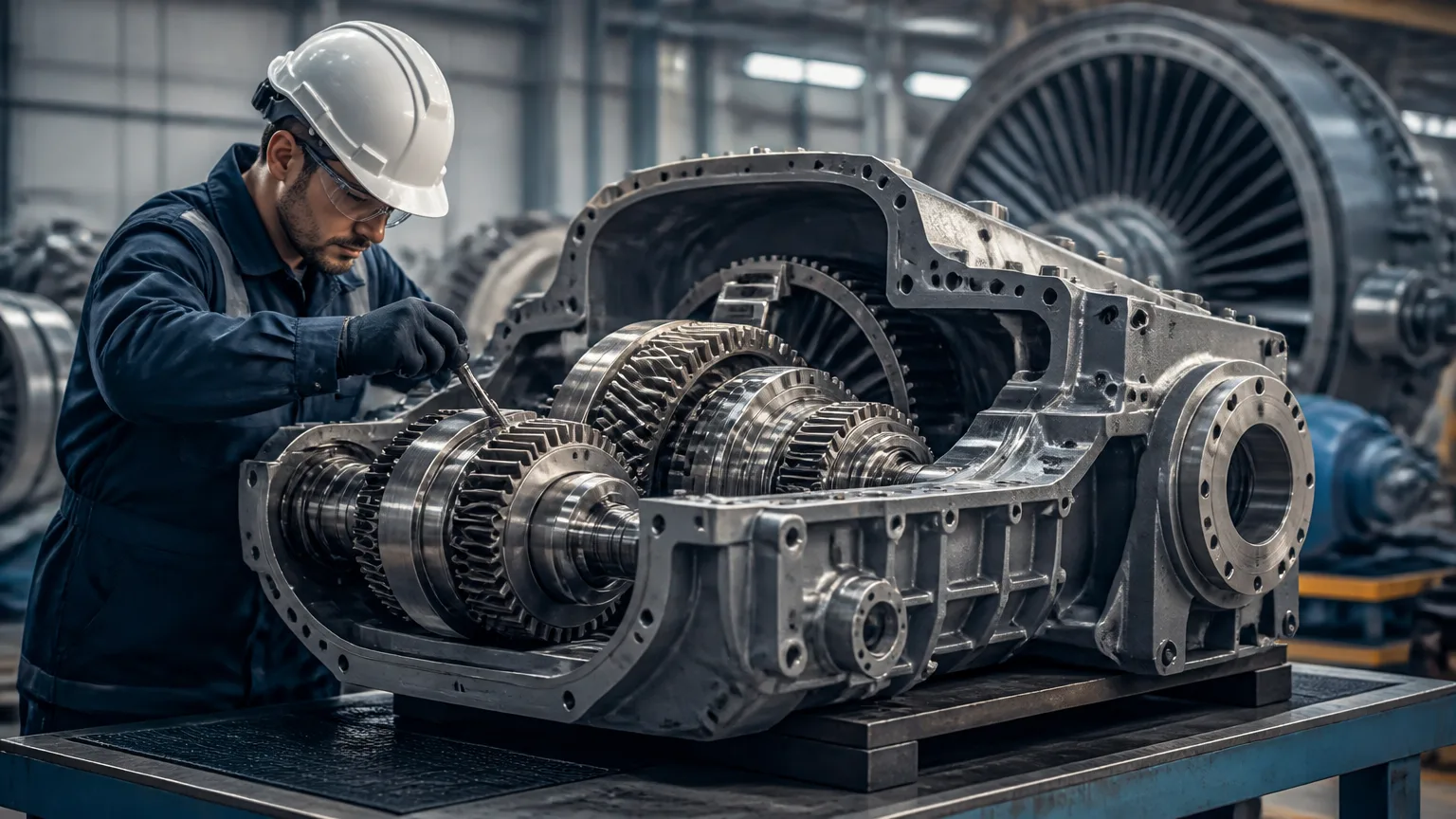
A GE gearbox repair center can play a critical role in protecting industrial uptime. GE gearboxes support manufacturing lines, turbines, conveyors, and process equipment, where a failure can interrupt production, damage connected systems, and increase operating costs.
Specialized service providers inspect the gearbox, identify the failure’s root cause, and assess the most practical solution. Repair decisions depend on the gearbox’s condition, operating environment, load requirements, and replacement-part availability. An experienced team can compare repair and replacement paths instead of assuming a full rebuild is always best.
By working with Industrial Gearbox Solutions, operators can make informed decisions that restore reliability while controlling downtime and replacement costs. The right evaluation helps determine whether targeted repairs, a complete rebuild, or a replacement offers the strongest long-term value.
GE Gearbox Repair Services: Inspection, Diagnosis, and Failure Analysis
The repair process begins when the GE gearbox arrives at the repair center. Technicians document its condition, record visible damage, and review operating history, load conditions, maintenance records, and recent symptoms. Common warning signs include abnormal noise, overheating, vibration, contaminated oil, leaks, backlash, and reduced output performance.
Technicians then disassemble and inspect the gearbox systematically. Dimensional checks identify worn fits, distortion, and shaft runout. Shaft and bearing inspections reveal scoring, looseness, pitting, or excessive wear. Gear teeth are evaluated for cracking, spalling, scuffing, and abnormal contact patterns. Housing checks identify cracks, bore wear, and alignment problems, while lubrication assessment examines oil condition, viscosity, level, and contamination.
A reliable GE gearbox repair center does more than replace visibly damaged components. Its technicians determine why the failure occurred and whether other parts face the same risk. The investigation may identify overload, misalignment, poor lubrication, contamination, material fatigue, or improper installation.
This root-cause analysis helps prevent repeat failures and supports the correct repair scope. Depending on the findings, the recommended solution may involve targeted component replacement, rebuilding a gearbox, a complete rebuild, or replacement. Detailed findings also help operators plan downtime and control long-term costs.
What the GE Gearbox Rebuild Process Includes
A qualified GE gearbox repair center follows a controlled workflow to restore performance and reduce the risk of repeat failure. Technicians typically:
- Disassemble the gearbox methodically and catalog each component.
- Clean housings, shafts, gears, bearings, and other parts.
- Inspect wear, damage, and dimensional condition against manufacturer specifications or engineering requirements.
- Replace or refurbish damaged bearings, seals, shafts, gears, keys, and related components.
- Reassemble, lubricate, and test the completed unit.
During inspection, technicians verify that gear geometry, tooth profiles, hardness, and material compatibility remain correct. Parts that can be restored may be machined, ground, or otherwise refurbished. Components outside allowable limits are replaced to protect load capacity and service life.
Precision assembly controls are critical. The repair team checks bearing fits, gear backlash, shaft alignment, endplay, and fastener torque requirements. They also confirm proper sealing and select the correct lubricant for the gearbox load, speed, temperature, and operating environment. Accurate torque calculation supports correct operating decisions and helps prevent overload-related failures.
Final testing may include rotation checks, vibration monitoring, temperature observation, noise evaluation, and leak inspection. The repair center documents measurements, replaced parts, lubrication details, and test results. This record gives maintenance teams the evidence needed to approve the gearbox for return to service and plan future inspections.
Repair or Replace? Evaluating the Best GE Gearbox Solution
Repair is usually practical when the housing remains serviceable and critical dimensions are recoverable. Parts must also be available, and the gearbox must still meet required torque, speed, and duty-cycle demands. In these cases, targeted repairs or a complete rebuild can restore performance without changing the existing installation.
Replacement may be preferable when the housing has extensive damage, components are obsolete, or failures have occurred repeatedly. Severe gear damage can also make rebuilding uneconomical, especially when repair costs approach those of a suitable replacement, refurbished unit, or engineered alternative.
A replacement must match more than the gearbox nameplate. Evaluate gear ratio, input and output configuration, torque, speed, duty cycle, mounting dimensions, motor compatibility, and environmental conditions. Understanding gear reduction can also help confirm whether the proposed unit fits the application.
A qualified GE gearbox repair center can compare these options using total cost of ownership. The assessment should include purchase price, installation changes, lead time, downtime, energy use, maintenance, and expected service life. This broader review helps manufacturers choose the solution that delivers dependable operation and the strongest long-term value.
Application Support, Installation, and Preventive Maintenance
Support from a GE gearbox repair center can continue well beyond shop testing. Before startup, technicians may review coupling condition, mounting surfaces, lubrication systems, alignment, load patterns, and expected operating temperatures. These checks identify installation issues that could undermine the repair.
Commissioning should be controlled rather than moving immediately to full production demand. Operators should monitor vibration, noise, temperature rise, oil leakage, and abnormal loading during staged operation. Correct installation and variable speed drive maintenance also help protect connected equipment.
Preventive maintenance should include:
- Scheduled oil inspection and contamination control
- Vibration monitoring and seal checks
- Alignment verification after installation or major maintenance
- Prompt investigation of temperature, noise, load, or performance changes
These practices help detect developing faults early, protect repaired components, and extend gearbox service life.
Choosing a GE Gearbox Repair Center
A qualified GE gearbox repair center should support the full decision process, from diagnosis and rebuilding to replacement planning. When requesting an evaluation, provide the gearbox model, serial information, application details, failure symptoms, operating conditions, and maintenance history. Complete information helps technicians define the repair scope accurately.
Manufacturers should also expect documented inspections, realistic lead-time updates, and comprehensive testing before return to service. The strongest repair partner combines technical workmanship with clear records and solutions aligned with production priorities. This approach supports reliable operation while controlling downtime, replacement costs, and long-term maintenance risk.