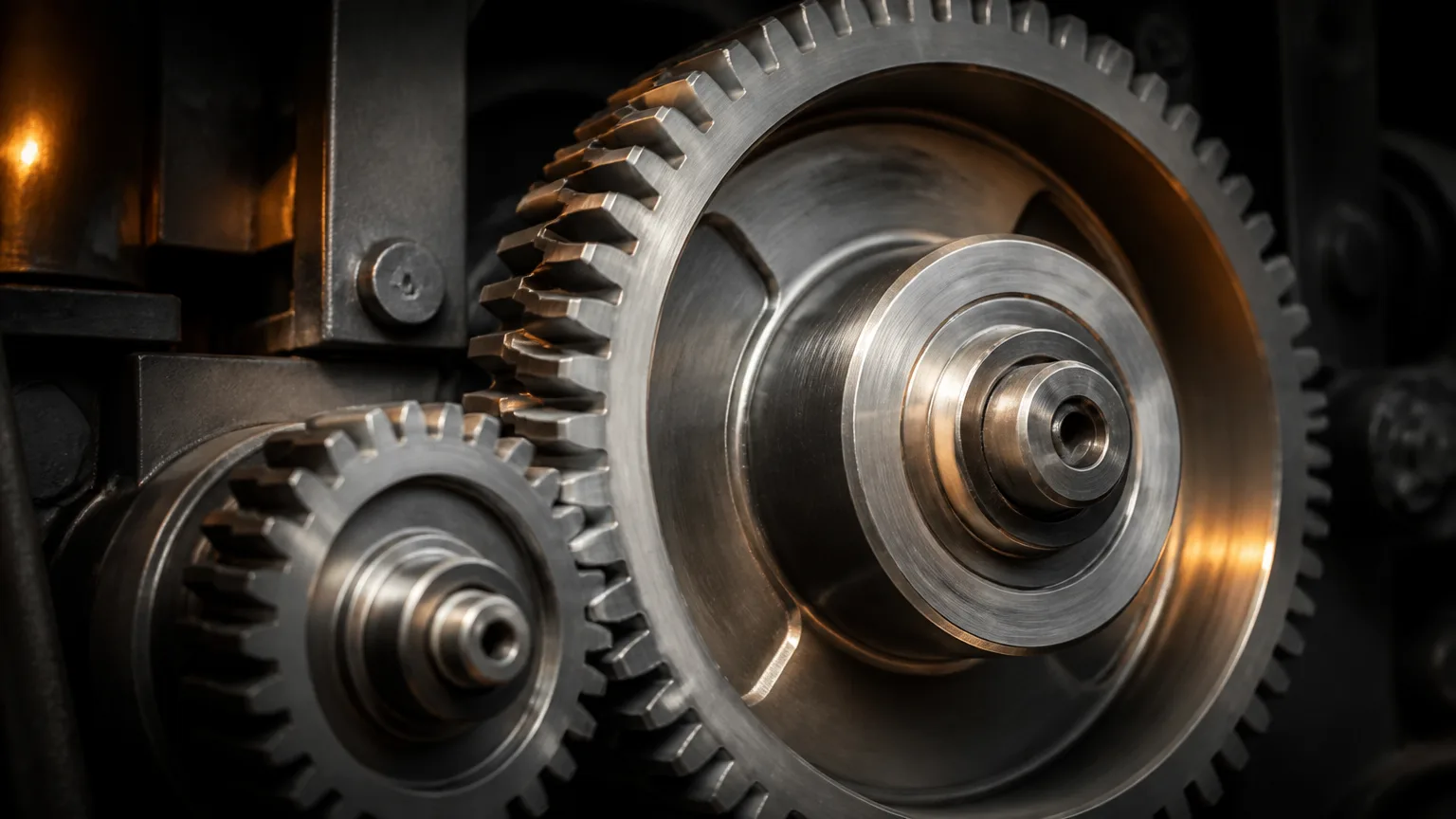
A gear ratio helps match a motor’s speed and torque to the demands of the driven machine. Reducing speed through gearing generally increases available torque, while increasing speed generally reduces torque. The right balance can affect performance, efficiency, and equipment life. Test speed and reduction combinations using our gear ratio calculator.
That balance depends on the application and operating conditions—not simply on choosing the highest speed or torque. This article explains how gear ratio shapes industrial output and informs gearbox selection and service across a range of industrial gearbox solutions.
How to Read and Calculate a Gear Ratio
A gear ratio describes how input speed relates to output speed. In a 5:1 reduction, the input shaft makes five revolutions for every one revolution of the output shaft. The output therefore turns at about one-fifth the input speed, while torque may increase, subject to gearbox efficiency and operating conditions.
For a basic gear pair, calculate the ratio by dividing the driven gear’s tooth count by the driving gear’s tooth count. If a 20-tooth driving gear turns a 100-tooth driven gear, the ratio is 100 divided by 20, or 5:1. The driven gear rotates once for every five rotations of the driving gear.
This example makes the speed change clear: if the input runs at 1,500 revolutions per minute, the output runs at about 300 rpm. In a compound gear train, each stage has its own ratio, and the overall ratio is found by multiplying the stage ratios.
Manufacturers may state ratios using different conventions, such as reduction ratio or input-to-output speed ratio. Confirm how a specification is defined before comparing units or selecting a gearbox.
How Gear Ratio Changes Speed, Torque, and Power
A reduction gearbox lowers output speed and can increase output torque. A speed-increasing arrangement generally does the reverse: it raises output speed while reducing available torque. This trade-off helps match a motor to industrial loads, such as conveyors that need steady pulling force or process equipment that requires higher shaft speed.
For a reduction ratio, estimate output speed by dividing input speed by the ratio. For example, a 10:1 reduction with a 1,500 rpm input produces an ideal output speed of about 150 rpm. Compare that estimate with the machine’s required operating speed, and confirm the manufacturer’s ratio convention before selecting a unit. Battenfeld gearbox information can help when reviewing application-specific options.
In an ideal gearbox, reduced speed corresponds to increased torque, with transmitted power unchanged. In practice, friction, heat, and other losses reduce efficiency, so output torque is lower than the ideal estimate and transmitted power is lower than input power. The actual result depends on gearbox design, condition, and operating conditions.
Ratio alone does not determine whether a gearbox will perform reliably. Check that the motor can supply the required torque and power, then account for duty cycle, load variation, and service factor. These factors help ensure the gearbox can handle both normal operation and demanding conditions.
Choosing a Ratio for the Driven Equipment
Start with the driven machine’s required speed, torque, load profile, and process constraints. Then compare those needs with the motor speed and gearbox specifications. The gear ratio helps estimate output speed and torque, but selection must account for how the equipment operates over time.
Consider startup loads, frequent starts and stops, shock loads, and changes in operating conditions. A ratio that meets steady-state requirements may still leave the gearbox under strain during demanding cycles. An incorrect ratio can also reduce process performance or push the machine outside its intended operating range.
When repairing or replacing a gearbox, confirm the application and unit specifications before choosing a replacement. For example, Werner Pfleiderer gearbox repair should begin with checking the equipment’s operating demands and existing gearbox details. Similarly, Koellmann gearbox repair and replacement can involve verifying the required output speed, torque, mounting, and duty conditions. Matching the full operating profile—not just the ratio—helps teams select a gearbox suited to the machine and process.
When Gearbox Condition Changes the Output
If measured output speed or torque differs from expectations, the gear ratio may not be the only cause. Compare operating speed and load with the equipment’s original specifications before assuming the ratio is wrong. A design mismatch may require a different gearbox; a change in performance over time can signal deterioration.
Wear, damaged gear teeth, bearing problems, lubrication issues, or misalignment can disrupt dependable power transmission. These conditions may increase noise and heat, reduce efficiency, and make output less reliable. Inspection can help identify whether the issue calls for adjustment, repair, or replacement.
When inspection shows that repair is appropriate, rebuilding may be one option. Review gearbox rebuilding options alongside replacement based on gearbox condition, operating demands, and equipment requirements. A ratio specification describes a design relationship; it does not confirm that a gearbox in service can still deliver its intended output.
Match the Ratio to the Job—and Verify the Gearbox
Gear ratio provides a starting point for understanding how a gearbox changes output speed and torque. In practice, efficiency, motor capacity, and load also shape performance. A high reduction ratio may increase torque while lowering speed, but it won’t guarantee the machine gets the output it needs.
Before troubleshooting or replacing a gearbox, compare the machine’s required speed and load with the unit’s specifications. Check its condition, duty cycle, and operating demands as well. Verifying the full application helps you choose a suitable repair or replacement and avoid repeat performance problems.